PVC vs PP Cooling Tower Fills: What Is the Difference?
Choosing the right cooling tower fill is essential for maintaining efficient heat transfer, stable water distribution, and reliable cooling tower performance. Among the most widely used materials, PVC and PP cooling tower fills are often compared because both offer good corrosion resistance, lightweight construction, and long service life.
However, PVC and PP are not identical. Their differences in temperature resistance, mechanical properties, chemical stability, cost, and application suitability can significantly affect the performance of an industrial cooling system.
So, PVC vs PP cooling tower fills: what is the difference? The answer depends on the operating temperature, water chemistry, cooling tower design, maintenance requirements, and project budget.
This guide explains the key differences between PVC cooling tower fill and PP cooling tower fill and provides practical guidance for selecting the right cooling tower filler for different applications.
What Is Cooling Tower Fill and Why Does the Material Matter?
Cooling tower fill is the internal media installed inside a cooling tower to increase contact between circulating water and air.
Instead of allowing water to fall directly through the tower, the fill creates a large wetted surface area. Water spreads into thin films or droplets while air passes through the fill structure. This increases evaporation and improves heat transfer.
How Does Cooling Tower Fill Improve Heat Transfer?
A properly designed cooling tower fill performs several important functions:
Increases water-to-air contact area
Extends water residence time
Improves evaporation
Promotes heat transfer
Helps reduce cooling tower size requirements
Supports stable cooling performance
Improves energy efficiency when properly selected
Why Is Fill Material Important?
The material determines how the fill performs under heat, chemicals, mechanical stress, and long-term wet conditions.
A high-quality cooling tower filler should ideally provide:
This is why material selection is an important part of cooling tower design and replacement.
What Is PVC Cooling Tower Fill?
PVC cooling tower fill is manufactured primarily from polyvinyl chloride and is widely used in HVAC, commercial, and industrial evaporative cooling systems.
PVC is popular because it offers a practical balance between performance, cost, manufacturability, and chemical resistance.
What Are the Main Features of PVC Cooling Tower Fill?
Typical advantages include:
Lightweight construction
Good corrosion resistance
Good resistance to many chemicals
Easy thermoforming
Cost-effective production
Large surface-area-to-volume ratio
Good performance in conventional cooling tower applications
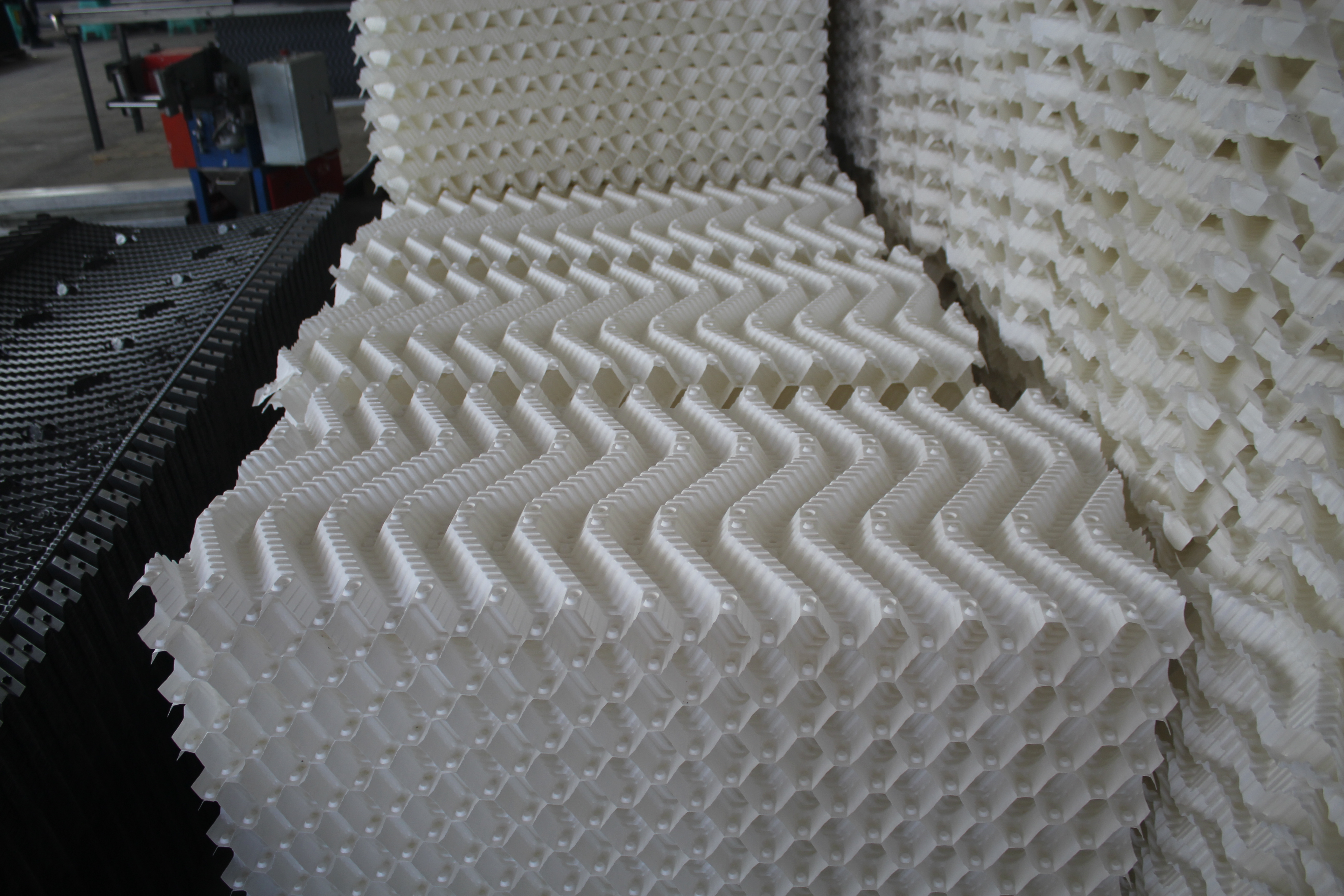
PVC fill is commonly produced as film fill, with corrugated or specially formed sheets designed to increase water distribution and air contact.
Where Is PVC Cooling Tower Fill Commonly Used?
PVC cooling tower filler is frequently used in:
For normal-temperature applications, PVC can provide an effective combination of heat-transfer performance and operating economy.
What Is PP Cooling Tower Fill?
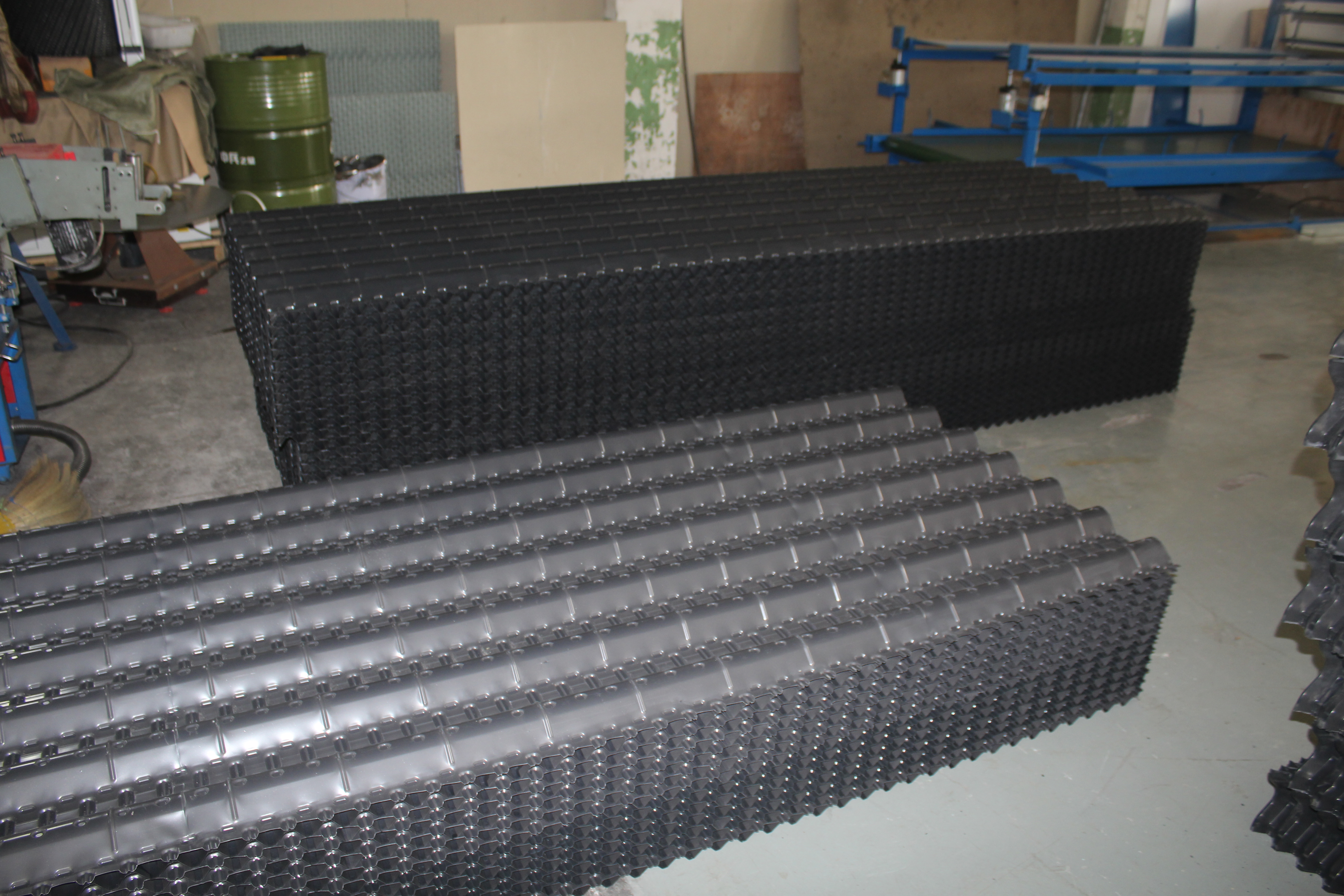
PP cooling tower fill is manufactured from polypropylene. PP is another thermoplastic material commonly used for cooling tower fill where higher temperature resistance or specific chemical resistance is required.
Compared with PVC, polypropylene generally offers better resistance to elevated temperatures.
What Are the Main Features of PP Cooling Tower Fill?
PP cooling tower filler can provide:
Higher temperature resistance than conventional PVC
Good chemical resistance
Good fatigue resistance
Lightweight construction
Good dimensional stability at suitable operating conditions
Strong resistance to many aggressive environments
Where Is PP Cooling Tower Fill Used?
PP cooling tower fill can be considered for applications involving:
Higher circulating-water temperatures
Industrial process cooling
Certain chemical-processing environments
Applications where improved thermal resistance is important
Specialized cooling tower systems
Why Is PP Attractive for High-Temperature Applications?
The molecular structure of polypropylene allows it to maintain useful mechanical properties at temperatures where conventional PVC may become less suitable.
However, the exact operating limit depends on the fill design, water chemistry, airflow, loading, manufacturing process, and other system conditions.
PVC vs PP Cooling Tower Fills: What Is the Difference?
The biggest differences between PVC and PP cooling tower fills are related to temperature resistance, chemical resistance, mechanical characteristics, cost, and application conditions.
| Property | PVC Cooling Tower Fill | PP Cooling Tower Fill |
| Material | Polyvinyl chloride | Polypropylene |
| Temperature resistance | Good for conventional applications | Generally higher |
| Chemical resistance | Good | Very good for many chemicals |
| Weight | Lightweight | Lightweight |
| Cost | Generally economical | Often higher |
| Processability | Excellent | Excellent |
| Typical application | HVAC and standard industrial cooling | Higher-temperature and specialized applications |
| Maintenance | Relatively easy | Relatively easy |
| Availability | Widely available | Widely available |
These characteristics provide a starting point, but material alone should not determine the final selection.
Is PP Cooling Tower Fill More Heat Resistant Than PVC?
In general, PP cooling tower fill has higher temperature resistance than conventional PVC cooling tower fill.
This is one of the most important differences between the two materials.
Why Does Temperature Resistance Matter?
Cooling tower fill operates continuously in contact with warm circulating water and air. If the water temperature exceeds the recommended range of the fill material, the sheets can soften, deform, or lose dimensional stability.
What Happens When Fill Material Gets Too Hot?
Excessive temperature can cause:
For this reason, PP can be attractive for applications where water temperatures are relatively high.
Which Has Better Chemical Resistance: PVC or PP?
Both PVC and PP offer useful chemical resistance, but PP can provide advantages in certain aggressive chemical environments.
The actual result depends heavily on the chemical concentration, operating temperature, exposure time, and specific formulation.
Why Does Water Chemistry Affect Cooling Tower Fill?
Cooling tower water can contain:
A material that performs well in one water chemistry may not be suitable for another.
Should You Check Chemical Compatibility Before Ordering Fill?
Yes.
Before selecting a cooling tower filler, users should provide the supplier with relevant information about:
Circulating-water temperature
Chemical composition
Chemical concentration
pH range
Water flow rate
Airflow conditions
Cooling load
Existing fill type
This information helps determine whether PVC, PP, or another material is appropriate.
Is PVC Cooling Tower Fill Cheaper Than PP?
In many projects, PVC cooling tower fill is more economical than PP cooling tower fill, particularly for conventional operating conditions.
Cost, however, should not be evaluated only by the initial purchase price.
What Determines the Total Cost of Cooling Tower Fill?
The overall cost can include:
Material price
Manufacturing cost
Transportation
Installation
Cleaning
Maintenance
Replacement frequency
Cooling performance
Energy consumption
Why Can a More Expensive Fill Be Economical?
If an industrial cooling tower operates at elevated temperatures or under chemically demanding conditions, a more suitable PP fill may have a longer service life.
Therefore, the correct comparison is not simply:
PVC = cheaper
and
PP = more expensive
Instead, consider the total cost of ownership over the expected operating period.
Which Cooling Tower Fill Provides Better Heat Transfer?
Neither PVC nor PP automatically provides better heat transfer simply because of its material.
Fill geometry, surface area, water loading, air velocity, film thickness, fouling, and installation quality can have a major impact on cooling performance.
Why Does Fill Geometry Matter More Than Material Alone?
Modern film fills are designed with carefully engineered channels and surface patterns.
These structures can:
Increase effective wetted area
Improve water spreading
Promote air turbulence
Extend water contact time
Reduce dry spots
Improve air-water interaction
What Should You Compare Besides PVC and PP?
When evaluating cooling tower fill, compare:
Sheet thickness
Fill height
Flute geometry
Surface area
Cell size
Water loading
Air velocity
Pressure drop
Fouling resistance
Temperature rating
The best material cannot compensate for an inappropriate fill design.
Is PVC or PP Better for Industrial Cooling Towers?
There is no universal answer because industrial cooling towers operate under very different conditions.
When Is PVC Cooling Tower Fill a Practical Choice?
PVC may be suitable when:
Water temperature is within the recommended range
The application uses relatively conventional cooling-water chemistry
Cost efficiency is important
The cooling tower operates under standard HVAC or industrial conditions
A widely available replacement fill is preferred
When Should You Consider PP Cooling Tower Fill?
PP may be considered when:
Operating temperatures are higher
Greater thermal resistance is required
Specific chemical exposure makes PP advantageous
The project requires specialized industrial cooling performance
Does Industrial Service Always Require PP?
No.
Many industrial cooling towers operate successfully with PVC fill. The decision should be based on actual operating conditions rather than assuming that PP is automatically superior.
PVC vs PP Cooling Tower Fills: How Does Service Life Compare?
Service life depends on more than material selection.
A cooling tower fill can experience:
High temperature
UV exposure
Chemical attack
Scale formation
Algae growth
Sediment accumulation
Physical impact
Poor water distribution
What Can Shorten Cooling Tower Fill Life?
1. Excessive Temperature
Operating outside the manufacturer's recommended temperature range can accelerate deformation.
2. Poor Water Quality
Scale and biological deposits can block fill passages.
3. Aggressive Chemicals
Incorrect chemical dosing may damage certain plastics over time.
4. Poor Maintenance
Blocked or dirty fill reduces airflow and water contact.
5. Incorrect Installation
Compression, unsupported fill blocks, or improper spacing can reduce mechanical stability.
Therefore, choosing the correct material is only one part of extending cooling tower fill life.
How Does Fouling Affect PVC and PP Cooling Tower Fills?
Fouling is one of the biggest challenges for any cooling tower fill.
Even a high-performance cooling tower filler can lose efficiency if its channels become blocked.
What Causes Cooling Tower Fill Fouling?
Common causes include:
Calcium carbonate scale
Suspended solids
Rust particles
Algae
Bacteria and biofilm
Process contaminants
What Happens When Fill Becomes Blocked?
Blocked fill can lead to:
Reduced airflow
Increased pressure drop
Uneven water distribution
Reduced heat-transfer area
Higher fan energy consumption
Higher outlet-water temperature
This means that water treatment and regular inspection are just as important as material selection.
How Should You Choose Between PVC and PP Cooling Tower Fill?
A systematic selection process can help avoid costly mistakes.
Step 1: Check the Operating Temperature
Start with the normal and maximum circulating-water temperature.
If the application involves higher temperatures, PP may deserve closer consideration.
Step 2: Analyze Water Chemistry
Review:
pH
Chloride concentration
Chemical additives
Process contaminants
Cleaning chemicals
Then verify compatibility with the selected material.
Step 3: Check the Existing Cooling Tower Design
Measure or confirm:
Why Is Dimensional Compatibility Important?
Even a high-quality cooling tower filler may perform poorly if it does not match the original tower's design.
Step 4: Compare Hydraulic Performance
Consider the relationship between:
Water flow
Airflow
Pressure drop
Surface area
Fill geometry
A fill with excessive pressure drop can increase fan energy requirements.
Step 5: Evaluate Total Cost
Compare both purchase cost and expected operating life.
A material with a higher initial cost may be economically reasonable when it provides better suitability for demanding conditions.
Can PVC and PP Cooling Tower Fills Be Used in the Same Tower?
In some replacement projects, different materials may appear technically interchangeable, but this should not be assumed.
What Should Be Checked Before Changing Material?
When replacing PVC fill with PP fill, or vice versa, check:
Why Should Replacement Fill Match the Original Design?
The cooling tower is an integrated system.
Changing the fill geometry or operating characteristics can affect:
Airflow
Fan performance
Water distribution
Heat transfer
Pressure drop
Cooling capacity
Therefore, material replacement should be evaluated as a system change rather than simply a plastic-sheet substitution.
What Are the Latest Considerations When Selecting Cooling Tower Fill?
Modern cooling tower projects increasingly focus on energy efficiency, water conservation, service life, and maintenance accessibility.
Can Better Fill Geometry Reduce Energy Consumption?
Potentially, yes.
A well-designed fill can improve heat transfer without unnecessarily increasing airflow resistance. This can help the cooling tower achieve the required thermal duty while supporting efficient fan operation.
Why Is Water Conservation Becoming More Important?
Cooling towers lose water through:
Evaporation
Blowdown
Drift
Splashing
Leakage
The fill primarily affects evaporation and heat transfer rather than eliminating water consumption. However, improved thermal performance can help the overall cooling system operate more efficiently.
Why Is Easy Maintenance Important?
Cooling tower fill should not only perform well when new. It should remain accessible for inspection, cleaning, and replacement.
A practical cooling tower filler design should consider:
Cleaning access
Fill block handling
Inspection
Replacement procedures
Water treatment strategy
PVC vs PP Cooling Tower Fills: Which One Should You Choose?
The choice between PVC cooling tower fill and PP cooling tower fill should be based on operating conditions rather than material popularity.
PVC Cooling Tower Fill May Be Suitable When:
The operating temperature is within the recommended range
The water chemistry is compatible
Conventional HVAC or industrial cooling is involved
Cost efficiency is important
Standard fill availability is required
PP Cooling Tower Fill May Be Suitable When:
Higher temperature resistance is needed
The application has demanding thermal conditions
Certain chemical exposures favor polypropylene
Specialized industrial service conditions apply
What Is the Most Important Selection Rule?
Match the cooling tower fill material and geometry to the actual operating environment.
There is no single cooling tower filler that is ideal for every cooling tower.
How Can You Buy the Right Cooling Tower Fill?
Selecting a reliable cooling tower fill supplier is important when purchasing replacement or new fill media.
A professional supplier should be able to provide information about:
What Information Should You Send to a Supplier?
For a faster quotation and technical recommendation, provide:
Cooling tower model
Existing fill dimensions
Fill material
Fill quantity
Water inlet temperature
Water outlet temperature
Water flow rate
Airflow information
Cooling tower application
Photos of the existing fill
This allows the supplier to recommend a suitable PVC cooling tower fill, PP cooling tower fill, or other cooling tower filler.
Final Thoughts: PVC vs PP Cooling Tower Fills
So, PVC vs PP cooling tower fills: what is the difference?
PVC is widely used because it offers a practical combination of heat-transfer performance, corrosion resistance, manufacturability, and cost efficiency. PP provides higher temperature resistance and can be attractive for demanding industrial applications.
However, material is only one part of cooling tower performance.
The final selection should consider temperature, water chemistry, fill geometry, water loading, airflow, pressure drop, fouling risk, maintenance, and total operating cost.
By evaluating these factors together, cooling tower operators can select a cooling tower filler that matches their system requirements and supports reliable long-term cooling performance.