PP Cooling Tower Fill Media: A Complete Selection Guide
Choosing the right PP cooling tower fill media is an important part of designing, upgrading, or maintaining an efficient cooling tower. The fill media determines how water spreads through the tower, how much contact occurs between water and air, and how effectively heat can be transferred from the circulating water to the atmosphere.
Polypropylene, commonly known as PP, is widely used for cooling tower fill because it combines low weight, chemical resistance, mechanical durability, and manufacturing flexibility. PP cooling tower fill media can be produced in different structures, thicknesses, dimensions, and configurations to suit various cooling tower applications.
However, selecting the right PP fill is not simply a matter of choosing the thickest sheet or the highest surface area. Water quality, temperature, airflow, tower configuration, fouling potential, maintenance requirements, and installation conditions all need to be considered.
This complete guide explains how PP cooling tower fill media works, what types are available, how to select the right design, and what buyers should check before purchasing.
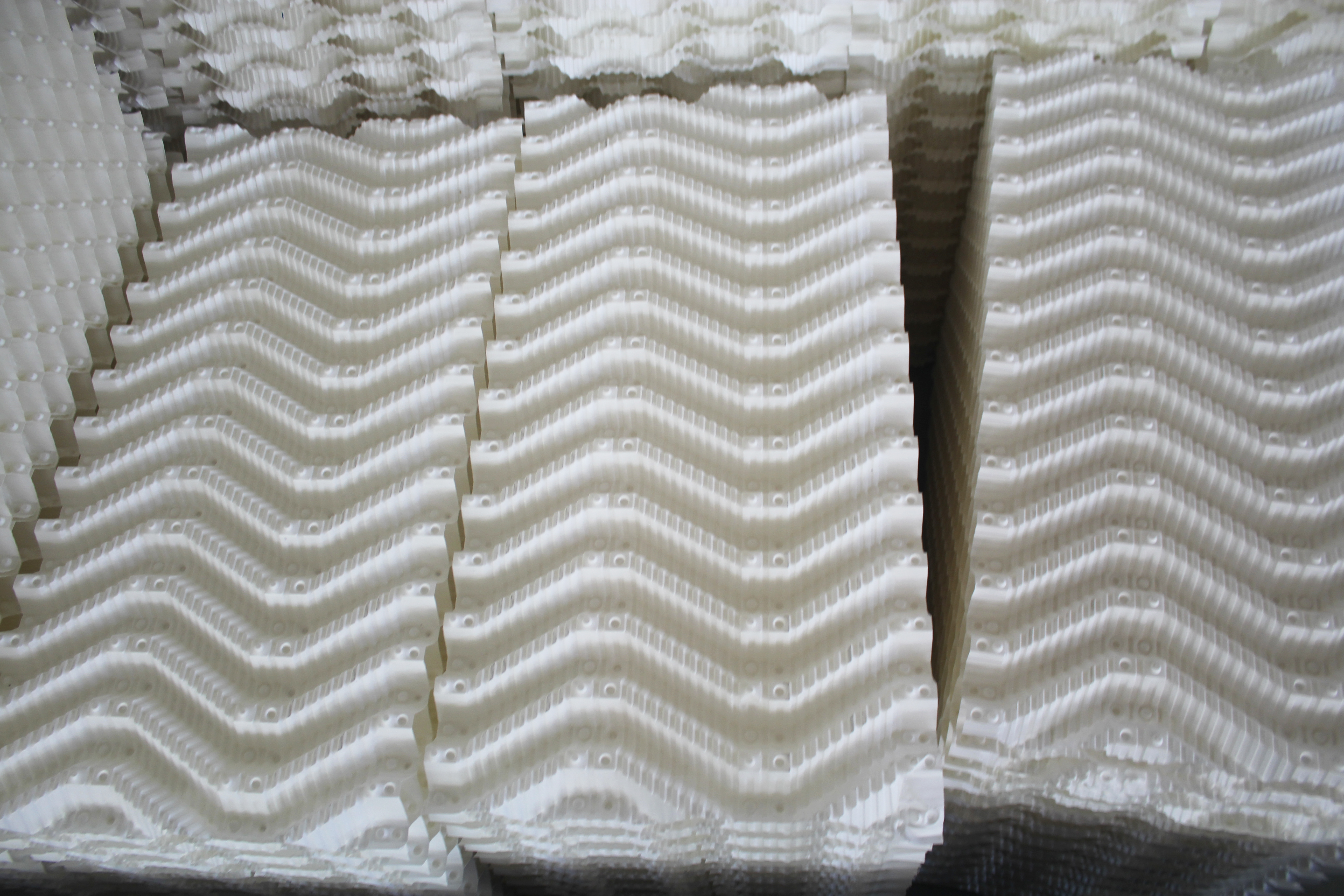
What Is PP Cooling Tower Fill Media?
PP cooling tower fill media is a heat-transfer component installed inside a cooling tower to increase the contact area between circulating water and air.
When hot water enters the cooling tower, it is distributed over the fill surface. Air passes through the fill, allowing heat and a portion of the water to evaporate. The resulting evaporation removes heat from the circulating water.
Why Is Fill Media Important in a Cooling Tower?
Without an effective fill system, water would have relatively limited contact with the air moving through the tower.
The fill media helps:
Spread water over a larger surface
Increase air-water contact
Improve heat transfer
Increase water residence time
Support evaporative cooling
Reduce the required tower size for a given cooling duty
How Does Fill Media Improve Heat Transfer?
The basic principle is simple:
More effective air-water contact → better heat and mass transfer → improved cooling performance
However, the actual performance depends on the complete cooling tower system rather than the fill alone. Water distribution, airflow, fan performance, inlet temperature, ambient conditions, and water chemistry can all influence results.
Why Is Polypropylene Used for Cooling Tower Fill?
PP is an attractive material for cooling tower applications because it offers a useful combination of chemical, mechanical, and processing characteristics.
What Are the Main Benefits of PP Fill Media?
Key advantages can include:
Good chemical resistance
Low material weight
Resistance to moisture
Good mechanical strength
Flexible manufacturing options
Suitable for customized dimensions
Good resistance to many water-treatment environments
Easy handling during installation
Is PP Better Than Other Cooling Tower Fill Materials?
There is no universal material that is best for every cooling tower.
Common fill materials include:
The appropriate material depends on the operating environment.
When Should Buyers Consider PP?
PP may be worth considering when the application requires a combination of lightweight construction, chemical resistance, and customized manufacturing.
For applications involving elevated temperatures or aggressive water chemistry, buyers should verify the specific PP material and product design with the manufacturer rather than relying on the material name alone.
What Types of PP Cooling Tower Fill Media Are Available?
The structure of the fill determines how water and air interact inside the tower.
What Is PP Film Fill?
Film fill uses thin surfaces to create a large area over which water can spread into a relatively thin film.
Its objective is to maximize effective air-water contact within a compact volume.
What Are the Advantages of Film-Type PP Fill?
Potential advantages include:
High effective surface area
Compact installation
Efficient water distribution
Suitable for many modern cooling tower designs
Potentially strong heat-transfer performance
Film fill is often considered for systems with relatively clean circulating water.
What Is PP Splash Fill?
Splash fill uses repeated impact and redistribution to break water into droplets or smaller streams.
Instead of relying primarily on a continuous water film, splash fill promotes repeated contact between water and air.
When Is Splash Fill Useful?
Splash fill may be considered for applications where suspended solids, biological growth, or fouling make certain film-fill designs less suitable.
The final selection should be based on water quality and tower operating conditions.
How Does Cooling Tower Configuration Affect PP Fill Selection?
The cooling tower configuration is one of the first technical factors to consider.
What Is PP Fill for Counterflow Cooling Towers?
In a counterflow cooling tower, water flows downward while air moves upward.
The fill must therefore support effective countercurrent air-water contact.
What Should Buyers Check for Counterflow Fill?
Consider:
Fill height
Flute geometry
Airflow resistance
Water distribution
Sheet spacing
Installation dimensions
Fouling potential
What Is PP Fill for Crossflow Cooling Towers?
In a crossflow tower, air typically moves horizontally across the falling water.
The fill arrangement must support the tower's horizontal airflow and water-distribution pattern.
Why Can't Buyers Use Any Fill in Any Tower?
Fill geometry is designed around airflow and water movement. Installing an unsuitable fill configuration may affect pressure drop, water distribution, and overall tower performance.
Therefore, buyers should identify whether the system is crossflow or counterflow before selecting PP cooling tower fill media.
How Do You Choose the Right PP Cooling Tower Fill?
Selecting fill media requires a combination of technical and commercial considerations.
1. Check the Cooling Tower Type
First determine:
Crossflow
Counterflow
Induced draft
Forced draft
Mechanical draft
Natural draft
The fill should be compatible with the tower configuration.
2. Evaluate Water Quality
Water quality can have a major impact on fill selection.
What Water Conditions Should Be Considered?
Evaluate:
Suspended solids
Hardness
Scaling tendency
Biological growth
Oil contamination
Chemical concentration
pH
Corrosive components
Clean water and heavily contaminated water may require different fill approaches.
3. Check Operating Temperature
Operating temperature is another critical consideration.
Buyers should provide the manufacturer with:
Why Does Temperature Matter?
Plastic materials have temperature-dependent mechanical properties. Therefore, the actual operating conditions should be checked against the manufacturer's specifications.
4. Determine the Required Fill Dimensions
Measure the existing installation or refer to the cooling tower drawings.
Important dimensions include:
Length
Width
Height
Sheet thickness
Block dimensions
Support spacing
Accurate dimensions can reduce installation problems during replacement projects.
Does PP Fill Thickness Affect Performance?
Yes, thickness can influence both mechanical properties and product cost.
What Happens If the Fill Is Too Thin?
A very thin sheet may reduce material consumption, but it may also affect rigidity, handling, dimensional stability, or service life depending on the application.
Is Thicker Fill Always Better?
Not necessarily.
Increasing thickness can increase material consumption and cost without automatically producing proportional improvements in cooling performance.
What Is the Right Thickness?
The appropriate thickness depends on:
Fill design
Tower configuration
Water loading
Mechanical requirements
Installation method
Operating conditions
The manufacturer should recommend or confirm the thickness based on the actual application.
How Does Fill Geometry Affect Cooling Performance?
Material alone does not determine cooling performance.
The geometry of the fill is equally important.
What Design Features Should Be Evaluated?
Important features include:
Flute shape
Flute angle
Surface pattern
Sheet spacing
Contact area
Water path
Air passage
Fill height
Why Is Flute Design Important?
Flute geometry controls how water moves over the surface and how air passes through the fill.
An effective design attempts to achieve a balance between:
Heat transfer + Water distribution + Airflow + Pressure drop + Fouling resistance
A design optimized for only one factor may not deliver the best overall result.
How Does Water Quality Affect PP Cooling Tower Fill Selection?
Water quality is often underestimated during fill selection.
What Happens When Fill Becomes Fouled?
Deposits, scale, algae, sludge, and other contaminants can accumulate on the fill surface.
This can:
Reduce effective surface area
Restrict airflow
Disrupt water distribution
Increase pressure drop
Reduce cooling performance
Increase maintenance requirements
Which PP Fill Is Suitable for Poor Water Quality?
There is no single answer.
For water containing high levels of suspended solids or biological contaminants, buyers may consider designs with larger passages or splash-type configurations.
Should You Use Film Fill with Dirty Water?
Film fill may require relatively clean water to maintain its designed performance.
If the water has significant fouling potential, discuss the application with the manufacturer before selecting a high-density film fill.
PP Cooling Tower Fill vs PVC Cooling Tower Fill
PP and PVC are both widely used plastic materials for cooling tower fill, but their characteristics are not identical.
What Is the Difference Between PP and PVC Fill?
| Feature | PP Cooling Tower Fill | PVC Cooling Tower Fill |
| Material | Polypropylene | Polyvinyl chloride |
| Weight | Lightweight | Lightweight |
| Chemical resistance | Good | Good |
| Manufacturing flexibility | High | High |
| Temperature suitability | Application dependent | Application dependent |
| Customization | Available | Available |
| Typical applications | Industrial and demanding environments | HVAC and industrial applications |
The actual performance depends on the specific formulation and fill design.
Which Should You Choose?
Instead of automatically choosing PP or PVC, compare the materials according to:
How Long Does PP Cooling Tower Fill Last?
There is no universal service life for PP cooling tower fill.
What Factors Affect Fill Service Life?
Important factors include:
Water temperature
UV exposure
Water chemistry
Scale formation
Biological growth
Mechanical damage
Cleaning practices
Airborne contaminants
Installation quality
How Can You Extend Fill Service Life?
Good maintenance practices can help protect cooling tower fill.
These may include:
Maintaining proper water treatment
Monitoring water chemistry
Removing debris
Preventing excessive scaling
Controlling biological growth
Inspecting fill periodically
Cleaning according to manufacturer recommendations
When Should PP Cooling Tower Fill Be Replaced?
Replacement should generally be based on actual condition and cooling performance rather than a fixed calendar date.
What Are the Signs of Damaged Fill?
Look for:
Cracks
Deformation
Brittle sheets
Excessive scaling
Blocked passages
Severe biological growth
Broken fill sections
Poor water distribution
Can Poor Cooling Performance Indicate Fill Problems?
Yes, but poor cooling performance does not necessarily mean that the fill is the only problem.
Other potential causes include:
A complete system inspection is therefore recommended before ordering replacement fill.
How Should Buyers Purchase PP Cooling Tower Fill Media?
Purchasing decisions should combine technical specifications and supplier evaluation.
What Should Be Included in an RFQ?
A detailed request for quotation should include:
Cooling tower type
Fill type
Material
Dimensions
Thickness
Quantity
Operating conditions
Water quality
Application
Delivery destination
Packaging requirements
Why Is a Detailed RFQ Important?
It allows manufacturers to quote the same specification and makes supplier comparison more meaningful.
How to Choose a PP Cooling Tower Fill Manufacturer?
The manufacturer is an important part of the purchasing decision.
What Should You Check?
Evaluate:
Production capacity
Manufacturing equipment
Material control
Quality inspection
Product range
Customization capability
Packaging
Export experience
Lead time
Technical support
Can a Manufacturer Provide Customized PP Fill?
Many manufacturers can customize PP cooling tower fill according to project requirements.
Customization may include:
Length
Width
Thickness
Fill height
Surface pattern
Color
Packaging
Pallet dimensions
What Information Helps With Customization?
Provide:
Existing fill dimensions
Cooling tower type
Photos
Drawings
Required quantity
Operating conditions
Installation requirements
The more complete the technical information, the easier it is for the manufacturer to assess the project.
How Can You Reduce PP Cooling Tower Fill Purchasing Costs?
Price optimization should consider the entire procurement process.
Can Bulk Orders Lower the Unit Cost?
Larger orders may allow manufacturers to improve production efficiency and offer more competitive unit prices.
However, buyers should consider warehouse capacity and actual project demand before ordering large quantities.
Can Packaging Reduce Logistics Costs?
Yes.
PP cooling tower fill is relatively light but can be bulky. Efficient pallet design and container loading can therefore affect the overall landed cost.
What Should You Discuss With the Manufacturer?
Ask about:
Optimizing these details can help reduce unnecessary logistics costs.
What Are the Common Mistakes When Selecting PP Fill Media?
Choosing Only by Price
The cheapest product may not provide the desired balance of quality, service life, and performance.
Ignoring Water Quality
A fill design suitable for clean water may not be suitable for heavily contaminated water.
Selecting the Wrong Dimensions
Incorrect dimensions can create installation problems and increase modification work.
Focusing Only on Surface Area
A larger nominal surface area does not automatically guarantee better overall cooling performance.
Ignoring Airflow Resistance
Fill must allow sufficient airflow while providing effective air-water contact.
Buying Without Confirming the Application
Always provide the manufacturer with operating conditions before finalizing the fill selection.
PP Cooling Tower Fill Media Selection Checklist
Before purchasing, buyers can use the following checklist.
Technical Requirements
Cooling tower type confirmed
Crossflow or counterflow confirmed
PP material confirmed
Fill type selected
Dimensions measured
Thickness confirmed
Operating temperature confirmed
Water quality evaluated
Required quantity calculated
Supplier Requirements
Manufacturer verified
Product sample reviewed
Quality control confirmed
Customization capability checked
Production capacity confirmed
Lead time confirmed
Packaging reviewed
Shipping terms confirmed
Conclusion
Selecting the right PP cooling tower fill media requires more than choosing a plastic fill based on material or price. The best selection should match the cooling tower configuration, water quality, operating temperature, airflow requirements, dimensions, maintenance conditions, and project budget.
PP can provide a useful combination of lightweight construction, chemical resistance, durability, and manufacturing flexibility. However, the final performance depends on both the material and the fill design.
For replacement projects and new cooling tower installations, buyers should provide detailed technical information to a qualified PP cooling tower fill manufacturer. Comparing product specifications, samples, quality control, customization, price, packaging, and delivery can help create a more reliable sourcing process.
With the right selection and proper maintenance, PP cooling tower fill media can support stable heat transfer and efficient cooling performance across a wide range of industrial and commercial cooling applications.


