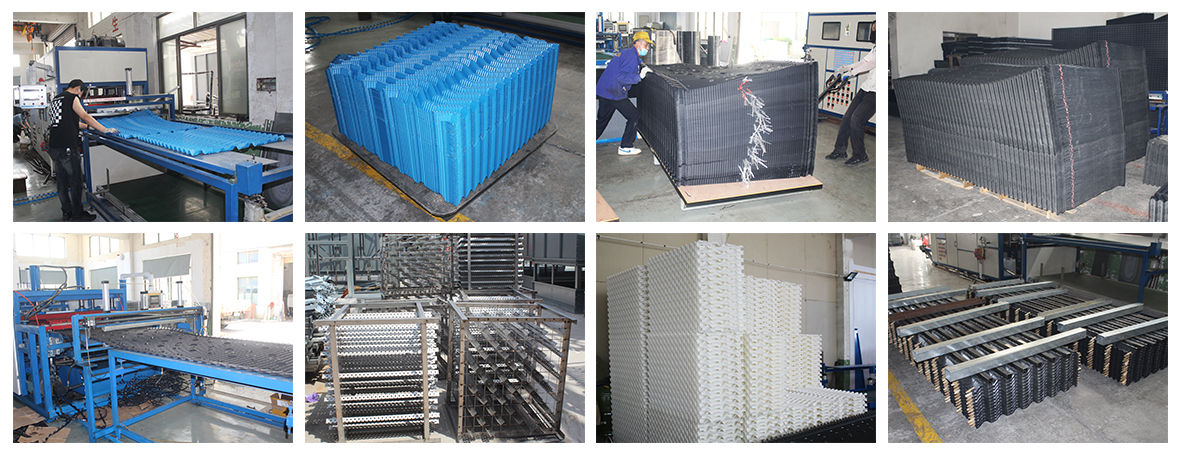
Choosing the right fill for cooling tower applications is essential for efficient heat transfer, stable cooling performance, and long service life. Cooling tower fill media creates a large contact area between circulating water and air, allowing heat to be removed through evaporation.
However, not every fill works equally well in every cooling tower. Water quality, tower design, operating temperature, airflow, cooling load, and maintenance requirements all affect fill selection.
This guide explains how to choose the right cooling tower fill for new installations, retrofit projects, and cooling tower fill replacement.
What Is Fill for Cooling Tower?
Fill for cooling tower equipment is the heat-transfer media installed inside a cooling tower. Hot water is distributed over the fill while air moves through it. The fill increases water-air contact and encourages evaporation.
The two main types are:
Hybrid cooling tower fill is also available for applications requiring characteristics of both designs.
Common fill materials include PVC and PP (polypropylene).
The right combination of fill type, material, geometry, and installation configuration can have a significant effect on tower performance.
Why Is Cooling Tower Fill Important?
The primary purpose of cooling tower fill is to increase the effective contact area between water and air.
Good fill design can help:
Improve heat transfer
Increase evaporation
Reduce the required fill volume
Support the required cold-water temperature
Improve cooling tower capacity
Make better use of tower space
But thermal performance is only one part of the selection process. A fill that performs well with clean water may not be suitable for heavily contaminated or poorly treated water.
Step 1: Determine the Cooling Tower Type
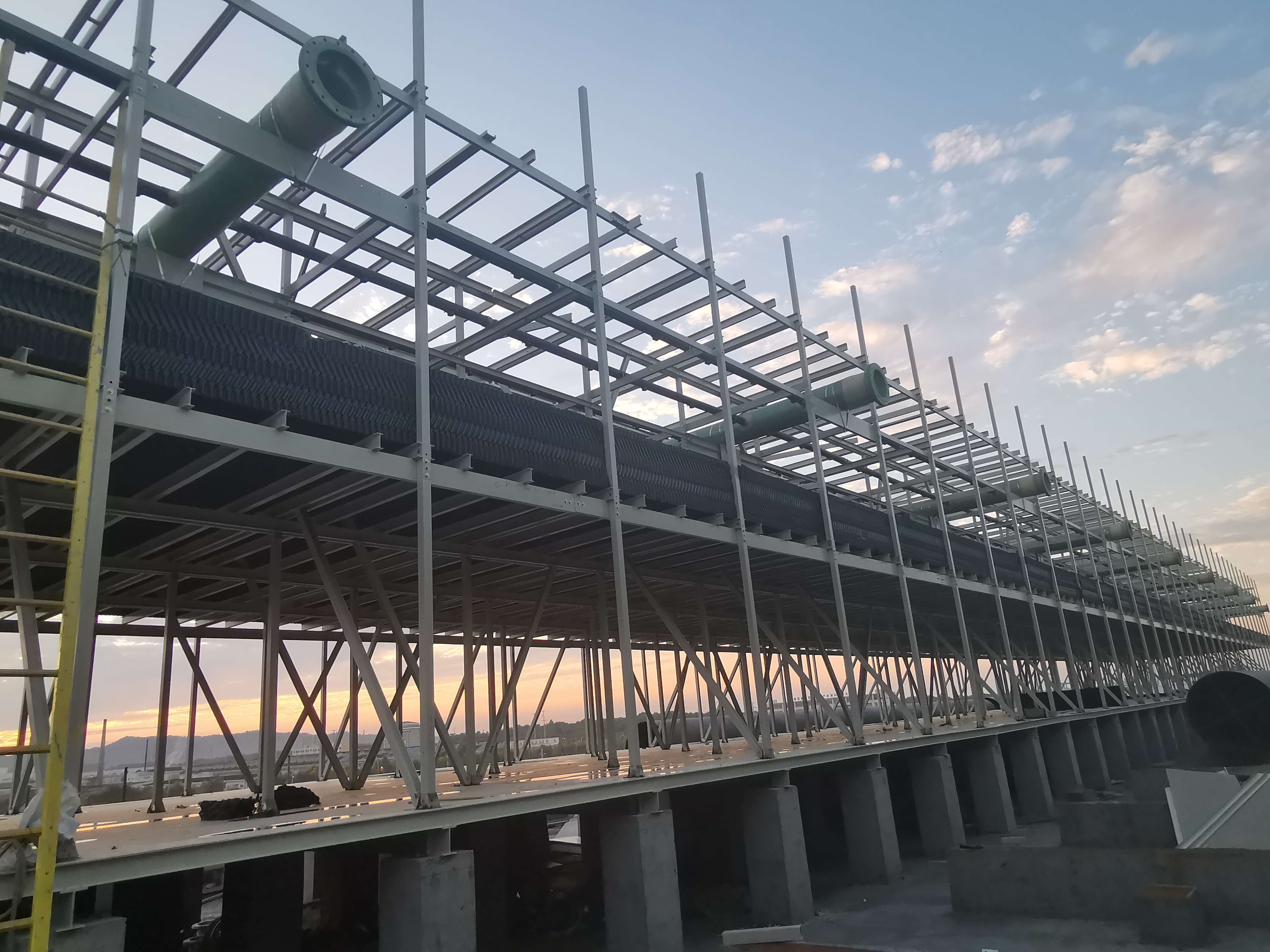
Start by identifying the cooling tower configuration.
Common configurations include:
Crossflow cooling towers
Counterflow cooling towers
Induced-draft cooling towers
Forced-draft cooling towers
Open-circuit cooling towers
Closed-circuit cooling towers
The fill must be compatible with the tower's airflow and water-distribution arrangement.
For example, crossflow cooling tower fill and counterflow cooling tower fill can have different geometries and installation requirements.
Before selecting a product, confirm the tower manufacturer, model, dimensions, and existing fill arrangement.
Step 2: Evaluate Water Quality
Water quality is one of the most important factors when selecting fill for cooling tower systems.
Consider:
Suspended Solids
High concentrations of suspended solids can accumulate inside fill passages and restrict airflow or water flow.
Scale
Hard-water deposits can reduce the effective surface area and increase blockage.
Biological Growth
Algae, bacteria, and other biological deposits can foul cooling tower fill.
Oil and Chemicals
Industrial process water may contain oil or chemicals that affect fill materials.
If the circulating water has a high fouling potential, an open splash-fill design may be more practical than a tightly packed film-fill structure.
Step 3: Choose Film Fill or Splash Fill
Film Fill
Film fill for cooling towers spreads water into a thin film across specially shaped sheets.
Advantages include:
PVC film fill is widely used in HVAC and industrial cooling applications.
Film fill is generally most appropriate when water treatment is effective and suspended solids are controlled.
Splash Fill
Splash fill for cooling towers repeatedly breaks falling water into droplets.
Its open structure can provide greater tolerance to suspended solids and fouling.
Advantages include:
Good fouling resistance
Open water and airflow passages
Easier inspection
Suitable for challenging water conditions
Good industrial durability
Splash fill is commonly considered for industrial cooling towers where water quality can be difficult to control.
Step 4: Select the Fill Material
The material is another important consideration.
PVC Cooling Tower Fill
PVC cooling tower fill is widely used for film-fill applications.
Typical advantages include:
PVC is commonly selected for many commercial and industrial cooling tower applications.
PP Cooling Tower Fill
PP cooling tower fill is frequently used for splash-fill applications and certain film-fill designs.
Potential advantages include:
Always check the manufacturer's recommended operating temperature and chemical compatibility before selecting PVC or PP.
Step 5: Check Thermal Requirements
The fill must be capable of handling the required cooling load.
Important design information includes:
The approach is the difference between the cold-water temperature leaving the tower and the entering-air wet-bulb temperature.
A smaller approach generally requires more effective heat transfer and careful fill selection.
Do not select fill based only on advertised surface area. Thermal performance depends on the complete fill geometry and operating conditions.
Step 6: Consider Airflow and Pressure Drop
Cooling tower fill affects airflow through the tower.
A highly compact fill structure can provide substantial surface area but may also create airflow resistance.
Consider:
Air velocity
Pressure drop
Fan capacity
Fill depth
Cell geometry
Tower configuration
The selected fill should work within the cooling tower fan's available airflow and static-pressure capability.
Changing fill geometry during a retrofit without checking airflow can affect overall tower performance.
Step 7: Consider Fouling and Maintenance
A cooling tower fill system requires regular inspection and maintenance.
If the site has a history of scaling or biological fouling, prioritize a fill design that can be inspected and cleaned effectively.
Consider:
A fill with excellent theoretical thermal performance can lose effectiveness quickly if its passages become blocked.
Step 8: Measure Existing Fill for Replacement
For cooling tower fill replacement, accurate measurements are essential.
Record:
Photographs of the existing fill and its installation can also help suppliers identify the appropriate replacement.
Do not assume that fill blocks with the same external dimensions have identical thermal performance. Internal geometry can differ significantly.
Step 9: Check Operating Temperature
Operating temperature should be considered when selecting fill material.
PVC and PP have different temperature characteristics. Higher-temperature applications may require specific PP fill designs or other specialized materials.
Always compare:
Actual operating temperature → Material rating → Fill manufacturer's specifications
This is particularly important for industrial process cooling applications.
Step 10: Compare Total Cost, Not Just Purchase Price
The cheapest fill for cooling tower may not be the most economical choice over its service life.
Consider the total cost of:
Initial fill purchase
Transportation
Installation
Cleaning
Water treatment
Maintenance
Replacement frequency
Energy consumption
A suitable fill can help maintain thermal performance and reduce avoidable maintenance problems.
Cooling Tower Fill Selection Checklist
Before purchasing cooling tower fill, confirm the following:
| Selection Factor | What to Check |
| Tower type | Crossflow or counterflow |
| Fill type | Film, splash, or hybrid |
| Material | PVC, PP, or other |
| Water quality | Solids, scale, biological growth |
| Water flow | Design circulation rate |
| Temperature | Hot and cold water temperatures |
| Airflow | Fan capacity and air velocity |
| Fill dimensions | Length, width, height |
| Cell geometry | Existing fill pattern |
| Maintenance | Cleaning and inspection requirements |
| Application | HVAC or industrial process cooling |
Common Mistakes When Choosing Cooling Tower Fill
Several mistakes can reduce cooling tower performance.
Choosing Based Only on Price
Low-cost fill may not match the required thermal or mechanical specifications.
Ignoring Water Quality
Fill selection should reflect actual circulating-water conditions.
Using the Wrong Dimensions
Even small differences in fill configuration can create installation problems.
Ignoring Airflow
A change in fill resistance can affect fan performance.
Focusing Only on Surface Area
Effective cooling depends on the interaction of fill geometry, water distribution, airflow, and operating conditions.
Frequently Asked Questions
What is the best fill for a cooling tower?
There is no universal best fill. Film fill can be suitable for clean, properly treated water, while splash fill is often considered for applications with higher fouling or suspended solids.
Is PVC or PP better for cooling tower fill?
Both materials have important applications. PVC is widely used for film fill, while PP is common in splash-fill applications. The correct choice depends on temperature, water chemistry, fill design, and tower conditions.
How do I select cooling tower fill replacement?
Start by identifying the tower type, measuring the existing fill, checking water quality and operating temperatures, and confirming the required thermal performance.
How often should cooling tower fill be replaced?
There is no fixed replacement interval. Fill should be inspected regularly and replaced when it becomes excessively damaged, blocked, deteriorated, or unable to provide the required performance.
Can film fill be used in an industrial cooling tower?
Yes. Film fill is widely used in industrial cooling towers, provided the water quality, thermal requirements, operating temperature, and fouling conditions are appropriate.
Conclusion
Selecting the right fill for cooling tower applications requires a balance between thermal performance, water quality, material compatibility, airflow, maintenance, and cost.
Film fill offers high surface area and efficient heat transfer for many clean-water systems. Splash fill provides an open structure that can be advantageous in applications with suspended solids and fouling. Hybrid designs can provide another option for demanding operating conditions.
For a cooling tower retrofit or fill replacement project, always evaluate the complete operating environment rather than choosing fill based on one specification.
Power Tower Cooling Technology (Shaoxing) Co.,Ltd supplies PVC and PP cooling tower fill, film fill, splash fill, and replacement cooling tower fill media for commercial and industrial applications.
Internal Links for Other CoolingTowerParts
Cooling Tower Fill
Cooling Tower Nozzles
Cooling Tower Drift Eliminators
Cooling Tower Louvers
Cooling Tower Fan Blades
Cooling Tower Motors


