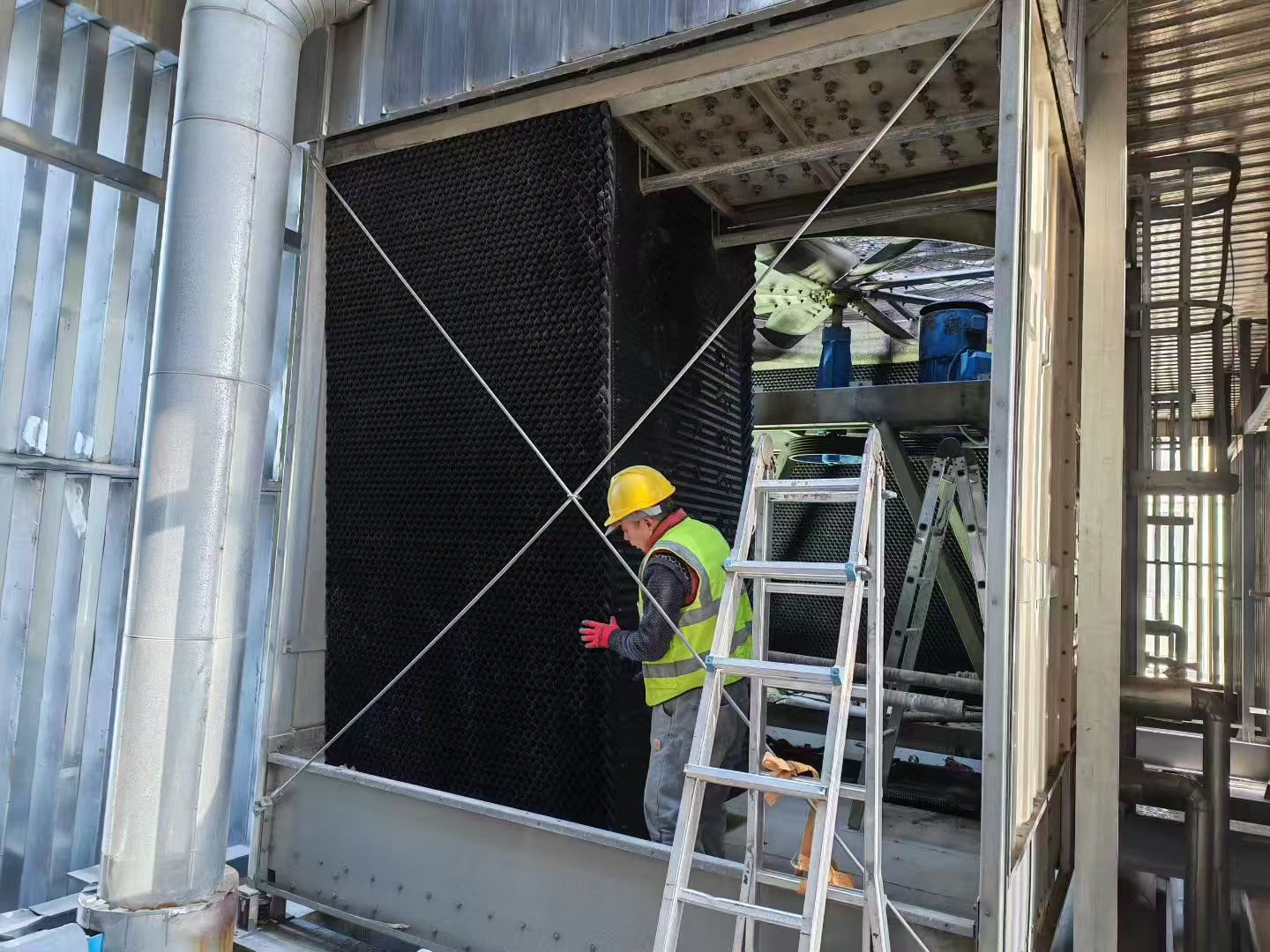
Fill for cooling tower systems is a critical component in industrial heat-rejection equipment. It increases the contact area between circulating water and air, helping the cooling tower transfer heat more effectively through evaporation.
Industrial cooling towers operate under demanding conditions. High water flow rates, elevated temperatures, suspended solids, scale, biological growth, and continuous operation can all affect fill performance. Choosing the right industrial cooling tower fill is therefore important for thermal efficiency, maintenance, and long-term reliability.
This guide explains the types, materials, applications, benefits, and replacement considerations for cooling tower fill in industrial environments.
What Is Fill for Cooling Tower?
Cooling tower fill, also called cooling tower fill media, is installed inside the tower to improve water-air contact.
Hot process water enters the cooling tower and flows through the fill section. At the same time, air moves through the tower. The fill increases the effective surface area and contact time between the water and air.
This allows more heat to transfer from the circulating water to the air.
Depending on the design, fill can spread water into thin films, break water into smaller droplets and streams, or combine both approaches.
Common industrial cooling tower fill types include:
PVC film fill
PP film fill
PP splash fill
PVC splash fill
Hybrid fill
Structured fill packs
Splash bars and grids
Why Is Cooling Tower Fill Important in Industrial Applications?
Industrial processes often generate large amounts of heat that must be removed continuously.
Cooling towers may be used in:
Power generation
Chemical processing
Petrochemical plants
Steel manufacturing
Metal processing
Food and beverage production
Plastic manufacturing
Data centers
HVAC and district cooling
Refineries
Industrial process cooling
In these applications, cooling tower performance can directly affect process stability and equipment operating conditions.
Properly selected fill helps maximize the available heat-transfer area within the tower. This can allow the tower to achieve its required cooling duty without unnecessarily increasing its physical size.
Main Types of Industrial Cooling Tower Fill
1. Film Fill
Film fill uses specially formed sheets to spread water into a thin layer over a large surface area.
Corrugated or embossed sheets create passages for water and air. As water moves across the surfaces, the large effective area promotes heat and mass transfer.
Benefits of Film Fill
High effective surface area
Efficient heat transfer
Compact design
Suitable for many industrial cooling towers
Available in PVC and PP
Good thermal performance when water quality is controlled
Film fill is commonly used where thermal efficiency is a major priority.
However, the relatively narrow passages can be vulnerable to blockage from scale, sediment, algae, and other contaminants.
2. Splash Fill
Splash fill works differently. Instead of forming a continuous water film, it repeatedly breaks falling water into smaller streams and droplets.
Water strikes splash bars or grids, changes direction, and breaks apart before moving to the next level.
Benefits of Splash Fill
Good tolerance of suspended solids
Open water and airflow passages
Suitable for challenging water conditions
Relatively easy to inspect
Available in different configurations
Common in industrial process cooling
Splash fill can be a practical choice where water quality makes conventional film fill difficult to maintain.
3. Hybrid Fill
Hybrid cooling tower fill combines characteristics of film and splash configurations.
The specific design varies, but the objective is generally to balance thermal performance with fouling resistance and maintenance requirements.
Hybrid fill may be considered when an industrial application requires both effective heat transfer and greater tolerance of challenging operating conditions.
Cooling Tower Fill Materials
PVC Cooling Tower Fill
PVC cooling tower fill is widely used for film-fill applications.
PVC can provide:
PVC film fill is common in many industrial and commercial cooling towers.
PP Cooling Tower Fill
Polypropylene (PP) cooling tower fill is used for both film and splash applications.
PP is valued for its resistance to higher operating temperatures and certain chemical environments.
PP splash fill is particularly common in industrial applications where fouling and suspended solids are concerns.
The appropriate material should always be selected according to actual operating temperature, water chemistry, and tower design.
How Does Industrial Cooling Tower Fill Improve Heat Transfer?
Cooling tower fill improves heat transfer through several mechanisms.
Greater Contact Area
Fill spreads or breaks up water, increasing the area available for air-water interaction.
Longer Contact Time
The fill slows the direct fall of water through the tower, giving water more time to interact with moving air.
Improved Water Distribution
Properly designed fill helps distribute water across the available cooling area.
Enhanced Evaporation
Cooling towers rely primarily on evaporative cooling. Increasing the air-water interface supports evaporation and heat removal.
Better Air-Water Interaction
Film channels and splash structures promote mixing and contact between water and air as they move through the tower.
Industrial Applications of Cooling Tower Fill
Power Plants
Cooling towers remove waste heat from power-generation processes. Reliable fill performance is important because large volumes of circulating water may need continuous cooling.
Splash fill can be considered for applications with challenging water quality, while film fill may be used where higher thermal performance is required.
Chemical and Petrochemical Plants
Chemical processes frequently require stable cooling-water temperatures.
Fill selection should consider process temperature, chemical exposure, water quality, and required cooling capacity.
Steel and Metal Processing
Industrial furnaces, rolling mills, casting equipment, and other processes can generate substantial heat.
Cooling towers equipped with appropriate fill can help remove heat from process-water systems.
Manufacturing Plants
Manufacturing facilities may use cooling towers for machinery, molds, compressors, heat exchangers, and process equipment.
The correct fill can help maintain consistent cooling-water conditions.
HVAC and District Cooling
Large commercial and industrial HVAC systems often use cooling towers to reject condenser heat.
Film fill is commonly used where controlled water quality and high thermal performance are priorities.
How to Select Fill for Industrial Cooling Towers
Choosing the right fill for cooling tower applications requires more than comparing product prices.
Consider these factors:
1. Water Quality
Check suspended solids, hardness, biological activity, and chemical treatment.
Poor water quality may favor an open splash-fill configuration.
2. Operating Temperature
Confirm that the fill material can withstand the maximum circulating-water temperature.
3. Water Flow Rate
Fill must be compatible with the tower's circulating-water loading. Excessive or insufficient water loading can affect performance.
4. Airflow
Fill geometry influences airflow resistance. The existing fan system must be capable of providing the required airflow.
5. Fouling Risk
If the tower operates with dirty or untreated water, fouling resistance should be a major selection criterion.
6. Thermal Requirement
Consider the required water temperature, range, approach, and overall cooling duty.
7. Maintenance Access
Select a fill configuration that can be inspected and maintained effectively under actual site conditions.
Cooling Tower Fill Replacement for Industrial Projects
Industrial cooling tower fill eventually needs inspection and, in some cases, replacement.
Common replacement indicators include:
When ordering cooling tower fill replacement, provide as much information as possible, including:
Cooling tower manufacturer
Tower model
Crossflow or counterflow design
Existing fill type
Fill dimensions
Material
Sheet thickness and spacing
Operating temperature
Water flow rate
Photos of the existing installation
Matching only the overall dimensions may not be sufficient. Fill geometry, support configuration, water loading, and airflow requirements should also be considered.
How to Maintain Industrial Cooling Tower Fill
Proper maintenance can extend the service life of cooling tower fill.
Recommended practices include:
Maintain an appropriate water-treatment program.
Inspect fill regularly.
Remove debris and sediment.
Control scale formation.
Control biological growth.
Inspect water-distribution nozzles.
Avoid excessive pressure during cleaning.
Monitor cold-water temperature.
Check for damaged or collapsed fill.
Replace severely deteriorated fill.
A clean and properly wetted fill surface provides better conditions for heat transfer than heavily fouled or damaged fill.
Industrial Cooling Tower Fill: Buyer Checklist
Before purchasing replacement fill, industrial buyers should confirm:
| Requirement | What to Check |
| Fill type | Film, splash, or hybrid |
| Material | PVC or PP |
| Tower design | Crossflow or counterflow |
| Dimensions | Length, width, and height |
| Operating temperature | Normal and maximum |
| Water quality | Solids, scale, biological growth |
| Water flow | Required loading |
| Airflow | Fan capacity and pressure drop |
| Thermal duty | Range and approach |
| Installation | Existing supports and configuration |
This information helps suppliers recommend a suitable replacement rather than simply supplying a generic fill pack.
Frequently Asked Questions
What is the best fill for an industrial cooling tower?
There is no single fill type for every industrial application. Film fill offers high surface area, while splash fill is often more tolerant of suspended solids and fouling. The best choice depends on water quality, thermal requirements, temperature, airflow, and tower design.
Is PVC or PP better for cooling tower fill?
Both materials are widely used. PVC is common for film fill, while PP is widely used for film and splash fill. Material selection should be based on operating temperature, water chemistry, and application requirements.
How long does industrial cooling tower fill last?
Service life varies considerably with water quality, temperature, cleaning practices, and operating conditions. Regular inspection is more useful than relying on a fixed replacement interval.
Can cooling tower fill be replaced without replacing the whole tower?
Yes. In many retrofit projects, existing fill can be removed and replaced while retaining the cooling tower structure and other components, provided the new fill is compatible with the tower design.
Conclusion
Fill for cooling tower systems plays a central role in industrial heat rejection. By increasing water-air contact area and supporting evaporative cooling, fill helps cooling towers remove heat from power plants, manufacturing facilities, chemical processes, HVAC systems, and other industrial operations.
Film fill is suitable for applications emphasizing high thermal performance, while splash fill can provide greater tolerance to challenging water conditions. Hybrid fill offers another option where a balance between thermal performance and fouling resistance is required.
For a new installation or cooling tower fill replacement, consider water quality, temperature, airflow, water loading, thermal duty, and maintenance requirements before making a purchase.
Power Tower Cooling Technology (Shaoxing) Co.,Ltd supplies PVC cooling tower fill, PP fill, film fill, splash fill, and industrial cooling tower fill replacement solutions for a wide range of applications.
Internal Links for Other CoolingTowerParts
Cooling Tower reducer
Cooling Tower Nozzles
Cooling Tower Drift Eliminators
Cooling Tower Louvers
Cooling Tower Fan Blades
Cooling Tower Motors


