SMC FRP Fan Stack for Cooling Tower – Custom Size Fan Shroud
A cooling tower fan stack is an essential structural component of an industrial cooling tower. It provides a controlled airflow passage for the fan, helps guide discharged air upward, and supports stable ventilation performance. The design, material, dimensions, and manufacturing quality of the fan stack can directly influence cooling tower operation, structural reliability, and long-term maintenance costs.
An SMC FRP fan stack for cooling tower applications offers an attractive solution for industrial facilities that require corrosion resistance, lightweight construction, and customized dimensions. Manufactured using Sheet Molding Compound (SMC) technology, FRP fan stacks combine fiberglass reinforcement with resin materials to create durable structural components suitable for demanding outdoor environments.
Compared with conventional metal fan stacks, SMC FRP fan shrouds offer several advantages, including resistance to rust, flexible design options, convenient transportation, and reduced maintenance requirements.
For cooling tower manufacturers, engineering contractors, and industrial buyers, selecting a custom-size fan shroud is important to ensure compatibility with the existing fan assembly and cooling tower structure.
This article explains the characteristics, manufacturing process, advantages, applications, customization options, and selection considerations of SMC FRP cooling tower fan stacks.
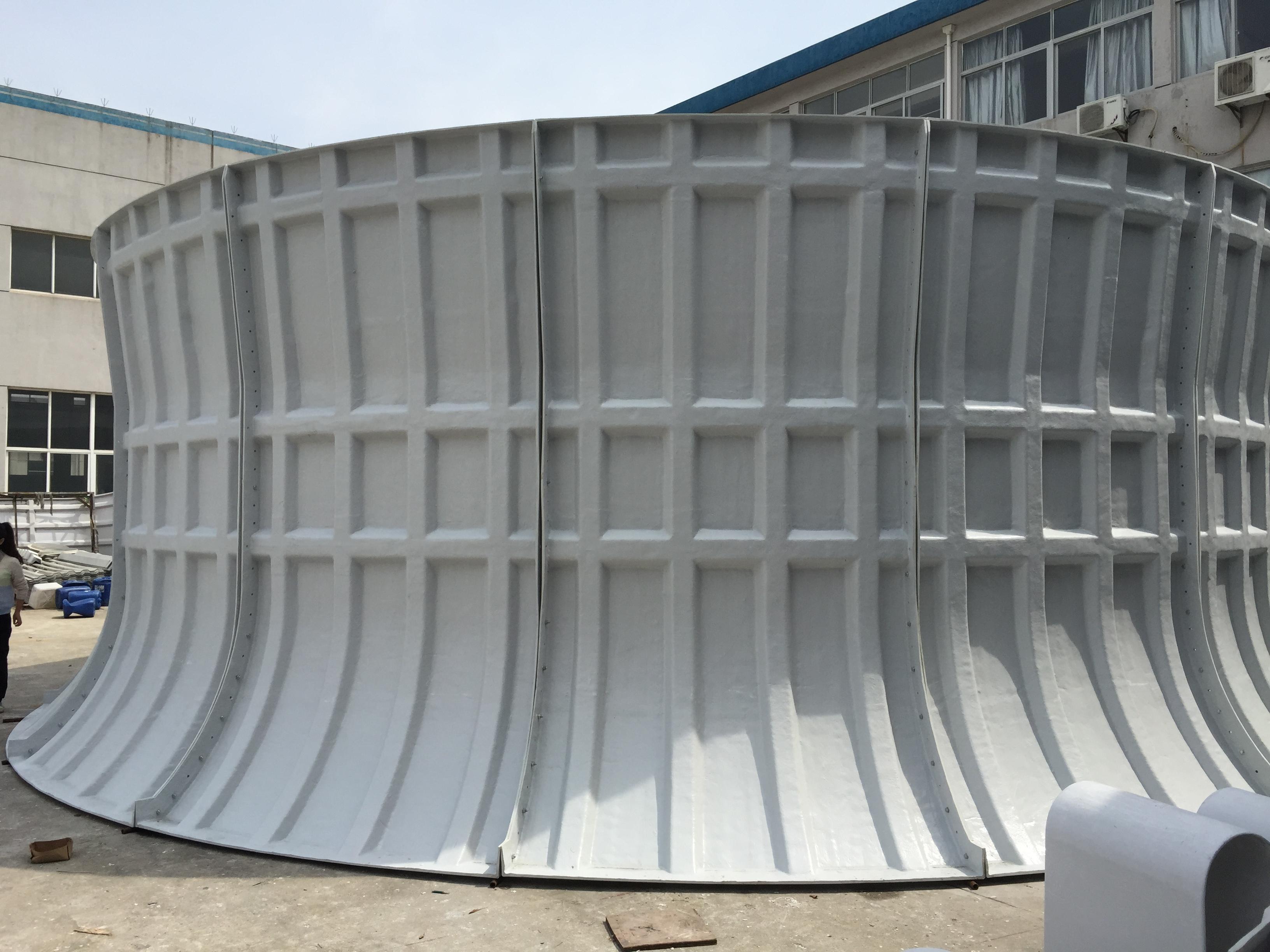
What Is an SMC FRP Fan Stack for Cooling Towers?
An SMC FRP fan stack is a fiberglass-reinforced plastic structure installed around the fan section of a mechanical draft cooling tower.
Its primary function is to provide an aerodynamic passage that directs air discharged by the cooling tower fan. It is also commonly called a cooling tower fan cylinder, fan shroud, or fan stack.
SMC stands for Sheet Molding Compound, a composite material consisting of reinforcing fibers, resin, fillers, and other additives. The material is processed through a controlled molding procedure to produce components with consistent dimensions and structural properties.
What Does a Cooling Tower Fan Stack Do?
The fan stack serves several important functions in a cooling tower system.
1. Guides Airflow
The fan stack creates a defined passage for air moving through the fan. A properly designed structure helps direct discharged air upward and reduce unnecessary airflow disturbance.
2. Supports Fan Performance
The fan stack works together with the fan blades, hub, motor, and gearbox. Its dimensions and geometry should be compatible with the fan design to avoid unnecessary airflow restrictions.
3. Protects the Fan Assembly
The fan cylinder provides a structural enclosure around the fan area and can help protect the assembly from certain external influences.
4. Improves Cooling Tower Appearance
A well-manufactured FRP fan shroud provides a clean and uniform exterior finish, contributing to the overall appearance of industrial cooling tower equipment.
Why Choose SMC FRP Material for a Cooling Tower Fan Stack?
Material selection is one of the most important considerations when manufacturing a cooling tower fan stack.
Traditional fan stacks may use galvanized steel, stainless steel, or other materials. However, FRP has become an attractive alternative for industrial cooling towers because of its corrosion resistance and lightweight properties.
SMC FRP combines fiberglass reinforcement with a thermosetting resin system, providing a practical balance of mechanical strength, dimensional consistency, and environmental durability.
1. Excellent Corrosion Resistance
Cooling towers operate in environments with continuous moisture, water droplets, and high humidity.
Metal fan stacks may experience corrosion over time, particularly when protective coatings become damaged.
SMC FRP does not rust like conventional steel. Its corrosion resistance makes it suitable for many industrial environments.
Suitable for Demanding Industrial Conditions
SMC FRP fan stacks can be considered for applications involving:
High humidity.
Continuous water exposure.
Industrial cooling water environments.
Coastal installations.
Chemical processing facilities.
Outdoor cooling tower installations.
Actual chemical resistance depends on the resin formulation and the substances present in the operating environment.
2. Lightweight Construction
One of the major benefits of FRP materials is their relatively low weight compared with many traditional metal structures.
A lightweight cooling tower fan stack can offer several practical advantages:
Easier transportation.
More convenient handling.
Reduced lifting requirements.
Simplified installation.
Lower structural dead load.
For large industrial cooling towers, reducing component weight can help simplify transportation and installation planning.
3. High Mechanical Strength
SMC FRP uses fiberglass reinforcement to improve the mechanical properties of the resin matrix.
When properly designed and manufactured, SMC components can provide suitable strength and stiffness for cooling tower structural applications.
The final performance depends on fiber content, resin formulation, molding conditions, wall thickness, and structural geometry.
4. Good Weather Resistance
Cooling tower fan stacks are generally installed outdoors and exposed to sunlight, rain, wind, and temperature fluctuations.
SMC FRP formulations can incorporate UV-resistant additives and suitable surface finishes to improve outdoor durability.
Protection Against UV Exposure
Ultraviolet radiation can gradually affect the surface of certain composite materials.
For outdoor cooling tower applications, manufacturers should consider:
UV-resistant resin systems.
Suitable surface coatings.
Gelcoat protection.
Appropriate material formulation.
Regular surface inspection.
5. Low Maintenance Requirements
Unlike conventional steel structures, FRP fan stacks do not require regular rust removal and repainting to prevent metallic corrosion.
This can reduce certain maintenance tasks and help control long-term operating costs.
However, regular inspections are still necessary to identify cracks, loose connections, surface damage, and structural deterioration.
SMC FRP Fan Stack vs. Traditional Metal Fan Stack
When selecting a fan shroud for an industrial cooling tower, buyers often compare FRP with galvanized steel and stainless steel.
Each material has different performance characteristics.
Material Comparison
Performance Factor | SMC FRP | Galvanized Steel | Stainless Steel |
Weight | Lightweight | Heavy | Heavy |
Corrosion resistance | Excellent with suitable formulation | Depends on coating condition | Grade-dependent |
Rust resistance | Does not rust | Can rust if coating fails | Generally good |
Design flexibility | High | Moderate | Moderate |
Maintenance | Relatively low | Coating maintenance may be required | Relatively low |
Customization | Excellent | Good | Good |
Initial cost | Application-dependent | Application-dependent | Often higher |
Which Material Is Better for Industrial Cooling Towers?
There is no universal material suitable for every cooling tower project.
SMC FRP is particularly attractive when corrosion resistance, reduced weight, and customized shapes are important.
Galvanized steel may be suitable when traditional metal construction and specific structural requirements are preferred.
Stainless steel can be considered for applications requiring particular metallic properties and corrosion resistance.
For many industrial cooling tower projects, SMC FRP provides a practical balance between durability, installation convenience, and maintenance requirements.
How Is an SMC FRP Cooling Tower Fan Stack Manufactured?
Manufacturing quality directly affects the mechanical performance, appearance, and service life of an FRP fan stack.
SMC technology uses a controlled molding process to produce composite components with consistent shapes and dimensions.
1. Raw Material Preparation
The first step involves preparing the SMC material.
Typical SMC formulations contain:
Unsaturated polyester or other suitable resin systems.
Chopped fiberglass reinforcement.
Mineral fillers.
Initiators and additives.
Pigments and surface modifiers.
The formulation should be selected according to the required mechanical properties, environmental conditions, and intended application.
2. Compression Molding
The prepared SMC material is placed into a heated mold.
Hydraulic pressure and controlled temperature allow the material to flow and cure into the required shape.
Important Manufacturing Parameters
The manufacturer must control several production factors:
Mold temperature.
Molding pressure.
Curing time.
Material quantity.
Fiber distribution.
Component thickness.
Proper process control helps reduce defects and improve product consistency.
3. Trimming and Finishing
After molding, excess material is removed and the component edges are finished.
Additional operations may include drilling, machining, surface treatment, and dimensional correction.
4. Assembly and Connection
Depending on the fan stack design, multiple molded sections may need to be connected to form a complete cylindrical structure.
The connection method should provide sufficient strength and maintain the required geometry.
Connection Options
Depending on project requirements, manufacturers may use:
Bolted connections.
Reinforced flange connections.
Mechanical fastening systems.
Customized connection structures.
Connection design should account for wind loads, vibration, structural loads, and installation conditions.
5. Quality Inspection
Before shipment, finished products should undergo appropriate inspections.
These may include:
Custom Size SMC FRP Fan Shroud for Different Cooling Tower Projects
Different cooling tower manufacturers and industrial facilities use different fan diameters, tower structures, and airflow requirements.
Therefore, a standard-size fan shroud may not always meet the installation requirements.
A custom-size SMC FRP fan stack can be manufactured according to project drawings, equipment specifications, or existing component dimensions.
1. Customized Diameter
The fan stack diameter must be compatible with the fan assembly and the surrounding cooling tower structure.
An incorrectly sized shroud may cause airflow restrictions or installation difficulties.
What Should Buyers Confirm?
Before ordering, confirm:
Fan diameter.
Fan stack internal diameter.
Overall external diameter.
Required installation clearance.
Connection flange dimensions.
2. Customized Height
The height of the fan stack influences the discharge configuration and overall cooling tower structure.
Different cooling tower designs may require different stack heights.
Manufacturers should evaluate the fan arrangement, discharge requirements, and structural limitations before confirming the final dimensions.
3. Customized Wall Thickness
Wall thickness should be selected according to the size and structural requirements of the fan stack.
Important factors include:
Excessive thickness can increase weight and cost, while insufficient thickness may reduce stiffness and structural reliability.
4. Customized Color and Surface Finish
SMC FRP fan stacks can be manufactured with different colors and surface finishes according to customer requirements.
Common options include:
The final surface appearance depends on the selected material formulation and finishing process.
5. Customized Section Design
For large-diameter cooling towers, manufacturing and transporting a single-piece fan stack may be impractical.
A sectional design can provide a more convenient solution.
Benefits of Sectional Fan Stack Construction
Easier transportation.
More flexible installation.
Reduced handling difficulties.
Convenient replacement of individual sections.
Better adaptability to large industrial structures.
The section connection design must maintain structural integrity and proper alignment.
What Factors Affect Cooling Tower Fan Stack Performance?
Although the fan stack is primarily a structural and airflow-guiding component, its design can influence the performance of the complete fan system.
1. Fan Stack Diameter
The internal diameter should match the fan design and required airflow passage.
An unsuitable diameter may create unnecessary airflow losses or interfere with the fan assembly.
2. Fan Stack Height
Stack height affects the discharge arrangement and should be considered together with fan diameter, fan position, and cooling tower configuration.
The optimal design depends on the specific cooling tower and its operating requirements.
3. Internal Surface Smoothness
A reasonably smooth internal surface helps avoid unnecessary surface irregularities and airflow disturbances.
SMC FRP can provide a relatively uniform molded surface when the mold and manufacturing process are properly controlled.
4. Structural Stability
A fan stack must maintain its shape under environmental and operating loads.
The structure should be evaluated for:
5. Compatibility with Cooling Tower Fan Blades
The fan stack must provide adequate clearance for the rotating blades.
Insufficient clearance may create a risk of mechanical contact during operation, especially if there is excessive vibration or structural deformation.
Proper installation measurements are essential.
How to Choose the Right SMC FRP Fan Stack Manufacturer?
Selecting an experienced manufacturer is important for ensuring product quality and project compatibility.
A reliable supplier should understand composite materials, cooling tower structures, fan system requirements, and customized manufacturing.
1. Check FRP Material Quality
Ask about the resin system, fiberglass reinforcement, material formulation, and environmental resistance.
For outdoor applications, UV resistance and weathering performance should also be considered.
2. Evaluate Manufacturing Capabilities
A qualified manufacturer should have suitable molding equipment, molds, and production facilities.
Questions to Ask the Manufacturer
Does the factory manufacture SMC FRP components directly?
Can it produce customized fan stack dimensions?
What molding process is used?
Can it provide dimensional inspection records?
Does it support OEM production?
Can it manufacture sectional fan stack structures?
3. Review Previous Industrial Projects
Experience in cooling tower applications is valuable.
Manufacturers familiar with cooling tower fan systems are more likely to understand installation requirements and structural considerations.
4. Confirm Customization and Engineering Support
For replacement projects, the manufacturer should be able to review drawings, samples, or existing equipment dimensions.
Engineering support helps reduce the risk of dimensional mismatches.
5. Consider Delivery and After-Sales Support
For international buyers, transportation and installation arrangements are important.
Before ordering, confirm:
SMC FRP Fan Stack Applications in Different Industries
SMC FRP fan stacks are suitable for various mechanical draft cooling tower applications.
1. Power Generation Industry
Power plants require reliable cooling systems to support continuous operation.
FRP fan stacks can be considered for cooling tower projects where lightweight construction and corrosion resistance are important.
2. Chemical and Petrochemical Plants
Chemical facilities may expose cooling tower structures to aggressive environmental conditions.
The appropriate FRP material formulation can help improve resistance to moisture and selected chemicals.
3. HVAC and Commercial Buildings
Large commercial buildings, industrial parks, and centralized air-conditioning systems use cooling towers to reject heat.
FRP fan shrouds can provide a lightweight and corrosion-resistant option for these applications.
4. Steel and Metallurgical Industries
Steel plants and metallurgical facilities often operate cooling systems under demanding conditions.
Custom SMC FRP fan stacks can be evaluated according to operating temperature, environmental exposure, and structural requirements.
5. Wastewater Treatment Facilities
Wastewater treatment plants may contain humid environments and airborne substances that affect conventional materials.
FRP structures can provide useful corrosion resistance when the resin system is properly selected.
Installation and Maintenance Tips for SMC FRP Cooling Tower Fan Stacks
Even high-quality FRP fan stacks require proper installation and periodic inspection.
Correct installation helps maintain structural stability and avoid interference with the rotating fan assembly.
1. Inspect the Installation Foundation
Before installing the fan stack, check the supporting structure and connection surfaces.
The foundation should be level, stable, and capable of supporting the expected loads.
2. Verify Dimensions Before Assembly
Measure the fan stack diameter, height, flange dimensions, and connection positions.
For sectional structures, check the alignment of all sections before final fastening.
3. Check Fan Blade Clearance
The distance between the fan blades and the internal wall of the fan stack should meet the equipment design requirements.
Insufficient clearance may result in blade contact and equipment damage.
4. Inspect Bolts and Connections
All fasteners should be installed according to the manufacturer's recommendations.
Loose connections can increase vibration and reduce structural stability.
5. Perform Regular Inspections
A practical inspection schedule should include:
Inspection Item | Recommended Check |
FRP surface | Cracks, fading, and surface damage |
Connections | Loose bolts and damaged joints |
Stack structure | Deformation and alignment |
Fan clearance | Possible blade interference |
Support structure | Corrosion and structural damage |
Vibration | Abnormal movement during operation |
Inspection frequency should be adjusted according to operating conditions and manufacturer recommendations.
FAQ About SMC FRP Cooling Tower Fan Stacks
1. What Is the Difference Between SMC FRP and Traditional FRP Fan Stacks?
SMC FRP fan stacks are manufactured using Sheet Molding Compound, typically through compression molding.
Other FRP products may be produced using hand lay-up, filament winding, pultrusion, or other composite manufacturing methods.
SMC is particularly suitable for producing repeatable molded components with controlled shapes and dimensions.
2. Can SMC FRP Fan Stacks Be Customized?
Yes. SMC FRP fan stacks can be designed according to customer drawings and project specifications.
Customization may include diameter, height, wall thickness, connection structure, color, and sectional configuration.
3. Are FRP Fan Stacks Better Than Steel Fan Stacks?
FRP fan stacks offer advantages in corrosion resistance and weight reduction.
Steel structures may be preferred for certain applications requiring specific metallic structural characteristics.
The best choice depends on environmental conditions, structural requirements, budget, and installation considerations.
4. Can SMC FRP Fan Stacks Be Used for Large Cooling Towers?
Yes. Large cooling tower fan stacks can be designed using suitable structural dimensions and sectional construction.
The manufacturer should evaluate wind loads, structural stiffness, connection strength, and installation requirements.
5. Does a Fan Stack Improve Cooling Tower Efficiency?
A properly designed fan stack helps guide discharged airflow and supports the intended fan operating conditions.
However, overall cooling tower efficiency also depends on fan selection, fill media, water distribution, airflow resistance, and operating conditions.
6. How Long Does an SMC FRP Fan Stack Last?
The service life depends on material formulation, manufacturing quality, UV exposure, temperature, mechanical loading, and maintenance.
A properly designed and maintained FRP fan stack can provide long-term service, but its actual lifespan should be evaluated according to the operating environment.
7. What Information Is Required for a Custom Fan Stack Quotation?
Buyers should provide the following information:
Cooling tower brand and model.
Fan diameter.
Fan stack diameter.
Overall height.
Required wall thickness.
Connection and flange dimensions.
Material requirements.
Quantity.
Drawings or reference photographs.
Providing these details helps manufacturers prepare a more accurate quotation.
Conclusion: Choose a Custom SMC FRP Fan Stack for Reliable Cooling Tower Performance
An SMC FRP fan stack for cooling tower applications provides a practical solution for industrial facilities seeking corrosion resistance, lightweight construction, and customized manufacturing.
With its fiberglass reinforcement, suitable resin formulation, and compression molding technology, SMC FRP can offer good mechanical properties, dimensional consistency, and long-term environmental durability.
Compared with traditional metal fan shrouds, SMC FRP fan stacks can reduce component weight, eliminate conventional rusting, and provide greater flexibility in customized designs.
For cooling tower manufacturers, engineering contractors, and industrial equipment buyers, selecting the right fan stack requires careful consideration of diameter, height, wall thickness, fan clearance, connection design, and operating environment.
Working with an experienced SMC FRP fan stack manufacturer can help ensure that each component matches the cooling tower structure and project requirements.
Whether you need a standard FRP fan cylinder or a custom-size cooling tower fan shroud, choosing the right material and manufacturing process is an important investment in cooling tower reliability, airflow management, and long-term operating performance.


