English


Views: 0 Author: jessi Publish Time: 2026-11-04 Origin: Site


Cooling tower fan blades play an essential role in maintaining efficient airflow and heat rejection in industrial cooling systems. The material used to manufacture these blades directly affects their strength, weight, corrosion resistance, aerodynamic performance, service life, and maintenance requirements. Selecting the right cooling tower fan blade material is therefore an important decision for cooling tower manufacturers, industrial facility operators, and replacement parts suppliers.
Different cooling tower applications require different fan blade materials. Fiberglass Reinforced Plastic (FRP), aluminum alloy, stainless steel, and other composite materials are commonly considered for industrial fan blade manufacturing. Each material offers specific advantages depending on operating conditions, fan diameter, rotational speed, environmental exposure, and project requirements.
For companies planning to install a new cooling tower fan or replace existing blades, understanding material properties can help improve operating efficiency and reduce long-term costs.
This article explores the main types of cooling tower fan blade materials, their characteristics, advantages, limitations, and practical selection considerations.

The fan is one of the most important components of a mechanical cooling tower. It draws or pushes large volumes of air through the tower, supporting heat exchange between circulating water and the surrounding atmosphere.
The material of the fan blade determines how effectively it can perform under continuous operating conditions.
Fan blade materials influence the overall weight and structural design of the blade. Lightweight materials can reduce the load on the fan shaft, gearbox, motor, and supporting structure.
A properly designed lightweight fan blade can offer several advantages:
Lower mechanical loading on the drive system.
Reduced starting torque requirements.
Improved flexibility in fan design.
Better compatibility with energy-efficient motor systems.
Reduced structural stress under suitable operating conditions.
However, lightweight construction alone does not guarantee high efficiency. Blade geometry, pitch angle, surface finish, and aerodynamic design are equally important.
Cooling towers operate in environments with high humidity, water droplets, and continuous exposure to moisture. Depending on water treatment and industrial processes, the surrounding atmosphere may also contain chemicals and corrosive substances.
If the blade material has poor corrosion resistance, long-term exposure can cause:
Surface oxidation.
Material deterioration.
Reduced structural strength.
Increased maintenance requirements.
Premature blade replacement.
Selecting corrosion-resistant materials is particularly important for chemical plants, power stations, wastewater treatment facilities, and coastal industrial installations.
Cooling tower fans often operate continuously for extended periods. Their blades must withstand centrifugal forces, aerodynamic pressure, vibration, and repeated mechanical loading.
The selected material should provide sufficient strength and stiffness to maintain the required blade shape throughout operation.
Material selection also influences the total cost of ownership.
A material with excellent corrosion resistance and fatigue performance may require less maintenance over its service life. Although its initial purchase price may be higher, it could provide better long-term value.
Several materials are used in cooling tower fan blade manufacturing. The most common options include FRP, aluminum alloy, stainless steel, and engineered composite materials.
FRP, or Fiberglass Reinforced Plastic, is widely used in industrial cooling tower fan applications. It combines glass fiber reinforcement with a resin matrix to create a lightweight and relatively strong composite structure.
FRP fan blades are designed to provide a balance of mechanical strength, corrosion resistance, and aerodynamic performance.
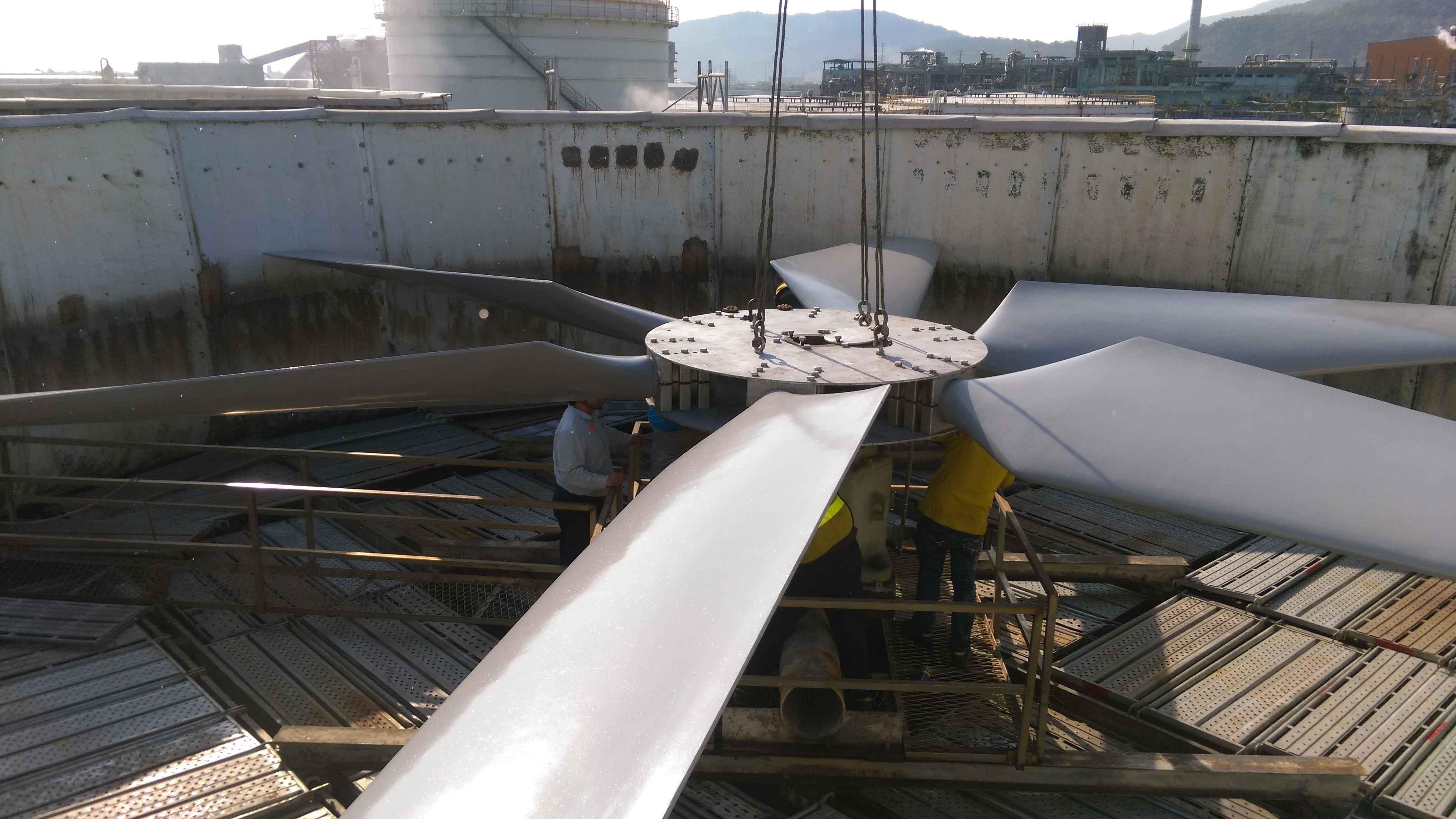
Excellent corrosion resistance
FRP materials generally resist moisture, many common industrial chemicals, and corrosive environments. Their actual chemical resistance depends on the resin system and manufacturing process.
Lightweight construction
Compared with many metal alternatives, FRP blades can achieve a relatively low weight while maintaining suitable structural strength.
Good design flexibility
FRP manufacturing allows different blade profiles, thicknesses, lengths, and reinforcement arrangements to be developed according to project requirements.
Low maintenance requirements
FRP does not experience conventional metal rusting. Properly manufactured blades can therefore reduce corrosion-related maintenance.
Suitable for humid and corrosive environments.
Good strength-to-weight ratio.
Flexible aerodynamic design.
No conventional metallic rusting.
Suitable for customized industrial applications.
Potentially lower maintenance costs.
FRP fan blades are commonly considered for:
Industrial cooling towers.
Power generation facilities.
Chemical processing plants.
Petrochemical installations.
Wastewater treatment facilities.
Large HVAC cooling systems.
For many industrial projects, FRP is an attractive choice when corrosion resistance and lightweight construction are important.
Aluminum alloy is another popular material for industrial fan blades. It offers a combination of relatively low weight, good mechanical properties, and convenient manufacturing.
Aluminum blades are frequently used in axial fan applications where precise dimensions and consistent blade geometry are required.
Lightweight metal construction
Aluminum is considerably lighter than many traditional structural metals, helping reduce the weight of the rotating fan assembly.
Good machinability
Aluminum alloys can be processed using various machining and forming methods, allowing manufacturers to produce different blade shapes and mounting configurations.
Good thermal conductivity
Aluminum transfers heat efficiently, although thermal conductivity is generally not a primary selection factor for cooling tower fan blades.
Protective surface treatment
Anodizing, coating, and other surface treatments can improve corrosion resistance and surface durability.
Relatively low weight.
Good manufacturing consistency.
Suitable mechanical strength when properly designed.
Convenient installation and adjustment.
Good recyclability.
Suitable for various industrial fan configurations.
Aluminum can experience corrosion under certain chemical and environmental conditions. Surface treatment and alloy selection are therefore important.
In addition, aluminum blades must be designed carefully to withstand centrifugal forces, vibration, and fatigue during long-term operation.
Stainless steel is known for its mechanical strength and corrosion resistance. It may be selected for specialized industrial environments where metallic construction is preferred.
Different stainless steel grades provide different levels of corrosion resistance and mechanical performance.
High mechanical strength
Stainless steel can provide excellent structural strength, making it suitable for demanding mechanical applications.
Corrosion resistance
Certain stainless steel grades offer good resistance to moisture and specific corrosive substances. However, resistance to chlorides and aggressive chemicals varies significantly by grade.
High durability
When correctly selected and maintained, stainless steel components can provide long service life.
Advantages |
Limitations |
|---|---|
High mechanical strength |
Higher material weight |
Good corrosion resistance with suitable grades |
Higher manufacturing costs |
Strong structural properties |
May increase drive-system loading |
Suitable for specialized applications |
Requires appropriate corrosion assessment |
Stainless steel may be suitable when a cooling tower operates in an environment requiring specific metallic properties, higher mechanical strength, or specialized corrosion resistance.
However, its additional weight must be considered when designing the fan drive system.
Composite materials are increasingly important in modern industrial fan manufacturing.
In addition to traditional fiberglass reinforcement, some applications may use advanced composite systems incorporating different fibers and resin technologies.
High strength-to-weight ratio.
Flexible structural design.
Potentially excellent fatigue performance.
Good corrosion resistance depending on the resin system.
Ability to optimize blade stiffness and aerodynamic shape.
Fiberglass composites are widely used because they provide a practical balance between performance and manufacturing cost.
Carbon fiber composites offer a higher stiffness-to-weight ratio in many designs but generally involve higher material and production costs.
For standard industrial cooling tower applications, FRP fiberglass blades are often a more economical choice.
Understanding the differences between materials makes it easier to select an appropriate solution.
Material |
Weight |
Corrosion Resistance |
Relative Cost |
Typical Application |
|---|---|---|---|---|
FRP |
Low |
Excellent with suitable resin |
Medium |
Industrial cooling towers |
Aluminum alloy |
Low |
Good with suitable treatment |
Medium |
Axial cooling fans |
Stainless steel |
High |
Grade-dependent |
High |
Specialized industrial environments |
Carbon fiber composite |
Very low |
Generally excellent |
Very high |
Specialized high-performance systems |
Note: These are general comparisons. Actual performance depends on material grade, resin formulation, manufacturing quality, blade geometry, and operating environment.
There is no single material that is ideal for every cooling tower.
FRP: A strong choice for corrosion resistance and lightweight construction.
Aluminum: Suitable for applications requiring lightweight metallic blades and manufacturing precision.
Stainless steel: Appropriate for selected applications requiring specific metallic properties.
Carbon fiber composites: Suitable for specialized projects with demanding weight and stiffness requirements.
For many industrial cooling tower replacement projects, FRP and aluminum are practical options worth evaluating first.
Choosing the correct material requires more than comparing purchase prices. Engineers should evaluate the complete operating environment and fan system.
Temperature affects the mechanical properties of fan blade materials.
Different FRP resin systems have different temperature resistance limits. Aluminum and stainless steel also experience changes in mechanical properties at elevated temperatures.
Before purchasing replacement blades, confirm:
Normal operating temperature.
Maximum air temperature.
Possible temperature fluctuations.
Exposure to hot water or steam.
Temperature resistance of the resin or protective coating.
For high-temperature cooling tower applications, material selection should be based on the manufacturer's verified operating limits.
The chemical composition of circulating water and the surrounding atmosphere can influence material durability.
For example, cooling towers used in chemical plants may experience exposure to acidic or alkaline substances.
Important considerations include:
Water treatment chemicals.
Chloride concentration.
Humidity levels.
Salt spray exposure.
Industrial airborne contaminants.
Cleaning chemicals.
For FRP blades, the resin system should be selected according to the expected chemical environment.
Fan diameter and operating speed directly influence blade loading.
Larger fan blades and higher rotational speeds can create significant centrifugal forces and aerodynamic loads.
The blade must maintain its designed shape under operating loads. Excessive deformation can change the blade pitch and airflow characteristics.
Manufacturers should evaluate:
Blade root strength.
Structural stiffness.
Centrifugal loading.
Fatigue resistance.
Vibration characteristics.
Dynamic balance requirements.
Material selection and blade design should be considered together.
Even high-quality materials cannot guarantee excellent fan performance if the blade profile is poorly designed.
Blade pitch angle
The pitch angle determines how the blade interacts with the airflow. Incorrect pitch settings can affect airflow volume, motor loading, and overall fan efficiency.
Blade profile
The aerodynamic profile influences pressure generation, airflow distribution, and operating noise.
Blade length and width
These dimensions must match the fan diameter, hub configuration, and operating requirements.
Surface finish
A smooth and consistent surface helps maintain the intended aerodynamic characteristics.
The installation method also affects the long-term reliability of fan blades.
Before replacing existing blades, check the hub dimensions, mounting holes, blade angle, and fastening arrangements.
Confirm the fan diameter.
Verify blade mounting dimensions.
Check the hub assembly.
Set the correct blade pitch.
Inspect all fasteners.
Verify fan clearance.
Perform appropriate balancing checks.
Incorrect installation can cause vibration, excessive mechanical loading, and premature component failure.
Energy efficiency is an important consideration for industrial cooling tower operators.
The fan motor can consume a substantial amount of electricity during continuous operation. Therefore, optimizing the fan assembly can help reduce operating costs.
Lightweight blades can reduce the inertia of the rotating assembly and may reduce starting loads.
However, the steady-state power required by the fan depends primarily on the airflow, pressure requirement, fan efficiency, and operating speed.
A well-designed blade profile can improve airflow while maintaining an appropriate power requirement.
Material properties help manufacturers maintain the required blade geometry under operating conditions.
Properly designed and balanced fan blades help reduce unwanted vibration and mechanical stress.
This can support more stable operation and help protect bearings, gearboxes, motors, and other drive components.
When combined with a variable frequency drive (VFD), a properly selected fan assembly can support flexible airflow control.
Reducing fan speed when full airflow is unnecessary can provide significant energy savings.
The relationship between fan speed and power is approximately:
Where:
\(P_1\) = Original fan power.
\(P_2\) = New fan power.
\(N_1\) = Original fan speed.
\(N_2\) = New fan speed.
This relationship is based on fan affinity laws and assumes comparable operating conditions and system characteristics.
Using unsuitable materials or low-quality manufacturing processes can reduce fan reliability.
Metal blades without suitable corrosion protection may experience oxidation and surface damage.
For composite blades, unsuitable resin selection or poor manufacturing quality may lead to environmental degradation.
Repeated loading, vibration, and improper installation can cause fatigue damage.
Cracks near the blade root or mounting area should be inspected carefully.
Uneven blade weight, inconsistent pitch angles, or structural damage can create imbalance.
Excessive vibration may affect the fan shaft, gearbox, motor, and supporting structure.
Blade deformation or incorrect pitch adjustment can reduce airflow and negatively affect cooling tower performance.
Poor material selection can increase maintenance frequency and replacement expenses.
Choosing a suitable material and reliable manufacturer helps reduce these risks.
Selecting the right manufacturer is just as important as choosing the blade material.
A professional manufacturer should understand cooling tower fan structures, aerodynamic requirements, material characteristics, and industrial operating conditions.
Ask the manufacturer about the raw materials used in production.
For FRP fan blades, important details include:
Glass fiber type and reinforcement structure.
Resin formulation.
Fiber content.
Manufacturing process.
Temperature resistance.
Chemical compatibility.
For aluminum blades, check the alloy grade, surface treatment, and mechanical properties.
Reliable manufacturers should have suitable production equipment and quality control procedures.
For FRP blades, manufacturing methods may include hand lay-up, vacuum-assisted processes, and other controlled composite molding techniques.
Consistent production helps ensure that blade dimensions, weight, and structural properties meet the required specifications.
Before placing an order, ask about relevant inspection and testing procedures.
These may include:
Dimensional inspection.
Material testing.
Blade weight inspection.
Structural inspection.
Blade pitch verification.
Dynamic balancing.
Finished product inspection.
Testing requirements should be appropriate for the blade design and operating conditions.
Different cooling tower brands and models may use different fan diameters, hub assemblies, and blade mounting systems.
A manufacturer with customization capabilities can help develop replacement blades according to existing equipment specifications.
Required Information |
Purpose |
|---|---|
Cooling tower brand and model |
Equipment identification |
Fan diameter |
Blade sizing |
Number of blades |
Fan configuration |
Existing blade material |
Material comparison |
Blade length and width |
Dimensional matching |
Blade pitch angle |
Aerodynamic matching |
Hub dimensions |
Installation compatibility |
Operating temperature |
Material selection |
Providing accurate information helps manufacturers recommend suitable replacement solutions.
FRP has become an important material option for cooling tower fan replacement projects because it combines lightweight construction, corrosion resistance, and flexible manufacturing.
FRP blades can be designed for various cooling tower configurations, including:
Counterflow cooling towers.
Crossflow cooling towers.
Industrial mechanical draft cooling towers.
Power plant cooling systems.
HVAC cooling towers.
Chemical industry cooling systems.
FRP manufacturing offers flexibility in blade geometry, reinforcement, and resin selection.
This allows manufacturers to develop products for different fan diameters, operating speeds, and environmental conditions.
Unlike conventional steel blades, FRP blades do not rust in the traditional metallic sense.
This characteristic makes them attractive for cooling towers exposed to moisture and certain corrosive environments.
Nevertheless, FRP blades still require regular inspections for cracking, delamination, erosion, and other forms of damage.
FRP is a popular choice for many industrial cooling tower applications because of its lightweight structure, corrosion resistance, and design flexibility.
Aluminum is another practical option, while stainless steel and carbon fiber composites are used for more specialized requirements.
Both materials have advantages.
FRP generally offers excellent corrosion resistance and flexible composite design. Aluminum provides lightweight metallic construction and good manufacturing precision.
The better option depends on operating temperature, chemical exposure, fan dimensions, mechanical loading, and budget.
There is no universal service life for cooling tower fan blades.
Their lifespan depends on material quality, operating conditions, installation accuracy, maintenance frequency, and environmental exposure.
Regular inspection can help identify problems before they lead to unexpected failure.
Yes, but the resin system and composite structure must be suitable for the actual operating temperature.
Manufacturers should confirm the allowable continuous operating temperature and relevant mechanical properties before production.
Yes, material can influence blade weight, stiffness, and the ability to maintain aerodynamic geometry.
However, airflow requirements, fan design, blade pitch, rotational speed, and overall system efficiency have a more direct influence on operating power.
Mixing different blade materials is generally not recommended unless the complete assembly has been specifically engineered and verified for that configuration.
Differences in weight, stiffness, geometry, and dynamic response can cause imbalance and uneven loading.
A complete compatible blade set is generally preferable.
Buyers should provide the fan diameter, blade quantity, blade dimensions, pitch angle, hub type, operating speed, and existing equipment model.
Photos, drawings, and samples can also help manufacturers confirm compatibility.
Choosing the right cooling tower fan blade material is essential for improving fan reliability, maintaining airflow performance, and controlling long-term operating costs.
FRP, aluminum alloy, stainless steel, and advanced composite materials each offer different advantages. FRP is particularly attractive for industrial cooling tower applications because of its corrosion resistance, lightweight construction, and customization flexibility. Aluminum is also a practical choice where lightweight metallic construction is preferred.
Before selecting replacement fan blades, buyers should consider operating temperature, chemical exposure, fan diameter, rotational speed, aerodynamic requirements, and installation compatibility.
Working with an experienced cooling tower fan blade manufacturer can help ensure that the selected material and blade design meet the requirements of the entire cooling system.
For industrial buyers, investing in properly engineered fan blades is not simply a component replacement decision. It is an important step toward improving cooling tower reliability, maintaining efficient airflow, and achieving more stable long-term operation.


