Fiberglass Cooling Tower Fan Stack – Aerodynamic Design & Performance Benefits
A cooling tower fan stack is an important structural component of a mechanical draft cooling tower. It surrounds the fan assembly, guides discharged air, and helps maintain stable airflow through the cooling tower system. Its material, shape, height, diameter, and aerodynamic design can all influence airflow behavior, operating efficiency, and long-term equipment reliability.
A fiberglass cooling tower fan stack is an increasingly popular solution for industrial cooling tower applications because it combines lightweight construction, corrosion resistance, structural strength, and flexible manufacturing options. Made from fiberglass-reinforced plastic (FRP), this type of fan stack is designed to withstand humid environments and demanding industrial operating conditions.
In addition to material advantages, aerodynamic design plays an important role in fan stack performance. A properly designed fiberglass fan cylinder can help guide airflow, reduce unnecessary flow disturbances, and support the efficient operation of cooling tower fans.
For cooling tower manufacturers, engineering contractors, and industrial buyers, understanding fiberglass fan stack design is essential when selecting new equipment or replacing existing components.
This article explores fiberglass cooling tower fan stack materials, aerodynamic structures, performance benefits, manufacturing processes, customization options, and selection considerations.
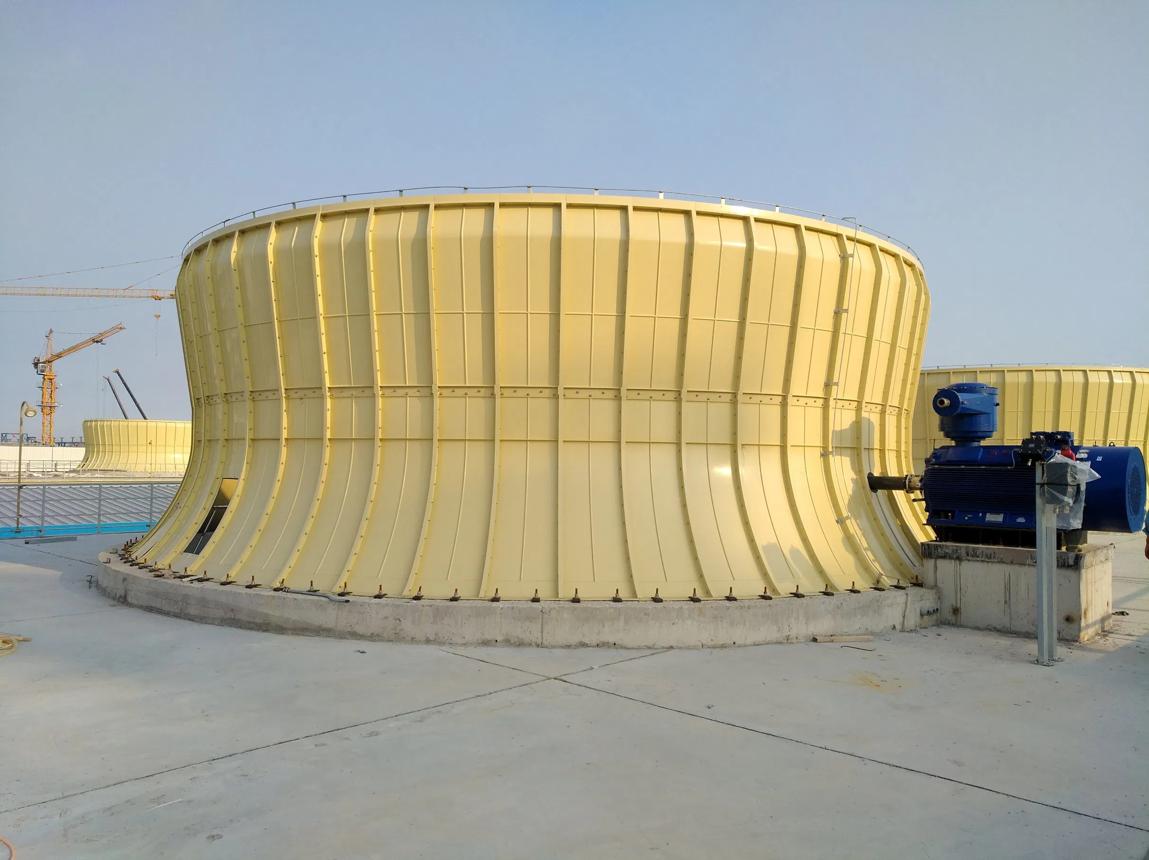
What Is a Fiberglass Cooling Tower Fan Stack?
A fiberglass cooling tower fan stack is a cylindrical or specially shaped FRP structure installed around the fan assembly of a mechanical draft cooling tower.
It is also known as a cooling tower fan cylinder, fiberglass fan shroud, or FRP fan stack.
Its primary purpose is to provide a defined airflow passage for the fan and direct discharged air away from the cooling tower structure.
Unlike traditional metal fan stacks, fiberglass fan stacks are manufactured using composite materials that combine reinforcing glass fibers with resin.
What Are the Main Functions of a Cooling Tower Fan Stack?
A fiberglass fan stack performs several important functions within a cooling tower system.
1. Directing Airflow
The fan stack creates a controlled passage around the fan blades. Its geometry helps guide discharged air upward and away from the cooling tower.
2. Supporting Fan Performance
A properly designed fan stack helps maintain suitable airflow conditions around the fan assembly.
Its internal diameter, height, and shape should be compatible with the fan's aerodynamic characteristics.
3. Protecting the Fan Area
The structure provides an enclosure around the fan section and helps limit exposure to certain external environmental influences.
4. Supporting Structural Integration
The fan stack connects with the upper cooling tower structure and must withstand relevant wind loads, vibration, and environmental exposure.
Why Is Fiberglass a Good Material for Cooling Tower Fan Stacks?
Material selection has a direct influence on the service life and maintenance requirements of a cooling tower fan stack.
Fiberglass Reinforced Plastic (FRP) combines glass fiber reinforcement with a polymer resin matrix. This composite structure provides a useful balance of strength, weight, corrosion resistance, and design flexibility.
1. Excellent Corrosion Resistance
Cooling towers operate in environments characterized by high humidity, water droplets, and continuous moisture exposure.
Conventional metal fan stacks may experience corrosion when protective coatings deteriorate.
Fiberglass does not rust like steel, making it suitable for many industrial environments.
Suitable for Corrosive Industrial Applications
FRP fan stacks can be considered for:
Chemical processing plants.
Petrochemical facilities.
Power generation stations.
Wastewater treatment plants.
Coastal industrial installations.
Large HVAC cooling systems.
The actual chemical resistance depends on the resin formulation and the chemicals present in the operating environment.
2. Lightweight Construction
One of the most important advantages of fiberglass is its relatively low density compared with many conventional structural metals.
A lightweight fan stack offers several practical benefits:
Easier transportation.
More convenient lifting and handling.
Reduced structural dead load.
Simplified installation.
Greater flexibility in sectional construction.
For large cooling tower projects, weight reduction can simplify logistics and installation planning.
3. High Strength-to-Weight Ratio
Although fiberglass is lightweight, properly engineered FRP structures can provide good mechanical strength.
Glass fiber reinforcement helps improve tensile strength and structural stiffness.
This is important because cooling tower fan stacks must withstand wind pressure, vibration, and other mechanical loads.
4. Weather and UV Resistance
Outdoor cooling tower components are continuously exposed to sunlight, rain, temperature fluctuations, and atmospheric pollutants.
Suitable FRP resin systems and protective surface treatments can improve weather resistance.
How Can UV Protection Improve Fan Stack Durability?
Ultraviolet exposure may gradually degrade the surface of some composite materials.
Manufacturers can improve outdoor durability through:
UV-resistant resin formulations.
Gelcoat surface protection.
Protective coatings.
Appropriate material thickness.
Regular surface inspections.
5. Low Maintenance Requirements
Fiberglass fan stacks do not require conventional rust removal and repainting to prevent metallic corrosion.
This can reduce certain maintenance activities and help control long-term maintenance costs.
However, periodic inspection remains necessary to identify cracks, delamination, loose connections, and surface deterioration.
How Does Aerodynamic Design Improve Fiberglass Cooling Tower Fan Stack Performance?
Aerodynamic design is one of the most important considerations when developing a high-performance cooling tower fan stack.
The fan stack is not simply a protective cylinder. Its geometry influences how air enters the fan, passes through the rotating blades, and exits the cooling tower.
A well-designed structure should provide a suitable airflow passage while minimizing unnecessary restrictions and flow disturbances.
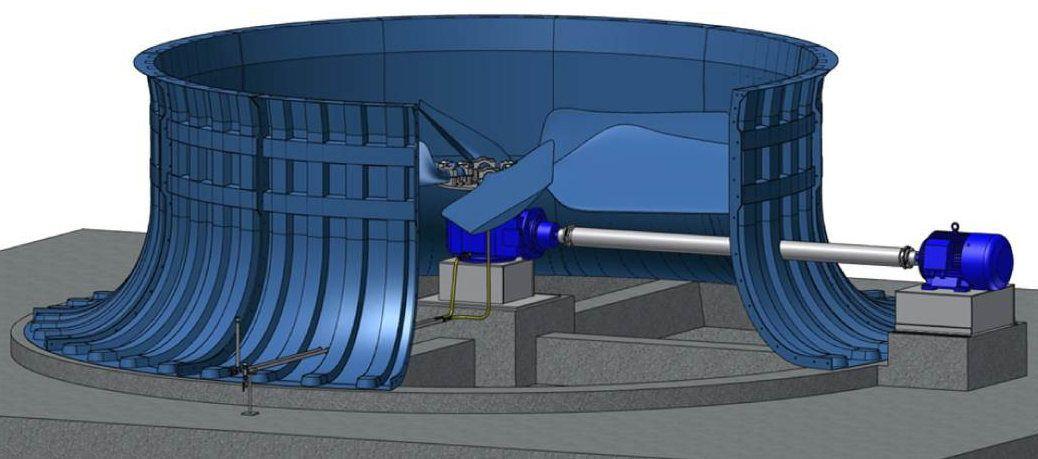
1. Optimized Fan Stack Diameter
The internal diameter of the fan stack must be compatible with the fan diameter and operating requirements.
An improperly selected diameter can affect airflow conditions and create unnecessary losses.
Why Is Diameter Important?
If the fan stack is too narrow, it may restrict airflow and increase interference with the fan assembly.
If it is excessively large, the structure may not provide the intended aerodynamic guidance.
Therefore, manufacturers should consider:
Fan blade diameter.
Fan hub dimensions.
Blade tip clearance.
Operating speed.
Required airflow volume.
Fan stack geometry.
The final dimensions should be determined through engineering calculations and equipment specifications.
2. Optimized Fan Stack Height
Fan stack height affects the discharge configuration of the cooling tower.
A properly designed stack can help guide the discharged air upward and reduce the influence of nearby structural obstructions.
Important Design Considerations
The optimal height depends on:
Cooling tower configuration.
Fan diameter.
Fan operating conditions.
Discharge velocity.
Wind exposure.
Nearby buildings and equipment.
A taller fan stack is not automatically more efficient. Its dimensions should be selected according to the complete cooling tower design.
3. Smooth Internal Surface
The internal surface of a fan stack can influence airflow resistance.
Fiberglass molding and finishing processes can produce a relatively smooth internal surface when properly controlled.
Benefits of a Uniform Internal Surface
Fewer unnecessary surface irregularities.
Consistent internal geometry.
Reduced local airflow disturbances.
Easier cleaning and inspection.
Surface smoothness should be considered together with the overall aerodynamic profile.
4. Proper Fan Blade Clearance
The clearance between the fan blade tips and the internal wall of the fan stack is a critical design parameter.
Insufficient clearance can create a risk of mechanical contact, while excessive clearance may affect the intended fan performance.
What Should Be Checked?
Correct clearance helps protect the fan assembly and maintain stable operation.
5. Aerodynamic Profile and Air Discharge
Some fan stack designs incorporate tapered, curved, or specially shaped sections.
These geometries may be used to manage airflow expansion and discharge characteristics.
How Does a Proper Profile Help?
A suitable profile can help:
Guide airflow in the intended direction.
Reduce unnecessary flow separation.
Improve discharge uniformity.
Support the fan's designed operating conditions.
The best geometry depends on the fan and cooling tower configuration rather than a universal shape.
What Are the Main Performance Benefits of Fiberglass Cooling Tower Fan Stacks?
A fiberglass cooling tower fan stack offers several advantages when its material, dimensions, and structure are correctly selected.
1. Improved Airflow Management
The fan stack provides a defined passage for discharged air.
Its aerodynamic geometry helps guide airflow and supports the intended operation of the fan system.
2. Reduced Structural Weight
Compared with many traditional metal structures, fiberglass fan stacks can be lighter.
This helps simplify handling and may reduce the dead load imposed on the supporting cooling tower structure.
3. Better Corrosion Resistance
FRP is particularly attractive for cooling towers operating in humid or corrosive environments.
Unlike conventional steel, fiberglass does not develop ordinary iron rust.
4. Lower Corrosion-Related Maintenance
The corrosion resistance of fiberglass can reduce the need for repeated rust removal and protective repainting.
This can be beneficial for cooling towers installed in remote or difficult-to-access industrial locations.
5. Flexible Customization
FRP manufacturing supports different dimensions, thicknesses, shapes, colors, and connection arrangements.
This allows manufacturers to develop fan stacks for various cooling tower brands and models.
6. Long-Term Structural Reliability
When properly designed, manufactured, installed, and maintained, fiberglass fan stacks can provide reliable service under demanding operating conditions.
Their actual service life depends on material formulation, structural loads, UV exposure, installation quality, and maintenance.
Fiberglass Fan Stack vs. Metal Cooling Tower Fan Stack
When selecting a replacement fan stack, buyers often compare fiberglass with galvanized steel and stainless steel.
Each material has specific characteristics.
Performance Comparison
Comparison Factor | Fiberglass FRP | Galvanized Steel | Stainless Steel |
Weight | Lightweight | Heavy | Heavy |
Corrosion resistance | Excellent with suitable resin | Depends on coating | Depends on grade |
Rust resistance | Does not rust | Can rust if coating fails | Generally good |
Design flexibility | High | Moderate | Moderate |
Maintenance | Relatively low | Coating maintenance may be required | Relatively low |
Customization | Flexible | Flexible | Flexible |
Installation | Convenient handling | Requires suitable lifting | Requires suitable lifting |
Which Material Is Better for Cooling Tower Applications?
Fiberglass is an attractive option when weight reduction, corrosion resistance, and customized manufacturing are important.
Galvanized steel may be suitable for projects where traditional metal construction is preferred.
Stainless steel can provide specific mechanical and corrosion-resistance properties, depending on the selected grade.
The final choice should consider operating conditions, structural requirements, project budget, and expected maintenance costs.
How Is a Fiberglass Cooling Tower Fan Stack Manufactured?
The manufacturing process plays an important role in determining the structural quality and dimensional accuracy of an FRP fan stack.
Different production methods may be used depending on the product design, dimensions, and required performance.
1. Raw Material Selection
The first step involves selecting suitable fiberglass reinforcement and resin materials.
Common resin options include:
The choice depends on chemical exposure, temperature, mechanical requirements, and environmental conditions.
2. Mold Preparation
Manufacturers prepare molds according to the required fan stack dimensions and shape.
The mold must provide suitable dimensional accuracy and surface quality.
3. Fiberglass Reinforcement and Resin Application
Glass fiber reinforcement is combined with the selected resin system.
Depending on the manufacturing method, this may involve hand lay-up, spray-up, vacuum-assisted processes, or other composite fabrication techniques.
Why Is Fiber Distribution Important?
Uneven reinforcement can result in inconsistent mechanical properties.
Proper material distribution helps improve structural consistency and reduce the risk of weak areas.
4. Curing and Finishing
After the material is formed, it undergoes curing under controlled conditions.
The finished sections are then trimmed, drilled, and processed according to the assembly requirements.
5. Quality Inspection
Before delivery, the manufacturer should perform appropriate inspections.
Important inspection items include:
Overall dimensions.
Wall thickness.
Surface appearance.
Resin curing quality.
Connection dimensions.
Structural integrity.
Assembly accuracy.
Custom Fiberglass Cooling Tower Fan Stack for Different Applications
Different cooling tower projects require different fan stack dimensions.
A custom fiberglass fan stack can be manufactured according to project drawings, existing equipment measurements, or customer specifications.
1. Custom Diameter
Fan stack diameter must match the cooling tower fan arrangement.
Manufacturers should confirm the fan blade diameter, internal clearance, and installation requirements before production.
2. Custom Height
Different cooling tower structures require different fan stack heights.
The height should be determined according to discharge requirements, fan configuration, and structural limitations.
3. Custom Wall Thickness
Wall thickness is related to structural stiffness and mechanical loading.
The manufacturer should evaluate wind loads, support arrangements, fan vibration, and overall stack dimensions.
4. Custom Shape and Design
Fiberglass manufacturing allows different shapes and connection arrangements.
Available designs may include:
5. Custom Color and Surface Finish
FRP fan stacks can be produced in different colors according to project requirements.
UV-resistant surface treatments can also be considered for outdoor applications.
What Factors Should You Consider When Selecting a Fiberglass Fan Stack?
Selecting the correct fan stack requires a comprehensive evaluation of the cooling tower structure and operating conditions.
1. Cooling Tower Fan Specifications
Before ordering, confirm the following information:
These details help manufacturers evaluate compatibility.
2. Operating Environment
The installation environment determines the material requirements.
Consider:
Ambient temperature.
Humidity.
Chemical exposure.
UV radiation.
Wind conditions.
Industrial pollution.
3. Structural Design Requirements
The fan stack should have sufficient strength and stiffness for the expected operating loads.
Important structural considerations include wind pressure, support spacing, connection strength, and vibration.
4. Installation Space
Available installation space may limit the fan stack diameter, height, and sectional arrangement.
Accurate measurements are especially important for replacement projects.
5. Manufacturing Quality
Choose a manufacturer with experience in FRP composite production and cooling tower component manufacturing.
Ask about material specifications, manufacturing methods, inspection procedures, and customization capabilities.
How to Install and Maintain a Fiberglass Cooling Tower Fan Stack?
Proper installation and maintenance help protect the fan stack and improve cooling tower reliability.
1. Check the Supporting Structure
Before installation, inspect the supporting beams, foundation, and mounting surfaces.
Ensure that the supporting structure is stable and suitable for the expected loads.
2. Verify Fan Stack Dimensions
Confirm the internal diameter, overall height, flange dimensions, and mounting positions.
For sectional fan stacks, check the alignment of each section before fastening.
3. Maintain Proper Blade Clearance
Check the distance between the fan blade tips and the fan stack wall.
The clearance must follow the fan manufacturer's specifications.
4. Inspect Fasteners and Connections
Ensure that all bolts and connections are installed correctly.
Improper fastening may cause vibration, misalignment, and structural damage.
5. Perform Regular Maintenance
A basic maintenance checklist includes:
Inspection Item | What to Check |
FRP surface | Cracks, scratches, and surface deterioration |
Fan stack structure | Deformation and damage |
Connections | Loose or missing fasteners |
Fan clearance | Blade-to-stack interference |
Supporting structure | Corrosion and looseness |
Operating vibration | Abnormal movement or noise |
Inspection intervals should be determined according to operating conditions and manufacturer recommendations.
How Does a Fiberglass Fan Stack Work with Other Cooling Tower Components?
The fan stack is part of a complete mechanical draft cooling tower system.
Its performance should be evaluated together with other important components.
1. Cooling Tower Fan Blades
The fan blades generate airflow through the cooling tower.
Their diameter, pitch angle, profile, and rotational speed must be compatible with the fan stack design.
2. Fan Hub Assembly
The fan hub connects the blades to the rotating shaft.
Its dimensions and installation position influence blade alignment and fan clearance.
3. Fan Motor and Gearbox
The motor provides the driving power, while the gearbox adjusts rotational speed when required.
The fan stack should accommodate the complete fan assembly without interfering with its operation.
4. Cooling Tower Fill Media
Fill media increases the contact area between water and air, supporting heat and mass transfer.
The fan stack helps guide discharged air, while the fill system contributes directly to the cooling process.
5. Drift Eliminators
Drift eliminators reduce the amount of water droplets carried out of the cooling tower with the exhaust air.
They work together with the airflow system to support water conservation and stable operation.
FAQ About Fiberglass Cooling Tower Fan Stacks
1. What Is a Fiberglass Cooling Tower Fan Stack?
A fiberglass cooling tower fan stack is an FRP structure installed around the fan assembly. It guides discharged air and provides a structural enclosure for the fan section.
2. What Are the Main Advantages of an FRP Fan Stack?
The main advantages include lightweight construction, corrosion resistance, flexible customization, weather resistance, and relatively low corrosion-related maintenance.
3. Does a Fiberglass Fan Stack Improve Cooling Tower Efficiency?
A properly designed fan stack can support the intended airflow conditions and reduce unnecessary airflow disturbances.
However, overall cooling tower efficiency also depends on fan performance, fill media, water distribution, heat transfer, and operating conditions.
4. Can Fiberglass Fan Stacks Be Customized?
Yes. Manufacturers can customize diameter, height, wall thickness, shape, color, and connection arrangements according to project requirements.
5. Is FRP Better Than Steel for Cooling Tower Fan Stacks?
FRP offers advantages in corrosion resistance and weight reduction. Steel may be suitable for projects requiring specific metallic structural characteristics.
The best material depends on environmental exposure, structural requirements, and budget.
6. How Long Can a Fiberglass Cooling Tower Fan Stack Last?
Its service life depends on material quality, resin formulation, UV exposure, mechanical loading, installation quality, and maintenance.
Regular inspection helps identify potential damage and extend reliable service.
7. Can an Existing Metal Fan Stack Be Replaced with an FRP Fan Stack?
Yes, in many cases. However, replacement requires checking the existing dimensions, supporting structure, fan clearance, connection points, and structural loads.
A manufacturer should review the project specifications before confirming compatibility.
8. What Information Is Needed for a Custom Fiberglass Fan Stack?
Buyers should provide:
Cooling tower brand and model.
Fan diameter.
Fan stack diameter.
Overall height.
Required wall thickness.
Mounting and flange dimensions.
Installation drawings or photographs.
Required quantity.
These details help manufacturers provide accurate technical recommendations and quotations.
Conclusion
A fiberglass cooling tower fan stack is a practical solution for industrial cooling systems that require lightweight construction, corrosion resistance, and flexible structural design.
Its performance depends not only on the quality of FRP materials but also on aerodynamic geometry, fan stack diameter, height, internal surface quality, and installation clearance.
A properly designed fiberglass fan shroud can help guide discharged airflow, support stable fan operation, and reduce corrosion-related maintenance requirements.
For cooling tower manufacturers, replacement contractors, and industrial buyers, choosing an experienced FRP fan stack manufacturer is essential. Professional material selection, accurate dimensional design, and reliable manufacturing processes can help ensure that the finished product meets the requirements of the cooling tower system.
Whether you need a standard fiberglass fan cylinder or a customized FRP cooling tower fan stack, investing in the right aerodynamic design and material solution can contribute to reliable operation and long-term cooling tower performance.


