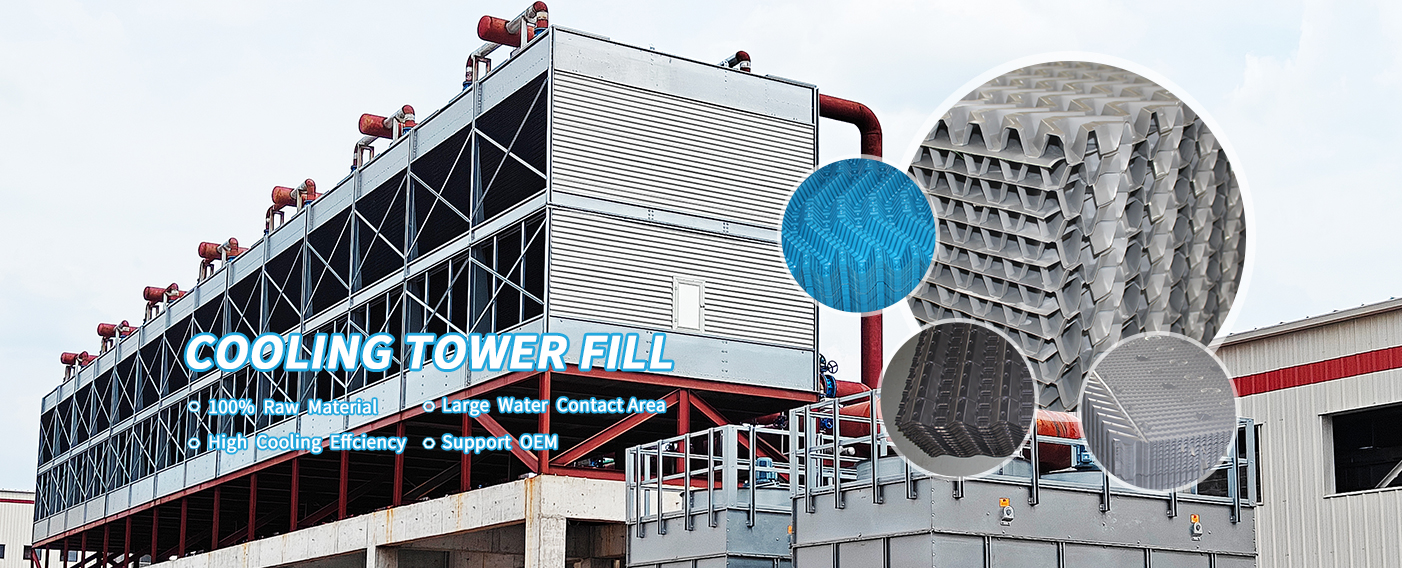
Cooling tower fill is a key component that improves the contact between circulating water and air, allowing a cooling tower to transfer heat more efficiently. Choosing the right fill for cooling tower applications can affect thermal performance, maintenance requirements, water quality tolerance, and the service life of the tower.
The three main categories are splash fill, film fill, and hybrid fill. Each uses a different approach to increase water-air contact.
This guide explains how these cooling tower fill types work, where they are used, and what industrial buyers should consider when selecting fill media.
What Is Fill for Cooling Tower?
Cooling tower fill, also called cooling tower fill media, is installed inside the tower between the water distribution system and the air outlet or inlet.
Its main purpose is to increase the effective contact area between hot water and moving air.
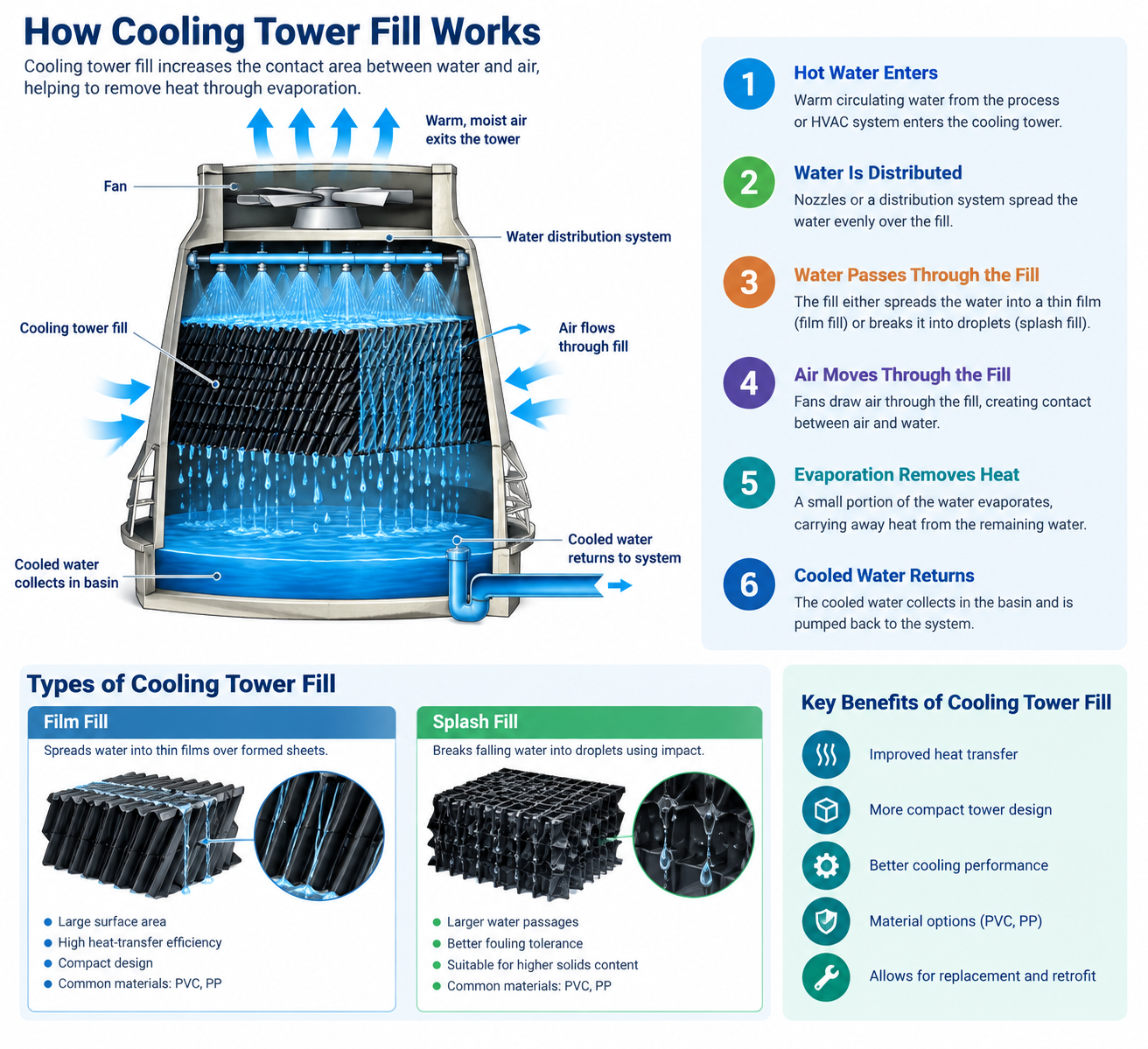
When warm circulating water enters the fill section, the fill either spreads the water into thin films, breaks it into smaller streams and droplets, or combines both mechanisms. Air passing through the fill absorbs heat and moisture, reducing the temperature of the circulating water.
Common cooling tower fill materials include:
The best option depends on tower design, water quality, operating temperature, and required cooling performance.
How Does Cooling Tower Fill Improve Heat Transfer?
The cooling process depends on effective heat and mass transfer between water and air.
Without fill, water would fall through the tower relatively quickly, limiting contact with air. Fill increases both the surface area and contact time.
A properly designed fill system can:
Increase water-air contact area
Spread water more evenly
Break water into smaller streams or droplets
Increase contact time
Promote turbulence and mixing
Support evaporative cooling
This is why fill is often considered one of the most important thermal components in an evaporative cooling tower.
Splash Fill for Cooling Towers
Splash fill works by repeatedly breaking falling water into smaller streams and droplets.
Instead of spreading water across continuous sheets, splash bars or grids interrupt the water flow. Water strikes the fill surfaces and splashes outward before contacting another surface farther down the fill section.
This repeated breakup increases the effective water-air contact area.
Advantages of Splash Fill
Splash fill is commonly selected for applications where water quality is a major concern.
Key benefits include:
Good resistance to fouling
Better tolerance of suspended solids
Open passages for water and air
Relatively easy inspection and cleaning
Suitable for many industrial applications
Available in PP and other materials
Because splash fill has more open passages than many film-fill designs, it can be a practical choice for cooling towers handling water with higher levels of suspended solids or biological contaminants.
Splash Fill Applications
Splash fill can be used in:
Industrial cooling towers
Wastewater cooling applications
Process cooling systems
Older cooling tower retrofits
Towers with challenging water quality
Applications where fouling resistance is important
The exact splash-fill configuration should be selected according to the tower's water loading, airflow, temperature, and support arrangement.
Film Fill for Cooling Towers
Film fill uses specially formed sheets to spread water into a thin film over a large surface area.
Corrugated or embossed PVC and PP sheets create passages through which water and air move. As water spreads across the surfaces, the available water-air contact area becomes much larger than with unrestricted falling water.
Film fill is widely used when high thermal performance and compact tower design are important.
Advantages of Film Fill
Common benefits include:
High effective surface area
Efficient heat and mass transfer
Compact fill arrangement
High thermal performance
Suitable for many HVAC and industrial towers
Available in different sheet designs and spacings
However, film fill generally requires appropriate water treatment and maintenance. Narrow passages can become blocked by scale, sediment, algae, or other contaminants.
PVC Film Fill vs. PP Film Fill
PVC cooling tower fill is widely used because it combines good thermal performance, chemical resistance, and cost efficiency.
PP cooling tower fill can provide better resistance to higher temperatures and certain chemical conditions. PP is also widely used for splash fill.
The correct material should be selected based on the actual operating conditions rather than material preference alone.
Hybrid Cooling Tower Fill
Hybrid fill combines characteristics of film and splash fill.
The exact design varies between manufacturers and applications, but the objective is generally to balance thermal performance with resistance to fouling.
A hybrid arrangement may use different fill structures within the same tower or a specially designed fill geometry that provides both film formation and water breakup.
Benefits of Hybrid Fill
Depending on the design, hybrid cooling tower fill can offer:
Improved water-air contact
Good thermal performance
Better tolerance of certain water-quality conditions
Flexible tower design
A balance between heat-transfer efficiency and maintainability
Hybrid fill can be useful when neither conventional film fill nor splash fill fully matches the application's requirements.
Splash vs. Film vs. Hybrid Fill
The following comparison provides a general overview:
| Feature | Splash Fill | Film Fill | Hybrid Fill |
| Main principle | Breaks water into droplets/streams | Spreads water into thin films | Combines film and splash characteristics |
| Heat-transfer area | High | Very high | High to very high |
| Fouling tolerance | Generally high | Generally lower | Depends on design |
| Water quality | Suitable for challenging water | Best with controlled water quality | Application dependent |
| Maintenance | Relatively accessible | Requires good cleaning and water treatment | Design dependent |
| Common material | PP | PVC, PP | PVC, PP or combinations |
| Typical use | Industrial/process cooling | HVAC and industrial towers | Specialized/retrofit applications |
These are general characteristics. Actual performance depends on fill geometry, water loading, airflow, temperature, and tower design.
How to Choose the Right Fill for Cooling Tower Applications
Selecting cooling tower fill should begin with the operating conditions rather than simply choosing the most thermally efficient product.
1. Check Water Quality
Water containing high levels of suspended solids, algae, or other contaminants may require a more open fill configuration.
Film fill is generally more sensitive to blockage, while splash fill can provide greater tolerance to fouling.
2. Consider Cooling Requirements
If the tower requires high heat-transfer performance in a relatively compact space, film fill may be considered.
For applications where maintenance and fouling resistance are higher priorities, splash fill may be more appropriate.
3. Check Operating Temperature
Fill material must withstand the actual circulating-water temperature.
PVC and PP have different temperature capabilities, so confirm the material specification before ordering.
4. Match Water Loading and Airflow
Fill must work with the tower's existing water and airflow conditions.
Changing fill geometry without checking water loading and pressure drop can affect tower performance.
5. Consider Maintenance
Think about how frequently the tower can be shut down for inspection and cleaning.
A fill that performs well under laboratory conditions may not be suitable if the actual water quality causes rapid fouling.
Cooling Tower Fill Replacement Considerations
When replacing existing fill, measure the current installation carefully.
Important information includes:
Cooling tower type
Crossflow or counterflow configuration
Fill dimensions
Fill height
Sheet thickness
Sheet spacing
Material
Water flow rate
Operating temperature
Existing support arrangement
Nozzle and distribution system
Current cooling performance
For retrofit projects, an OEM-compatible or aftermarket cooling tower fill replacement should match the tower's physical and thermal requirements.
Do not select replacement fill based only on the brand or overall dimensions. Fill geometry can significantly affect airflow, water distribution, pressure drop, and heat transfer.
Common Questions About Cooling Tower Fill
Is film fill better than splash fill?
Neither is universally better. Film fill can provide high heat-transfer performance, while splash fill is often better suited to applications with challenging water quality. The correct choice depends on the tower and operating conditions.
What is the most common material for cooling tower fill?
PVC and polypropylene are two widely used materials. PVC is common for film fill, while PP is widely used for both film and splash applications.
Can film fill be used with dirty water?
It can be used in some applications, but suspended solids, scale, and biological growth can block its passages. Proper filtration and water treatment are important.
What is hybrid cooling tower fill?
Hybrid fill combines film and splash characteristics to balance heat-transfer performance, water distribution, and fouling tolerance.
When should cooling tower fill be replaced?
Fill should be inspected and replaced when it becomes severely fouled, damaged, brittle, collapsed, or unable to provide the required thermal performance.
Conclusion
Choosing the right fill for cooling tower applications requires a balance between heat-transfer performance, water quality, maintenance, operating temperature, and tower configuration.
Splash fill is known for its open structure and fouling tolerance. Film fill provides a high effective surface area and is widely used where thermal efficiency is important. Hybrid fill aims to combine useful characteristics of both approaches.
For new installations and cooling tower fill replacement projects, evaluate the complete operating environment before selecting the fill type. Properly matched and maintained fill can help maintain cooling capacity, water distribution, and long-term tower performance.
Power Tower Cooling Technology (Shaoxing) Co.,Ltd supplies PVC film fill, PP film fill, splash fill, hybrid cooling tower fill, and replacement fill media for industrial and commercial cooling tower applications.
Internal Links for Other CoolingTowerParts
Cooling Tower reducer
Cooling Tower Nozzles
Cooling Tower Drift Eliminators
Cooling Tower Louvers
Cooling Tower Fan Blades
Cooling Tower Motors


