How Does Counterflow Cooling Tower Fill Improve Cooling Efficiency?
Counterflow cooling towers are widely used in industrial cooling, HVAC systems, power generation, process cooling, and other applications where efficient heat rejection is essential. One of the most important components inside a counterflow cooling tower is the counterflow cooling tower fill.
Although cooling tower fill may appear to be a simple plastic component, its design has a direct impact on heat transfer, water distribution, airflow resistance, evaporation, energy consumption, and overall tower performance. A properly selected cooling tower fill increases the contact area between hot water and air, allowing more heat to be transferred before the water reaches the cold-water basin.
So, how does counterflow cooling tower fill improve cooling efficiency? What materials and designs are commonly used? And how should industrial users select the right cooling tower filler?
This guide explains the working principles, benefits, selection factors, maintenance requirements, and applications of counterflow cooling tower fill.
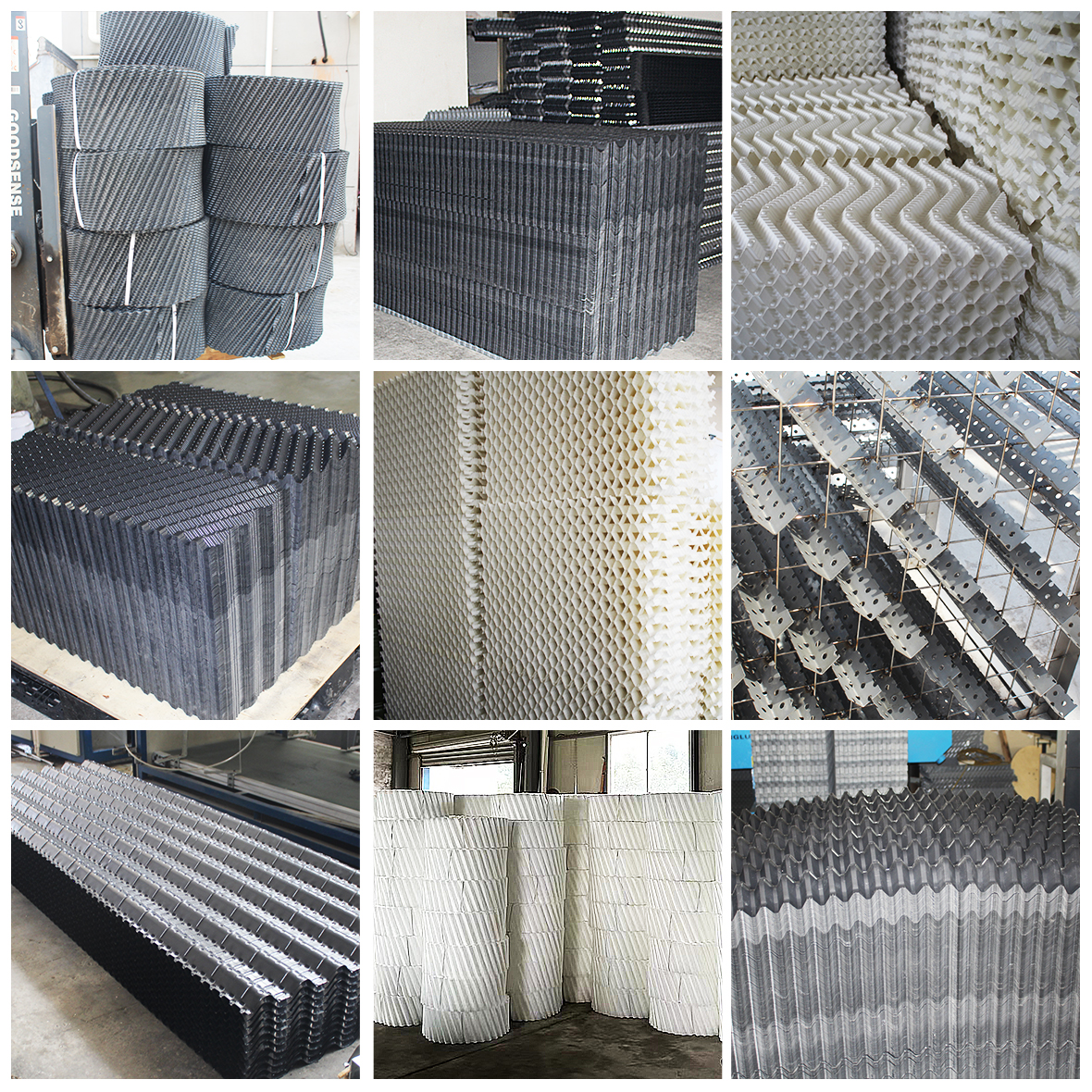
What Is Counterflow Cooling Tower Fill?
Counterflow cooling tower fill is a type of cooling tower fill media installed inside a counterflow cooling tower to increase the contact area between circulating water and air.
In a typical counterflow tower, hot process water flows downward while air moves upward. The two streams travel in opposite directions, creating a countercurrent heat-transfer process.
How Does Counterflow Cooling Tower Fill Work?
The cooling process can be simplified into several steps:
Hot water enters the upper section of the cooling tower.
The water distribution system spreads water across the fill surface.
Water flows downward through the cooling tower filler.
Air moves upward through the fill.
Heat and a portion of the water evaporate into the air.
Cooled water collects in the basin and returns to the system.
The fill media slows down the water and spreads it into thin films or droplets. This dramatically increases the contact area between water and air.
Why Is Contact Area Important?
Heat transfer becomes more effective when a larger water surface is exposed to moving air. Instead of allowing water to fall rapidly through the tower, the counterflow cooling tower fill creates an extended wet surface.
This provides more time and surface area for sensible and evaporative heat transfer.
Why Is Counterflow Cooling Tower Fill Important for Cooling Efficiency?
The performance of a counterflow cooling tower depends on several components, including the fan, motor, water distribution system, drift eliminator, and fill.
Among these components, the cooling tower fill plays a particularly important role in determining how effectively water and air interact.
Does Cooling Tower Fill Increase Heat Transfer Area?
Yes. One of the main functions of cooling tower fill is to increase the effective heat-transfer area.
A well-designed fill creates a large wetted surface within a relatively compact volume. This allows the tower to achieve greater cooling capacity without simply increasing its physical size.
Film Fill vs. Splash Fill
Two common fill technologies are film fill and splash fill.
Film fill uses closely spaced sheets with specially designed patterns. Water spreads across the sheets and forms thin films.
Splash fill uses bars or other structures that repeatedly break water into droplets as it falls.
Film fill generally provides a high specific surface area and is widely used where relatively clean water is available. Splash fill can be advantageous in applications where water contains suspended solids or where fouling resistance is important.
Does Counterflow Fill Increase Water-Air Contact Time?
Yes. The geometry of the fill slows the downward movement of water and distributes it across a larger surface.
As water travels downward, it repeatedly interacts with upward-moving air. The extended contact improves evaporative cooling and allows the tower to achieve a lower outlet-water temperature under suitable operating conditions.
How Does Fill Improve Evaporative Cooling?
Evaporative cooling is the primary cooling mechanism in many open cooling towers.
When warm water comes into contact with relatively dry air, a small amount of water evaporates. The energy required for evaporation is taken from the remaining water, reducing its temperature.
A properly designed cooling tower fill media promotes this process by maximizing the water-air interface.
How Does Counterflow Cooling Tower Fill Improve Thermal Performance?
The thermal performance of cooling tower fill depends on its ability to promote efficient interaction between air and water.
What Is the Role of Fill Geometry?
Fill geometry controls how water spreads, how air moves, and how long the two phases remain in contact.
Common design features include:
These features encourage water redistribution and create turbulence while maintaining an appropriate balance between heat transfer and airflow resistance.
Why Does Water Distribution Matter?
Even a high-quality cooling tower filler cannot perform properly if water distribution is poor.
Uneven distribution can create:
Dry areas
Overloaded wet areas
Reduced heat-transfer area
Localized scaling
Increased water temperature
Uneven airflow utilization
Uniform water distribution helps the entire fill pack operate effectively.
How Does Airflow Affect Fill Performance?
Airflow is equally important. The fill must allow sufficient air to pass through its channels without creating excessive pressure drop.
If the fill channels are too restrictive, the fan may require more energy to maintain the required airflow.
Therefore, an efficient counterflow cooling tower fill must balance:
Heat-transfer performance + water distribution + airflow resistance + fouling resistance
What Materials Are Used for Counterflow Cooling Tower Fill?
Different cooling tower applications require different fill materials.
Why Is PVC Commonly Used for Cooling Tower Fill?
PVC is one of the most widely used materials for cooling tower fill because it offers a combination of:
Good corrosion resistance
Low weight
Practical mechanical strength
Good processability
Competitive cost
Suitable heat-transfer characteristics
PVC cooling tower fill is commonly used in HVAC systems, industrial cooling systems, and general process applications.
When Is PP Cooling Tower Fill a Better Option?
Polypropylene, or PP, can provide improved temperature resistance compared with standard PVC in certain applications.
PP cooling tower fill may be considered when the operating temperature or chemical conditions exceed the practical range of conventional PVC fill.
PVC vs. PP Cooling Tower Fill
| Feature | PVC Fill | PP Fill |
| Material cost | Generally economical | Generally higher |
| Temperature resistance | Good for standard applications | Higher |
| Corrosion resistance | Good | Excellent |
| Weight | Lightweight | Lightweight |
| Typical applications | HVAC and industrial cooling | Higher-temperature applications |
The final choice should always be based on actual water temperature, chemistry, operating conditions, and tower design.
What Are the Main Benefits of Counterflow Cooling Tower Fill?
A properly selected counterflow cooling tower fill can provide several operational advantages.
1. Higher Heat Transfer Efficiency
The fill increases the effective surface area available for heat and mass transfer.
2. Compact Cooling Tower Design
A high-performance fill can provide substantial heat-transfer area within a relatively small volume, helping reduce the required tower footprint for a specific cooling duty.
3. Better Water-Air Interaction
The fill distributes water into thin films or repeated droplets, improving interaction with upward-moving air.
4. Improved Cooling Capacity
When the fill, airflow, water flow, and distribution system are properly matched, the tower can remove more heat from circulating water.
5. Potential Energy Savings
Efficient fill design can contribute to lower fan requirements and improved thermal performance. However, actual energy savings depend on the entire cooling tower system rather than the fill alone.
How Does Fill Design Affect Cooling Tower Pressure Drop?
Pressure drop is an important consideration when selecting cooling tower fill.
What Happens If Pressure Drop Is Too High?
Excessive pressure drop can increase fan power requirements. In mechanical-draft cooling towers, this may increase operating costs and reduce the efficiency of the complete system.
Therefore, selecting fill solely according to maximum surface area is not always appropriate.
Is More Surface Area Always Better?
Not necessarily.
A fill with extremely dense channels may provide a high theoretical surface area but could also:
Increase airflow resistance
Collect debris more easily
Increase fouling risk
Require more fan energy
Reduce airflow under dirty conditions
The best cooling tower filler is one that provides an appropriate balance between heat-transfer performance and hydraulic/airflow characteristics.
What Factors Should You Consider When Selecting Counterflow Cooling Tower Fill?
Choosing the right cooling tower fill requires more than comparing dimensions and prices.
What Operating Temperature Should Be Considered?
The water temperature entering the fill is one of the most important parameters.
Higher-temperature applications may require materials with improved thermal stability.
How Clean Is the Circulating Water?
Water quality strongly affects fill selection.
For relatively clean water, high-efficiency film fill can be suitable.
For water containing solids, biological matter, or other contaminants, a more open fill design may be preferable.
How Does Water Chemistry Affect Fill Selection?
pH, dissolved minerals, suspended solids, oil contamination, and chemical additives can affect fill service life.
A material that performs well in one water system may have a shorter service life in another.
What Is the Required Cooling Capacity?
The required heat rejection determines the amount and type of fill needed.
Important design parameters include:
Water flow rate
Entering water temperature
Leaving water temperature
Ambient wet-bulb temperature
Airflow rate
Tower dimensions
Required approach temperature
These parameters should be evaluated together rather than selecting fill based only on tower size.
How Should Counterflow Cooling Tower Fill Be Maintained?
Even high-quality cooling tower fill requires proper maintenance.
Why Does Fill Cleaning Matter?
Dust, algae, scale, sludge, biological growth, and other contaminants can accumulate on the fill surface.
This can restrict water flow and airflow while reducing the effective heat-transfer area.
What Are the Signs of Dirty Cooling Tower Fill?
Common warning signs include:
Increasing outlet-water temperature
Reduced cooling capacity
Higher fan power
Uneven water distribution
Increased pressure drop
Visible scale or biological growth
Blocked fill channels
How Can Cooling Tower Fill Be Cleaned?
The cleaning method depends on the type and condition of contamination.
Routine maintenance may include:
Visual inspection
Removal of large debris
Controlled water cleaning
Scale treatment when necessary
Biological control
Inspection of damaged fill sections
Verification of water distribution
Aggressive cleaning methods should be avoided if they can deform or damage the fill sheets.
When Should Cooling Tower Fill Be Replaced?
Cleaning can restore performance when the fill is contaminated but structurally sound. Replacement may be necessary when the fill has suffered severe deterioration.
What Are Common Reasons for Fill Replacement?
Cooling tower fill may need replacement because of:
Can New Fill Improve an Older Cooling Tower?
In some cases, replacing outdated or severely damaged fill can improve water distribution and heat-transfer performance.
However, the replacement fill should be compatible with the existing tower dimensions, support system, water distribution system, airflow design, and operating conditions.
What Is the Difference Between Counterflow and Crossflow Cooling Tower Fill?
Counterflow and crossflow towers use different air and water flow arrangements.
How Does Counterflow Fill Differ From Crossflow Fill?
In a counterflow cooling tower:
In a crossflow tower:
The fill geometry and distribution requirements are therefore different.
Which Fill Should Be Used?
There is no universal fill design suitable for every cooling tower. The appropriate choice depends on the tower configuration, water quality, thermal duty, airflow requirements, and maintenance conditions.
How Can Manufacturers Improve Counterflow Cooling Tower Fill Performance?
Cooling tower filler manufacturers continuously optimize fill designs to improve thermal performance and operational reliability.
Can Fill Geometry Be Customized?
Yes. Depending on the application, manufacturers may offer different sheet thicknesses, flute patterns, heights, widths, and assembly configurations.
Customization can help match the fill to:
Why Is Fill Thickness Important?
Fill thickness affects mechanical strength, weight, handling, and service life.
A thicker sheet may provide additional structural durability, while a thinner sheet can reduce material consumption and weight.
The correct thickness should be selected according to the application rather than simply choosing the thickest available material.
How Can You Optimize Counterflow Cooling Tower Fill Performance?
Selecting high-quality fill is only one part of achieving efficient cooling.
Can Water Distribution Be Improved?
Yes. The distribution system should deliver water uniformly across the fill surface.
Improving nozzle layout, spray coverage, and operating pressure can help eliminate dry zones and excessive local water loading.
Can Airflow Be Optimized?
Fan selection, fan speed, air inlet conditions, drift eliminator condition, and fill pressure drop all affect airflow.
A properly balanced system can achieve the required cooling performance without unnecessarily increasing fan power.
How Important Is Water Treatment?
Water treatment is critical because poor water quality can reduce fill performance over time.
A suitable water treatment program can help control:
Scale
Corrosion
Algae
Bacteria
Suspended solids
Clean fill generally provides better airflow and heat-transfer conditions than heavily fouled fill.
Why Choose a Professional Cooling Tower Filler Manufacturer?
The quality of the fill can influence both initial cooling performance and long-term operating reliability.
What Should You Check When Choosing a Supplier?
Consider the supplier's:
Why Is Application Matching Important?
A professional manufacturer should be able to evaluate operating conditions instead of simply recommending a standard product.
The right counterflow cooling tower fill should be matched to the actual thermal and hydraulic requirements of the cooling tower.
Frequently Asked Questions About Counterflow Cooling Tower Fill
What Is Counterflow Cooling Tower Fill Used For?
Counterflow cooling tower fill increases water-air contact area and promotes heat and mass transfer, helping the tower cool circulating water more effectively.
Is PVC Suitable for Counterflow Cooling Tower Fill?
PVC is widely used for standard cooling tower applications because of its corrosion resistance, lightweight construction, and practical cost. The correct material depends on operating temperature and water chemistry.
How Long Does Cooling Tower Fill Last?
Service life varies significantly depending on water quality, temperature, chemical exposure, UV exposure, mechanical conditions, and maintenance. Regular inspection is essential for determining actual replacement needs.
Can Counterflow Fill Be Used With Dirty Water?
Some fill designs are more tolerant of suspended solids and fouling than others. For dirty or contaminated water, an open splash-fill design may be more appropriate than tightly spaced film fill.
Does Cooling Tower Fill Reduce Energy Consumption?
Efficient fill can contribute to lower system energy consumption by improving heat transfer and allowing the cooling tower to meet its thermal duty effectively. Actual energy consumption also depends on fan efficiency, pump operation, water flow, ambient conditions, and system control.
What Is the Best Cooling Tower Fill?
There is no single best fill for every application. The appropriate cooling tower fill media should match the tower design, water quality, thermal load, operating temperature, airflow, and maintenance requirements.
Conclusion: Why Does Counterflow Cooling Tower Fill Improve Cooling Efficiency?
Counterflow cooling tower fill improves cooling efficiency by maximizing the contact between hot circulating water and upward-moving air. Its surface structure distributes water, increases the effective heat-transfer area, extends water-air contact time, and supports evaporative cooling.
However, fill performance depends on more than surface area. Material, geometry, water distribution, airflow resistance, water quality, operating temperature, and maintenance all influence the final result.
For industrial cooling towers, selecting the right cooling tower filler and maintaining it properly can help support stable cooling performance, reliable operation, and long-term equipment efficiency.
When selecting or replacing counterflow cooling tower fill, always evaluate the complete cooling system rather than treating the fill as an isolated component.


