Professional Industrial Cooling Tower Fan Replacement Solutions
Industrial cooling towers operate continuously in demanding environments where reliable airflow is essential for maintaining efficient heat transfer. Over time, cooling tower fans may experience blade damage, corrosion, vibration, mechanical wear, or declining performance. When these problems become serious, replacing the fan or its critical components can be more economical than continuing repeated repairs.
Professional industrial cooling tower fan replacement solutions help restore airflow performance, improve equipment reliability, and reduce unexpected maintenance costs. Whether replacing an entire fan assembly or upgrading individual cooling tower fan blades, selecting compatible components is essential for achieving stable operation.
For power plants, chemical processing facilities, HVAC systems, manufacturing plants, and other industrial applications, a properly planned replacement project can extend cooling tower service life and support long-term operational efficiency.
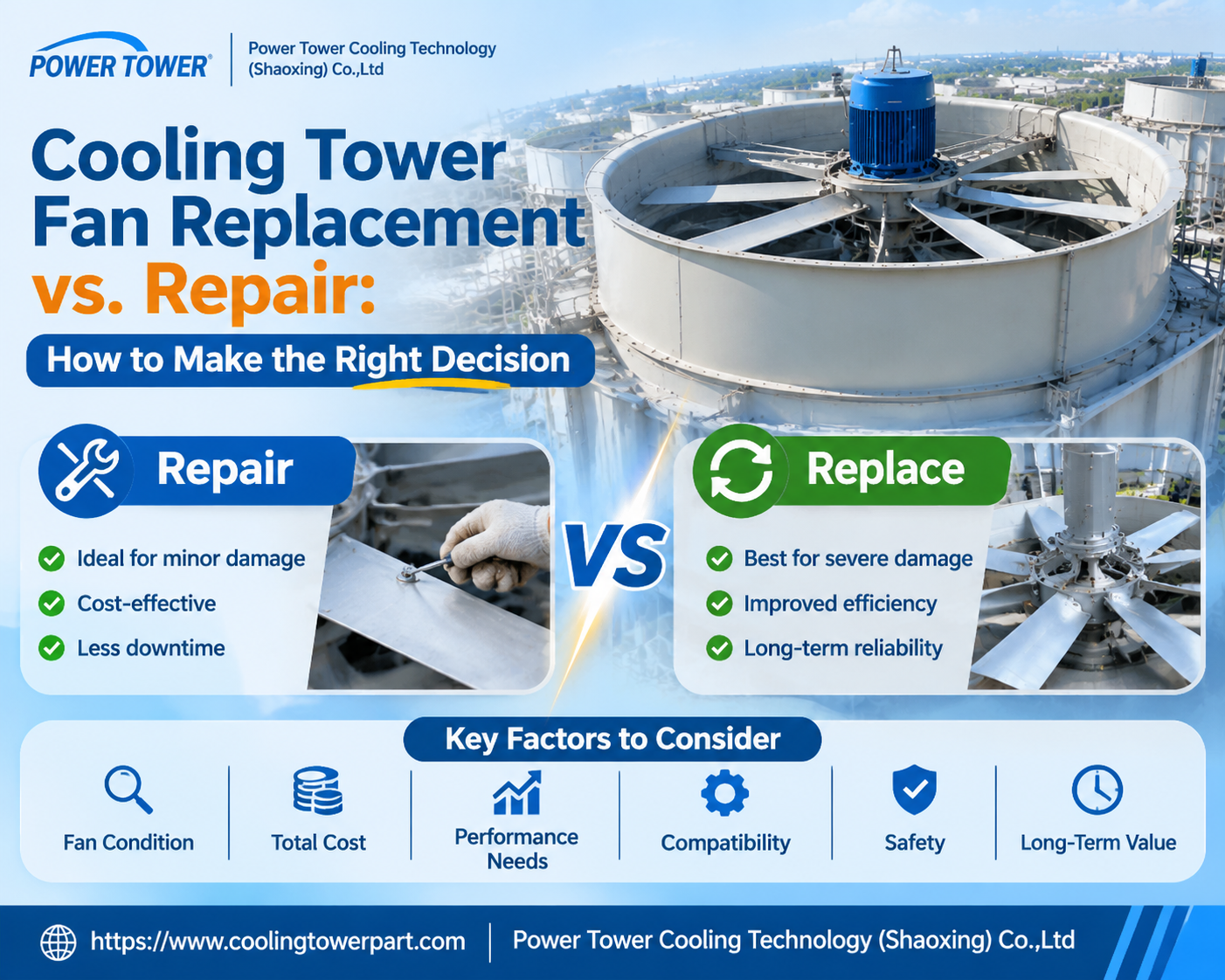
Why Is Industrial Cooling Tower Fan Replacement Necessary?
The cooling tower fan is responsible for moving air through the tower and supporting the evaporation and heat rejection process. When the fan cannot operate efficiently, the entire cooling system may be affected.
1. Restore Airflow Performance
A damaged or poorly performing fan may not deliver the airflow required by the cooling tower.
Common Airflow Problems
Replacing worn or unsuitable components can help restore the fan's intended operating conditions.
2. Reduce Mechanical Vibration and Noise
Long-term operation can cause fan blades, hubs, bearings, and other rotating components to deteriorate.
How Fan Replacement Helps
Replacing damaged or unbalanced components can reduce mechanical stress and improve operating stability. However, vibration should be properly diagnosed before replacement because problems may also originate from the gearbox, motor, shaft, bearings, or support structure.
3. Prevent Unexpected Equipment Shutdowns
An industrial cooling tower fan failure can interrupt cooling operations and affect production schedules.
Common Failure Risks
A planned replacement program helps reduce the likelihood of unexpected failures.
4. Improve Long-Term Maintenance Efficiency
Repeated repairs may become expensive when the fan assembly has reached the end of its useful service life.
A replacement solution can reduce recurring maintenance requirements, particularly when several major components have deteriorated simultaneously.
When Should You Replace an Industrial Cooling Tower Fan?
Not every fan problem requires complete replacement. Some conditions can be corrected through maintenance, component repair, or balancing. However, certain warning signs indicate that replacement should be considered.
Visible Damage to Cooling Tower Fan Blades
Fan blades are continuously exposed to moisture, airflow forces, environmental contaminants, and mechanical stress.
Common Blade Damage
Cracks near the blade root
Surface erosion
Corrosion or material deterioration
Permanent deformation
Damaged mounting connections
Delamination in FRP blades
When structural damage affects blade strength or operating safety, replacement may be necessary.
Persistent Vibration During Operation
Excessive vibration may indicate imbalance, misalignment, mechanical looseness, or damaged components.
Warning Signs
Increasing vibration levels
Repeated bearing failures
Loose mounting bolts
Unusual gearbox noise
Movement of supporting structures
If vibration continues after appropriate maintenance and balancing, technicians should evaluate whether the fan assembly requires replacement.
Reduced Cooling Tower Performance
A fan that cannot maintain its designed airflow may contribute to higher cooling water temperatures.
Possible causes include:
A complete system inspection is necessary before deciding which components should be replaced.
Rising Maintenance and Operating Costs
When a fan requires frequent repairs, replacement may provide better long-term value.
Factors to Evaluate
The decision should consider the total cost of ownership rather than the initial purchase price alone.
Main Components Involved in Cooling Tower Fan Replacement
A cooling tower fan is a complete rotating system. Successful replacement requires attention to the compatibility of its major components.
Cooling Tower Fan Blades
The fan blades generate airflow and directly influence the fan's aerodynamic performance.
Important Replacement Specifications
Replacement cooling tower fan blades should match the fan design and operating requirements.
FRP Cooling Tower Fan Blades
FRP (Fiber Reinforced Plastic) blades are commonly used in industrial cooling towers because they combine lightweight construction with corrosion resistance.
Key advantages include:
Relatively low weight
Good corrosion resistance
Flexible aerodynamic design
Customizable dimensions
Suitability for humid environments
Reduced rotating mass compared with some heavier alternatives
The actual performance depends on fiber reinforcement, resin selection, manufacturing quality, and structural design.
Cooling Tower Fan Hub Assembly
The fan hub connects individual blades and transfers rotational force from the drive system to the fan assembly.
Important Hub Replacement Considerations
An incompatible hub can create installation problems and affect mechanical reliability.
Cooling Tower Fan Motor
The motor supplies the power required to rotate the fan.
Motor Specifications to Check
Rated power
Voltage
Frequency
Rotational speed
Protection rating
Insulation class
Mounting configuration
Operating environment
A replacement motor must be compatible with the existing electrical system and mechanical drive arrangement.
Cooling Tower Fan Gearbox
Gearboxes are used in many industrial cooling towers to transmit power and adjust fan rotational speed.
Gearbox Replacement Factors
Power rating
Input speed
Output speed
Gear ratio
Shaft dimensions
Mounting configuration
Lubrication requirements
A gearbox should be selected according to the fan's operating requirements and the cooling tower manufacturer's specifications.
Fan Shaft and Supporting Structure
The shaft transfers rotational force through the drive system, while the supporting structure maintains the alignment and position of the fan assembly.
Inspection Requirements
Replacing the fan without inspecting related mechanical components may leave the original problem unresolved.
How to Choose the Right Industrial Cooling Tower Fan Replacement
Selecting a replacement fan requires more than matching the outside diameter. Buyers and maintenance engineers should evaluate the complete operating system.
Step 1: Identify the Existing Fan Specifications
Begin by collecting technical information about the original cooling tower fan.
Essential Information
Accurate information helps suppliers recommend compatible replacement products.
Step 2: Evaluate the Operating Environment
Industrial cooling towers may operate under different environmental conditions.
Environmental Factors
High humidity
Chemical exposure
Salt-containing air
High operating temperatures
Dust and airborne particles
Continuous operating schedules
Material selection should reflect the actual environment rather than relying only on general product descriptions.
Step 3: Select Suitable Fan Blade Materials
Different materials offer different mechanical and environmental properties.
FRP Fan Blades
FRP blades are suitable for many industrial applications where corrosion resistance and lightweight construction are important.
Aluminum Fan Blades
Aluminum blades can offer a favorable strength-to-weight ratio and are used in various cooling tower designs.
Steel Fan Blades
Steel blades may be suitable for certain heavy-duty applications, depending on the corrosion protection system and structural requirements.
Material | Main Characteristics | Important Considerations |
FRP | Lightweight and corrosion-resistant | Resin and laminate quality |
Aluminum | Relatively lightweight and rigid | Alloy and corrosion protection |
Steel | High structural strength | Weight and corrosion control |
The best material depends on the fan design, operating environment, and project requirements.
Step 4: Confirm Aerodynamic Compatibility
A replacement fan should provide suitable airflow characteristics for the cooling tower.
Important Aerodynamic Factors
Changing blade dimensions or pitch without engineering evaluation may affect airflow and motor loading.
Step 5: Check Installation Compatibility
Before purchasing, verify that the replacement assembly matches the existing mounting structure.
Important dimensions include blade root connections, hub interfaces, shaft dimensions, flange arrangements, and mounting-hole positions.
Complete Cooling Tower Fan Replacement Process
A professional replacement project should follow a structured procedure to ensure safe installation and reliable operation.
1. Initial Equipment Inspection
Before removing the existing fan, technicians should inspect the complete system.
Inspection Checklist
The inspection helps determine whether the project requires complete fan replacement or only selected component upgrades.
2. Prepare the Replacement Components
Confirm that all replacement components match the approved technical specifications.
Preparation Requirements
Verify product dimensions.
Check material specifications.
Inspect blade surfaces.
Confirm hub compatibility.
Check fastener specifications.
Review installation drawings.
Prepare suitable lifting equipment.
3. Remove the Existing Fan Assembly
Before disassembly, the cooling tower must be shut down and isolated.
Important Safety Procedures
Follow lockout/tagout requirements.
Disconnect electrical power.
Confirm the fan has completely stopped.
Use approved lifting equipment.
Protect nearby components.
Follow site-specific working-at-height procedures.
Large industrial fans should only be removed by qualified personnel using appropriate equipment.
4. Install the Replacement Fan Components
The new fan assembly should be installed according to the manufacturer's instructions.
Installation Considerations
Confirm hub positioning.
Check blade installation direction.
Maintain equal blade spacing.
Set the specified blade pitch.
Tighten fasteners to approved torque values.
Verify fan clearance.
Check shaft and drive alignment.
Incorrect installation can create vibration, mechanical interference, or uneven airflow.
5. Perform Fan Balancing and Alignment Checks
After installation, the rotating assembly should be checked for balance and mechanical alignment.
Why Balancing Matters
Uneven mass distribution can produce centrifugal forces during rotation. These forces may cause excessive vibration and accelerate wear in bearings, gearboxes, and supporting structures.
Balancing should be carried out using appropriate equipment and procedures.
6. Conduct Trial Operation
Before returning the cooling tower to normal operation, perform controlled commissioning checks.
Performance Checks
Fan rotation direction
Operating speed
Motor current
Abnormal noise
Vibration levels
Bearing temperature
Gearbox condition
Airflow behavior
Any abnormal condition should be investigated before the system enters continuous operation.
Common Mistakes During Cooling Tower Fan Replacement
Incorrect component selection and installation can reduce the benefits of a replacement project.
Choosing a Fan Based Only on Diameter
Two fans with the same diameter may have different blade profiles, pitch angles, hub configurations, and airflow characteristics.
Better approach: Compare complete technical specifications rather than relying on diameter alone.
Ignoring Blade Weight Differences
Uneven blade weight can cause imbalance and vibration.
Better approach: Confirm blade weight consistency and follow the specified balancing procedure.
Using the Wrong Blade Pitch Angle
Incorrect pitch settings may change airflow performance and increase motor loading.
Better approach: Follow the original design specifications or obtain an engineering recommendation before changing the pitch.
Replacing the Fan Without Checking the Gearbox
A damaged or incorrectly selected gearbox may prevent the new fan from operating correctly.
Better approach: Inspect the drive system during the replacement project.
Skipping Commissioning Tests
A fan that has been installed successfully may still have problems with vibration, alignment, electrical loading, or airflow.
Better approach: Complete all required commissioning checks before returning the equipment to normal operation.
Benefits of Professional Industrial Cooling Tower Fan Replacement Solutions
A well-planned replacement project can provide several long-term benefits.
Improved Operating Reliability
New components that match the cooling tower specifications can help restore stable fan operation.
Reduced Noise and Vibration
Replacing damaged blades, correcting installation errors, and balancing the rotating assembly can reduce unnecessary vibration and associated noise.
Better Airflow Control
Appropriate blade geometry, pitch settings, and fan stack compatibility help maintain the intended airflow conditions.
Lower Maintenance Requirements
Replacing severely worn components can reduce repeated repair work and improve maintenance planning.
Extended Cooling Tower Service Life
Upgrading critical fan components can help maintain the overall cooling tower system, provided the remaining structure and mechanical equipment are also in suitable condition.
How to Maintain a Replacement Cooling Tower Fan
Regular maintenance is necessary to protect the investment in new fan components.
Inspect Cooling Tower Fan Blades Regularly
Check blades for cracks, deformation, surface damage, and unusual deposits.
Blade Maintenance Recommendations
Clean accumulated dirt when necessary.
Check blade mounting bolts.
Inspect blade roots and connections.
Verify pitch consistency.
Look for signs of corrosion or delamination.
Replace structurally damaged blades.
Monitor Vibration and Noise
Vibration measurements provide useful information about the mechanical condition of the fan system.
Record measurements under consistent operating conditions and investigate significant changes.
Maintain the Gearbox and Motor
Check lubrication, operating temperature, electrical conditions, and abnormal noise according to the manufacturer's maintenance instructions.
Keep Installation Records
Maintain records of replacement parts, blade specifications, balancing results, inspection dates, and maintenance activities.
These records make future troubleshooting and component procurement easier.
How to Select a Reliable Cooling Tower Fan Replacement Supplier
Choosing a suitable supplier is important for industrial buyers who need compatible components and dependable technical communication.
Evaluate Product Range
A supplier offering different cooling tower fan components can help buyers coordinate replacement requirements.
Related products may include:
Check Customization Capabilities
Some cooling tower models require non-standard replacement dimensions or mounting configurations.
Information to Provide to Suppliers
Existing fan photographs
Product drawings
Fan diameter
Blade quantity
Blade dimensions
Hub specifications
Motor power
Operating speed
Application environment
Providing accurate information helps reduce specification errors.
Review Quality Control Procedures
Before purchasing, buyers should ask about material inspection, dimensional inspection, product testing, and manufacturing quality controls.
Consider Export and Delivery Requirements
For international procurement, packaging, shipping dimensions, documentation, and delivery schedules are also important.
A clear technical quotation should identify the product specifications, supplied components, packaging arrangements, and commercial terms.
Industrial Cooling Tower Fan Replacement Solutions from Power Tower Cooling Technology (Shaoxing) Co.,Ltd
Power Tower Cooling Technology (Shaoxing) Co.,Ltd focuses on cooling tower products and component solutions for industrial applications.
For cooling tower fan replacement projects, selecting compatible components is important for restoring airflow performance and maintaining mechanical stability.
Cooling Tower Fan Blade Replacement
When replacing cooling tower fan blades, buyers should confirm the following specifications:
FRP fan blades can be considered for applications where lightweight construction and corrosion resistance are important.
Fan Hub and Drive Component Compatibility
Fan blades should work correctly with the hub, gearbox, motor, and shaft assembly.
A replacement project should evaluate these components together to avoid compatibility problems.
Customized Replacement Requirements
For industrial cooling tower replacement projects, buyers can prepare existing equipment drawings, product photographs, and technical specifications to support product evaluation.
Accurate project information helps determine suitable replacement dimensions and component configurations.
Frequently Asked Questions About Industrial Cooling Tower Fan Replacement
How Do I Know When a Cooling Tower Fan Needs Replacement?
Common warning signs include cracked blades, severe corrosion, persistent vibration, abnormal noise, reduced airflow, and repeated mechanical failures. A professional inspection can determine whether repair or complete replacement is more appropriate.
Can I Replace Only the Cooling Tower Fan Blades?
Yes. Individual cooling tower fan blades can sometimes be replaced without changing the complete fan assembly. However, replacement blades must match the original design, dimensions, weight requirements, pitch settings, and hub connections.
Should I Replace the Fan Hub When Replacing Fan Blades?
Not necessarily. If the existing hub is structurally sound and compatible with the replacement blades, it may remain in service. However, damaged, corroded, or incompatible hubs should be evaluated for replacement.
Are FRP Cooling Tower Fan Blades Suitable for Industrial Applications?
Yes. FRP blades are used in many industrial cooling towers because of their lightweight construction, corrosion resistance, and design flexibility. Their suitability depends on material quality, structural design, operating speed, and environmental conditions.
Does Replacing a Cooling Tower Fan Reduce Energy Consumption?
It may help reduce energy consumption when the existing fan is damaged, inefficient, or incorrectly matched to the cooling system. However, actual energy savings depend on fan selection, operating conditions, motor efficiency, airflow requirements, and system design.
How Long Does a Cooling Tower Fan Replacement Project Take?
The duration depends on fan size, equipment accessibility, replacement scope, lifting requirements, and installation complexity. Replacing individual blades generally involves a different workload from replacing a complete fan assembly.
What Information Is Needed to Order a Replacement Cooling Tower Fan?
Buyers should provide the cooling tower model, fan diameter, blade quantity, blade dimensions, motor power, rotational speed, hub configuration, and relevant drawings or photographs.
Conclusion
Professional Industrial Cooling Tower Fan Replacement Solutions are essential for maintaining reliable airflow, reducing mechanical problems, and supporting long-term cooling tower performance.
A successful replacement project requires careful evaluation of the fan blades, hub assembly, motor, gearbox, shaft, and supporting structure. Selecting compatible cooling tower fan blades and following proper installation, balancing, and commissioning procedures can help reduce vibration, improve operating stability, and minimize maintenance risks.
For industrial facilities planning a cooling tower fan upgrade or replacement, accurate technical specifications and reliable component selection are the foundation of a successful project.


