Introduction to Industrial Cooling Tower Fan Balancing
Industrial cooling towers play an essential role in maintaining stable operating temperatures in power plants, manufacturing facilities, HVAC systems, chemical processing plants, and other industrial applications. The cooling tower fan is one of the most important components because it moves large volumes of air through the tower to support heat rejection.
However, when a cooling tower fan becomes unbalanced, it can generate excessive vibration, abnormal noise, and mechanical stress. These problems may affect operating efficiency, increase maintenance costs, and shorten the service life of critical equipment.
Industrial Cooling Tower Fan Balancing is an important maintenance process that helps distribute rotating mass evenly around the fan assembly. Proper balancing reduces vibration, minimizes noise, protects mechanical components, and supports reliable cooling tower operation.
The condition of the cooling tower fan blades is particularly important. Differences in blade weight, pitch angle, installation position, or accumulated deposits can create uneven loading during rotation. Therefore, fan balancing should be considered an essential part of cooling tower inspection and preventive maintenance.
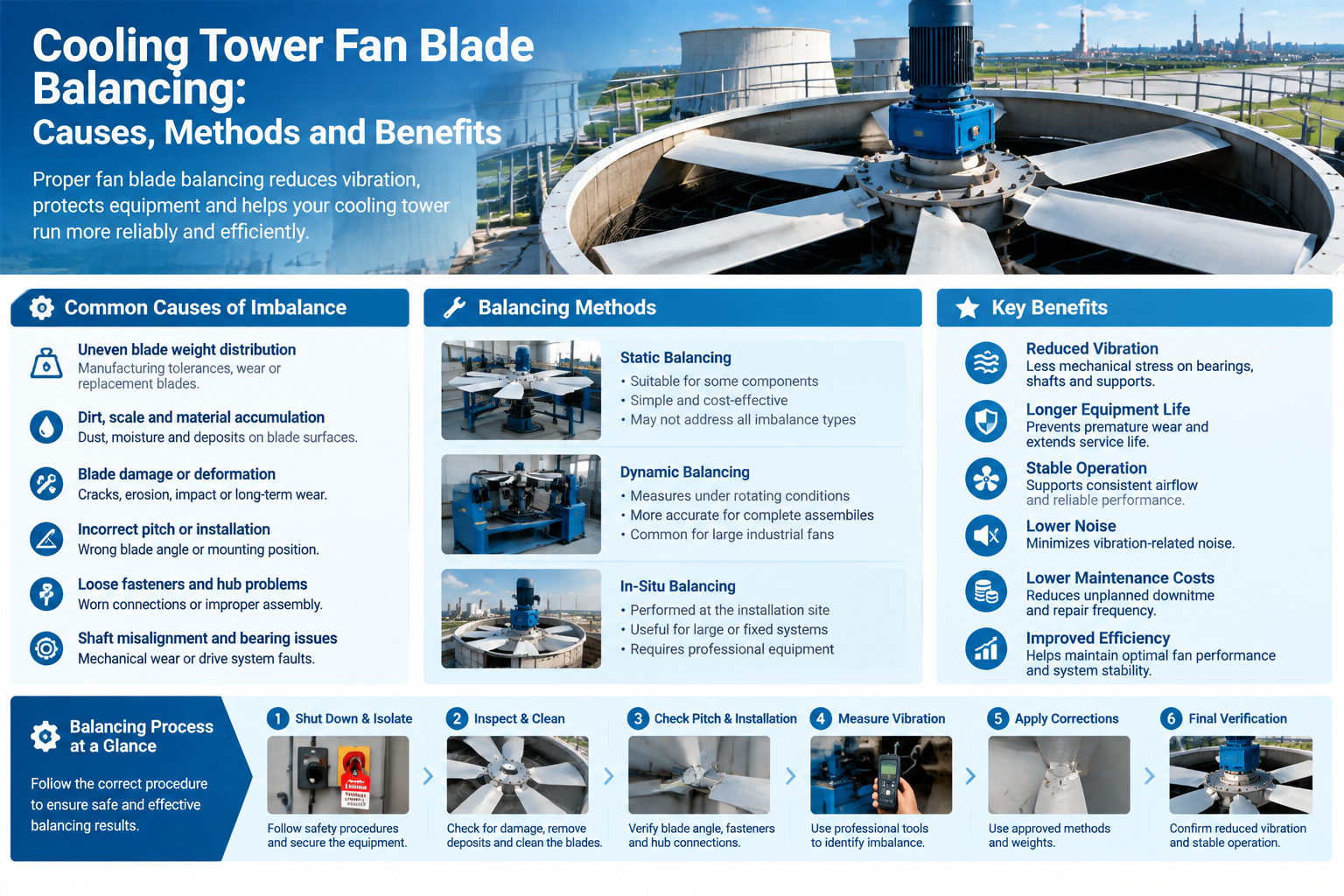
Why Is Cooling Tower Fan Balancing Important?
Cooling tower fans typically operate for extended periods under demanding industrial conditions. Even a relatively small imbalance can produce significant vibration because the fan rotates continuously at high speed.
1. Reduce Excessive Operating Noise
Unbalanced fans often produce unusual mechanical sounds, including humming, rattling, and periodic vibration-related noise.
Common Sources of Fan Noise
Uneven weight distribution among fan blades
Loose blade mounting bolts
Incorrect blade pitch settings
Damaged or deformed fan blades
Worn bearings or gearbox components
Misalignment between the motor, gearbox, and drive system
Proper balancing helps reduce vibration-related noise and creates a more stable operating environment.
2. Minimize Mechanical Vibration
Excessive vibration places additional stress on the fan shaft, gearbox, motor bearings, support structures, and other connected components.
Potential Consequences of Uncontrolled Vibration
Premature bearing wear
Loose mechanical connections
Gearbox damage
Fatigue cracks in structural components
Increased motor loading
Unexpected equipment shutdown
Balancing the rotating assembly helps reduce unnecessary mechanical stress and supports longer equipment life.
3. Improve Cooling Tower Operating Efficiency
A properly balanced fan can rotate more smoothly and maintain stable airflow conditions. Although balancing alone does not guarantee higher thermal performance, it helps prevent mechanical problems that may interfere with normal fan operation.
How Balanced Fans Support Efficiency
Reduce energy losses caused by abnormal mechanical conditions.
Maintain more consistent fan rotation.
Help preserve the intended airflow distribution.
Reduce the likelihood of unplanned maintenance.
Support stable cooling tower operation.
What Causes Industrial Cooling Tower Fan Imbalance?
Understanding the causes of imbalance is the first step toward selecting an effective balancing solution.
Uneven Cooling Tower Fan Blade Weight
The cooling tower fan blades must have appropriate weight distribution to maintain stable rotation. Manufacturing variations, repairs, or replacement with incompatible blades can create mass differences.
Blade Weight Differences
If one blade is heavier than the others, centrifugal force may become unevenly distributed during rotation. This can cause vibration that increases with operating speed.
When replacing cooling tower fan blades, it is important to consider blade weight, dimensions, material, and mounting specifications.
Incorrect Fan Blade Pitch Angle
Blade pitch determines the angle at which the fan interacts with the incoming air. If individual blades are installed at different angles, they may generate uneven aerodynamic forces.
Effects of Incorrect Pitch Settings
A consistent blade pitch setting is essential for maintaining stable fan operation.
Dirt and Material Accumulation
Cooling tower environments expose fan assemblies to moisture, dust, airborne particles, and other contaminants.
How Deposits Create Imbalance
When dirt or mineral deposits accumulate unevenly on the blade surfaces, the mass distribution changes. Even if the fan was correctly balanced during installation, contamination can gradually introduce imbalance.
Regular cleaning and visual inspections help prevent this problem.
Damaged or Deformed Fan Blades
Long-term operation, corrosion, accidental impact, and environmental exposure may cause blade deformation or structural damage.
Common Blade Problems
Cracks near the blade root
Surface erosion
Localized deformation
Loose mounting connections
Resin or coating deterioration
Uneven repairs
Damaged blades should be inspected and evaluated before attempting to balance the fan. Balancing cannot correct structural defects or restore the original strength of a damaged blade.
Improper Installation and Mechanical Alignment
Incorrect installation can create vibration even when the fan blades have acceptable weight distribution.
Potential installation-related problems include:
Incorrect hub positioning
Uneven blade spacing
Loose fasteners
Shaft misalignment
Improper gearbox installation
Unstable fan support structures
A complete inspection should examine the entire rotating assembly rather than focusing only on the blades.
Industrial Cooling Tower Fan Balancing Methods
Different balancing methods are suitable for different fan designs, operating conditions, and vibration problems. The appropriate method depends on the fan structure, operating speed, and equipment condition.
Static Fan Balancing
Static balancing is generally used to identify and correct mass distribution differences in a stationary rotating component.
How Static Balancing Works
The fan assembly or individual component is supported using an appropriate balancing fixture. The technician identifies the heavy side and determines the necessary correction.
Correction may involve adding or removing an approved amount of balancing material at an appropriate location.
Advantages of Static Balancing
Relatively straightforward procedure
Useful for identifying heavy spots
Suitable for certain smaller or simpler components
Helps establish an initial balance condition
However, static balancing may not adequately address all vibration problems in large industrial cooling tower fans.
Dynamic Fan Balancing
Dynamic balancing evaluates the rotating assembly under controlled operating or test conditions. It considers vibration characteristics associated with rotation and helps identify correction requirements.
Dynamic Balancing Procedure
Inspect the fan, hub, shaft, and mounting system.
Check blade condition and installation consistency.
Measure initial vibration using suitable instruments.
Determine the vibration characteristics and correction requirements.
Apply approved balancing corrections.
Perform another measurement to evaluate the results.
Record the final vibration and balancing data.
Why Dynamic Balancing Is Important
Large industrial fans may experience vibration caused by both static and dynamic imbalance. Dynamic balancing provides more comprehensive information about the rotating assembly and is particularly useful for demanding industrial applications.
On-Site Cooling Tower Fan Balancing
In many industrial facilities, removing a large cooling tower fan for workshop balancing is inconvenient or expensive.
On-site balancing allows technicians to assess and correct certain imbalance conditions without completely dismantling the fan assembly.
Typical On-Site Balancing Steps
Check the mechanical condition of the fan system.
Inspect the cooling tower fan blades and hub.
Measure vibration at appropriate locations.
Evaluate operating speed and vibration characteristics.
Apply controlled correction weights when suitable.
Verify the results after correction.
On-site balancing should only be performed by qualified personnel using appropriate instruments and safety procedures.
The Role of Cooling Tower Fan Blades in Noise and Vibration Control
The design, material, weight, and installation quality of cooling tower fan blades directly influence the stability of a cooling tower fan system.
Blade Design and Aerodynamic Performance
Fan blade geometry affects airflow, pressure distribution, and aerodynamic loading. Poorly matched blade profiles or inconsistent installation angles can create uneven aerodynamic forces.
Important Blade Design Factors
Blade length and width
Airfoil profile
Blade pitch angle
Root connection design
Structural stiffness
Surface finish
Material distribution
Selecting blades that match the original fan design helps maintain consistent mechanical and aerodynamic performance.
FRP Cooling Tower Fan Blades
FRP (Fiber Reinforced Plastic) fan blades are widely used in industrial cooling tower applications because they combine relatively low weight with corrosion resistance and design flexibility.
Advantages of FRP Fan Blades
Lightweight construction
Good corrosion resistance
Suitable for humid operating environments
Flexible aerodynamic design
Potential for customized dimensions and blade profiles
Reduced rotating mass compared with some heavier blade materials
However, FRP blades still require proper manufacturing quality control, dimensional consistency, and weight inspection.
Aluminum Cooling Tower Fan Blades
Aluminum fan blades are another option for industrial cooling tower systems. Their relatively low weight and corrosion-resistant surface characteristics make them suitable for selected applications.
Important Considerations
Whether using FRP or aluminum blades, all blades within the same fan assembly should meet the required specifications.
How to Balance an Industrial Cooling Tower Fan Correctly
A systematic balancing procedure helps identify the actual source of vibration and avoids unnecessary component replacement.
Step 1: Shut Down and Inspect the Fan
Before inspection, shut down the cooling tower fan and follow the facility's lockout/tagout procedures.
Initial Inspection Checklist
Check each blade for visible damage.
Inspect the hub and blade mounting connections.
Look for loose or missing fasteners.
Remove accumulated dirt and deposits.
Check for corrosion and structural deformation.
Inspect the gearbox, motor, and shaft assembly.
Never inspect or adjust a rotating fan while it is operating unless a specific measurement procedure has been designed for safe operation by qualified personnel.
Step 2: Check Blade Pitch and Position
Measure the blade pitch using suitable instruments and compare the results with the manufacturer's specifications.
Important Measurements
Consistent blade positioning helps reduce uneven aerodynamic loading.
Step 3: Measure Initial Vibration
Use suitable vibration measurement equipment to evaluate the fan system.
Measurements may be taken at appropriate bearing housings, gearbox locations, motor bearings, or structural support points.
Parameters to Evaluate
The measurement locations and acceptance criteria should follow the equipment manufacturer's recommendations and applicable vibration standards.
Step 4: Identify the Imbalance Location
Vibration data can help technicians determine whether the problem is related to fan imbalance, mechanical looseness, misalignment, bearing defects, or other causes.
Avoid Incorrect Balancing Corrections
Not every vibration problem is caused by fan imbalance. For example, a damaged bearing or loose gearbox mounting may produce similar symptoms.
Correct diagnosis should come before adding balancing weights.
Step 5: Apply Appropriate Balancing Corrections
Once imbalance has been confirmed, technicians can determine the appropriate correction method.
Possible corrections include:
Approved balancing weights
Removal of unsuitable accumulated deposits
Replacement of incompatible blades
Correction of blade installation errors
Proper adjustment of the fan assembly
Any modification must comply with the fan manufacturer's requirements. Unapproved drilling, cutting, welding, or weight attachment may damage the blade or hub.
Step 6: Verify the Final Results
After correction, repeat the vibration measurements under suitable operating conditions.
Compare the results with the initial measurements and the applicable acceptance criteria.
A final balancing report should include the measurement conditions, correction locations, correction weights, and final results.
Common Mistakes in Cooling Tower Fan Balancing
Incorrect balancing procedures can create additional mechanical problems instead of solving the original issue.
Balancing Without Inspecting the Fan
Adding correction weights without checking the blade condition may hide the symptoms of a more serious mechanical problem.
Better practice: Inspect the entire fan assembly before starting the balancing process.
Ignoring Blade Pitch Differences
A fan may have acceptable mass balance but still experience uneven aerodynamic loading because of inconsistent blade pitch.
Better practice: Verify the pitch of every blade and compare it with the manufacturer's specifications.
Using Incompatible Replacement Blades
Replacing one damaged blade with a blade of different dimensions, weight, or aerodynamic design can affect the entire rotating assembly.
Better practice: Select replacement cooling tower fan blades that match the required fan specifications and balancing requirements.
Applying Excessive Correction Weights
Incorrectly positioned or excessive balancing weights can introduce new imbalance conditions.
Better practice: Use professional balancing equipment and follow an established correction procedure.
Ignoring Mechanical Components
Vibration may originate from the gearbox, motor, shaft, bearings, or support structure rather than the fan itself.
Better practice: Include connected mechanical components in the vibration diagnosis.
Cooling Tower Fan Balancing and Preventive Maintenance
Regular maintenance helps prevent imbalance from developing into serious equipment failure.
Establish a Regular Inspection Schedule
Inspection frequency should depend on operating hours, environmental conditions, equipment design, and manufacturer recommendations.
Recommended Maintenance Activities
Component | Inspection Focus |
Cooling tower fan blades | Cracks, deformation, dirt and erosion |
Fan hub | Corrosion, looseness and structural condition |
Blade fasteners | Tightness and visible damage |
Gearbox | Noise, leakage and vibration |
Motor | Bearing condition and operating temperature |
Shaft and coupling | Alignment and wear |
Fan support structure | Looseness, cracks and corrosion |
Monitor Vibration Trends
Recording vibration measurements over time helps maintenance teams identify gradual changes.
A sudden increase in vibration may indicate blade damage, loose components, or a developing mechanical fault.
Benefits of Vibration Monitoring
Early identification of abnormal operating conditions
Better maintenance planning
Reduced risk of unexpected shutdown
Improved equipment reliability
More effective troubleshooting
Clean Fan Blades Regularly
Uneven deposits can affect blade weight and aerodynamic performance. Cleaning should follow the blade manufacturer's recommendations to avoid damaging protective coatings or composite surfaces.
How to Select a Reliable Cooling Tower Fan Blade Supplier
Choosing the right replacement components is an important part of maintaining a balanced fan system.
Evaluate Product Quality and Manufacturing Consistency
A reliable supplier should be able to provide clear product specifications and explain its quality inspection procedures.
Key Evaluation Factors
Consider Customization Requirements
Different cooling tower models may require different blade lengths, profiles, pitch settings, and hub connections.
A supplier should understand the application requirements before recommending replacement blades.
Review Technical Support
Technical communication is important when replacing fan blades or resolving vibration problems.
Before purchasing, provide relevant information such as fan diameter, operating speed, existing blade dimensions, hub configuration, and application conditions.
Industrial Cooling Tower Fan Balancing Solutions from Power Tower Cooling Technology (Shaoxing) Co.,Ltd
Power Tower Cooling Technology (Shaoxing) Co.,Ltd focuses on cooling tower products and component solutions for industrial applications.
For cooling tower fan replacement and maintenance projects, selecting compatible fan components is important for maintaining stable airflow and mechanical operation.
Cooling Tower Fan Blade Solutions
When evaluating replacement cooling tower fan blades, industrial buyers should consider:
FRP blade material and structural design
Blade dimensions and aerodynamic profile
Pitch angle requirements
Hub connection compatibility
Weight consistency
Operating speed and application conditions
Supporting Stable Fan System Operation
A cooling tower fan is a complete rotating system rather than an isolated component. Fan blades, hubs, gearboxes, motors, shafts, and support structures must work together.
Selecting suitable components and following proper installation and balancing procedures can help reduce noise, control vibration, and improve long-term operating reliability.
Industrial buyers can provide their existing fan specifications and application requirements when requesting replacement component recommendations.
Frequently Asked Questions About Industrial Cooling Tower Fan Balancing
How Often Should an Industrial Cooling Tower Fan Be Balanced?
There is no universal balancing interval for every cooling tower. Balancing should be considered during initial installation, after blade replacement or major repairs, and whenever abnormal vibration is detected. Regular vibration monitoring helps determine when further inspection is necessary.
Can Unbalanced Cooling Tower Fan Blades Cause Excessive Noise?
Yes. Uneven mass distribution among cooling tower fan blades can create rotating forces that produce vibration and mechanical noise. However, noise may also result from loose components, bearing damage, gearbox problems, or aerodynamic interference.
What Is the Difference Between Static and Dynamic Fan Balancing?
Static balancing identifies mass distribution differences in a stationary component. Dynamic balancing evaluates the rotating assembly and can address imbalance conditions that static balancing may not fully resolve.
Can FRP Cooling Tower Fan Blades Be Balanced?
Yes. FRP cooling tower fan blades can be included in appropriate fan balancing procedures. Their weight, dimensions, installation position, and structural condition should be checked before correction.
Does Fan Balancing Improve Cooling Tower Efficiency?
Proper balancing primarily improves mechanical stability and reduces vibration-related losses and maintenance risks. It can help maintain reliable fan operation, but actual cooling efficiency also depends on airflow, water distribution, heat load, fill condition, and overall system design.
What Should Be Checked Before Balancing a Cooling Tower Fan?
Technicians should inspect blade condition, blade pitch, hub connections, fasteners, gearbox, motor, shaft alignment, bearings, and support structures. Vibration measurements should then be used to identify the actual source of the problem.
Conclusion
Industrial Cooling Tower Fan Balancing is essential for controlling excessive noise and vibration in industrial cooling systems. Uneven blade weight, incorrect pitch settings, accumulated deposits, damaged components, and installation errors can all contribute to fan imbalance.
A systematic approach that combines visual inspection, vibration measurement, appropriate balancing methods, and regular preventive maintenance helps maintain stable fan operation.
Equally important is the selection of high-quality cooling tower fan blades that match the fan's mechanical and aerodynamic requirements. By combining suitable replacement components with professional balancing procedures, industrial facilities can reduce mechanical stress, improve equipment reliability, and support consistent cooling tower performance.


