Fiberglass Cooling Tower Fan Stack: Structure, Strength and Performance
A fiberglass cooling tower fan stack is an important structural component designed to guide airflow through an industrial cooling tower. It surrounds the fan assembly, helps control air movement, and supports efficient air discharge. Compared with traditional metal structures, a fiberglass fan stack offers advantages such as corrosion resistance, lightweight construction, design flexibility, and relatively low maintenance requirements.
In industrial cooling systems, the fan stack works together with the fan, motor, gearbox, fan hub, and cooling tower fan blades to maintain stable airflow. Its structural design and material quality can influence airflow conditions, mechanical reliability, and long-term operating performance.
For power plants, chemical facilities, HVAC systems, manufacturing plants, and other industrial applications, selecting a suitable fiberglass cooling tower fan stack is essential for reliable equipment operation.
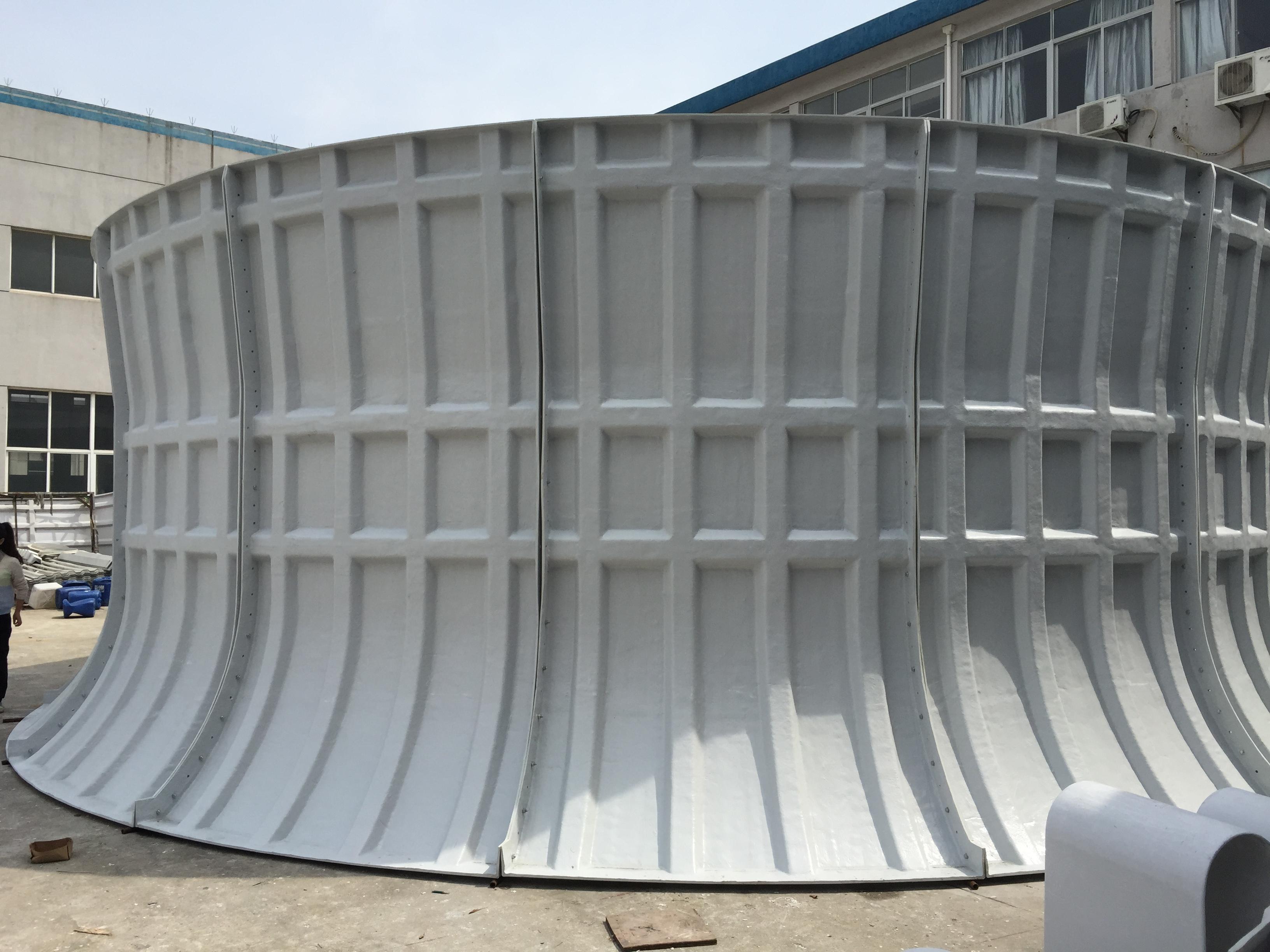
What Is a Fiberglass Cooling Tower Fan Stack?
A fiberglass cooling tower fan stack is an air-guiding enclosure installed around the cooling tower fan. It is commonly manufactured from fiber-reinforced plastic (FRP), a composite material consisting of reinforcing fibers and a resin matrix.
Its primary function is to direct air discharged by the fan upward and away from the cooling tower structure.
Main Functions of a Fiberglass Fan Stack
A properly designed fan stack performs several important functions.
1. Guide Airflow
The fan stack helps direct the airflow generated by the cooling tower fan toward the atmosphere. Its shape and dimensions influence the airflow path and discharge conditions.
2. Support Fan System Performance
The fan stack provides a defined airflow passage around the fan assembly. Appropriate design helps reduce unnecessary airflow interference and supports stable fan operation.
3. Protect the Fan Assembly
Depending on its configuration, the fan stack can provide a degree of protection for the fan area against external environmental exposure and accidental contact.
4. Improve Structural Integration
The fan stack connects with the cooling tower structure and helps form a complete fan discharge section. Its mounting design must match the tower's structural arrangement.
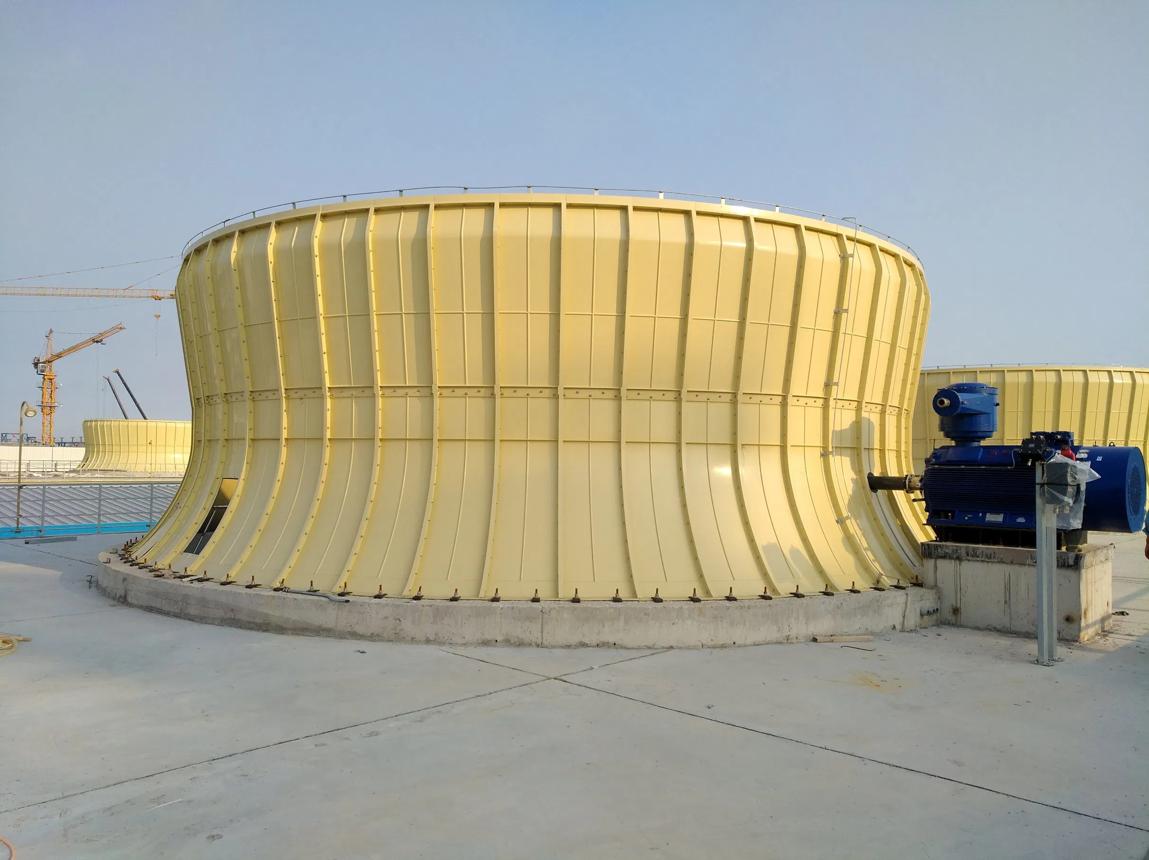
How Does a Fiberglass Fan Stack Work?
When the cooling tower fan rotates, it draws air through the cooling tower and discharges it through the fan stack.
The stack guides the discharged air upward, helping separate the exhaust airflow from the surrounding environment.
A well-designed fan stack should have suitable dimensions, smooth internal surfaces, and an appropriate transition profile to avoid unnecessary airflow resistance.
Main Structure of a Fiberglass Cooling Tower Fan Stack
The structure of a fiberglass cooling tower fan stack depends on the cooling tower model, fan diameter, installation environment, and operating requirements.
Although designs vary, most FRP fan stacks contain several basic structural sections.
1. Cylindrical or Tapered Fan Stack Body
The main body forms the airflow passage around the cooling tower fan.
Cylindrical Structure
A cylindrical fan stack has a relatively consistent diameter throughout its height. This configuration may be suitable for cooling tower designs with straightforward airflow requirements.
Tapered Structure
A tapered fan stack has a gradually changing diameter. Its profile can be designed to guide airflow through the discharge section and support the intended aerodynamic characteristics.
The appropriate shape should be determined according to fan diameter, airflow requirements, stack height, and the overall cooling tower design.
2. Reinforced Mounting Flange
The mounting flange connects the fiberglass fan stack to the supporting structure.
Important Flange Design Factors
A properly designed flange helps distribute connection loads and reduces the risk of localized stress during operation.
3. Reinforcement Ribs
Reinforcement ribs increase the structural stiffness of the fan stack.
Benefits of Reinforcement Ribs
Improve resistance to deformation.
Support the fan stack under environmental loads.
Increase local structural stiffness.
Help maintain the designed shape.
Improve connection stability.
The number, position, and dimensions of reinforcement ribs should be determined through structural design rather than selected arbitrarily.
4. Internal Surface
The internal surface of the fan stack is directly exposed to moving air.
Why Surface Quality Matters
A smooth and consistent internal surface helps avoid unnecessary airflow disturbances caused by rough transitions, protrusions, or poorly finished joints.
Good manufacturing quality also helps make inspection and cleaning easier.
5. Connection and Assembly Components
Large fiberglass fan stacks may be manufactured in multiple sections for transportation and installation.
Common Connection Considerations
Section alignment
Joint reinforcement
Bolt spacing
Sealing requirements
Connection strength
Ease of maintenance
The assembly method should maintain the intended geometry and structural integrity of the complete fan stack.
Why Is Fiberglass Used for Cooling Tower Fan Stacks?
Fiberglass reinforced plastic is widely used in cooling tower components because it offers a combination of mechanical properties and environmental resistance.
Excellent Corrosion Resistance
Cooling towers operate in humid environments where components may be exposed to water droplets, chemicals, airborne contaminants, and changing temperatures.
Traditional metal structures may require protective coatings or additional corrosion-control measures.
How FRP Helps Resist Corrosion
The resin matrix provides a protective material structure, while the reinforcing fibers contribute mechanical strength.
The actual chemical resistance depends on the resin system, manufacturing quality, operating temperature, and exposure conditions.
Lightweight Construction
Compared with many conventional metal structures, fiberglass fan stacks can offer a favorable strength-to-weight ratio.
Advantages of Lightweight Design
Easier transportation
More convenient installation
Reduced handling requirements
Flexible sectional manufacturing
Potentially lower supporting-structure loads
The actual weight advantage depends on the dimensions, wall thickness, reinforcement design, and selected materials.
Good Structural Strength
Fiberglass fan stacks combine reinforcing fibers with resin to create a composite structure.
Factors Affecting FRP Strength
A properly engineered laminate structure can provide the stiffness and strength required for specific cooling tower operating conditions.
Electrical Insulation Properties
FRP is generally electrically nonconductive compared with conventional metallic materials.
This characteristic can be useful in certain industrial environments, although electrical safety must still be evaluated for the complete cooling tower installation.
Flexible Customization
Fiberglass manufacturing allows fan stacks to be produced in different shapes and dimensions.
Manufacturers can develop customized designs according to project requirements, including:
Fiberglass Cooling Tower Fan Stack and Airflow Performance
Airflow is one of the most important considerations when designing a cooling tower fan stack.
The stack should work with the fan system to discharge air smoothly and maintain the intended operating conditions.
How Fan Stack Geometry Affects Airflow
The shape and dimensions of the fan stack influence the movement of air around the fan discharge area.
Stack Diameter
The stack diameter must be compatible with the fan diameter and the cooling tower design.
An unsuitable diameter may affect airflow distribution, discharge velocity, or the interaction between the fan and the surrounding structure.
Stack Height
Stack height influences the discharge configuration and the relationship between exhaust airflow and the surrounding environment.
A suitable height should be determined according to the cooling tower design and site conditions.
Taper Angle and Transition Profile
The transition between different stack diameters should be designed carefully.
Sudden changes in geometry may increase airflow disturbance and local pressure losses.
Relationship Between Fan Stack and Cooling Tower Fan Blades
The fan stack and cooling tower fan blades operate as parts of the same airflow system.
The blades generate airflow, while the stack provides the passage through which the discharged air moves.
Important Matching Factors
Fan blade diameter
Blade pitch angle
Fan rotational speed
Fan operating point
Stack diameter
Stack height
Internal airflow profile
An appropriate match between the fan and stack helps the system operate according to its intended design.
Reducing Airflow Losses
A well-designed FRP fan stack should avoid unnecessary internal obstructions and poorly designed transitions.
Design Recommendations
Maintain a consistent internal profile where required.
Avoid unnecessary structural protrusions.
Ensure joints are properly aligned.
Match the stack geometry to the fan system.
Verify dimensions before manufacturing.
Evaluate airflow performance during system design.
It is important to recognize that a fan stack alone does not determine cooling tower efficiency. Fill condition, water distribution, ambient conditions, fan performance, and tower configuration also influence overall thermal performance.
Manufacturing Process of Fiberglass Cooling Tower Fan Stacks
Manufacturing quality directly affects the durability, dimensional accuracy, and structural performance of an FRP fan stack.
Different production methods may be used depending on product size, geometry, production volume, and engineering requirements.
1. Design and Dimension Confirmation
The manufacturing process begins with reviewing the cooling tower's technical requirements.
Information Required Before Production
Accurate drawings and measurements help prevent installation problems.
2. Mold Preparation
A suitable mold is prepared according to the required fan stack geometry.
The mold should provide the necessary dimensional accuracy and surface quality.
3. Fiber and Resin Selection
The reinforcing fiber and resin system should be selected according to the intended operating environment.
Common Reinforcement Materials
Common Resin Options
Polyester resin
Vinyl ester resin
Epoxy resin
The appropriate combination depends on mechanical requirements, chemical exposure, temperature conditions, and project specifications.
4. Lamination and Forming
Fiberglass reinforcement is combined with resin to create the composite structure.
The manufacturing method may include hand lay-up, spray-up, vacuum-assisted processes, or other suitable composite-forming techniques.
Important Process Controls
Fiber distribution
Resin impregnation
Laminate thickness
Air bubble control
Curing conditions
Layer arrangement
Consistent process control helps reduce manufacturing defects.
5. Curing and Demolding
After forming, the FRP component must undergo appropriate curing.
The curing process allows the resin to develop its required mechanical properties.
The product is then removed from the mold for further processing.
6. Trimming and Surface Finishing
Excess material is removed, edges are finished, and connection areas are prepared.
The internal and external surfaces should be inspected for visible defects and finishing quality.
7. Final Quality Inspection
Before delivery, the finished fan stack should be checked against the approved drawings and project specifications.
Quality Standards and Inspection for FRP Fan Stacks
Quality inspection is essential for ensuring that fiberglass cooling tower fan stacks meet their intended structural and dimensional requirements.
Dimensional Inspection
Manufacturers should verify the main dimensions before shipment.
Key Inspection Items
Dimensional accuracy is particularly important for large replacement projects.
Visual Surface Inspection
Visual inspection helps identify defects that may affect product quality.
Common inspection points include:
Structural and Connection Inspection
The mounting flange, reinforcement areas, and section joints should be evaluated according to the applicable design requirements.
For projects with specific load requirements, appropriate engineering calculations or testing may also be necessary.
Material and Manufacturing Traceability
For industrial projects, buyers may request material specifications, manufacturing records, inspection reports, and relevant test documentation.
These records help improve product traceability and quality management.
Fiberglass Fan Stack vs. Metal Cooling Tower Fan Stack
Both fiberglass and metal fan stacks can be used in industrial cooling towers. The appropriate choice depends on environmental conditions, structural requirements, maintenance expectations, and project budgets.
Comparison Factor | Fiberglass Fan Stack | Metal Fan Stack |
Weight | Generally lightweight | Depends on metal type and thickness |
Corrosion resistance | Good with suitable resin selection | Depends on material and coating |
Customization | Flexible composite forming | Depends on fabrication method |
Maintenance | Often relatively low | May require corrosion protection |
Structural design | Depends on laminate and reinforcement | Depends on metal grade and thickness |
Surface protection | Depends on resin and finish | May require protective coatings |
Installation | Can be easier due to lower weight | Depends on structure and weight |
When Should You Choose a Fiberglass Fan Stack?
FRP may be a suitable option when the cooling tower operates in a humid or corrosive environment and lightweight construction is important.
It is also useful for replacement projects where customized dimensions are required.
When Should You Consider a Metal Fan Stack?
Metal structures may be appropriate when the existing tower design, engineering specifications, or project requirements favor a metallic construction.
The decision should be based on the complete operating environment rather than material price alone.
Installation and Maintenance of Fiberglass Cooling Tower Fan Stacks
Correct installation and regular inspection help maintain the structural condition and operating performance of a fiberglass fan stack.
Installation Considerations
Before installation, verify that the fan stack dimensions match the cooling tower structure.
Important Installation Steps
Inspect the foundation and supporting structure.
Check the fan stack dimensions and connection points.
Confirm the position of the mounting flange.
Align individual sections where applicable.
Install the specified fasteners.
Complete required joint sealing.
Inspect the structure before operating the fan.
Installation procedures should follow the manufacturer's drawings and project-specific requirements.
Regular Inspection
FRP fan stacks should be inspected periodically, particularly in facilities with high humidity, chemical exposure, or strong environmental loading.
Maintenance Checklist
Check for cracks and visible deformation.
Inspect flange connections.
Examine section joints and sealing.
Look for signs of delamination.
Check for surface deterioration.
Remove accumulated dirt when necessary.
Inspect nearby fan components.
Coordinate Fan Stack Maintenance with Fan Blade Inspection
The condition of the fan stack should be evaluated together with the cooling tower fan assembly.
During maintenance, technicians should also inspect:
Cooling tower fan blades
Fan hub
Blade mounting bolts
Motor and gearbox
Shaft and bearings
Fan support structure
This comprehensive inspection helps identify problems that may affect the entire fan system.
Common Problems with Fiberglass Cooling Tower Fan Stacks
Although FRP fan stacks offer several advantages, improper design, manufacturing defects, and poor maintenance can still cause operational problems.
Cracks and Surface Damage
Cracks may result from impact, excessive local stress, improper installation, or material deterioration.
Recommended Solutions
Identify the cause before carrying out repairs. Repairs should use compatible materials and follow an appropriate composite repair procedure.
Flange Deformation
Insufficient reinforcement, uneven bolt tightening, or incorrect installation may cause flange deformation.
Recommended Solutions
Check flange dimensions, connection conditions, and structural support. Replace or repair components when they no longer meet the required specifications.
Section Joint Leakage
Poorly aligned sections or unsuitable sealing materials may allow water or air leakage at connection points.
Recommended Solutions
Inspect the joint design, alignment, fasteners, and sealing system. Use compatible sealing materials according to the manufacturer's instructions.
Delamination
Delamination occurs when composite layers separate from one another.
Recommended Solutions
Assess the affected area and determine whether professional composite repair or component replacement is necessary. Serious structural delamination should not be treated as a cosmetic issue.
Airflow Disturbance
An incorrectly sized fan stack or poorly finished internal surface may contribute to unwanted airflow disturbance.
Recommended Solutions
Check the stack geometry, fan diameter, internal profile, and installation alignment. Any modification should be supported by engineering evaluation.
How to Choose a Reliable Fiberglass Cooling Tower Fan Stack Manufacturer
Selecting an experienced manufacturer is important for obtaining a fan stack that meets the project's technical and installation requirements.
Evaluate Manufacturing Capabilities
Buyers should understand the manufacturer's experience with large FRP structures and customized industrial components.
Questions to Ask
Can the manufacturer produce the required dimensions?
What fiberglass reinforcement materials are available?
Which resin systems can be selected?
How is laminate thickness controlled?
What dimensional inspections are performed?
Can the manufacturer provide technical drawings?
Check Customization Options
A suitable manufacturer should be able to evaluate project drawings and confirm whether the proposed fan stack design matches the existing cooling tower.
Customization may include diameter, height, wall thickness, flange design, section arrangement, and reinforcement structure.
Review Product Quality Documentation
For industrial purchasing, buyers should request relevant technical information, inspection records, and material documentation.
Clear specifications help reduce communication errors during international procurement.
Consider Transportation and Installation
Large fiberglass fan stacks may require sectional manufacturing or special packaging.
Before placing an order, confirm:
Shipping dimensions
Section quantity
Packaging method
Assembly requirements
Installation drawings
Delivery arrangements
Fiberglass Cooling Tower Fan Stack Solutions from Power Tower Cooling Technology (Shaoxing) Co.,Ltd
Power Tower Cooling Technology (Shaoxing) Co.,Ltd provides cooling tower products and component solutions for industrial applications.
For fiberglass cooling tower fan stack projects, selecting the correct dimensions, material structure, and installation configuration is important for achieving compatibility with the existing cooling tower.
Customized FRP Fan Stack Requirements
When requesting a fiberglass fan stack solution, buyers should prepare the following information:
Cooling tower model
Existing fan diameter
Required fan stack height
Overall stack dimensions
Mounting flange specifications
Installation drawings or photographs
Operating environment
Special project requirements
Integrated Cooling Tower Fan Components
A fiberglass fan stack should be considered together with the complete fan system.
Related components may include:
Matching these components to the original cooling tower design helps support reliable installation and operation.
FAQ About Fiberglass Cooling Tower Fan Stacks
What Is a Fiberglass Cooling Tower Fan Stack Made Of?
A fiberglass cooling tower fan stack is generally made from glass fiber reinforcement combined with a resin matrix. Common resin options include polyester, vinyl ester, and epoxy, depending on the application and required material properties.
What Are the Main Advantages of FRP Fan Stacks?
The main advantages include lightweight construction, corrosion resistance, flexible customization, and a favorable strength-to-weight ratio. Actual performance depends on material selection and manufacturing quality.
Can Fiberglass Cooling Tower Fan Stacks Be Customized?
Yes. FRP fan stacks can be manufactured in different diameters, heights, wall thicknesses, flange configurations, and sectional arrangements according to project drawings and technical requirements.
Does a Fiberglass Fan Stack Improve Cooling Tower Efficiency?
A properly designed fan stack helps guide discharged air and reduce unnecessary airflow disturbances. However, overall cooling tower efficiency also depends on fan performance, cooling tower fill, water distribution, ambient conditions, and system design.
How Long Can a Fiberglass Cooling Tower Fan Stack Last?
Service life depends on resin selection, manufacturing quality, operating temperature, chemical exposure, environmental conditions, and maintenance practices. Regular inspection helps identify deterioration before it becomes a serious structural problem.
Can a Fiberglass Fan Stack Be Used with FRP Cooling Tower Fan Blades?
Yes. Fiberglass fan stacks can be used in cooling tower systems equipped with FRP cooling tower fan blades. The fan diameter, operating speed, stack geometry, and installation configuration should be properly matched.
Is an FRP Fan Stack Suitable for Cooling Tower Replacement Projects?
Yes. Customized FRP fan stacks can be considered for replacement projects. Accurate measurements of the existing structure and fan assembly are important before manufacturing.
Conclusion
A fiberglass cooling tower fan stack is an important component for guiding airflow and supporting the operation of industrial cooling tower fan systems. Its structure, material strength, internal geometry, and manufacturing quality all influence long-term performance.
With lightweight construction, corrosion resistance, and flexible customization, FRP fan stacks offer a practical solution for many industrial cooling tower applications.
For the best results, the fan stack should be designed to match the cooling tower's operating requirements and work properly with the cooling tower fan blades, hub, motor, and gearbox. Proper installation, regular inspection, and suitable maintenance can help extend service life and maintain reliable cooling tower operation.


