Why Is Cooling Tower Fan Blade Balancing Important?
Cooling tower fan blade balancing is an essential part of maintaining reliable and efficient cooling tower operation. Large industrial cooling tower fans rotate continuously and may operate for thousands of hours each year. Even a small difference in blade weight, pitch angle, or installation position can create an imbalance that produces excessive vibration.
A professionally balanced fan assembly distributes rotating mass and aerodynamic loading more evenly. This helps protect the fan hub, gearbox, motor, bearings, shaft, and supporting structure while maintaining stable airflow.
For industrial cooling towers, professional cooling tower fan blade balancing should be considered an important maintenance and commissioning procedure rather than an optional adjustment.
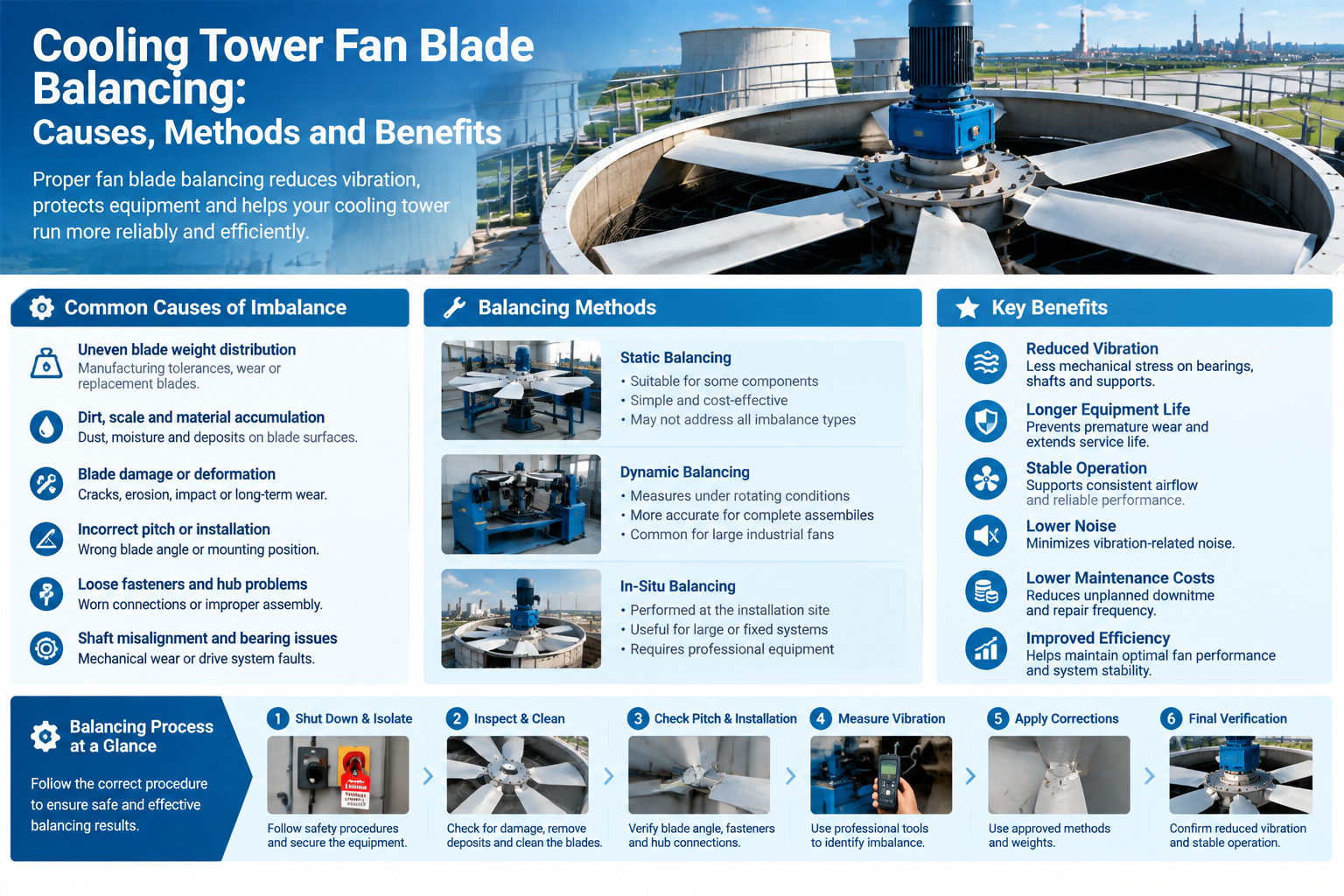
What Happens When Fan Blades Are Unbalanced?
An unbalanced cooling tower fan can produce several problems:
Excessive mechanical vibration
Increased bearing loads
Gearbox wear
Higher motor stress
Abnormal operating noise
Uneven airflow
Loose bolts and connections
Premature component failure
Increased maintenance costs
Why Can a Small Imbalance Become a Major Problem?
As fan rotational speed increases, centrifugal forces generated by an uneven rotating mass can become significant.
A relatively small weight difference at a large radial distance can generate a noticeable imbalance force. This force is repeatedly applied to rotating and stationary components during operation.
For this reason, large-diameter industrial fans require accurate blade installation and balancing.
What Causes Cooling Tower Fan Blade Imbalance?
Fan blade imbalance can develop during manufacturing, installation, operation, or maintenance.
Identifying the source of the imbalance is the first step toward an effective solution.
1. Unequal Blade Weight
Manufacturing differences can cause individual blades to have slightly different weights.
This is particularly important for large-diameter fans because even small mass differences can create significant centrifugal forces.
How Does Weight Difference Affect Fan Operation?
When blades with different masses rotate around the same hub, the center of mass may move away from the rotational axis.
This creates an unbalanced rotating assembly.
Professional manufacturers should therefore control blade weight and dimensions during production.
2. Incorrect Blade Pitch
Blade pitch refers to the angle at which the fan blade is installed relative to the plane of rotation.
If one blade has a different pitch angle from the others, it can generate different aerodynamic loading.
What Problems Can Incorrect Pitch Cause?
Incorrect blade pitch can result in:
All adjustable blades should be set according to the manufacturer's specified pitch.
3. Blade Deformation
Cooling tower fan blades can become deformed due to mechanical impact, environmental exposure, excessive loading, or long-term aging.
A deformed blade may have different aerodynamic characteristics from the other blades.
Common Causes of Blade Deformation
Damaged or permanently deformed blades should be inspected before attempting to rebalance the fan.
4. Loose Mounting Components
Loose bolts or mounting hardware can change the position of a blade during operation.
This can create both mechanical and aerodynamic imbalance.
Regular inspection of blade mounting hardware is therefore important.
5. Dirt and Material Accumulation
Deposits on fan blades can change blade weight and aerodynamic shape.
Water scale, dust, chemical deposits, and other contaminants may accumulate unevenly across the rotating assembly.
Why Should Fan Blades Be Cleaned Before Balancing?
If balancing is performed while blades contain uneven deposits, the balance condition may change after cleaning.
Therefore, fan blades should normally be inspected and cleaned before final balancing.
What Is the Difference Between Static and Dynamic Fan Blade Balancing?
Understanding different balancing methods helps determine the appropriate procedure for industrial cooling tower fans.
Static Balancing
Static balancing focuses on correcting mass distribution when the rotating assembly is stationary or under simplified balancing conditions.
The objective is to reduce the tendency of the assembly to rotate toward a heavier side.
When Is Static Balancing Useful?
Static balancing may be useful for individual components or specific fan configurations.
However, large industrial cooling tower fans often require more comprehensive balancing because operating conditions involve rotational and aerodynamic forces.
Dynamic Balancing
Dynamic balancing evaluates the rotating assembly while considering its behavior during rotation.
It can identify imbalance characteristics associated with the rotating assembly and rotational speed.
Why Is Dynamic Balancing Important?
Dynamic balancing can help identify:
For large industrial cooling tower fan systems, dynamic balancing can provide valuable information for achieving smooth operation.
How Is Professional Cooling Tower Fan Blade Balancing Performed?
A professional balancing procedure should follow a systematic process.
Step 1: Inspect the Complete Fan Assembly
Before balancing, inspect the fan blades, hub, shaft, gearbox, motor, bearings, and mounting structure.
What Should Be Checked?
Inspect for:
Cracked blades
Deformation
Loose fasteners
Worn bearings
Gearbox problems
Shaft misalignment
Damaged hub components
Excessive blade wear
Balancing should not be used as a substitute for repairing damaged equipment.
Step 2: Clean the Fan Blades
Remove accumulated dust, dirt, scale, and other deposits.
The blades should be in their normal operating condition before final balancing.
Step 3: Verify Blade Dimensions and Weight
Measure blade dimensions and compare individual blade weights where appropriate.
Why Is Weight Consistency Important?
Consistent blade weight helps reduce mass imbalance and improves the stability of the rotating assembly.
For replacement fan blades, manufacturers should provide consistent dimensional and weight control.
Step 4: Check Blade Pitch
Measure the pitch angle of every adjustable blade.
All blades should be adjusted consistently according to the required design specification.
Step 5: Inspect the Fan Hub
The hub must be checked for structural integrity and correct blade mounting.
Hub Inspection Points
Mounting holes
Blade attachment points
Fasteners
Shaft connection
Hub deformation
Corrosion
Cracks
A damaged hub can create vibration even when the fan blades themselves are correctly balanced.
Step 6: Perform Balancing
Depending on the fan configuration, balancing may involve component-level balancing or complete assembly dynamic balancing.
Professional technicians should use suitable balancing equipment and follow the equipment manufacturer's procedures.
Step 7: Conduct Trial Operation
After balancing, operate the fan under controlled conditions.
Monitor:
Vibration
Motor current
Rotational speed
Operating noise
Gearbox temperature
Bearing condition
Any abnormal behavior should be investigated before returning the equipment to full operation.
How Does Cooling Tower Fan Blade Balancing Reduce Vibration?
Cooling tower fan vibration is often one of the most visible symptoms of an imbalance problem.
However, vibration can also originate from other mechanical or structural causes.
1. Reduce Rotating Mass Imbalance
Proper balancing helps align the center of mass more closely with the rotational axis.
This reduces the centrifugal forces associated with mass imbalance.
2. Improve Rotating Stability
A balanced fan assembly rotates more smoothly.
This can reduce unnecessary loading on:
Bearings
Gearbox
Motor
Shaft
Hub
Supporting structure
3. Reduce Mechanical Fatigue
Continuous vibration can contribute to fatigue in structural components and fasteners.
Reducing vibration can therefore support longer equipment service life.
What If Vibration Remains After Balancing?
If vibration remains after fan balancing, the problem may originate from another component.
Potential causes include:
Shaft misalignment
Bearing wear
Gearbox problems
Motor imbalance
Structural resonance
Loose foundation bolts
Fan stack problems
A complete vibration analysis may be required.
How Does Fan Blade Material Affect Balancing?
Material selection can influence fan blade weight, stiffness, and dimensional stability.
FRP Cooling Tower Fan Blades
FRP, or Fiber Reinforced Plastic, is widely used for industrial cooling tower fan blades.
Balancing Considerations for FRP Blades
FRP blades can provide a favorable strength-to-weight ratio, but manufacturing consistency remains important.
Manufacturers should control:
Blade dimensions
Laminate thickness
Resin distribution
Fiber reinforcement
Blade weight
Mounting dimensions
Consistent manufacturing helps simplify assembly balancing.
Aluminum Cooling Tower Fan Blades
Aluminum blades are also used in many industrial cooling tower applications.
Their relatively low weight and structural rigidity make them suitable for various fan configurations.
Balancing Considerations for Aluminum Blades
Inspect aluminum blades for:
Deformation
Corrosion
Surface damage
Uneven material removal
Mounting damage
Any permanent deformation may affect the aerodynamic and balance characteristics of the blade.
FRP vs. Aluminum for Fan Balancing
| Factor | FRP Fan Blades | Aluminum Fan Blades |
| Weight | Generally lightweight | Relatively lightweight |
| Corrosion resistance | Generally excellent | Depends on alloy and protection |
| Structural rigidity | High when properly designed | High |
| Weight consistency | Depends on manufacturing quality | Depends on manufacturing accuracy |
| Maintenance | Relatively low | Requires corrosion inspection |
| Customization | High | Established manufacturing options |
The material itself does not guarantee good balance. Manufacturing accuracy, blade dimensions, mounting consistency, and assembly procedures are equally important.
What Are the Signs That Cooling Tower Fan Blades Need Balancing?
Recognizing early warning signs can help prevent more serious equipment damage.
1. Increasing Vibration
A sudden or gradual increase in fan vibration is one of the most common warning signs.
Vibration should be compared with previous operating measurements whenever possible.
2. Abnormal Noise
Unusual rattling, humming, or mechanical noise may indicate imbalance or another rotating equipment problem.
3. Loose Bolts and Fasteners
Repeatedly loose mounting bolts can indicate excessive vibration.
The root cause should be identified instead of simply tightening the bolts repeatedly.
4. Uneven Blade Wear
Different wear patterns between blades may indicate uneven loading or aerodynamic conditions.
5. Increased Motor Current
An increase in motor current may indicate higher fan loading.
Incorrect blade pitch, mechanical resistance, or aerodynamic problems should be investigated.
6. Reduced Cooling Performance
If the cooling tower cannot maintain the required water outlet temperature, insufficient airflow may be involved.
However, cooling performance problems can also originate from fill, water distribution, ambient conditions, or other system components.
How Often Should Cooling Tower Fan Blades Be Balanced?
There is no universal balancing interval for every cooling tower.
The appropriate frequency depends on operating hours, fan size, environmental conditions, maintenance history, and equipment design.
Balance During Initial Installation
New fan assemblies should be inspected and balanced according to the manufacturer's requirements before full operation.
Balance After Blade Replacement
If one or more blades are replaced, the entire assembly should be evaluated.
Replacing a single blade may change the mass distribution of the rotating assembly.
Why Should All Blades Be Checked?
Even if the replacement blade has the same dimensions, small differences in weight or mounting position may affect balance.
Balance After Major Maintenance
Balancing should be considered after:
Balance When Vibration Increases
Unexpected vibration should trigger an inspection.
Do not wait for a scheduled maintenance interval if the fan develops abnormal operating behavior.
What Are Common Cooling Tower Fan Balancing Mistakes?
Incorrect balancing procedures may fail to solve vibration problems or create new issues.
Mistake 1: Balancing Without Inspection
Balancing a damaged blade or worn hub does not correct the underlying mechanical problem.
Mistake 2: Ignoring Blade Pitch
A fan can have acceptable mass balance but still experience uneven aerodynamic loading because of inconsistent blade pitch.
Mistake 3: Balancing Dirty Blades
Uneven deposits can change the balance condition.
Clean the blades before final balancing.
Mistake 4: Replacing Only One Blade Without Checking the Assembly
A new blade may have slightly different weight characteristics from the original blades.
The complete rotating assembly should be inspected after replacement.
Mistake 5: Ignoring the Gearbox and Motor
Vibration does not always originate from the fan blades.
Gearbox wear, bearing problems, shaft misalignment, and motor imbalance can also generate vibration.
Mistake 6: Using Inadequate Measurement Equipment
Large industrial fans require suitable measurement and balancing equipment.
Professional technicians should use appropriate vibration and balancing instruments.
How Can Manufacturers Improve Fan Blade Balance During Production?
Balancing begins before the fan reaches the cooling tower.
Manufacturing quality has a major influence on the final performance of the assembled fan.
1. Maintain Consistent Blade Dimensions
Manufacturers should control blade length, chord, thickness, and mounting dimensions.
2. Control Blade Weight
Individual blades should be weighed and compared according to the manufacturer's quality-control requirements.
3. Maintain Consistent Blade Geometry
Small variations in blade shape may affect aerodynamic loading.
Accurate molds and manufacturing processes are particularly important for FRP fan blades.
4. Verify Mounting Interfaces
Blade mounting holes and root dimensions should be checked carefully.
Incorrect mounting geometry can affect blade position and assembly balance.
5. Conduct Assembly-Level Checks
Where appropriate, complete fan assemblies should undergo balancing and vibration verification before shipment or commissioning.
How Can Proper Balancing Improve Cooling Tower Fan Performance?
Professional cooling tower fan blade balancing provides several long-term benefits.
1. Improved Mechanical Reliability
Reduced vibration helps protect critical rotating components.
2. Lower Maintenance Requirements
A smoother-running fan can reduce wear on bearings, gearboxes, fasteners, and supporting structures.
3. More Stable Airflow
Consistent blade pitch and proper balance help maintain stable fan operation.
4. Reduced Risk of Unexpected Downtime
Early detection of imbalance can prevent vibration-related failures.
5. Potential Energy Savings
Balancing itself does not automatically make a fan aerodynamically more efficient. However, correcting severe imbalance and related mechanical problems can help restore the fan to its intended operating condition and avoid unnecessary losses.
How to Select a Professional Cooling Tower Fan Blade Balancing Service?
Choosing the right service provider is particularly important for large industrial cooling tower fans.
1. Look for Cooling Tower Experience
The service provider should understand the operating characteristics of large axial fans and industrial cooling tower equipment.
2. Check Balancing Capabilities
Ask whether the provider can perform appropriate static or dynamic balancing and vibration measurements.
3. Evaluate Technical Equipment
Professional equipment may include:
4. Consider Complete Fan System Inspection
A professional service provider should be able to evaluate the fan, hub, gearbox, motor, shaft, and supporting structure rather than focusing only on blade weight.
5. Request Technical Documentation
For industrial projects, balancing results, inspection records, vibration measurements, and adjustment information can be useful for future maintenance.
Frequently Asked Questions About Cooling Tower Fan Blade Balancing
What Is Cooling Tower Fan Blade Balancing?
Cooling tower fan blade balancing is the process of correcting uneven mass distribution and, where applicable, evaluating the operating balance of the rotating fan assembly.
The objective is to reduce unwanted vibration and support stable operation.
Why Does a Cooling Tower Fan Vibrate?
Possible causes include blade imbalance, incorrect blade pitch, damaged blades, loose fasteners, hub problems, shaft misalignment, bearing wear, gearbox defects, and structural resonance.
Is Static or Dynamic Balancing Better?
The appropriate method depends on the fan design and application.
Large industrial cooling tower fans may benefit from dynamic balancing because it evaluates rotating behavior under operating conditions.
Do FRP Fan Blades Need Balancing?
Yes. FRP fan blades still require appropriate weight, dimensional, and assembly control.
The material does not eliminate the need for balancing.
Can Balancing Increase Cooling Tower Efficiency?
Correct balancing primarily improves mechanical stability and reliability.
If imbalance has caused abnormal vibration, reduced operating speed, or mechanical losses, correcting the problem can help restore intended fan performance.
Should Fan Blades Be Balanced After Replacement?
Yes. After replacing blades, the complete rotating assembly should be inspected and evaluated because changes in blade weight or mounting position can affect balance.
Conclusion: Professional Fan Blade Balancing Supports Reliable Cooling Tower Operation
Professional cooling tower fan blade balancing is an important part of maintaining industrial cooling tower performance.
A balanced fan assembly can reduce unnecessary vibration, protect mechanical components, improve operating stability, and help prevent premature equipment failure. However, balancing should always be combined with proper inspection of the blades, hub, gearbox, motor, shaft, bearings, and supporting structure.
For industrial cooling tower operators, regular vibration monitoring, accurate blade pitch adjustment, consistent blade manufacturing, and professional balancing procedures can significantly improve long-term equipment reliability.
Whether you are replacing FRP fan blades, upgrading an existing fan assembly, or troubleshooting excessive cooling tower fan vibration, selecting an experienced cooling tower fan manufacturer or balancing specialist can help ensure that the complete fan system operates safely and efficiently.


