Industrial Cooling Tower Fan Replacement Solutions for Better Performance
Industrial cooling towers play an essential role in maintaining stable operating temperatures in power plants, chemical facilities, manufacturing factories, HVAC systems, and other industrial applications. As one of the most important components of a cooling tower, the fan directly affects airflow, heat transfer efficiency, energy consumption, and overall system performance.
Over time, cooling tower fans may experience blade damage, corrosion, vibration, reduced airflow, and mechanical wear. These problems can reduce cooling capacity and increase operating costs. In such situations, professional industrial cooling tower fan replacement solutions can help restore equipment performance, improve operational reliability, and extend the service life of the cooling tower.
Choosing the right replacement fan requires careful consideration of fan blade materials, diameter, pitch angle, motor power, airflow requirements, and operating conditions. This article explores the key factors involved in cooling tower fan replacement and explains how industrial facilities can achieve better cooling performance through proper fan selection and installation.
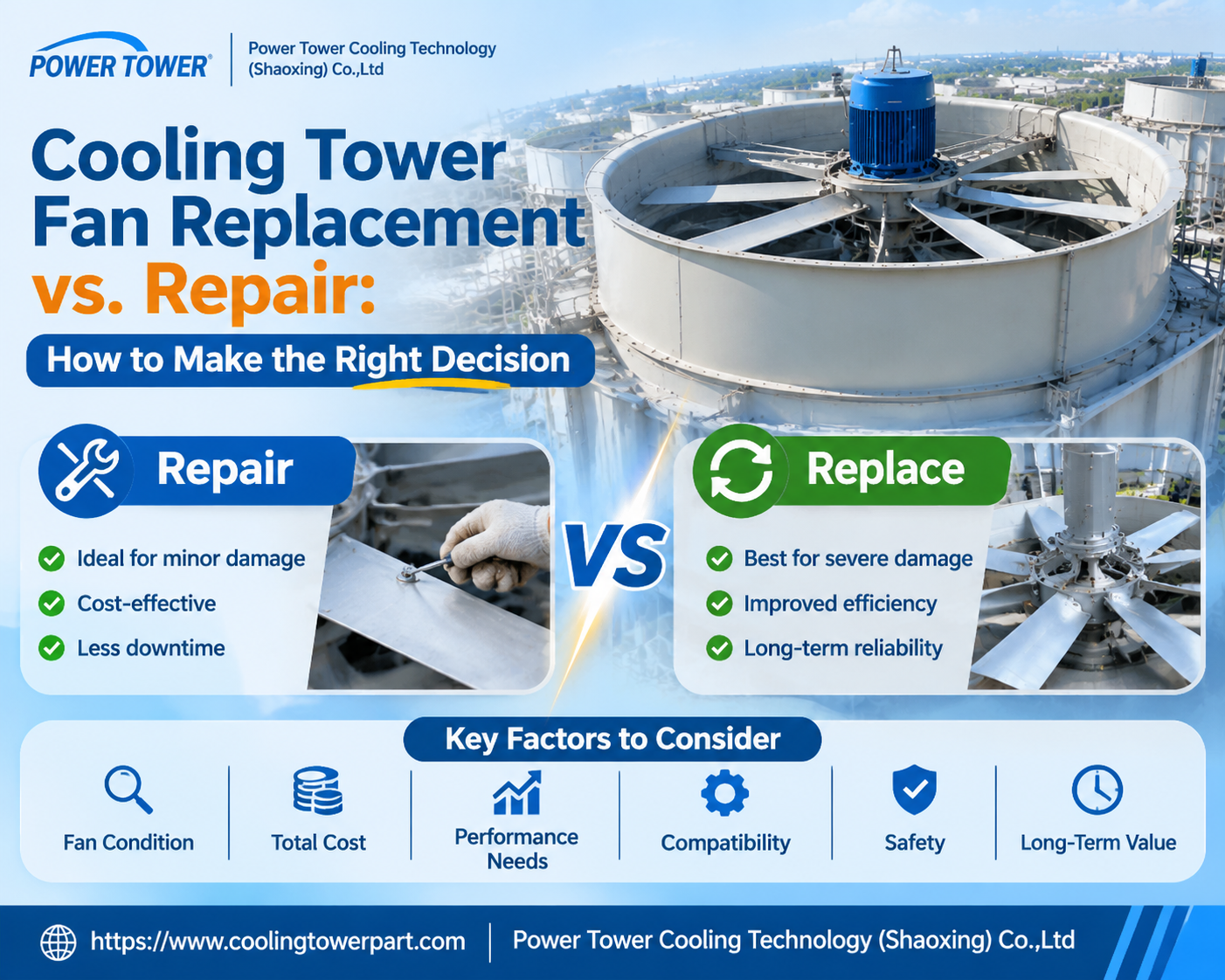
Why Is Industrial Cooling Tower Fan Replacement Important?
A cooling tower fan is responsible for moving large volumes of air through the cooling tower. This airflow supports the evaporation process and helps transfer heat from circulating water into the surrounding atmosphere.
When a fan becomes damaged or inefficient, the entire cooling system may be affected.
1. Restore Cooling Tower Airflow Efficiency
Insufficient airflow can reduce the cooling tower's heat rejection capacity. Damaged blades, incorrect blade angles, and accumulated dirt may prevent the fan from delivering the required air volume.
Replacing an outdated or damaged fan can help:
Restore designed airflow capacity.
Improve air circulation inside the cooling tower.
Support more effective heat exchange.
Reduce uneven airflow distribution.
Maintain stable cooling water temperatures.
Why Does Airflow Matter?
The performance of a cooling tower depends on the interaction between water distribution, fill media, and airflow. Even when the fill media and water distribution system are functioning properly, insufficient airflow can limit overall cooling efficiency.
A properly selected replacement fan helps restore the balance between air volume and water flow.
2. Reduce Energy Consumption
Older cooling tower fans may operate inefficiently because of outdated blade designs, excessive mechanical resistance, or unsuitable operating conditions.
Modern industrial cooling tower fans can incorporate improved aerodynamic profiles and lightweight materials to reduce unnecessary energy consumption.
Potential benefits include:
Lower fan motor power requirements.
Improved aerodynamic efficiency.
Reduced mechanical loading.
Better compatibility with variable frequency drives.
More efficient operation under different cooling loads.
3. Minimize Equipment Downtime
Unexpected fan failures can interrupt industrial production and increase maintenance expenses.
A planned cooling tower fan replacement helps reduce the risk of sudden equipment breakdowns. It also provides an opportunity to inspect related components, including the motor, gearbox, fan hub, transmission shaft, and supporting structure.
What Are the Common Signs That a Cooling Tower Fan Needs Replacement?
Identifying early warning signs can help facility managers avoid costly failures.
1. Cracked or Damaged Cooling Tower Fan Blades
Fan blades operate continuously under aerodynamic forces, centrifugal loads, vibration, and environmental exposure.
Over time, these conditions may cause cracks, deformation, surface deterioration, or structural damage.
Common Causes of Blade Damage
Long-term mechanical fatigue.
Excessive vibration during operation.
Corrosion caused by humid environments.
Incorrect blade pitch adjustment.
Impact from foreign objects.
Improper installation or maintenance.
When structural damage affects blade integrity, replacement is generally safer than continuing operation with unreliable components.
2. Excessive Noise and Vibration
Unusual noise and vibration are common indicators of cooling tower fan problems.
These conditions may result from blade imbalance, loose fasteners, damaged bearings, shaft misalignment, or gearbox problems.
Before replacing the entire fan, maintenance personnel should determine the actual source of vibration.
If the fan blades or hub assembly are structurally damaged, a complete replacement may be necessary.
3. Reduced Airflow and Cooling Capacity
A cooling tower fan that cannot generate sufficient airflow may cause higher cooling water outlet temperatures.
Possible reasons include:
Incorrect fan blade pitch.
Damaged or deformed blades.
Inappropriate fan diameter.
Poor aerodynamic performance.
Excessive air recirculation.
Motor or gearbox performance problems.
Replacing an inefficient fan with a properly engineered model can help restore the cooling tower's original performance.
4. Increased Maintenance Costs
Frequent blade repairs, repeated balancing, and continuous component adjustments may indicate that an existing fan has reached the end of its useful service life.
In these circumstances, replacing the complete fan assembly may be more economical than continuing with repeated repairs.
What Types of Industrial Cooling Tower Fans Are Available?
Different cooling tower designs require different fan configurations. Understanding the available fan types is essential when selecting replacement equipment.
1. Axial Flow Cooling Tower Fans
Axial flow fans are widely used in industrial cooling towers. They move air parallel to the fan shaft and are designed to handle large airflow volumes at relatively low pressure.
Main Advantages
High airflow capacity.
Relatively simple construction.
Suitable for large industrial cooling towers.
Good compatibility with FRP fan blades.
Flexible blade pitch adjustment options.
Axial fans are commonly installed in induced-draft and forced-draft cooling tower systems.
2. FRP Cooling Tower Fans
FRP cooling tower fans are manufactured using fiber-reinforced plastic materials. They are popular in industrial applications because of their corrosion resistance, lightweight construction, and mechanical strength.
Key Benefits of FRP Fan Blades
Excellent corrosion resistance.
Lightweight construction.
Good strength-to-weight ratio.
Resistance to moisture and many industrial environments.
Flexible aerodynamic design.
Reduced maintenance requirements.
FRP fans are particularly suitable for cooling towers operating in humid environments or facilities where corrosion is a major concern.
3. Aluminum Cooling Tower Fans
Aluminum cooling tower fans are another common replacement option. They offer relatively low weight, good structural rigidity, and convenient maintenance.
Where Are Aluminum Fans Used?
Aluminum fans may be suitable for:
Industrial HVAC cooling towers.
Power generation facilities.
Manufacturing plants.
Commercial cooling systems.
Certain chemical processing applications.
However, material selection should consider corrosion exposure, operating temperature, mechanical loading, and maintenance requirements.
4. Adjustable-Pitch Cooling Tower Fans
Adjustable-pitch fans allow operators to modify blade angles according to airflow and cooling requirements.
Benefits of Adjustable Blade Pitch
Flexible airflow adjustment.
Better adaptation to changing cooling loads.
Potential energy savings.
Improved system operating flexibility.
Proper pitch adjustment is essential because an excessive blade angle may increase motor loading, while an insufficient angle may reduce airflow.
How to Choose the Right Industrial Cooling Tower Fan Replacement?
Selecting a replacement fan involves more than matching the original fan diameter. The replacement must be compatible with the cooling tower structure and its operating conditions.
1. Confirm the Original Fan Specifications
Before purchasing a replacement, collect the technical information of the existing cooling tower fan.
Important parameters include:
Technical Parameter | Description |
Fan diameter | Overall fan size |
Airflow volume | Required air delivery |
Fan speed | Operating rotational speed |
Blade number | Number of fan blades |
Blade pitch angle | Installed blade angle |
Motor power | Required driving power |
Hub diameter | Fan hub connection size |
Installation height | Available installation space |
Why Is Accurate Measurement Important?
Incorrect dimensions may cause installation difficulties, mechanical interference, or reduced operating efficiency.
The replacement fan should be checked against the original equipment drawings and actual site measurements.
2. Select Suitable Fan Blade Materials
Material selection directly affects the service life and maintenance requirements of a replacement fan.
FRP vs. Aluminum Cooling Tower Fan Blades
Comparison | FRP Fan Blades | Aluminum Fan Blades |
Weight | Lightweight | Lightweight |
Corrosion resistance | Excellent | Depends on alloy and protection |
Strength | High | High |
Maintenance | Relatively low | Requires corrosion inspection |
Design flexibility | High | Depends on manufacturing process |
Industrial applications | Widely used | Widely used |
FRP fan blades are often preferred in corrosive and humid environments, while aluminum blades can be suitable for applications requiring metallic construction and specific mechanical properties.
3. Match the Fan Diameter and Airflow Requirements
Fan diameter is one of the most important parameters affecting cooling tower airflow.
A larger fan may move more air under suitable operating conditions, but simply increasing the diameter does not guarantee better cooling performance.
Engineers should evaluate:
Cooling tower dimensions.
Air inlet and outlet configuration.
Required airflow volume.
Fan rotational speed.
System resistance.
Motor and gearbox capacity.
The replacement fan should operate within the cooling tower's original design limitations.
4. Check Motor and Gearbox Compatibility
The fan must match the existing drive system or the specifications of a newly designed drive system.
Important considerations include:
An oversized fan may overload the motor or gearbox. Therefore, replacement selection should include a complete mechanical and electrical compatibility assessment.
5. Evaluate Operating Environment
Different industrial facilities have different operating conditions.
For example, chemical plants may require excellent corrosion resistance, while power plants may prioritize high airflow capacity and continuous operation.
Environmental factors to consider include:
What Components Are Included in a Cooling Tower Fan Replacement System?
A complete industrial cooling tower fan replacement project may involve several components rather than just replacing the fan blades.
1. Cooling Tower Fan Blades
Cooling tower fan blades generate airflow and directly influence aerodynamic performance.
Replacement blades should have suitable profiles, dimensions, materials, and pitch angles.
Important Blade Characteristics
2. Cooling Tower Fan Hub Assembly
The fan hub connects individual blades and transfers rotational power from the drive shaft to the fan assembly.
A suitable hub assembly should provide reliable blade positioning, secure connections, and sufficient mechanical strength.
Hub Assembly Inspection Points
Hub material and structural condition.
Blade mounting holes.
Fastener specifications.
Shaft connection dimensions.
Corrosion and deformation.
Mechanical alignment.
3. Cooling Tower Fan Stack
The fan stack is designed to guide airflow through the cooling tower fan system.
A properly designed fan stack can help reduce airflow losses and improve discharge conditions.
Why Is Fan Stack Compatibility Important?
The replacement fan must be compatible with the fan stack diameter and available installation clearance.
Incorrect dimensions may cause blade interference, increased turbulence, and unnecessary operating noise.
4. Motor and Gearbox
The motor and gearbox provide the mechanical power required to operate the fan.
During replacement projects, these components should be inspected for excessive vibration, bearing wear, lubrication problems, and abnormal operating temperatures.
Industrial Cooling Tower Fan Replacement Process
A professional replacement project should follow a systematic procedure to ensure safe installation and reliable operation.
Step 1: Inspect the Existing Cooling Tower Fan
Before removing the old fan, technicians should inspect the complete assembly.
The inspection should include:
This information helps determine whether the project requires blade replacement or a complete fan assembly replacement.
Step 2: Confirm Replacement Fan Dimensions
Measure the original equipment and verify all critical dimensions.
Essential Measurements
Fan outside diameter.
Hub mounting diameter.
Blade length.
Blade mounting configuration.
Shaft connection dimensions.
Available fan stack clearance.
The replacement manufacturer should confirm compatibility before production.
Step 3: Remove the Existing Fan Assembly
Before removal, the cooling tower must be shut down and isolated according to the site's lockout and tagout procedures.
Technicians should use suitable lifting equipment and follow approved procedures for handling large fan components.
Special attention should be given to protecting the fan stack and supporting structure.
Step 4: Install the New Cooling Tower Fan
The new fan should be installed according to the manufacturer's technical instructions.
Important installation requirements include:
Correct hub positioning.
Proper blade installation.
Accurate blade pitch adjustment.
Secure fastener tightening.
Correct shaft alignment.
Adequate fan stack clearance.
Check Blade Pitch Consistency
All blades should be installed at the specified pitch angle.
Uneven blade angles can result in inconsistent aerodynamic loading, vibration, and reduced fan performance.
Step 5: Perform Fan Balancing
Dynamic or static balancing requirements depend on the fan design and manufacturer specifications.
Balancing helps minimize vibration caused by uneven mass distribution.
A properly balanced fan can help reduce mechanical stress on bearings, shafts, gearboxes, and supporting structures.
Step 6: Conduct Trial Operation
After installation, the fan should undergo controlled commissioning.
Technicians should monitor:
Rotational direction.
Operating speed.
Motor current.
Vibration levels.
Noise levels.
Bearing temperature.
Airflow performance.
Any abnormal operating conditions should be investigated before the cooling tower returns to normal service.
How Can Cooling Tower Fan Replacement Improve Energy Efficiency?
Energy efficiency is one of the main reasons industrial facilities consider upgrading their cooling tower fans.
A properly engineered replacement can improve airflow performance while reducing unnecessary mechanical and aerodynamic losses.
1. Improve Aerodynamic Blade Design
Modern FRP cooling tower fan blades can be designed with optimized aerodynamic profiles.
These profiles help improve airflow distribution and reduce aerodynamic resistance under suitable operating conditions.
2. Optimize Blade Pitch Angle
Blade pitch directly affects the amount of air moved by the fan and the power required to drive it.
An optimized blade angle can help balance airflow capacity and motor loading.
However, the ideal pitch must be determined using fan performance data and actual system requirements.
3. Reduce Fan Operating Resistance
Fan stack geometry, blade clearance, and airflow passages influence system resistance.
Correcting unsuitable installation conditions during replacement may improve overall operating efficiency.
4. Combine Fan Replacement With VFD Control
A variable frequency drive (VFD) can adjust fan speed according to cooling demand.
When operating conditions permit, reducing fan speed can significantly lower power consumption.
For many fan systems, power consumption approximately follows the cube of rotational speed under similar operating conditions.
This means speed control can offer substantial energy-saving potential, although actual savings depend on system characteristics and operating conditions.
Common Mistakes to Avoid During Industrial Cooling Tower Fan Replacement
Even a high-quality replacement fan may perform poorly if the selection and installation processes are incorrect.
1. Choosing a Fan Based Only on Diameter
Matching the fan diameter without checking airflow, speed, motor power, and hub dimensions can result in poor performance.
A complete technical assessment is essential.
2. Ignoring Blade Pitch Adjustment
Incorrect pitch angles may cause excessive motor loading or insufficient airflow.
Always follow the manufacturer's recommended installation specifications.
3. Overlooking Fan Hub Compatibility
The hub must match the blade mounting configuration and drive shaft.
Incorrect connections may create mechanical instability and increase maintenance risks.
4. Ignoring Fan Balancing
An improperly balanced fan may produce excessive vibration and accelerate bearing and gearbox wear.
Balancing should be completed according to the manufacturer's requirements.
5. Selecting Unsuitable Materials
Choosing fan blades without considering corrosion, humidity, and operating temperature can shorten equipment service life.
Material selection should be based on actual operating conditions rather than purchase price alone.
How to Maintain a New Industrial Cooling Tower Fan After Replacement?
Proper maintenance helps protect the investment and maintain reliable cooling tower operation.
1. Conduct Regular Fan Blade Inspections
Inspect fan blades periodically for:
Surface cracks.
Structural deformation.
Corrosion.
Loose fasteners.
Surface contamination.
Unusual wear.
Damaged blades should be evaluated promptly by qualified maintenance personnel.
2. Monitor Vibration and Noise
Establish baseline vibration measurements after commissioning.
Compare future readings against the baseline and applicable equipment limits.
Unexpected changes may indicate blade imbalance, loose connections, bearing deterioration, or alignment problems.
3. Inspect the Fan Hub and Fasteners
Check the hub assembly and blade mounting connections according to the maintenance schedule.
Loose fasteners and damaged mounting components should be corrected before they cause further damage.
4. Maintain the Motor and Gearbox
Regularly inspect motor bearings, gearbox lubrication, seals, and coupling connections.
Proper lubrication and alignment can help extend the service life of the drive system.
5. Keep the Fan Stack Clean
Remove accumulated dirt, debris, and other obstructions from the fan stack.
A clean airflow passage helps maintain consistent ventilation and reduces unnecessary airflow resistance.
How to Choose a Reliable Industrial Cooling Tower Fan Replacement Manufacturer?
Selecting an experienced manufacturer is important for achieving reliable equipment performance and long-term operating value.
1. Evaluate Manufacturing Experience
Look for manufacturers with experience producing industrial axial fans, FRP cooling tower fan blades, fan hub assemblies, and complete replacement systems.
Relevant manufacturing experience helps ensure that products are designed for real industrial operating conditions.
2. Check Product Customization Capabilities
Different cooling tower brands and models may require different fan configurations.
A reliable manufacturer should be able to provide customized solutions based on:
3. Review Quality Control Procedures
Quality control should cover raw materials, production processes, dimensional inspections, mechanical strength, and final product testing.
For FRP fan blades, particular attention should be paid to fiber reinforcement, resin quality, curing processes, and structural consistency.
4. Consider Technical Support and After-Sales Service
A professional supplier should provide technical assistance during product selection, installation, commissioning, and maintenance.
This support is especially important for industrial facilities replacing large cooling tower fans or upgrading older cooling tower systems.
Why Choose Professional Cooling Tower Fan Replacement Solutions?
Professional replacement solutions help industrial facilities address existing fan problems while improving the reliability of the overall cooling system.
An experienced supplier can evaluate the original fan configuration, recommend suitable materials, and provide customized replacement components.
For industrial users, the most important benefits include:
Improved cooling tower airflow.
More reliable fan operation.
Reduced vibration and mechanical stress.
Better corrosion resistance.
Lower maintenance requirements.
Improved energy efficiency potential.
Extended equipment service life.
Whether replacing individual cooling tower fan blades or upgrading the complete fan assembly, correct engineering and installation are essential for achieving the expected results.
Frequently Asked Questions About Industrial Cooling Tower Fan Replacement
1. When Should an Industrial Cooling Tower Fan Be Replaced?
A cooling tower fan should be considered for replacement when it develops structural cracks, severe corrosion, persistent vibration, significant deformation, or poor operating performance.
Replacement may also be appropriate when maintenance costs become excessive.
2. Can FRP Cooling Tower Fan Blades Replace Aluminum Blades?
Yes. FRP cooling tower fan blades can replace aluminum blades when the new blades are properly engineered for the existing fan system.
However, engineers must verify blade dimensions, weight, hub compatibility, rotational speed, and mechanical loading before installation.
3. Does Replacing Cooling Tower Fan Blades Improve Cooling Efficiency?
It can. Replacing damaged or inefficient blades with properly designed replacement blades may restore airflow and improve heat rejection performance.
Actual improvements depend on the overall condition of the cooling tower, including its fill media, water distribution system, and airflow passages.
4. Is It Necessary to Replace the Fan Hub When Replacing Fan Blades?
Not always. If the existing hub is structurally sound and compatible with the replacement blades, it may be reused.
However, damaged, corroded, or incompatible hubs should be repaired or replaced.
5. How Can I Select the Correct Replacement Fan Size?
You should consider the original fan diameter, airflow requirements, operating speed, motor power, hub dimensions, fan stack clearance, and cooling tower design.
Providing the original fan drawings and equipment specifications to the manufacturer can help ensure accurate selection.
6. Are FRP Cooling Tower Fans Suitable for Industrial Applications?
Yes. FRP cooling tower fans are widely used in industrial cooling systems because of their lightweight construction, corrosion resistance, and design flexibility.
They can be suitable for power plants, chemical facilities, manufacturing factories, and industrial HVAC systems.
Conclusion
Industrial cooling tower fan replacement is an effective way to restore airflow performance, improve equipment reliability, and support energy-efficient cooling tower operation. Selecting the right replacement fan requires careful evaluation of blade materials, fan diameter, pitch angle, hub assembly, motor power, and operating environment.
For industrial facilities seeking long-term performance, FRP cooling tower fans offer an attractive combination of lightweight construction, corrosion resistance, and mechanical strength.
Working with an experienced cooling tower fan manufacturer can help ensure accurate product selection, reliable installation, and customized replacement solutions for different industrial cooling tower applications.
A well-planned replacement project not only solves existing fan problems but also creates opportunities to improve the performance and reliability of the entire cooling tower system.


