How To Choose The Best Industrial Cooling Tower Fan for Your Plant?
Selecting the best Industrial Cooling Tower Fan for your plant is an important decision that directly affects cooling performance, energy consumption, equipment reliability, and long-term operating costs. In industrial environments, cooling towers often operate continuously under demanding conditions. An incorrectly selected fan may result in insufficient airflow, excessive vibration, higher electricity bills, and frequent maintenance problems.
Different industrial plants have different cooling requirements. Power stations, chemical factories, steel mills, petrochemical facilities, and manufacturing plants may use cooling towers with different capacities, structures, and operating conditions. Therefore, choosing a suitable fan requires more than simply comparing fan diameter or motor power.
A reliable industrial cooling tower fan should provide sufficient airflow, maintain stable operation, match the cooling tower structure, and withstand the environmental conditions of the facility.
This guide explains the most important factors to consider when selecting an industrial cooling tower fan and how to make a practical purchasing decision for your plant.
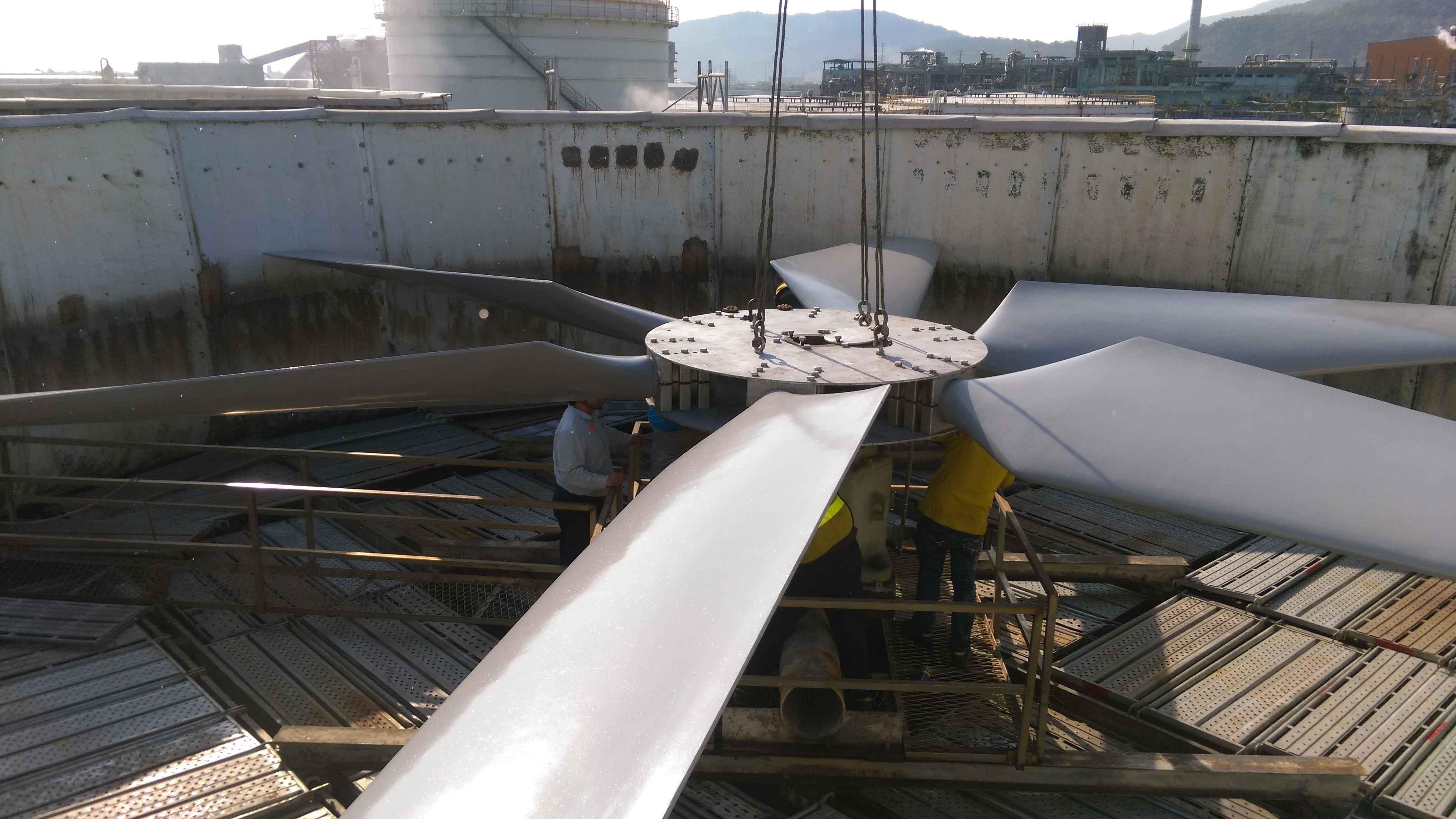
1. Understand Your Plant's Cooling Requirements
Before choosing an industrial cooling tower fan, you should understand the actual cooling requirements of your facility. The fan must work together with the cooling tower, water distribution system, fill media, and mechanical drive system.
Evaluate the Required Cooling Capacity
Cooling capacity is one of the first factors to consider when selecting a fan.
Industrial cooling towers remove heat from circulating water by transferring heat to the surrounding air. The fan creates the airflow necessary to support this heat exchange process.
Several operating parameters should be evaluated:
Circulating water flow rate.
Hot water inlet temperature.
Cold water outlet temperature.
Design wet-bulb temperature.
Required cooling range.
Cooling tower approach.
Expected operating load.
Why Cooling Capacity Matters
A fan with insufficient airflow may prevent the cooling tower from achieving its target outlet water temperature.
On the other hand, selecting an unnecessarily large fan may increase initial investment and energy consumption.
The objective is to select a fan that matches the actual thermal performance requirements of the cooling tower.
Identify Your Cooling Tower Type
Different cooling tower structures require different fan configurations.
Induced-Draft Cooling Towers
In induced-draft cooling towers, the fan is usually installed at the top of the tower. It pulls air through the fill section and discharges warm, humid air upward.
This configuration is widely used in industrial cooling systems because it can provide an effective airflow arrangement and help reduce the recirculation of warm exhaust air when properly designed.
Forced-Draft Cooling Towers
Forced-draft cooling towers use fans to push outside air into the tower.
The fan is commonly installed near the air inlet. This configuration may be suitable for specific industrial installations where the equipment layout, maintenance access, or ventilation requirements influence the design.
Crossflow and Counterflow Cooling Towers
Crossflow and counterflow cooling towers have different internal airflow and water distribution arrangements.
The fan must be selected according to the tower's airflow resistance, geometry, and design operating conditions.
2. Choose the Correct Fan Airflow and Static Pressure
Airflow is one of the most important performance indicators of an industrial cooling tower fan.
However, selecting a fan based only on its maximum airflow rating can lead to poor results. Buyers must also consider the pressure losses throughout the cooling tower.
Calculate the Required Air Volume
The required air volume depends on the cooling load, ambient conditions, and heat transfer characteristics of the tower.
A qualified cooling tower engineer should evaluate the required airflow using thermal design calculations and fan performance data.
Consider Actual Operating Conditions
The following factors may influence fan airflow requirements:
Ambient air temperature.
Atmospheric pressure and altitude.
Wet-bulb temperature.
Fill media resistance.
Drift eliminator resistance.
Air inlet and outlet geometry.
Operating water temperature.
A fan selected for one geographical location may not deliver the same cooling performance under different climatic conditions.
Understand Fan Static Pressure
Static pressure represents the resistance that the fan must overcome to move air through the cooling tower.
Airflow resistance can come from fill media, drift eliminators, louvers, structural supports, and other internal components.
Why Static Pressure Should Not Be Ignored
A fan may have an impressive free-air capacity but perform differently when installed in an actual cooling tower.
Therefore, buyers should request a fan performance curve showing airflow, pressure, rotational speed, and power requirements.
This information provides a more realistic basis for comparing different fan models.
3. Select the Right Industrial Cooling Tower Fan Blade Material
Blade material affects fan weight, mechanical strength, corrosion resistance, manufacturing cost, and service life.
FRP and aluminum alloy are two common choices for industrial cooling tower fan blades.
FRP Cooling Tower Fan Blades
FRP (Fiberglass Reinforced Plastic) fan blades are widely used in industrial cooling tower applications.
They combine relatively low weight with good corrosion resistance and flexible manufacturing possibilities.
Main Advantages of FRP Fan Blades
Good resistance to moisture and many corrosive environments.
Relatively lightweight construction.
Flexible blade profile design.
Suitable for customized manufacturing.
Reduced susceptibility to conventional metal corrosion.
FRP blades are particularly attractive for chemical plants, petrochemical facilities, and industrial cooling systems exposed to humid environments.
What Should Buyers Check?
Not all FRP fan blades have identical performance.
Buyers should evaluate resin selection, fiberglass reinforcement, blade thickness, structural design, manufacturing consistency, and operating temperature limits.
The blade must also be designed for the actual centrifugal and aerodynamic loads generated during operation.
Aluminum Alloy Cooling Tower Fan Blades
Aluminum alloy fan blades offer a different combination of mechanical properties and manufacturing characteristics.
They can provide good structural strength with relatively low weight and are used in various industrial ventilation and cooling applications.
Key Considerations for Aluminum Blades
Alloy grade and material quality.
Blade thickness and structural design.
Corrosion protection.
Surface treatment.
Fatigue resistance.
Compatibility with the fan hub.
FRP vs. Aluminum: Which Is Better?
Comparison | FRP Fan Blades | Aluminum Fan Blades |
Weight | Relatively lightweight | Relatively lightweight |
Corrosion resistance | Generally excellent | Depends on alloy and protection |
Manufacturing | Composite molding | Metal forming and machining |
Customization | Flexible blade design | Depends on manufacturing process |
Maintenance | Inspect for cracks and delamination | Inspect for corrosion and deformation |
Applications | Corrosive and humid environments | Various industrial applications |
The best material depends on the plant's operating environment, mechanical requirements, budget, and maintenance strategy.
4. Evaluate Fan Diameter and Blade Design
Fan diameter and blade geometry directly influence airflow generation and operating efficiency.
Choosing a fan with the wrong dimensions may result in poor airflow distribution or installation difficulties.
Determine the Appropriate Fan Diameter
Fan diameter should match the cooling tower fan deck, fan stack, and available installation clearance.
A larger fan can potentially move more air, but its performance depends on blade design, rotational speed, and system resistance.
Check Fan Stack Compatibility
The fan stack guides airflow and provides a suitable operating passage for the fan.
Its dimensions and internal geometry influence airflow conditions around the blades.
When replacing an existing fan, buyers should verify:
Consider Blade Pitch and Aerodynamic Profile
Blade pitch determines the angle at which the blade interacts with the incoming air.
An appropriate pitch helps the fan achieve the required airflow while maintaining reasonable power consumption.
Why Incorrect Blade Pitch Causes Problems
If the blade angle is too small, the fan may produce insufficient airflow.
If the blade angle is too large, the motor may experience excessive loading and consume more electricity.
The correct pitch must be determined according to the fan design and operating point rather than adjusted randomly.
Evaluate Blade Quantity and Structure
The number of blades influences the aerodynamic and mechanical characteristics of the fan.
More blades do not automatically mean better cooling performance.
Manufacturers should evaluate blade quantity, chord width, profile, rotational speed, and structural loading together.
5. Match the Fan With the Motor and Drive System
A high-quality industrial cooling tower fan cannot operate efficiently without a properly matched drive system.
The motor, gearbox, shaft, coupling, and fan assembly should be evaluated as one mechanical system.
Determine the Required Motor Power
Motor power should be based on the fan's operating requirements rather than an arbitrary standard rating.
Important factors include:
Avoid Motor Overloading
If the fan requires more power than the motor can safely provide, overheating, overcurrent protection trips, and reduced equipment life may occur.
Selecting an oversized motor is not automatically the best solution either, because it can increase purchasing costs and may operate inefficiently under certain load conditions.
Select the Appropriate Drive Configuration
Common industrial cooling tower fan drive configurations include:
Gearbox drive: Uses a speed-reduction gearbox to transmit power from the motor to the fan.
Belt drive: Uses pulleys and belts to transmit rotational power.
Direct drive: Connects the fan directly to the motor shaft or through an appropriate direct-drive arrangement.
Which Drive System Is Suitable?
The selection depends on fan diameter, operating speed, power requirements, maintenance preferences, and equipment layout.
For large industrial cooling towers, gearbox-driven systems are commonly used. Belt-driven and direct-drive configurations may be suitable for other applications.
Consider Variable Frequency Drives
Variable Frequency Drives (VFDs) allow operators to adjust fan motor speed according to cooling demand.
Benefits of VFD Control
Flexible airflow adjustment.
Reduced energy consumption under part-load conditions.
Better temperature control.
Reduced mechanical stress during suitable starting conditions.
Improved coordination with changing industrial loads.
However, VFD application requires checking motor compatibility, minimum operating speed, mechanical resonance, and the fan's permitted operating range.
6. Consider Noise, Vibration, and Operating Stability
Industrial cooling tower fans often operate for long periods. Excessive noise and vibration may indicate performance problems and increase maintenance requirements.
Understand the Main Causes of Fan Vibration
Common causes include:
Uneven blade weight.
Incorrect blade pitch.
Loose hub connections.
Shaft misalignment.
Damaged bearings.
Structural deformation.
Improper installation.
Why Dynamic Balancing Is Important
Fan balancing helps reduce vibration caused by mass imbalance in rotating components.
For large fan systems, balancing requirements should be established according to the equipment configuration and applicable engineering standards.
Both individual component quality and final assembly condition should be considered.
Reduce Aerodynamic Noise
Fan noise may be influenced by blade tip speed, blade profile, airflow turbulence, fan stack geometry, and installation conditions.
Practical Noise Reduction Measures
Use appropriately designed aerodynamic blades.
Avoid unnecessary increases in fan speed.
Maintain correct blade pitch.
Keep the fan stack and air passages unobstructed.
Check mechanical connections regularly.
Select suitable vibration isolation arrangements where required.
A quieter fan should not be achieved at the expense of required cooling capacity.
7. Evaluate the Operating Environment of Your Plant
Environmental conditions can significantly influence industrial cooling tower fan performance and material selection.
High-Temperature Industrial Environments
Some industrial plants operate cooling towers under high ambient temperatures or process-related thermal loads.
Fan materials and structural components must remain suitable for their specified operating temperature ranges.
Check Material Temperature Limits
For FRP fan blades, the resin system and composite structure should be suitable for the expected temperature.
Buyers should request relevant technical information instead of assuming all FRP products have the same temperature resistance.
Corrosive and Humid Environments
Chemical plants, coastal facilities, and wastewater treatment plants may expose cooling tower equipment to corrosive substances.
Recommended Selection Considerations
Corrosion-resistant blade materials.
Suitable hub and fastener materials.
Protective coatings where necessary.
Appropriate sealing and connection design.
Regular inspection procedures.
Dusty and Contaminated Environments
Dust and airborne particles can accumulate on fan blades and other internal cooling tower components.
This may change blade surface conditions, affect airflow, and increase maintenance requirements.
A suitable inspection and cleaning schedule should be established based on actual plant conditions.
8. Choose a Manufacturer With Strong Customization Capabilities
Industrial cooling tower projects often involve non-standard dimensions, older equipment, or specific installation requirements.
A manufacturer with customization capabilities can provide more suitable replacement solutions.
Check Manufacturing Experience
A professional manufacturer should understand cooling tower fan systems, blade structures, hub assemblies, and drive configurations.
Questions to Ask the Manufacturer
Before purchasing, consider asking:
What industrial cooling tower fan models can you supply?
Can you manufacture customized FRP fan blades?
Can you match existing fan dimensions?
What materials are available?
Do you provide balancing and inspection records?
Can you supply fan hubs and related components?
What technical documents are available?
The answers can help you determine whether the supplier understands your actual project requirements.
Request Technical Drawings and Product Specifications
Technical drawings are particularly important for replacement projects.
Buyers should provide the existing fan dimensions, blade quantity, hub connection details, and operating parameters whenever possible.
Important Information for a Quotation
Technical Parameter | Information to Provide |
Cooling tower type | Crossflow or counterflow |
Fan diameter | Actual required diameter |
Blade quantity | Number of blades |
Blade material | FRP or aluminum alloy |
Blade pitch | Existing or required angle |
Fan speed | Operating RPM |
Motor power | Rated motor power |
Hub configuration | Connection and mounting details |
Operating environment | Temperature, humidity, and corrosion conditions |
Project quantity | Required number of sets |
Accurate information helps manufacturers reduce quotation errors and recommend compatible products.
9. Compare Initial Price With Long-Term Operating Costs
The purchase price is only one part of the total cost of owning an industrial cooling tower fan.
A cheaper fan may become more expensive if it consumes excessive electricity or requires frequent repairs.
Calculate the Total Cost of Ownership
A practical purchasing evaluation should consider:
Why Energy Efficiency Matters
Industrial cooling tower fans may operate for thousands of hours annually.
Even a relatively small improvement in fan system efficiency can create meaningful energy savings over time.
For example, a plant operating a 75 kW fan for 8,000 hours annually uses:
\[ 75 \times 8,000 = 600,000 \text{ kWh} \]
If an optimized fan system reduces average power consumption by 10% under equivalent cooling conditions, the annual electricity saving would be:
\[ 600,000 \times 10\% = 60,000 \text{ kWh} \]
This is an illustrative calculation. Actual savings depend on operating conditions, electricity prices, and verified system performance.
Evaluate Maintenance Requirements
A good fan design should allow convenient inspection and maintenance.
Buyers should consider blade replacement procedures, hub accessibility, gearbox servicing, bearing inspection, and spare parts availability.
10. Common Mistakes to Avoid When Selecting an Industrial Cooling Tower Fan
Even experienced purchasing teams may overlook important technical factors during equipment selection.
Choosing a Fan Based Only on Price
The cheapest quotation may not include the same materials, specifications, balancing requirements, or technical support.
Always compare equivalent products.
Ignoring Existing Cooling Tower Dimensions
A fan may have suitable theoretical performance but still fail to fit the existing fan deck or fan stack.
Dimensional verification is essential for replacement projects.
Overlooking Fan Motor Compatibility
A fan with excessive power requirements may overload the existing motor.
The fan and motor must be evaluated together.
Selecting the Wrong Blade Material
Choosing a material without considering corrosion, temperature, and mechanical loading may lead to premature damage.
Ignoring Installation and Balancing
Even a high-quality fan can generate excessive vibration when installed incorrectly.
Proper assembly, alignment, pitch adjustment, and balancing are necessary for reliable operation.
11. Why Choose Power Tower Cooling Technology (Shaoxing) Co., Ltd?
For industrial customers looking for cooling tower fan products and replacement components, Power Tower Cooling Technology (Shaoxing) Co., Ltd is a supplier worth considering.
Selecting a suitable industrial cooling tower fan requires coordination between fan blades, hub assemblies, fan stacks, and the drive system. A supplier familiar with cooling tower equipment can help buyers clarify product specifications and identify suitable component configurations.
Industrial Cooling Tower Fan Products
Depending on project requirements, buyers may need different cooling tower fan components, including:
Industrial cooling tower fan blades.
FRP cooling tower fan blades.
Cooling tower fan hub assemblies.
Cooling tower fan stacks.
Cooling tower fan replacement components.
Customized cooling tower fan products.
Customized Solutions for Different Industrial Plants
Different industries require different fan specifications.
Power generation facilities may prioritize continuous operation and airflow capacity, while chemical plants may pay greater attention to corrosion resistance.
For replacement projects, providing drawings, dimensions, blade specifications, and operating parameters can help establish a more accurate product configuration.
Support for Global Industrial Buyers
When selecting a supplier for an international project, buyers should also evaluate technical communication, product inspection, packaging, export documentation, and delivery arrangements.
Power Tower Cooling Technology (Shaoxing) Co., Ltd can be contacted to discuss cooling tower product requirements and suitable replacement options.
12. Future Trends in Industrial Cooling Tower Fan Selection
Industrial cooling tower fan technology continues to develop as manufacturers and plant operators focus on energy efficiency, reliability, and intelligent equipment management.
More Aerodynamic Fan Blade Designs
Advanced blade profiles and improved aerodynamic optimization can help reduce airflow losses and improve operating efficiency.
Manufacturers are increasingly focusing on the relationship between blade geometry, tip clearance, fan speed, and pressure distribution.
Lightweight Composite Materials
FRP and other composite materials offer opportunities for developing lightweight and corrosion-resistant fan blades.
Future improvements in resin systems, reinforcement structures, and manufacturing processes may further expand their industrial applications.
Intelligent Fan Operation
Digital monitoring systems can help plant operators understand equipment conditions in real time.
Key Monitoring Parameters
Combining these measurements can support predictive maintenance and help identify abnormal operating conditions earlier.
Energy Optimization Through Variable-Speed Control
As industrial facilities pursue lower energy consumption, variable-speed fan control is becoming an important consideration.
Instead of operating continuously at full speed, a properly configured VFD system can adjust airflow according to actual cooling demand.
This can improve part-load efficiency while supporting stable cooling water temperatures.
FAQ About Industrial Cooling Tower Fan Selection
What Is the Best Material for an Industrial Cooling Tower Fan?
FRP and aluminum alloy are common options. FRP is attractive for corrosion resistance and flexible composite design, while aluminum alloy offers different mechanical and manufacturing characteristics. The best material depends on the plant's operating environment and engineering requirements.
How Do I Determine the Correct Industrial Cooling Tower Fan Size?
The correct fan size depends on required airflow, static pressure, cooling tower dimensions, fan deck clearance, and operating speed. A qualified engineer should evaluate these parameters before selecting the final fan.
How Much Motor Power Does an Industrial Cooling Tower Fan Need?
Motor power depends on airflow, static pressure, fan efficiency, and transmission losses. The motor should be matched to the fan's actual operating point rather than selected using fan diameter alone.
Are FRP Cooling Tower Fans Suitable for Chemical Plants?
FRP cooling tower fans can be suitable for many chemical plant environments because of their corrosion resistance. However, resin compatibility, chemical exposure, temperature, and structural requirements must be evaluated.
Can I Replace an Existing Cooling Tower Fan Without Changing the Motor?
Yes, in some cases. However, the replacement fan must be compatible with the existing motor's power, speed, shaft arrangement, and drive system. Its operating point should also be checked to prevent motor overloading.
How Can I Improve Industrial Cooling Tower Fan Efficiency?
Efficiency improvements may involve optimizing blade pitch, selecting suitable fan profiles, reducing airflow obstruction, maintaining proper balancing, and applying variable-speed control where appropriate.
How Often Should an Industrial Cooling Tower Fan Be Maintained?
Inspection frequency depends on operating conditions and manufacturer recommendations. Routine maintenance should include checking blades, hub connections, fasteners, vibration, motor performance, and gearbox condition where applicable.
Conclusion
Choosing the best Industrial Cooling Tower Fan for Your Plant requires a complete evaluation of cooling capacity, airflow, static pressure, blade material, fan diameter, motor compatibility, and operating environment.
A suitable fan should not only meet the required airflow specifications but also provide stable operation, reasonable energy consumption, convenient maintenance, and long-term mechanical reliability.
Before placing an order, compare manufacturers carefully, request detailed technical specifications, and confirm compatibility with your existing cooling tower system.
Whether you need a new industrial cooling tower fan, FRP cooling tower fan blades, or customized replacement components, working with an experienced cooling tower supplier can help you make a more informed purchasing decision and improve the long-term performance of your industrial cooling system.


