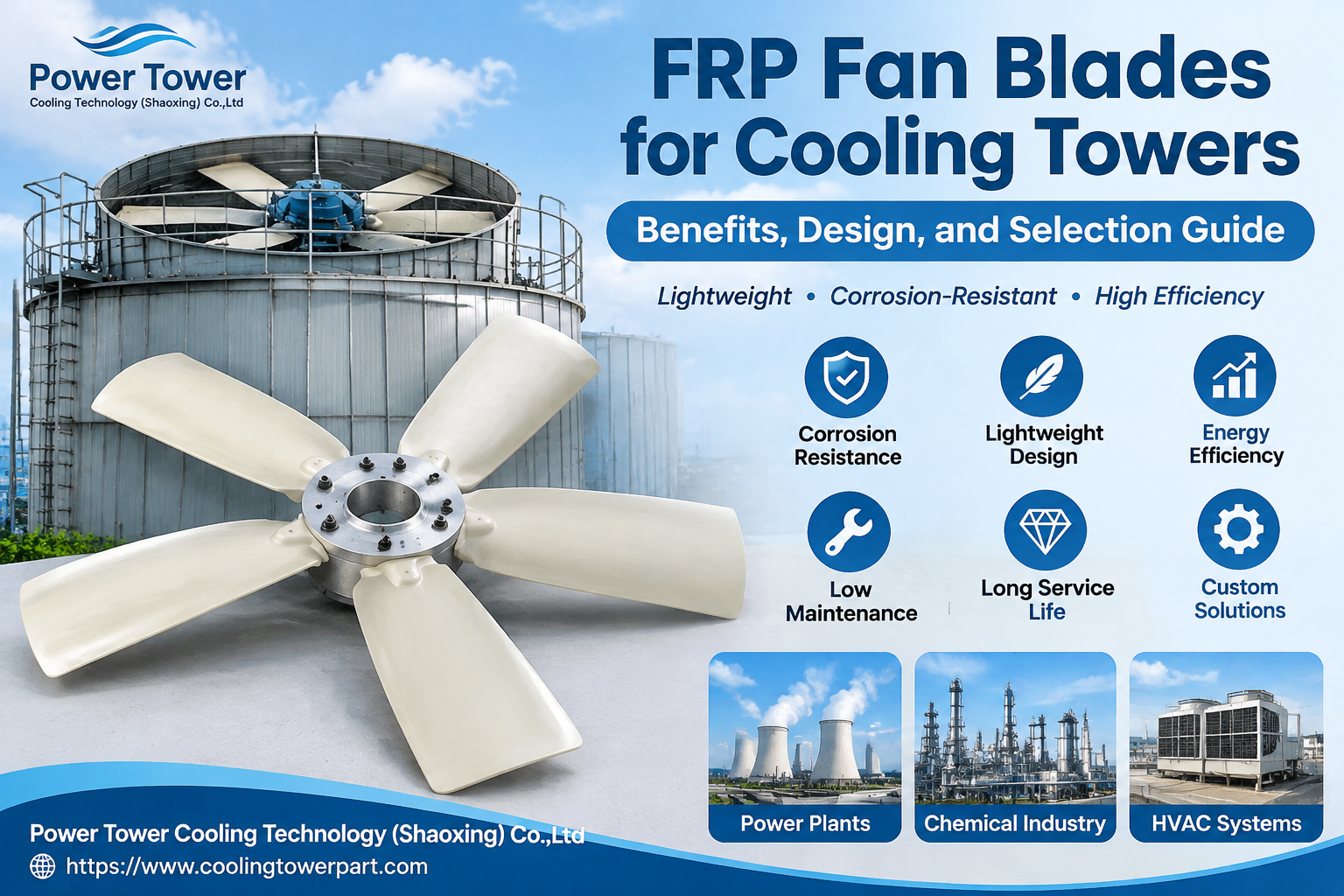
FRP fan blades for cooling towers are widely used in industrial cooling systems where corrosion resistance, lightweight construction, and reliable airflow are important. As a key component of a cooling tower, the fan directly affects airflow, heat rejection, operating efficiency, and equipment reliability.
Although a cooling tower fan may look like a simple rotating component, its design involves several important factors. Blade material, aerodynamic profile, pitch angle, fan diameter, and operating speed all influence overall performance. Choosing the wrong fan blades can lead to excessive vibration, increased motor load, insufficient airflow, and unnecessary maintenance costs.
So, why do many industrial cooling tower operators consider FRP fan blades? What makes them different from aluminum or stainless steel blades? And how can you select the right design for your cooling tower?
In this guide, we will explain the benefits, construction, applications, selection criteria, installation requirements, and maintenance of FRP cooling tower fan blades. We will also introduce the cooling tower component solutions offered by Power Tower Cooling Technology (Shaoxing) Co.,Ltd.
What Are FRP Fan Blades for Cooling Towers?
FRP stands for fiber-reinforced plastic. It is a composite material made by combining reinforcing fibers with a resin matrix. Glass fiber is commonly used in cooling tower fan blades because it offers a useful balance of strength, weight, and manufacturing flexibility.
FRP fan blades are designed to move large volumes of air through a cooling tower. As warm water flows through the tower, the fan helps draw or push air across the heat-transfer section. This airflow supports evaporation and removes heat from the circulating water.
Compared with some traditional metal designs, FRP blades offer a different combination of weight, corrosion resistance, and design flexibility. These properties make them worth considering for industrial environments where moisture, chemicals, and continuous operation can place significant demands on cooling tower equipment.
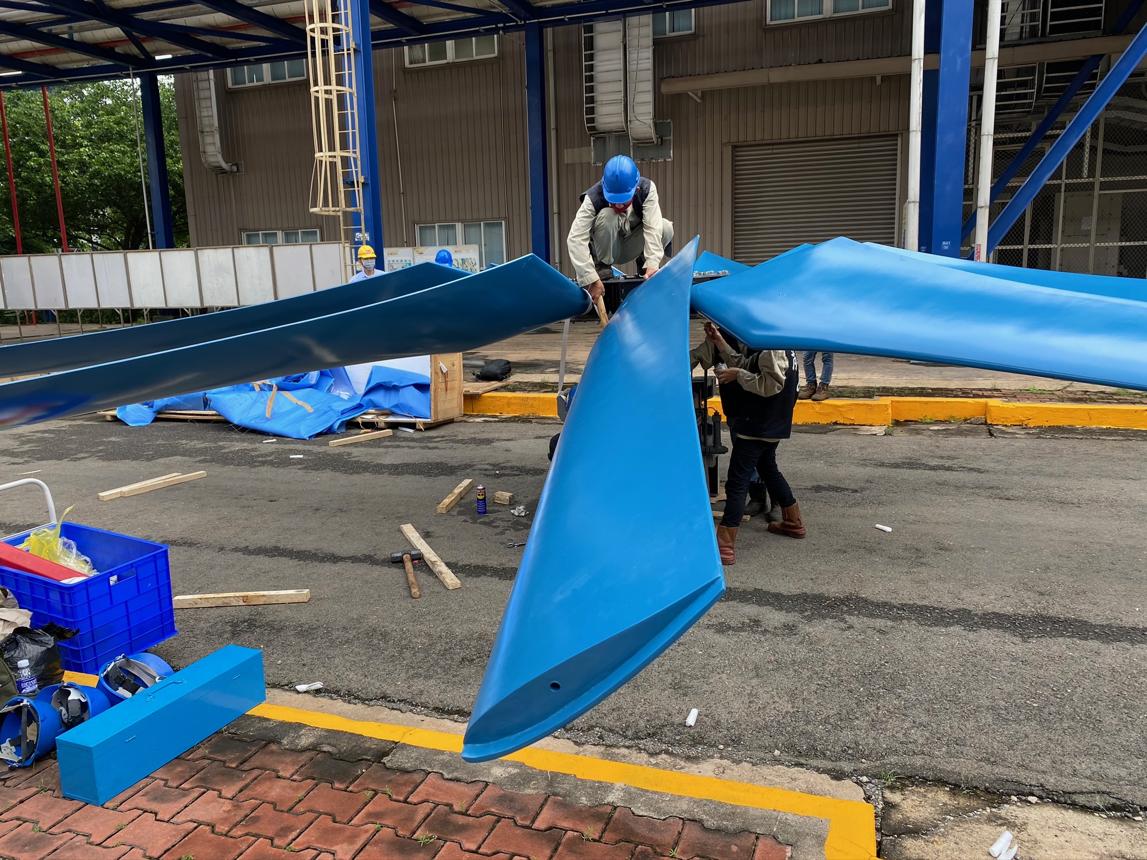
What Does FRP Mean?
FRP is not one material with a single fixed specification. Its properties depend on several factors:
The type of reinforcing fiber.
The resin system used.
Fiber orientation and distribution.
Blade thickness and internal structure.
Manufacturing and curing processes.
Quality control during production.
Polyester, vinyl ester, and epoxy resins may be considered for different operating environments. The correct selection depends on temperature, humidity, chemical exposure, and mechanical requirements.
For cooling tower applications, the objective is to manufacture a blade that can withstand continuous rotation, vibration, moisture, and environmental exposure while maintaining its intended aerodynamic shape.
How FRP Fan Blades Work in Cooling Towers
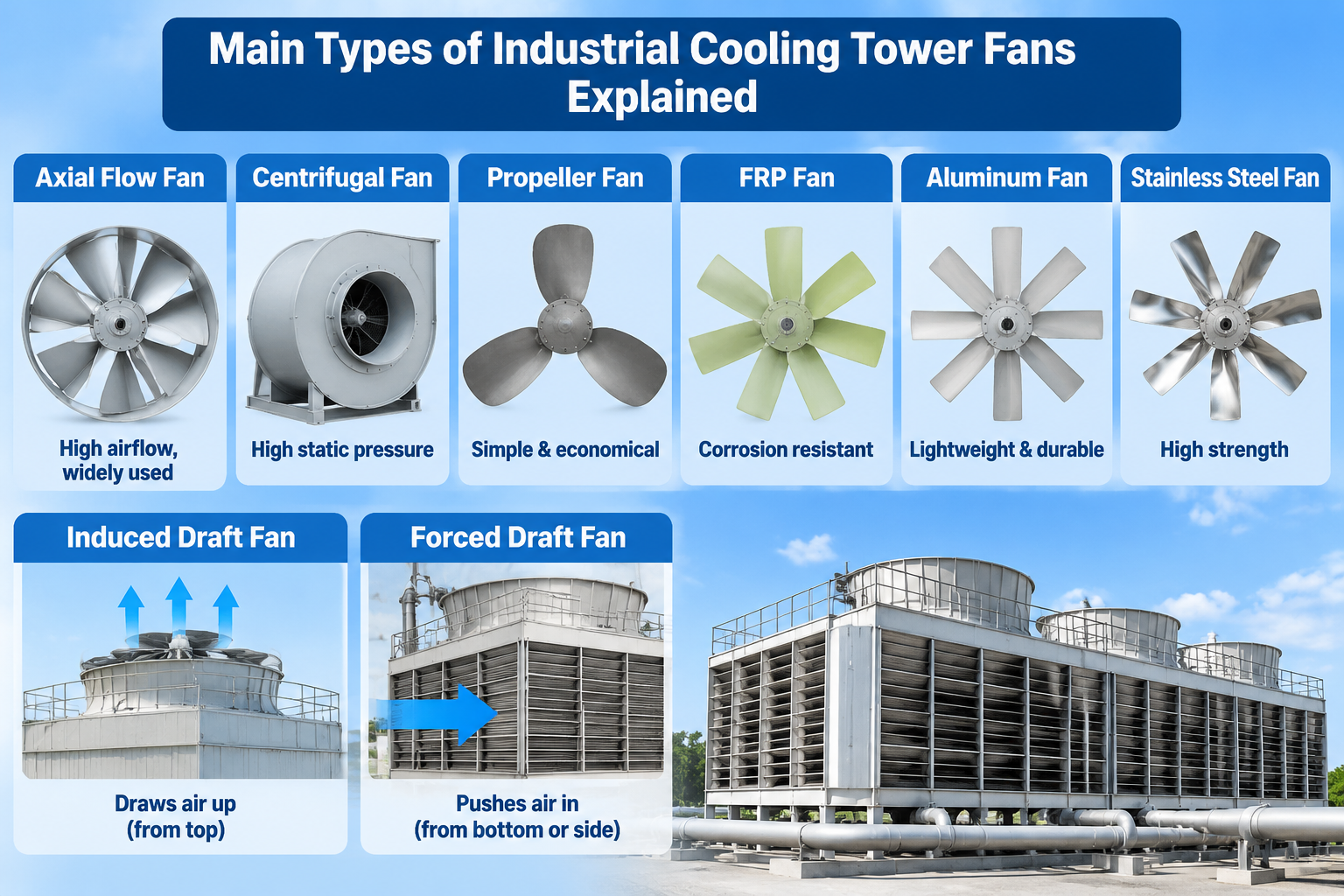
Cooling tower fans create airflow through the tower's heat-transfer section. In an induced-draft cooling tower, the fan is generally installed near the top and pulls air through the tower. In a forced-draft design, the fan pushes air into the tower.
FRP fan blades convert rotational energy from the drive system into airflow. Their aerodynamic profile creates the pressure difference needed to move air through the system.
Several factors influence fan performance:
Fan diameter.
Blade quantity.
Blade profile and width.
Blade pitch angle.
Rotational speed.
Airflow resistance.
Fan cylinder design.
A properly selected blade set helps the cooling tower achieve its required airflow without placing unnecessary demands on the motor or gearbox.
Main Components of an FRP Cooling Tower Fan
An FRP cooling tower fan is more than a group of rotating blades. It is a complete assembly in which the blades, hub, drive system, and fan cylinder must work together.
A problem in one component can affect the performance and reliability of the entire system.
FRP Fan Blade Structure
The blade is the aerodynamic component responsible for moving air. Its structure may include a shaped outer shell, internal reinforcement, and a connection area designed to transfer mechanical loads to the hub.
Important structural features include:
The blade must resist bending and vibration under operating loads. At the same time, its aerodynamic shape must be suitable for the required airflow and pressure conditions.
Fan Hub and Blade Connections
The hub connects individual blades to the rotating shaft or drive assembly. Depending on the fan design, blades may be attached using bolts, clamps, adjustable mounting arrangements, or other engineered connections.
The hub must distribute loads safely and maintain the correct blade position.
Before ordering replacement blades, check the following details:
Hub diameter and dimensions.
Mounting-hole pattern.
Bolt size and connection method.
Blade-root dimensions.
Blade mounting angle.
Compatibility with the existing fan assembly.
Never assume that blades from different fan models are interchangeable simply because their diameters appear similar.
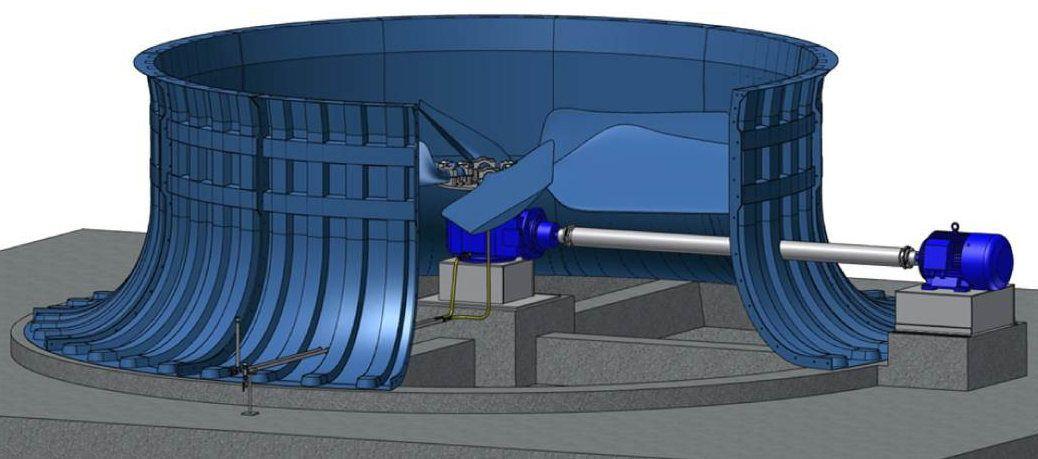
Fan Cylinder and Drive System
The fan cylinder, sometimes called the fan stack, guides airflow and provides clearance around the rotating blades.
The drive system may include an electric motor, gearbox, shaft, coupling, or belt arrangement, depending on the cooling tower design.
Incorrect alignment, excessive mechanical resistance, or unsuitable operating speed can reduce fan performance and increase vibration. Blade selection should therefore consider the complete fan assembly rather than the blade alone.
Key Benefits of FRP Fan Blades
Why do many cooling tower operators consider FRP fan blades? The answer is not just one feature. FRP combines several useful properties that can suit demanding industrial environments.
However, actual performance depends on blade design, material specification, manufacturing quality, and operating conditions.
1. Excellent Corrosion Resistance
Cooling towers operate in wet environments. Airborne moisture, water treatment chemicals, and industrial contaminants can expose fan components to corrosive conditions.
Properly selected FRP materials can provide strong resistance to moisture and many common cooling tower environmental conditions. Unlike some unprotected metal surfaces, FRP does not rely on a conventional metal coating to protect its composite structure.
This can make FRP an attractive option for towers where corrosion is a recurring maintenance concern.
However, FRP is not automatically resistant to every chemical. Different resin systems have different chemical resistance properties. If your cooling tower operates in a chemical or petrochemical environment, the expected exposure should be reviewed before selecting the material.
2. Lightweight Construction
One important advantage of FRP is its relatively low weight compared with many metal alternatives.
A lighter blade can reduce the mass that the fan drive system must rotate. It may also make handling and installation easier, especially when working on large industrial cooling towers.
Lightweight construction can be particularly useful when replacing older fan blades, provided that the new blades are compatible with the existing hub and drive arrangement.
However, a lighter blade does not automatically mean lower energy consumption. Actual power requirements depend on fan diameter, airflow, pressure, rotational speed, aerodynamic efficiency, and the complete drive system.
3. Strength and Structural Stability
Although FRP is lightweight, a properly engineered composite blade can provide the stiffness and strength required for industrial fan operation.
Fiber orientation and laminate design help determine how the blade responds to bending and other mechanical loads.
The blade must withstand:
Continuous aerodynamic loading.
Repeated starting and stopping.
Mechanical vibration.
Temperature changes.
Environmental exposure.
Loads around the blade root and hub connection.
Good structural design is essential because the blade root and mounting area can experience significant mechanical stress during operation.
4. Aerodynamic Performance and Energy Efficiency
Fan efficiency depends heavily on blade geometry.
A suitable airfoil profile can help the fan move the required airflow while limiting unnecessary aerodynamic losses. Blade pitch, surface finish, diameter, and rotational speed all contribute to performance.
FRP manufacturing allows designers to create different blade profiles and shapes for specific applications.
However, the material itself does not guarantee high efficiency. A poorly designed FRP fan may perform worse than a well-designed metal fan.
When comparing fan blades, consider verified performance data, including airflow, pressure, rotational speed, and power requirements. The objective is to achieve the required cooling tower performance without unnecessarily increasing energy consumption.
5. Lower Maintenance Requirements
FRP blades can reduce certain corrosion-related maintenance tasks when the material is suitable for the environment.
They may not require the same type of corrosion-protection coating used on some metal blades. This can simplify certain maintenance activities.
Even so, FRP fan blades are not maintenance-free. Operators should inspect them for cracks, surface damage, delamination, loose fasteners, unusual vibration, and other signs of deterioration.
Regular inspection helps identify problems before they develop into serious mechanical failures.
Where Are FRP Cooling Tower Fan Blades Used?
FRP fan blades can be considered for many cooling tower applications. The right design depends on airflow requirements, tower configuration, operating temperature, chemical exposure, and the fan's mechanical arrangement.
Power Plants and Energy Facilities
Power stations use cooling towers to reject heat from circulating cooling water. Fans may operate for long periods, making reliability and maintenance important considerations.
FRP blades can be suitable where their material specification matches the site's environmental and mechanical requirements.
Correct blade selection should account for the fan's duty point, operating speed, and required airflow.
Chemical and Petrochemical Industries
Chemical and petrochemical facilities may expose cooling tower equipment to humid air and airborne contaminants.
In these environments, corrosion resistance can be an important selection factor. FRP may offer advantages over certain metal materials, but the specific resin system must be compatible with the expected chemical exposure.
A material review is recommended before finalizing the blade design.
HVAC and Commercial Cooling Systems
Large commercial buildings, hospitals, data centers, and industrial HVAC facilities may use cooling towers as part of their heat-rejection systems.
Fan efficiency and dependable operation affect the overall cooling system. FRP blades may be considered when their dimensions and performance characteristics match the existing tower and fan assembly.
Steel, Cement, and Manufacturing Plants
Manufacturing facilities often operate cooling towers under demanding conditions. Dust, heat, moisture, and continuous operation can create challenging environments for fan equipment.
FRP blades may be a practical choice when their construction is designed for the site's conditions.
Operators should also consider dust accumulation, cleaning access, vibration, and maintenance procedures.
FRP vs. Aluminum vs. Stainless Steel Fan Blades
No blade material is best for every cooling tower. FRP, aluminum, and stainless steel each have different strengths and limitations.
The following comparison provides a general guide. Actual results depend on alloy or composite grade, blade design, manufacturing quality, and operating environment.
| Comparison Factor | FRP Fan Blades | Aluminum Fan Blades | Stainless Steel Fan Blades |
| Weight | Relatively lightweight | Lightweight | Generally heavier |
| Corrosion resistance | Good when correctly specified | Depends on alloy and treatment | Depends on stainless steel grade and exposure |
| Design flexibility | High composite design flexibility | Depends on manufacturing method | Depends on manufacturing method |
| Mechanical properties | Depends on fiber and resin design | Depends on alloy and blade structure | Generally high mechanical strength |
| Maintenance | Requires composite inspection | May require surface and corrosion checks | Requires inspection for corrosion and mechanical damage |
| Typical consideration | Corrosive or humid environments | Weight-sensitive applications | Applications requiring specific metal properties |
Which Material Should You Choose?
Choose FRP when lightweight construction, corrosion resistance, and composite design flexibility are important.
Consider aluminum when a lightweight metal blade is suitable for the operating environment and fan requirements.
Consider stainless steel when its mechanical properties and corrosion resistance are appropriate for the application.
When comparing options, look beyond the initial purchase price. Consider expected operating conditions, maintenance requirements, installation costs, fan performance, and replacement costs.
How Are FRP Fan Blades Designed?
FRP fan blade design involves more than choosing a material. Engineers must consider airflow, pressure, rotational speed, structural loads, and the geometry of the existing cooling tower.
A suitable blade must work efficiently while remaining mechanically stable throughout its operating life.
Blade Profile and Aerodynamic Shape
The blade profile determines how air flows around the blade as it rotates.
A suitable airfoil shape helps generate the pressure difference needed to move air through the tower. Blade width, twist, curvature, and thickness distribution can all affect performance.
The design should match the fan's intended operating point. Simply installing a blade with a similar appearance or diameter does not guarantee equivalent airflow.
Blade Pitch and Angle
Blade pitch is the angle at which a blade is installed relative to the plane of rotation or the manufacturer's defined reference.
Pitch affects airflow, pressure, and motor load. Increasing the pitch may increase airflow in some conditions, but it can also raise power demand and overload the drive system.
The correct angle must follow the fan manufacturer's specifications and be checked consistently across all blades.
Fiber and Resin Selection
The reinforcing fiber provides much of the composite's structural strength, while the resin binds the fibers together and helps protect the structure.
Glass fiber is commonly used for cooling tower fan blades. Resin selection should consider:
Manufacturers should also control fiber distribution, resin content, curing, and the quality of the blade root and connection areas.
Manufacturing Quality and Inspection
Consistent manufacturing is essential for reliable fan operation.
Important quality checks may include:
Visual inspection.
Dimensional verification.
Weight consistency.
Surface condition.
Connection-hole accuracy.
Checks for visible defects.
Relevant product testing, where specified.
Buyers should ask suppliers what quality-control procedures and product documentation are available.
How to Select the Right FRP Fan Blades
Selecting FRP fan blades should begin with the existing cooling tower and its operating requirements.
A blade that fits physically may still be unsuitable if its aerodynamic characteristics or mechanical connections do not match the system.
Use the following checklist before requesting a quotation.
1. Check Cooling Tower Type and Fan Diameter
First, identify whether the cooling tower is induced-draft or forced-draft, crossflow or counterflow, and whether it uses a single fan or multiple fans.
Record the existing fan diameter and available installation clearance.
Measure the fan cylinder carefully. The replacement blade set must provide suitable clearance from the cylinder and nearby components throughout rotation.
2. Confirm Airflow and Static Pressure
Airflow and pressure requirements are central to fan selection.
Ask for the original fan performance data if available. Important information may include:
Required airflow.
Static pressure.
Fan speed.
Motor power.
Operating conditions.
If the original data is unavailable, the tower model and site measurements can help a qualified supplier assess the replacement requirements.
Avoid selecting blades based only on the old blade's external dimensions.
3. Match Blade Quantity, Pitch, and Rotation Speed
Record the number of blades, their mounting arrangement, pitch angle, and rotation direction.
Confirm the motor speed and gearbox ratio, if a gearbox is installed.
A replacement set must be compatible with the fan hub and drive system. Changes to blade quantity or pitch should only be made after checking the fan design and motor load.
4. Consider Operating Conditions
Review the following site conditions:
These factors can influence material selection and maintenance needs.
If the cooling tower operates in a chemical environment, provide the supplier with details of the expected exposure rather than simply requesting a general corrosion-resistant blade.
5. Check Hub and Drive Compatibility
Hub dimensions and blade connections are critical.
Provide the hub model, mounting-hole pattern, bolt size, blade-root dimensions, and any available drawings.
Also confirm the motor, gearbox, shaft, and coupling arrangement. When possible, share photographs of the existing fan assembly from several angles.
These details reduce the risk of ordering incompatible replacement components.
FRP Fan Blade Installation Guide
Proper installation is essential for safety and performance.
Before work begins, isolate the fan's electrical supply and follow the site's lockout and tagout procedures. Confirm that the fan cannot start unexpectedly.
Installation should be performed by qualified personnel using the manufacturer's instructions.
Follow these general steps:
Inspect the existing assembly. Check the hub, mounting hardware, fan cylinder, and drive system before installing replacement blades.
Confirm blade compatibility. Verify blade dimensions, connection details, and the required installation arrangement.
Install the blades correctly. Use the specified mounting positions and recommended fastener specifications.
Check blade pitch. Measure the pitch of each blade using the same reference method.
Verify clearance. Check blade-tip clearance and confirm that the assembly rotates freely without contact.
Inspect fasteners. Confirm that all connections meet the manufacturer's requirements.
Complete commissioning checks. Follow the manufacturer's procedure and check for abnormal vibration, noise, and motor load during initial operation.
Never operate a fan if there is suspected blade damage or an unsafe installation condition.
Maintenance and Inspection Tips
A planned maintenance routine helps extend the useful service life of FRP fan blades.
Inspection frequency should reflect operating hours, environmental conditions, manufacturer recommendations, and the site's maintenance policy.
During inspection, look for:
Check the blade root and hub connections for looseness or damage. Inspect the fan cylinder for obstructions and confirm that the blade tips have adequate clearance.
Monitor vibration and unusual operating noise. If vibration increases, investigate the cause rather than assuming the blades simply need tightening.
Cleaning should use methods and products compatible with the resin system. Avoid aggressive chemicals or procedures that could damage the composite surface.
Any blade with suspected structural damage should be assessed by qualified personnel before the fan returns to service.
Common FRP Fan Blade Problems and Solutions
Even a well-designed FRP fan blade can develop problems if it is incorrectly installed, operated outside its intended conditions, or poorly maintained.
Here are some common issues and possible causes.
Excessive Vibration
Possible causes include:
Stop the fan when necessary and inspect the complete assembly. Do not assume that vibration always comes from the blades alone.
Cracks or Chips
Cracks and chips may result from impact, fatigue, handling damage, or excessive mechanical stress.
Have the blade assessed and replace it if its structural integrity is compromised. Do not return a structurally damaged blade to service without an appropriate technical assessment.
Reduced Airflow
Reduced airflow may be related to incorrect blade pitch, fan speed, rotation direction, obstructions, or fan-cylinder condition.
Also investigate changes in system resistance and other cooling tower components.
Unusual Noise
Look for loose components, blade contact, bearing or gearbox problems, and foreign objects.
Unusual noise should be investigated promptly because it may indicate a developing mechanical problem.
Surface Deterioration
Review the operating environment, cleaning chemicals, and material suitability.
Do not apply an unapproved coating or repair method without checking with the manufacturer.
When Should You Replace FRP Fan Blades?
Replacement may be necessary when a blade has:
A fan may also need a complete blade replacement when its performance no longer meets the cooling tower's requirements or when compatible spare parts are unavailable.
Do not wait for a blade to fail during operation. A damaged rotating component can create serious safety risks and cause additional damage to the fan assembly.
If only one blade appears damaged, ask the manufacturer whether individual replacement is permitted. Some fan designs require matched blade sets to maintain consistent weight, geometry, and balance.
How to Choose a Reliable FRP Fan Blade Manufacturer
A dependable supplier should understand cooling tower fan systems, not just composite materials.
Look for a manufacturer that can review the fan's dimensions, operating conditions, hub arrangement, and performance requirements.
Before placing an order, consider these points:
1. Technical knowledge: The supplier should understand cooling tower fan structures, blade profiles, pitch settings, and drive arrangements.
2. Material information: Ask about the fiber and resin systems used and their suitability for your operating environment.
3. Dimensional accuracy: Blade dimensions, connection positions, and mounting details should be checked against your existing equipment.
4. Quality control: Ask what inspections and product documentation are available.
5. Replacement support: A supplier should be able to review existing fan information and help assess replacement compatibility.
6. Communication: A reliable supplier should ask for the technical information needed to evaluate your requirements instead of promising that a blade will fit based on a single measurement.
Choosing a supplier based on technical support and product compatibility can help reduce installation problems and unnecessary replacement costs.
FRP Cooling Tower Fan Blade Solutions from Power Tower
Power Tower Cooling Technology (Shaoxing) Co.,Ltd focuses on cooling tower components and replacement solutions.
For customers looking for FRP fan blades for cooling towers, selecting a suitable product starts with understanding the existing fan and its operating conditions.
Rather than choosing blades by appearance alone, buyers should provide technical information so that dimensions, mounting arrangements, and operating requirements can be reviewed.
To help assess your replacement or customization requirements, prepare the following information:
Cooling tower brand and model.
Fan diameter.
Number of blades.
Existing blade dimensions and pitch.
Hub dimensions and connection details.
Motor power and speed.
Gearbox ratio, if applicable.
Required airflow or original fan data.
Operating environment.
Clear photographs of the existing fan and blades.
Providing these details makes it easier to evaluate product compatibility and identify the information needed for a suitable replacement solution.
You can learn more about cooling tower components and contact Power Tower through the official website:
https://www.coolingtowerpart.com
Frequently Asked Questions
Are FRP Fan Blades Suitable for All Cooling Towers?
No. FRP blades can be suitable for many industrial and commercial cooling towers, but compatibility depends on fan diameter, airflow, pressure, speed, hub design, motor capacity, and operating conditions.
The blade set should be checked against the fan manufacturer's specifications before installation.
Are FRP Fan Blades Better Than Aluminum Blades?
Neither material is always better.
FRP may be attractive where low weight and corrosion resistance are important. Aluminum can also offer a lightweight solution and may be suitable for many fan designs.
Compare the actual blade construction, aerodynamic performance, environmental compatibility, and total ownership cost before deciding.
How Long Do FRP Cooling Tower Fan Blades Last?
There is no single service-life figure that applies to every FRP blade.
Service life depends on material quality, design, operating speed, vibration, temperature, chemical exposure, maintenance, and installation quality.
Regular inspection is more reliable than assuming a fixed replacement interval.
Can FRP Fan Blades Be Customized?
Many FRP fan blade designs can be produced for specific dimensions and applications. However, customization requires accurate technical information and engineering review.
Provide the existing fan details, hub measurements, operating data, and photographs so the supplier can assess the requirements.
What Information Is Needed to Order Replacement FRP Fan Blades?
At minimum, prepare the cooling tower model, fan diameter, blade quantity, hub dimensions, blade pitch, motor speed, and clear photographs.
If available, also provide the original fan drawings, airflow requirements, and gearbox information. These details help the supplier evaluate compatibility.
Do FRP Fan Blades Need Regular Balancing?
Fan balance is important for safe and reliable operation. The required balancing procedure depends on the fan design and manufacturer specifications.
After blade replacement or repair, the complete fan assembly should be checked according to the manufacturer's commissioning and balancing requirements.
Conclusion
FRP fan blades offer an appealing combination of lightweight construction, corrosion resistance, structural design flexibility, and potential maintenance advantages for cooling tower applications.
But the right choice is not simply the blade made from the most attractive material. It is the blade that matches the cooling tower's airflow requirements, fan geometry, drive system, and operating environment.
Before purchasing replacement blades, confirm the fan diameter, blade quantity, pitch, hub connection, speed, and performance requirements. Work with a supplier that can review these details and provide clear technical guidance.
For cooling tower component and replacement inquiries, contact Power Tower Cooling Technology (Shaoxing) Co.,Ltd through:
Website: https://www.coolingtowerpart.com
Choosing the right FRP fan blades can help support reliable airflow, stable operation, and long-term cooling tower performance.


