How to Choose a Reliable Fiberglass Cooling Tower Fan Stack Manufacturer?
Choosing a reliable fiberglass cooling tower fan stack manufacturer is an important decision for industrial cooling tower projects. The fan stack plays a critical role in directing airflow, improving fan performance, reducing air recirculation, and supporting the overall operating efficiency of a cooling tower. A poorly designed or manufactured fan stack can lead to airflow losses, excessive vibration, structural problems, and higher maintenance costs.
Fiberglass Reinforced Plastic (FRP) has become a popular material for cooling tower fan stacks because of its lightweight structure, corrosion resistance, high strength-to-weight ratio, and design flexibility. However, not every manufacturer offers the same level of engineering capability, product quality, or customization.
For cooling tower operators, equipment distributors, engineering contractors, and OEM buyers, selecting the right supplier requires more than comparing prices. It involves evaluating material quality, manufacturing processes, structural design, dimensional accuracy, quality control, and after-sales support.
This article explains the key factors to consider when choosing a reliable fiberglass cooling tower fan stack manufacturer and how to identify a supplier capable of meeting your industrial requirements.
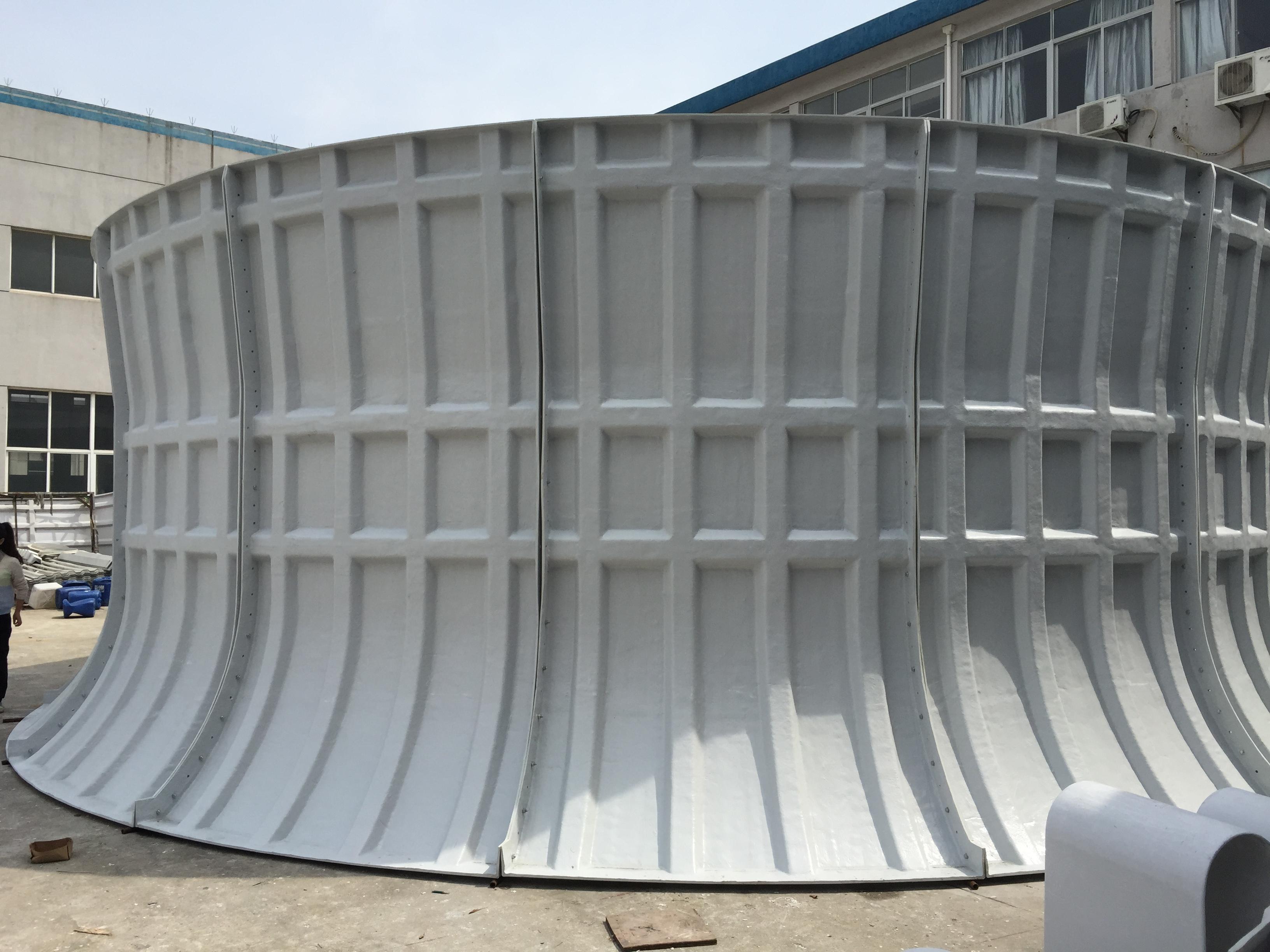
1. Understand the Importance of a Fiberglass Cooling Tower Fan Stack
Before selecting a manufacturer, it is essential to understand how a fiberglass cooling tower fan stack contributes to cooling tower operation.
The fan stack is the cylindrical or specially shaped structure surrounding the cooling tower fan. Its primary purpose is to guide discharged air upward and help establish a stable airflow pattern.
1.1 Improve Airflow Direction and Efficiency
A properly designed fan stack helps direct air vertically away from the cooling tower.
Its aerodynamic profile can help:
Reduce unnecessary airflow resistance.
Improve discharge airflow distribution.
Minimize the potential for hot air recirculation.
Support stable fan operation.
Improve overall cooling tower performance.
Why Does Fan Stack Geometry Matter?
The stack diameter, height, inlet profile, and outlet configuration influence how air moves through the fan system.
A poorly designed structure may create turbulence or additional pressure losses. Therefore, manufacturers should understand fan aerodynamics rather than simply produce a fiberglass shell based on basic dimensions.
1.2 Protect the Cooling Tower Fan Assembly
The fan stack also provides structural protection around the fan blades.
A properly manufactured stack helps maintain appropriate clearance between the rotating blades and surrounding structure.
Important Design Considerations
Accurate internal diameter.
Proper blade-tip clearance.
Sufficient structural rigidity.
Secure mounting connections.
Resistance to environmental exposure.
These factors are particularly important for large industrial cooling towers operating continuously.
2. Evaluate the Manufacturer's FRP Material Quality
Material quality is one of the most important factors when selecting a fiberglass cooling tower fan stack manufacturer.
FRP combines reinforcing glass fibers with a resin matrix to create a composite material suitable for demanding industrial environments.
2.1 Check the Fiberglass Reinforcement
Fiberglass reinforcement provides mechanical strength and helps the fan stack withstand operational loads.
A qualified manufacturer should be able to explain its reinforcement materials and laminate construction.
What Should Buyers Check?
Consider asking about:
Fiberglass reinforcement type.
Fiber content and distribution.
Laminate thickness.
Reinforcement orientation.
Surface protection and finishing.
Manufacturing consistency.
Different cooling tower applications may require different reinforcement configurations depending on stack dimensions, support arrangements, and operating conditions.
2.2 Examine the Resin System
The resin matrix protects the fiberglass reinforcement and transfers loads throughout the composite structure.
Common resin systems include:
How to Select the Appropriate Resin?
For ordinary industrial cooling tower applications, suitable polyester resin systems may provide an economical solution.
For environments involving more aggressive chemical exposure, vinyl ester systems may be considered.
Buyers should evaluate operating temperature, water chemistry, humidity, chemical exposure, and expected service conditions before choosing a resin system.
2.3 Consider UV and Weather Resistance
Cooling tower fan stacks are frequently installed outdoors and exposed to sunlight, rain, wind, and temperature changes.
A reliable manufacturer should provide suitable surface protection and finishing systems.
Look for:
UV-resistant gel coats or protective coatings.
Consistent surface finishing.
Moisture-resistant composite construction.
Appropriate outdoor installation specifications.
These details can help reduce premature surface degradation and extend the useful service life of the equipment.
3. Examine the Manufacturer's Design and Engineering Capabilities
A professional fiberglass cooling tower fan stack manufacturer should have the engineering capability to develop products for different cooling tower configurations.
Standard products may be suitable for some projects, but industrial cooling towers often require customized dimensions and structural arrangements.
3.1 Check Customization Capabilities
Different cooling tower brands and models may use different fan stack dimensions.
A qualified supplier should be able to manufacture customized FRP fan stacks according to project requirements.
Common Customization Options
Different stack diameters.
Customized stack heights.
Various wall thicknesses.
Different flange configurations.
Special mounting arrangements.
Customized colors and surface finishes.
For replacement projects, dimensional compatibility is particularly important because the new fan stack must fit the existing cooling tower structure.
3.2 Evaluate Aerodynamic Design Knowledge
A good manufacturer should understand the relationship between fan geometry and fan stack design.
Important Technical Parameters
Fan diameter: The stack must accommodate the fan diameter and the required blade-tip clearance.
Stack height: The height should be determined according to the cooling tower design and airflow requirements.
Inlet configuration: The inlet profile can influence airflow entry and local turbulence.
Outlet geometry: The upper section should support effective vertical air discharge.
Internal surface: A smooth and consistent internal surface can help avoid unnecessary airflow disturbances.
Manufacturers should avoid recommending dimensions without considering the actual fan assembly and operating conditions.
3.3 Request Engineering Drawings Before Production
Technical drawings help prevent misunderstandings during customization.
Before placing an order, buyers should request drawings showing:
Why Are Drawings Important?
Approved drawings provide a clear reference for manufacturing and inspection.
They also help buyers confirm whether the proposed fiberglass cooling tower fan stack is compatible with the existing equipment.
4. Investigate the Manufacturing Process
Manufacturing technology directly influences the consistency, mechanical properties, and appearance of an FRP cooling tower fan stack.
Buyers should understand how the supplier produces its fiberglass products.
4.1 Common FRP Manufacturing Methods
Different production methods are suitable for different fan stack designs.
Hand Lay-Up Process
Hand lay-up is a commonly used method for producing customized fiberglass components.
Fiberglass reinforcement is placed into a mold, and resin is applied to create the composite structure.
Advantages include:
Flexible product dimensions.
Suitable for customized shapes.
Relatively low tooling requirements.
Convenient production of specialized components.
However, manufacturing quality depends heavily on process control and worker experience.
Spray-Up Process
Spray-up uses specialized equipment to apply chopped fiberglass and resin onto a mold.
It can be suitable for certain large fiberglass structures and production requirements.
The manufacturer should control fiber distribution, resin content, thickness, and curing conditions.
Mold-Based Production
Mold-based manufacturing can improve dimensional consistency and surface quality.
For repeated production of similar fan stacks, suitable molds help maintain consistent product geometry.
4.2 Check Production Equipment and Facilities
A professional manufacturer should have suitable production facilities for large FRP components.
When evaluating a supplier, consider:
Mold quality and maintenance.
Fiberglass cutting equipment.
Resin mixing and application equipment.
Curing and finishing facilities.
Dimensional inspection tools.
Storage and packaging areas.
A factory with established production procedures is generally better positioned to deliver consistent products across multiple orders.
5. Verify Quality Control and Product Testing
Quality control is essential when purchasing a fiberglass cooling tower fan stack for industrial applications.
Because the fan stack operates near rotating equipment and is exposed to outdoor conditions, manufacturing defects can create operational and maintenance problems.
5.1 Inspect Dimensional Accuracy
Dimensional accuracy is especially important for replacement fan stacks.
Even small dimensional differences may affect installation, mounting alignment, or fan clearance.
Key Dimensions to Inspect
Stack internal diameter.
Overall height.
Circularity and roundness.
Flange thickness.
Bolt-hole spacing.
Mounting surface flatness.
Wall thickness consistency.
A reliable manufacturer should have documented inspection procedures.
5.2 Evaluate Structural Quality
The fan stack should have sufficient structural strength for its intended installation and operating conditions.
Depending on the design, important considerations may include:
Ask About Quality Documentation
Buyers can request relevant documents, such as:
Material specifications.
Production inspection reports.
Dimensional inspection records.
Resin and fiberglass material information.
Applicable quality management certifications.
Do not assume that a certification automatically guarantees product performance. Check whether the documentation applies to the actual manufacturing facility and product.
6. Compare Manufacturer Experience and Industry References
Experience is another important indicator when choosing a fiberglass cooling tower fan stack supplier.
Manufacturing large industrial composite components requires knowledge of material behavior, structural design, production techniques, and installation requirements.
6.1 Look for Relevant Cooling Tower Experience
A manufacturer with cooling tower industry experience is more likely to understand the practical requirements of fan stacks.
Check whether the company has experience supplying:
Industrial cooling tower fan stacks.
FRP cooling tower components.
Cooling tower fan shrouds.
FRP structural panels.
Customized cooling tower replacement parts.
Questions to Ask Potential Suppliers
How many years have you manufactured FRP cooling tower components?
Can you provide examples of previous fan stack projects?
Do you manufacture customized fan stacks?
Can you supply products for different cooling tower brands?
Do you support overseas industrial projects?
6.2 Check Customer References and Project Experience
Previous projects can help buyers understand the manufacturer's actual capabilities.
Ask for product photographs, technical drawings, project descriptions, or references where available.
Pay particular attention to projects involving similar stack diameters, operating conditions, and installation requirements.
A supplier's ability to explain previous technical challenges can also reveal its engineering experience.
7. Assess Custom Manufacturing and Replacement Services
For many industrial buyers, finding a manufacturer capable of producing non-standard fiberglass fan stacks is essential.
Older cooling towers may have discontinued components or dimensions that are unavailable from original equipment suppliers.
7.1 Replacement for Existing Cooling Towers
A customized FRP fan stack can be manufactured to replace damaged, corroded, or outdated structures.
The replacement process should begin with accurate measurements of the existing equipment.
Information Required for Replacement
Original cooling tower model.
Existing fan diameter.
Fan stack internal diameter.
Stack height.
Existing mounting dimensions.
Photographs of the installation.
Operating environment.
Providing complete information helps the manufacturer evaluate compatibility before production.
7.2 OEM and Customized Manufacturing
OEM buyers and cooling tower contractors may require fan stacks with specific dimensions, colors, structural configurations, and branding requirements.
An experienced manufacturer should be able to coordinate product development, sample approval, production, and quality inspection.
Benefits of Customized FRP Fan Stacks
Better compatibility with existing equipment.
Greater flexibility in product dimensions.
Application-specific material selection.
Consistent specifications for replacement projects.
More convenient sourcing of specialized components.
8. Consider Corrosion Resistance and Long-Term Durability
Cooling towers operate in environments with continuous moisture exposure, temperature fluctuations, and potentially corrosive substances.
These conditions can affect the service life of metal and composite components.
8.1 Why Is FRP Suitable for Cooling Tower Environments?
Fiberglass reinforced plastic offers several advantages over many traditional metallic materials.
| Performance Factor | FRP Fan Stack Characteristics |
| Corrosion resistance | Good resistance to many common cooling tower environmental conditions |
| Weight | Relatively lightweight |
| Structural strength | High strength-to-weight ratio |
| Maintenance | Generally low routine maintenance requirements |
| Design flexibility | Suitable for customized shapes and dimensions |
| Electrical properties | Generally electrically nonconductive |
Actual performance depends on resin selection, laminate design, manufacturing quality, and operating conditions.
8.2 Understand Long-Term Maintenance Requirements
Even durable FRP structures require periodic inspection.
Recommended maintenance activities include:
Checking for visible cracks.
Inspecting mounting bolts and connections.
Examining the surface for damage.
Checking for delamination or exposed fibers.
Inspecting the stack for deformation.
Confirming that fan blade clearance remains appropriate.
Regular inspections can help identify problems before they affect cooling tower operation.
9. Compare Pricing Without Sacrificing Quality
Price is an important purchasing consideration, but choosing the lowest quotation is not always the most economical decision.
A low-priced fiberglass cooling tower fan stack may involve thinner laminates, unsuitable resin systems, inconsistent manufacturing, or insufficient quality inspection.
9.1 Understand the Factors Affecting FRP Fan Stack Prices
The cost of a fiberglass fan stack depends on several factors.
Main Pricing Factors
Product dimensions: Larger diameters and greater heights generally require more materials.
Material selection: Fiberglass reinforcement and resin specifications influence production costs.
Wall thickness: Different structural requirements result in different material consumption.
Manufacturing method: Tooling, labor, and production complexity affect the final price.
Customization: Special designs and non-standard dimensions may increase engineering and production costs.
Packaging and transportation: Large fan stacks may require specialized packaging and shipping arrangements.
9.2 Compare Complete Technical Quotations
When comparing suppliers, make sure quotations cover the same technical specifications.
A useful quotation should clearly identify:
Comparing quotations based on identical requirements provides a more reliable basis for purchasing decisions.
10. Evaluate Communication and After-Sales Support
A reliable manufacturer should provide effective technical communication throughout the purchasing process.
This is particularly important for overseas buyers who may need customized products and international shipping arrangements.
10.1 Technical Support Before Ordering
Before production, the supplier should help confirm dimensions, material specifications, and installation requirements.
Good communication helps prevent incorrect orders and unnecessary modifications.
10.2 Production Updates and Delivery Coordination
Professional suppliers should provide reasonable updates during manufacturing.
Buyers should confirm:
10.3 After-Sales Technical Assistance
After-sales support can be important when installing or replacing large FRP fan stacks.
A dependable supplier should be prepared to help clarify installation dimensions, connection details, and product-related technical questions.
11. Common Mistakes to Avoid When Selecting a Manufacturer
Even experienced purchasing professionals can overlook important details when sourcing fiberglass cooling tower fan stacks.
11.1 Choosing a Supplier Based Only on Price
The cheapest product may not provide the required structural performance or dimensional accuracy.
Instead, compare technical specifications, manufacturing quality, and total project costs.
11.2 Ignoring Fan Blade Clearance
The fan stack must be compatible with the installed fan assembly.
Incorrect dimensions can create clearance problems and increase the risk of mechanical interference.
How to Avoid This Problem
Confirm the fan diameter, stack internal diameter, blade-tip clearance, and installation tolerances before production.
11.3 Overlooking Material Specifications
Simply stating that a product is made of fiberglass is insufficient.
Buyers should confirm the resin system, fiberglass reinforcement, laminate thickness, and protective surface treatment.
11.4 Failing to Approve Technical Drawings
Starting production without approved drawings can result in dimensional errors.
Always confirm critical measurements and mounting details before manufacturing begins.
11.5 Neglecting Transportation and Installation
Large fiberglass structures require suitable packaging and handling procedures.
Discuss transportation dimensions, lifting arrangements, and installation requirements with the manufacturer before ordering.
12. A Practical Checklist for Choosing the Best FRP Fan Stack Supplier
The following checklist can help purchasing managers and engineering contractors evaluate potential manufacturers.
| Evaluation Criteria | What to Confirm |
| Manufacturing experience | Experience with FRP cooling tower components |
| Material quality | Fiberglass reinforcement and resin specifications |
| Engineering capability | Ability to develop customized designs |
| Dimensional accuracy | Reliable inspection and measurement procedures |
| Manufacturing process | Suitable production methods and process controls |
| Product durability | Appropriate environmental resistance |
| Quality documentation | Material and inspection records |
| Customization | Ability to meet non-standard requirements |
| Delivery capability | Production and shipping arrangements |
| Technical support | Pre-sales and after-sales assistance |
A manufacturer that performs well across these areas is generally a stronger candidate for long-term cooperation.
13. Why Work with an Experienced Fiberglass Cooling Tower Fan Stack Manufacturer in China?
China has an established industrial supply chain for fiberglass reinforced plastic products and cooling tower components.
Working with an experienced Chinese manufacturer can provide access to customized production, competitive manufacturing costs, and a broad range of industrial cooling tower products.
13.1 Flexible Manufacturing Capabilities
Chinese FRP manufacturers can offer customized fan stack dimensions, different resin systems, and various structural configurations.
This flexibility is valuable for cooling tower replacement projects and OEM applications.
13.2 Integrated Cooling Tower Component Supply
Some manufacturers also supply complementary cooling tower components, such as:
Cooling tower fan blades.
FRP fan stacks.
Cooling tower fan hubs.
Cooling tower fill media.
Drift eliminators.
FRP structural components.
Working with a supplier familiar with multiple cooling tower components can simplify technical coordination and procurement.
13.3 Better Coordination for International Buyers
Experienced export manufacturers understand the importance of product specifications, packaging, shipping arrangements, and international documentation.
For overseas distributors and industrial contractors, this can make the purchasing process more efficient.
However, buyers should still evaluate each supplier according to its actual manufacturing facilities, technical capabilities, and product quality.
14. Final Thoughts: Make the Right Choice for Long-Term Cooling Tower Performance
Choosing a reliable fiberglass cooling tower fan stack manufacturer requires careful evaluation of material quality, engineering capabilities, production processes, product dimensions, and quality management.
A high-quality FRP cooling tower fan stack should provide suitable structural strength, corrosion resistance, dimensional accuracy, and compatibility with the cooling tower fan assembly.
Rather than focusing exclusively on the initial purchase price, industrial buyers should consider the complete value of the product, including installation compatibility, maintenance requirements, expected service life, and supplier support.
By working with an experienced manufacturer that understands cooling tower applications, buyers can reduce sourcing risks and obtain customized fiberglass fan stacks that meet their operational requirements.
For cooling tower contractors, distributors, and industrial plant operators, choosing the right manufacturing partner is an important step toward maintaining reliable and efficient cooling tower operation.


