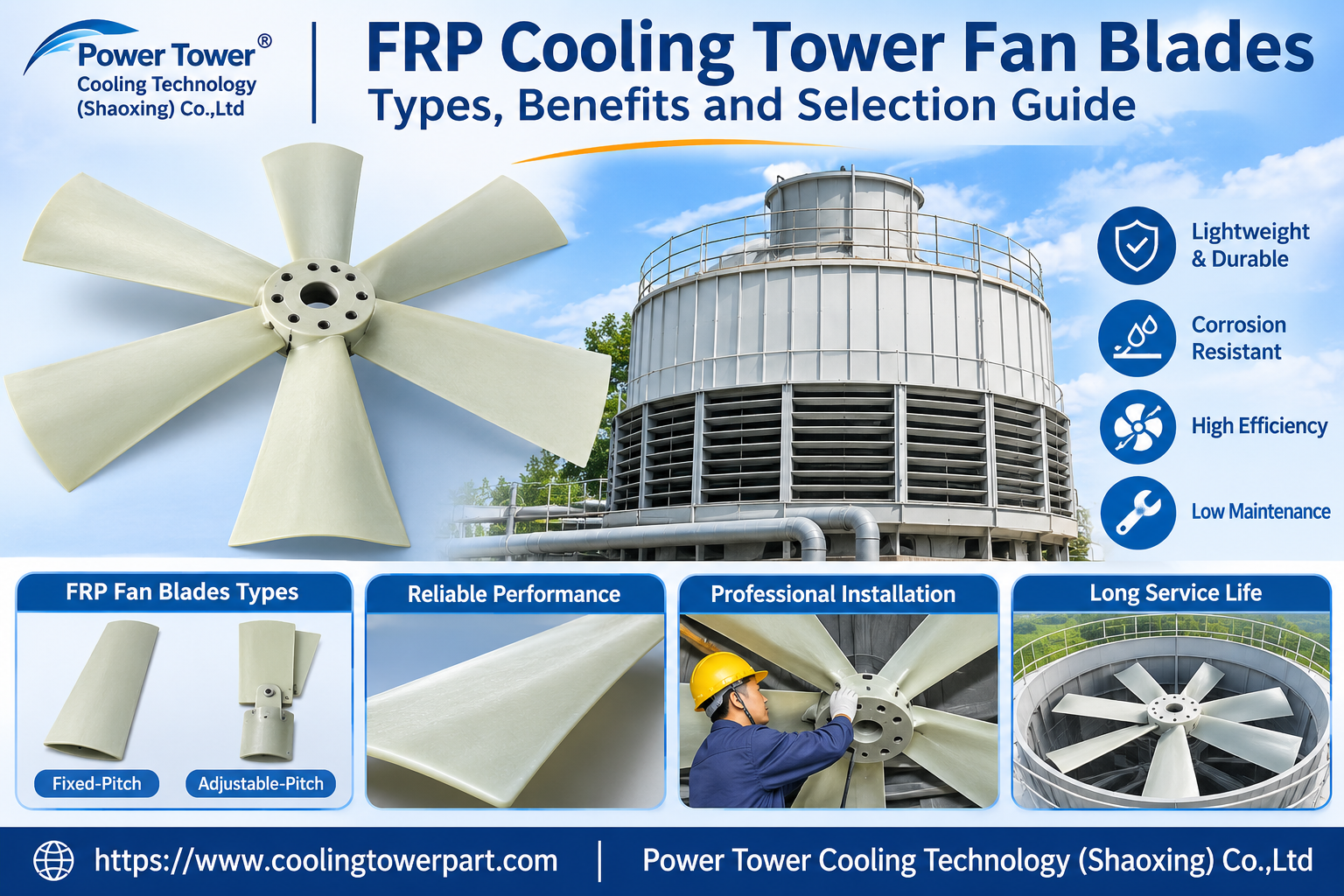
1. Introduction to FRP Cooling Tower Fan Blades
A cooling tower does an important job in industrial facilities: it removes unwanted heat from circulating water and helps equipment maintain a suitable operating temperature. But have you ever considered how much the fan system affects this process?
The cooling tower fan moves large volumes of air through the tower. Its performance influences heat rejection, operating stability, and energy consumption. Among the different components in this system, FRP cooling tower fan blades have become a popular option for many industrial applications.
FRP stands for Fiber Reinforced Plastic. This composite material combines reinforcing fibers with a resin matrix to create a lightweight structure with useful mechanical and corrosion-resistant properties.
Why do many cooling tower operators consider FRP blades? They offer a practical balance of weight, strength, corrosion resistance, and design flexibility. However, selecting the right blade is not simply a matter of choosing a material. You also need to consider fan diameter, airflow requirements, pitch angle, rotational speed, and hub compatibility.
In this guide, we will explore FRP cooling tower fan blade types, manufacturing methods, advantages, selection factors, common problems, and maintenance practices. Whether you are replacing damaged blades or planning a new cooling tower installation, this information can help you make a more informed decision.
2. What Are FRP Cooling Tower Fan Blades?
FRP cooling tower fan blades are aerodynamic components manufactured from fiber-reinforced plastic composites. They are installed on a fan hub and rotate to move air through a cooling tower.
Unlike ordinary plastic components, FRP blades contain reinforcing fibers that improve their mechanical properties. The resin binds these fibers together and forms the blade's shape.
FRP fan blades are used in different cooling tower configurations, including induced-draft and forced-draft systems. Their suitability depends on the fan design, operating conditions, and manufacturer specifications.
2.1 What Does FRP Mean?
FRP means Fiber Reinforced Plastic. It is a composite material made by combining two main elements:
Reinforcing fibers: These provide much of the material's tensile strength and stiffness.
Resin matrix: This binds the fibers, transfers loads, protects the reinforcement, and gives the component its shape.
Common reinforcement options include glass fibers, while resin systems may include polyester, vinyl ester, or epoxy. The appropriate combination depends on the required mechanical performance, chemical exposure, temperature, manufacturing process, and cost.
This combination gives FRP a useful advantage: manufacturers can design a component around a specific application rather than relying on the properties of a single conventional material.
2.2 How FRP Blades Work in a Cooling Tower
The basic job of a cooling tower fan blade is to create airflow.
As the motor drives the fan hub, the blades rotate and generate a pressure difference that moves air through the cooling tower. In a typical induced-draft cooling tower, the fan draws air through the tower and discharges warm, moisture-laden air above it. In a forced-draft arrangement, the fan pushes air into the tower.
The blade profile, pitch angle, diameter, and rotational speed all influence airflow and fan loading.
Think of the blades as the wings of an aircraft. Their shape and angle affect how air moves around them. A well-designed fan blade can move the required air volume while operating within the fan system's power and mechanical limits.
3. Main Types of FRP Cooling Tower Fan Blades
FRP fan blades are available in different designs. The best choice depends on the cooling tower's fan assembly, operating conditions, and performance requirements.
3.1 Fixed-Pitch FRP Fan Blades
Fixed-pitch blades have a set installation angle. Once installed, their pitch is not intended to be adjusted during normal operation.
They are suitable for applications where airflow requirements remain relatively consistent. Their simple configuration can make installation and inspection more straightforward.
However, fixed-pitch blades offer less flexibility when operating conditions change. If a cooling tower needs a different airflow rate, engineers may need to evaluate the fan system or select another blade configuration.
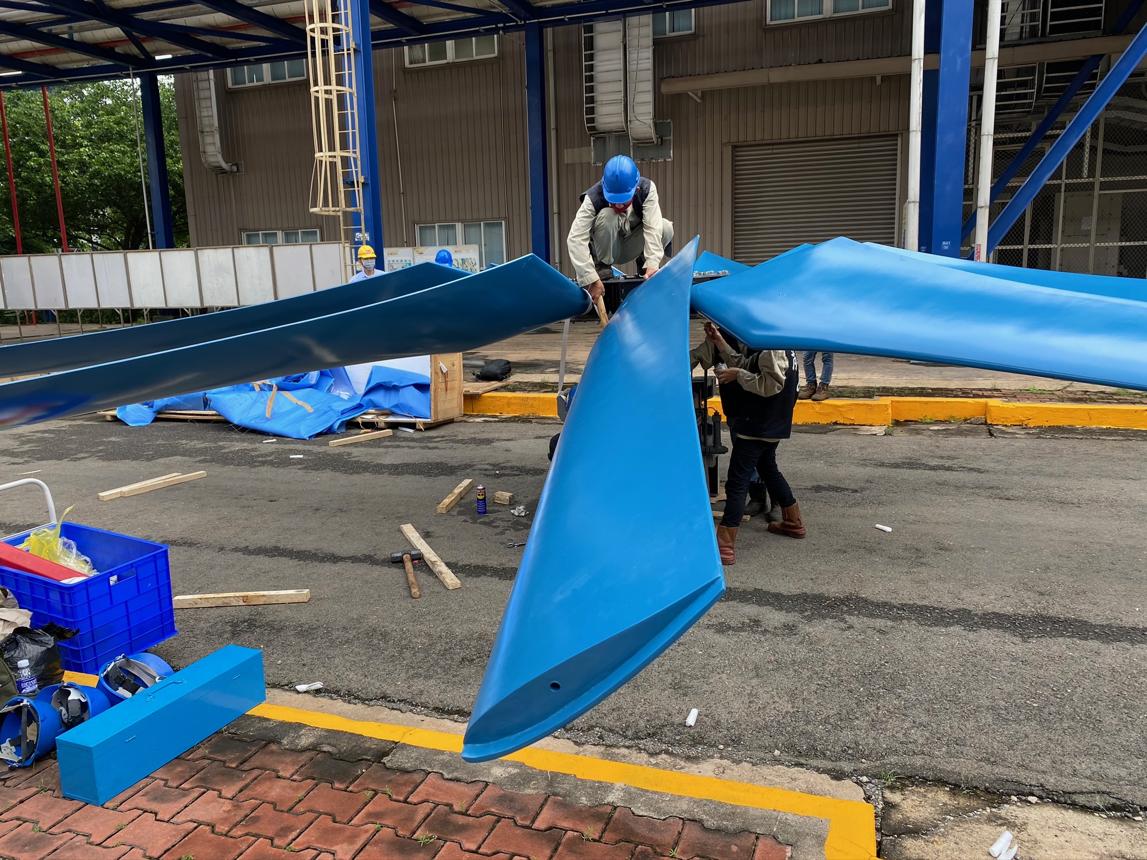
3.2 Adjustable-Pitch FRP Fan Blades
Adjustable-pitch blades allow the blade angle to be changed within the limits of the fan manufacturer's design.
This flexibility can help operators match fan performance to the cooling tower's airflow requirements. For example, a facility may need to adjust airflow after a process change or equipment upgrade.
But adjustable pitch does not mean operators should change the angle without engineering checks. Every adjustment affects fan loading, motor power, and aerodynamic performance.
The correct pitch must follow the fan manufacturer's recommendations and be checked against the motor's operating limits.
3.3 Hollow and Solid FRP Fan Blades
FRP blades can also differ in their internal construction.
Hollow blades use a hollow or internally supported structure. Depending on the design, this can reduce weight while maintaining the required stiffness.
Solid or solid-core blades use a more substantial internal structure. Their actual weight and mechanical characteristics depend on the reinforcement, resin, geometry, and manufacturing method.
Neither construction is automatically better for every cooling tower. Buyers should compare verified specifications, structural design, and suitability for the intended operating conditions.
4. How Are FRP Cooling Tower Fan Blades Manufactured?
Manufacturing quality has a direct effect on blade consistency, structural performance, and service life. Two blades may look similar from the outside but have different internal construction and quality.
4.1 Fiberglass Reinforcement and Resin
The manufacturing process begins with selecting suitable reinforcement fibers and resin.
Glass fiber provides reinforcement, while the resin forms the surrounding matrix. The fiber orientation, resin selection, and distribution all influence the final component's properties.
Manufacturers need to consider several factors:
Required mechanical strength and stiffness
Expected operating temperature
Moisture and chemical exposure
Blade dimensions and aerodynamic profile
Manufacturing process and quality controls
A suitable material system should be selected according to the real operating environment rather than appearance alone.
4.2 Blade Molding and Surface Finishing
After material preparation, the blade is formed using an appropriate molding process. The exact process depends on the manufacturer's design and production method.
During production, manufacturers need to control the blade's shape, thickness, surface quality, and dimensional consistency. The finished blade should also be checked for visible defects and relevant dimensional requirements.
Surface finishing matters because roughness, defects, or inconsistent geometry can affect the component's quality. However, a smooth appearance alone does not prove that a blade meets its structural or aerodynamic requirements.
For industrial buyers, it is useful to ask about manufacturing controls, inspection procedures, and available product documentation.
5. Key Benefits of FRP Cooling Tower Fan Blades
Why choose FRP instead of another material? The answer depends on the application, but FRP offers several practical benefits.
5.1 Lightweight Construction
One of the main advantages of FRP is its relatively low weight compared with many metal alternatives.
A lighter blade can reduce the mass that the fan assembly must support and accelerate. This may help reduce mechanical loading on certain parts of the system, although the actual result depends on the complete fan design.
Weight also matters during transportation, handling, and installation. Workers may find appropriately designed lightweight blades easier to handle, subject to safe lifting procedures.
5.2 Corrosion Resistance
Cooling towers operate in wet environments. Water droplets, humidity, treatment chemicals, and airborne contaminants can expose fan components to demanding conditions.
FRP does not rust in the same way as ordinary steel. This makes it attractive for cooling tower applications where moisture and corrosion are important concerns.
However, corrosion resistance does not mean unlimited chemical resistance. Different resin systems respond differently to chemicals, temperature, and environmental exposure. Buyers should confirm that the selected FRP material is suitable for their specific conditions.
5.3 High Strength and Structural Stability
Fiberglass reinforcement gives FRP useful strength and stiffness when the blade is properly designed and manufactured.
A fan blade must withstand centrifugal forces, aerodynamic loads, vibration, and environmental exposure during operation. Its structural design should account for these conditions.
Good material selection is only one part of the process. Fiber orientation, blade geometry, internal construction, manufacturing quality, and mounting design also matter.
5.4 Aerodynamic Performance
Fan efficiency depends heavily on blade geometry.
The blade profile, pitch angle, diameter, and surface condition influence how effectively the fan moves air. FRP manufacturing methods allow designers to create complex shapes that support specific aerodynamic requirements.
A well-matched blade can help the fan deliver the required airflow without unnecessary power consumption. Still, changing to FRP blades alone does not guarantee energy savings. The entire fan system must be evaluated.
5.5 Lower Maintenance Requirements
Because FRP does not develop ordinary rust, it may reduce some corrosion-related maintenance concerns compared with susceptible metal components.
That does not make FRP fan blades maintenance-free. Operators still need to inspect for cracks, impact damage, loose fasteners, surface deterioration, and vibration.
Regular inspection helps identify problems before they affect the complete fan assembly.
6. FRP vs. Aluminum Cooling Tower Fan Blades
FRP and aluminum are both used in industrial fan applications. Which one should you choose?
There is no universal answer. The right material depends on the fan design, operating environment, mechanical requirements, and total cost over the equipment's service life.
| Comparison Factor | FRP Fan Blades | Aluminum Fan Blades |
| Weight | Generally lightweight | Generally lightweight |
| Corrosion behavior | Does not rust like steel; chemical compatibility depends on resin | Can corrode under certain conditions |
| Design flexibility | Suitable for complex composite profiles | Depends on alloy and manufacturing method |
| Maintenance | Requires inspection for cracks and composite damage | Requires inspection for corrosion, fatigue, and damage |
| Repair | Depends on damage and approved repair procedures | Depends on alloy and repair method |
| Cost | Varies by design and production | Varies by alloy and manufacturing |
FRP may be a good choice where corrosion resistance and composite design flexibility are important. Aluminum may be suitable for applications where its material characteristics and existing fan design offer advantages.
Before replacing one material with another, check the fan manufacturer's requirements. A blade is not a universal spare part. Its geometry, weight, center of gravity, and mounting arrangement must match the fan system.
7. Factors to Consider When Selecting FRP Fan Blades
Choosing FRP cooling tower fan blades requires more than measuring the old blade and ordering a similar-looking replacement.
A correct selection should match the complete fan assembly and the cooling tower's operating requirements.
7.1 Fan Diameter and Blade Quantity
Start with the fan's basic dimensions.
Important information includes:
Even a small dimensional difference can affect clearance, balance, or airflow. Always confirm the measurements against the fan manufacturer's drawings or approved specifications.
7.2 Airflow and Static Pressure
Airflow is one of the most important performance requirements.
The fan must move enough air through the cooling tower to support the required heat rejection. Static pressure also matters because the fan must overcome resistance from fill, drift eliminators, louvers, and other internal components.
A replacement blade should be evaluated against the required airflow and pressure conditions. Choosing a blade based only on diameter may result in poor performance or excessive motor loading.
7.3 Blade Pitch Angle
Blade pitch affects the amount of air the fan moves and the power it requires.
A higher pitch may increase airflow, but it can also increase motor load. The relationship depends on the fan's aerodynamic design and operating speed.
If you are replacing existing blades, record the original pitch angle where possible. Any change should be reviewed by a qualified engineer or the fan manufacturer.
7.4 Operating Environment
Cooling towers can operate in very different environments.
Consider:
Water treatment chemicals
Ambient temperature
Humidity and continuous moisture
Dust and airborne particles
Salt exposure in coastal locations
Expected operating hours
These conditions help determine which resin system and blade construction are appropriate.
7.5 Hub and Mounting Compatibility
The blade must fit the fan hub correctly.
Check the mounting method, bolt pattern, root dimensions, clamping arrangement, and approved fasteners. Also confirm that the replacement blade is compatible with the hub's mechanical design.
Never assume that two blades are interchangeable simply because they have similar dimensions.
8. Common Problems with FRP Cooling Tower Fan Blades
FRP blades are designed for industrial use, but they can still develop problems during operation. Early detection is important because blade damage can affect the entire fan assembly.
8.1 Cracks and Surface Damage
Cracks may develop because of impact, excessive loading, material degradation, manufacturing defects, or unsuitable operating conditions.
Surface damage should not be ignored. Even a small visible defect may require professional assessment to determine whether it affects structural integrity.
Do not continue operating a fan with suspected serious blade damage. Follow the site's safety procedures and obtain a qualified inspection.
8.2 Vibration and Imbalance
Excessive vibration is a common warning sign in rotating equipment.
Possible causes include:
Vibration should be investigated systematically. Replacing a blade without checking the hub, motor, shaft, and supporting structure may not solve the underlying issue.
8.3 Incorrect Blade Angle
Unequal blade pitch can create uneven airflow and loading.
If one blade is installed at a different angle from the others, the fan may experience unbalanced aerodynamic forces. It may also fail to deliver the intended airflow.
During installation, measure blade pitch consistently and follow the manufacturer's instructions.
9. FRP Cooling Tower Fan Blade Maintenance Guide
Regular maintenance helps keep a cooling tower fan operating safely and reliably.
A practical inspection program should include the following steps:
1. Inspect the blade surfaces. Look for cracks, chips, impact marks, delamination, and unusual discoloration.
2. Check the mounting hardware. Inspect bolts, clamps, and connections according to the manufacturer's maintenance instructions.
3. Check blade pitch. Confirm that all blades are set to the specified angle.
4. Monitor vibration. Record vibration trends and investigate unusual changes.
5. Inspect the hub and drive system. Check for corrosion, looseness, wear, and alignment problems.
6. Keep records. Document inspection dates, findings, repairs, and replacement parts.
Always isolate the equipment and follow lockout/tagout procedures before working on the fan. Never inspect or adjust rotating blades while the equipment is running.
The inspection frequency should reflect operating hours, environmental conditions, manufacturer guidance, and the site's maintenance program.
10. When Should You Replace FRP Fan Blades?
There is no single replacement interval that applies to every FRP cooling tower fan blade.
Replacement decisions should be based on condition, operating history, and engineering assessment.
You may need to replace a blade when:
It has a crack or structural defect that cannot be safely repaired.
It shows serious impact damage or delamination.
Its mounting area is damaged.
It no longer meets the required mechanical or aerodynamic specifications.
The manufacturer recommends replacement following an inspection.
Can you replace only one blade? Sometimes, but this depends on the fan manufacturer's requirements and the condition of the complete blade set.
Mixing blades with different weights, profiles, or aerodynamic characteristics can create imbalance. In some cases, replacing a complete matched set is the safer option.
Before ordering, confirm the blade model, dimensions, material, pitch, hub connection, and fan operating conditions.
11. How to Find a Reliable FRP Cooling Tower Fan Blade Supplier
Finding a supplier is easy. Finding one that understands your actual cooling tower requirements takes more care.
A reliable supplier should be able to help you verify product compatibility and provide clear technical information.
Here are several points worth checking:
Product specifications: Ask for dimensions, material details, blade weight, mounting information, and available technical drawings.
Manufacturing quality: Learn how the supplier controls molding, dimensional consistency, and finished-product inspection.
Customization support: If your existing fan uses a special design, confirm whether the supplier can evaluate custom dimensions and mounting requirements.
Technical communication: A good supplier should ask about your fan model and operating conditions instead of recommending a blade based on appearance alone.
After-sales support: Ask how the supplier handles installation questions, product issues, and replacement requirements.
Do not make a purchasing decision based on price alone. A blade that does not match the fan system may create additional costs through installation difficulties, vibration, reduced airflow, or equipment downtime.
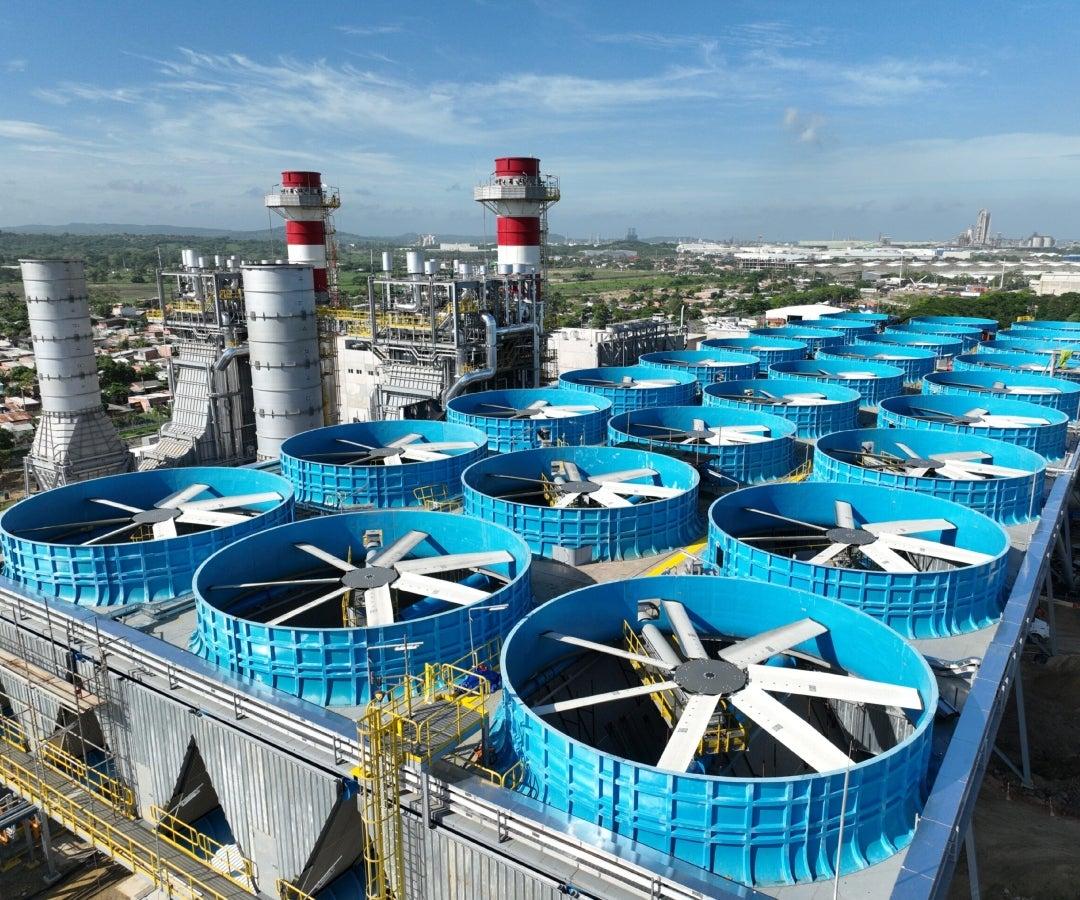
12. Why Consider Power Tower Cooling Technology?
When sourcing cooling tower components, buyers need a supplier that understands the relationship between individual parts and the complete cooling tower system.
Power Tower Cooling Technology (Shaoxing) Co.,Ltd focuses on cooling tower components and related products. Its website, https://www.coolingtowerpart.com, provides a point of contact for buyers researching cooling tower parts and replacement solutions.
If you are looking for FRP cooling tower fan blades or other cooling tower components, prepare your equipment information before making an inquiry.
Useful details include:
Cooling tower brand and model
Existing fan diameter
Blade quantity and dimensions
Hub and mounting details
Required airflow and operating speed, if available
Photos of the existing fan and blade assembly
Operating environment and replacement requirements
Providing these details makes it easier to evaluate compatibility and discuss a suitable solution.
For industrial buyers, accurate technical communication is an important first step toward selecting the right replacement components.
13. Frequently Asked Questions
13.1 What Are FRP Cooling Tower Fan Blades Made Of?
FRP cooling tower fan blades are made from reinforcing fibers, commonly glass fibers, combined with a resin matrix. The exact material system depends on the manufacturer's design and the intended operating environment.
13.2 Are FRP Fan Blades Better Than Aluminum Blades?
Not in every application. FRP offers corrosion resistance and design flexibility, while aluminum has its own mechanical and manufacturing advantages. The best option depends on fan requirements, environmental conditions, and compatibility.
13.3 Can FRP Fan Blades Be Customized?
Many FRP blade designs can be produced in different sizes and configurations. However, customization must account for aerodynamic performance, structural strength, fan speed, hub compatibility, and operating loads.
13.4 How Long Do FRP Cooling Tower Fan Blades Last?
Service life varies with material quality, design, operating conditions, maintenance, and exposure to environmental factors. Regular inspections and correct operation help identify deterioration early.
13.5 Can I Replace Only One Fan Blade?
It depends on the fan design and manufacturer's recommendations. Replacement blades must match the existing set in relevant dimensions, weight, profile, and aerodynamic characteristics. A complete set may be required to maintain balance and performance.
14. Conclusion
FRP cooling tower fan blades are a practical option for many industrial cooling applications. Their lightweight construction, corrosion resistance, and design flexibility make them attractive alternatives to some traditional blade materials.
But choosing the right blade requires more than selecting FRP. You need to check fan diameter, airflow, static pressure, pitch angle, operating environment, and hub compatibility. You should also pay attention to manufacturing quality and maintenance requirements.
If you are planning a replacement or upgrading an existing cooling tower fan, start with accurate equipment information and confirm the technical requirements before ordering.
Power Tower Cooling Technology (Shaoxing) Co.,Ltd provides cooling tower component information and product support through www.coolingtowerpart.com. Contact the company with your fan specifications and replacement requirements to discuss suitable cooling tower component solutions.


