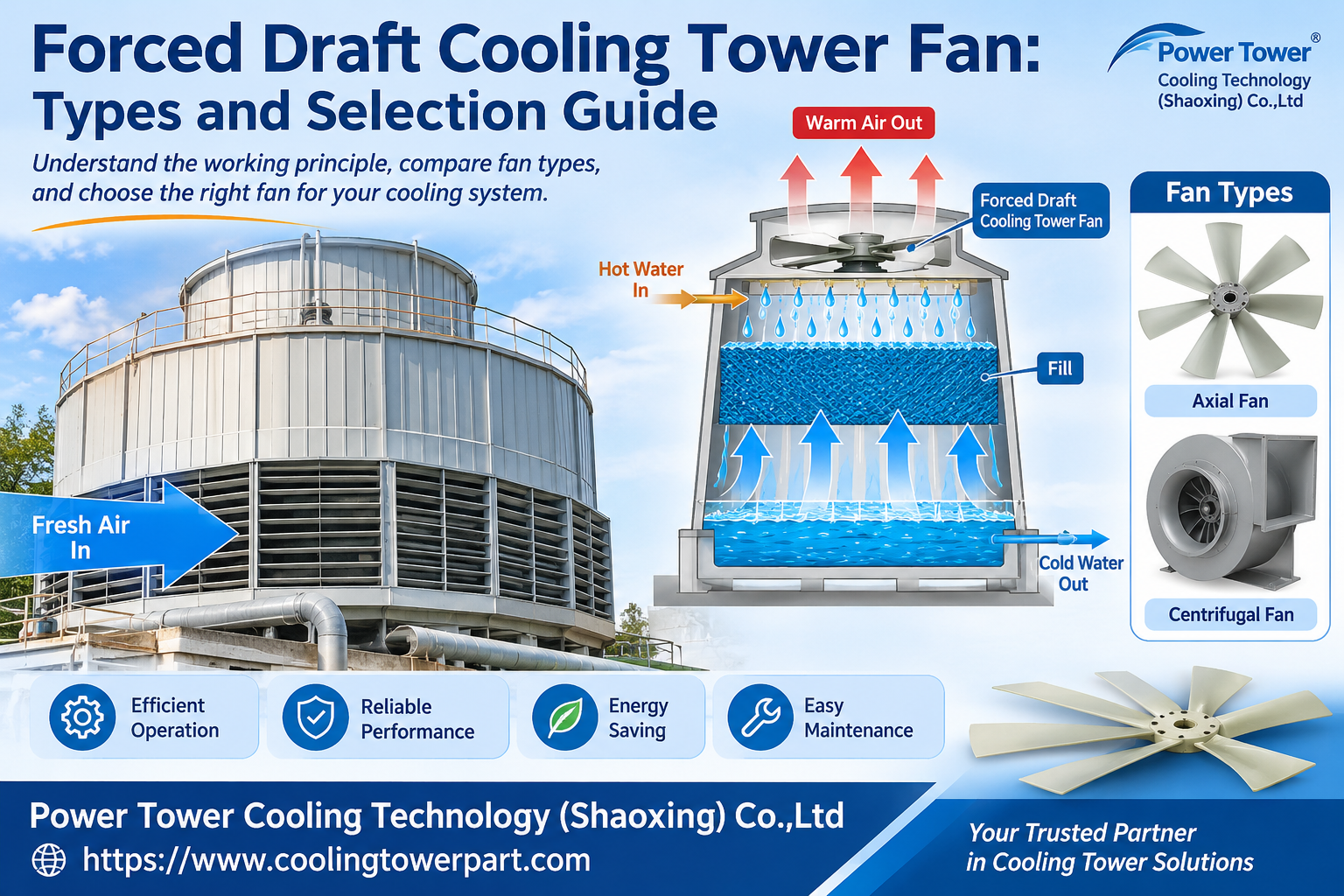
A cooling tower is an essential part of many industrial cooling systems. From chemical plants and power stations to manufacturing facilities and commercial HVAC installations, cooling towers help remove excess heat and maintain stable operating temperatures.
But how does air move through a cooling tower, and what role does the fan play in this process?
One important solution is the forced draft cooling tower fan. Unlike an induced draft system, which pulls air through the tower, a forced draft fan pushes fresh air into the cooling tower from the air inlet side. This creates the airflow needed for heat exchange between circulating water and ambient air.
Choosing the right forced draft cooling tower fan is not simply a matter of selecting a suitable diameter or motor power. Airflow capacity, static pressure, blade design, material selection, installation conditions, and energy efficiency all influence the final performance.
In this guide, we will explain the working principle of forced draft cooling tower fans, compare different fan types, discuss their advantages and limitations, and provide practical advice for selecting the right equipment for industrial applications.
Whether you are building a new cooling tower, replacing an existing fan, or planning an equipment upgrade, this guide will help you understand what matters most.
1. What Is a Forced Draft Cooling Tower Fan?
A forced draft cooling tower fan is a mechanical ventilation device installed on the air inlet side of a cooling tower. Its primary function is to push outside air into the tower and provide the airflow required for the cooling process.
The fan converts mechanical energy from an electric motor into airflow energy. As the blades rotate, they create a pressure difference that moves air through the tower's internal components.
Think of it as a powerful ventilation system that supplies fresh air instead of extracting indoor air.
In a typical forced draft cooling tower, the fan is installed near the bottom or side air inlet. Depending on the tower configuration, air may move vertically upward through the fill or horizontally across it.
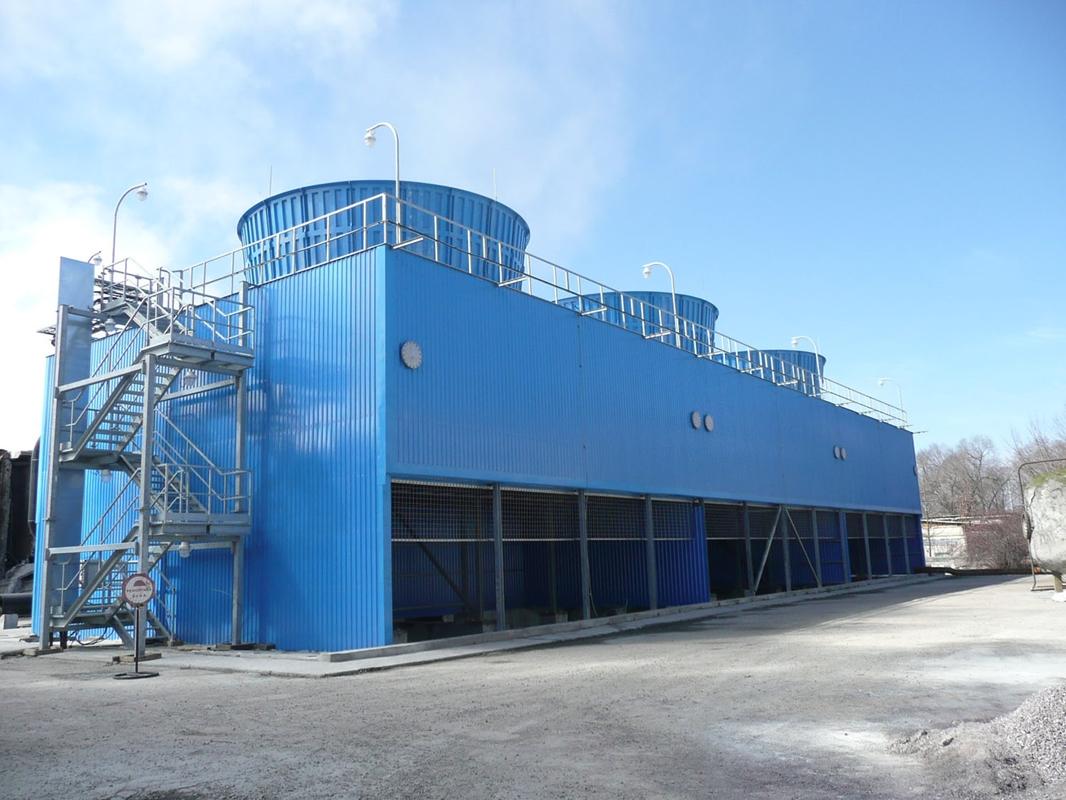
Forced draft cooling towers are commonly designed in two arrangements:
Both configurations use mechanical airflow to support heat and mass transfer, but their internal arrangements and pressure requirements differ.
1.1 Main Functions of a Forced Draft Cooling Tower Fan
The fan plays several important roles in cooling tower operation:
Supplies fresh ambient air to the cooling tower.
Maintains the airflow required for heat exchange.
Supports evaporation and heat rejection.
Helps maintain the required circulating water temperature.
Provides controlled ventilation under different operating loads.
A properly selected fan helps the cooling tower achieve its required thermal performance without unnecessary electrical consumption.
1.2 Common Industrial Applications
Forced draft cooling tower fans can be used in different industrial and commercial applications, including:
Chemical processing plants.
Manufacturing facilities.
Power generation systems.
Industrial process cooling.
Commercial HVAC systems.
Packaged cooling tower installations.
Equipment and machinery cooling systems.
The suitability of a forced draft arrangement depends on cooling capacity, available installation space, required airflow, system resistance, and environmental conditions.
2. How Does a Forced Draft Cooling Tower Fan Work?
Understanding the working principle is essential when selecting or replacing a cooling tower fan.
A forced draft cooling tower fan works by creating positive pressure on the air inlet side and pushing air through the cooling tower.
The process involves several stages.
2.1 Air Intake and Airflow Generation
Outside air enters through the cooling tower air inlet.
The electric motor drives the fan through a direct-drive or belt-driven arrangement. As the fan blades rotate, they accelerate the incoming air and push it into the tower.
The airflow then passes through the fill section and other internal components.
The amount of air supplied depends on several factors:
Fan diameter.
Blade pitch angle.
Rotational speed.
Fan aerodynamic design.
Air density.
System resistance.
If airflow is insufficient, the cooling tower may struggle to remove the required heat. If airflow is unnecessarily high, the fan may consume more electricity than needed.
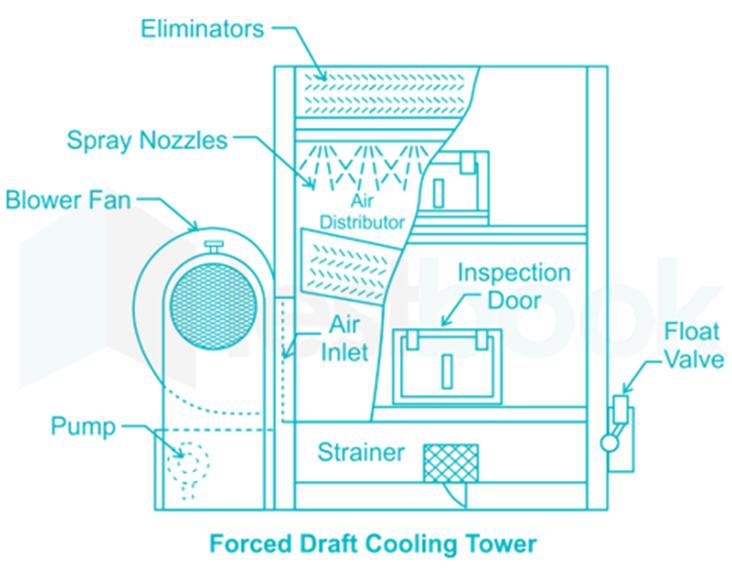
2.2 Heat Transfer and Water Cooling Process
After entering the cooling tower, air passes through the fill material.
Hot circulating water is distributed over the fill surface, forming thin water films or droplets depending on the fill design.
As air comes into contact with the water, heat and mass transfer take place simultaneously.
A portion of the water evaporates, carrying heat away from the remaining circulating water. The cooled water then collects in the basin and returns to the industrial process.
The cooling process depends on several operating conditions:
Entering water temperature.
Leaving water temperature.
Ambient wet-bulb temperature.
Water circulation rate.
Airflow volume.
Fill material performance.
Water distribution uniformity.
This explains why the fan cannot be considered separately from the rest of the cooling tower.
Even a high-performance fan cannot fully compensate for clogged fill, poor water distribution, or an incorrectly designed cooling system.
2.3 Why Static Pressure Matters
Static pressure is one of the most important factors in forced draft cooling tower fan selection.
As air moves through the tower, it encounters resistance from:
The fan must overcome these pressure losses while delivering the required airflow.
A fan selected only according to airflow volume may fail to achieve its expected performance once installed.
For this reason, engineers should evaluate airflow and static pressure together and check the manufacturer's fan performance curve before making a final decision.
3. Main Components of a Forced Draft Cooling Tower Fan
A forced draft cooling tower fan consists of several components that work together to produce stable airflow.
Understanding these components helps buyers evaluate product quality and plan maintenance more effectively.
3.1 Fan Blades and Hub
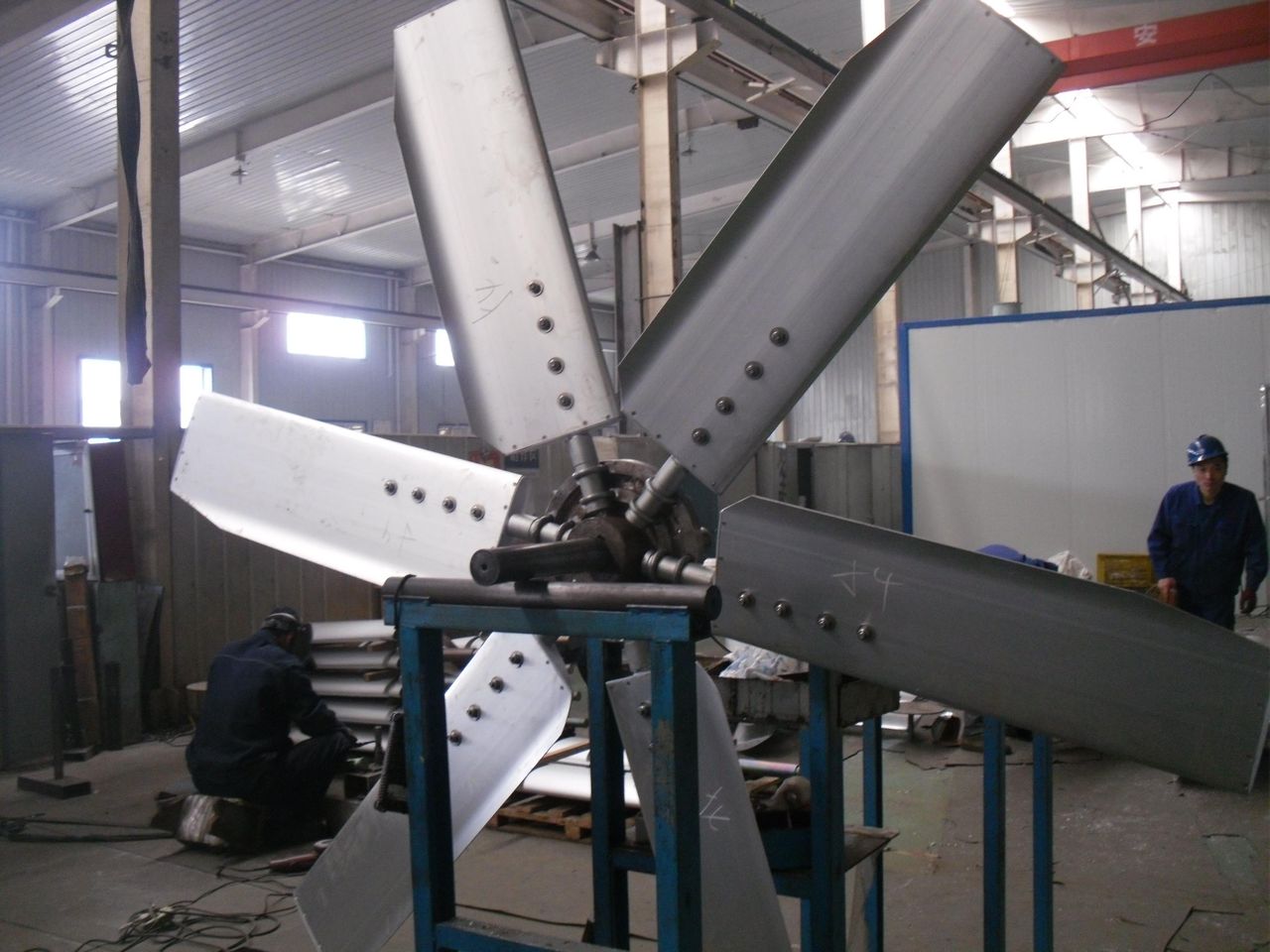
Fan blades are responsible for moving air through the cooling tower.
Their geometry directly influences airflow capacity, pressure, efficiency, noise, and power consumption.
Important blade design factors include:
Blade length and width.
Airfoil profile.
Pitch angle.
Blade thickness.
Material strength.
Rotational speed.
The hub connects the blades to the rotating shaft or drive assembly.
For industrial cooling tower applications, FRP (fiber-reinforced plastic) fan blades are popular because they combine lightweight construction with good corrosion resistance.
A properly designed hub is equally important because it keeps the blades securely positioned and supports mechanical stability during operation.
3.2 Fan Motor and Drive System
The motor provides the mechanical power required to rotate the fan.
Two common drive arrangements are direct drive and belt drive.
Direct drive
The motor connects directly to the fan assembly. This arrangement has fewer transmission components and can simplify maintenance.
Belt drive
Power is transmitted through belts and pulleys. This arrangement provides flexibility in speed selection through suitable pulley ratios, but requires regular inspection of belt tension and alignment.
The correct motor power depends on the fan operating point, aerodynamic efficiency, transmission losses, and actual service conditions.
3.3 Fan Casing and Air Duct
The fan casing guides incoming air and helps reduce unnecessary air leakage.
A properly designed inlet and casing can improve airflow distribution and reduce turbulence.
In forced draft systems, the inlet arrangement is particularly important because the fan must supply air without creating excessive pressure losses.
3.4 Supporting Structure and Protection Devices
The supporting structure carries the fan and motor assembly.
It must withstand operating loads, vibration, and environmental exposure.
Additional protective components may include:
Safety guards.
Vibration monitoring devices.
Motor overload protection.
Electrical isolation equipment.
Protective coatings.
These components improve operational safety and help prevent unexpected equipment damage.
4. Different Types of Forced Draft Cooling Tower Fans
Not every cooling tower uses the same fan design. Different industrial applications require different airflow characteristics, pressure capabilities, installation arrangements, and materials.
Understanding the main types makes it easier to choose the right product.
4.1 Axial Forced Draft Cooling Tower Fans
Axial fans move air mainly parallel to the fan shaft.
They are commonly selected for applications requiring relatively large airflow volumes.
Their main advantages include:
High airflow capacity.
Compact installation arrangements.
Relatively simple construction.
Good suitability for ventilation applications.
Axial fans are widely used in industrial cooling towers because they can deliver large quantities of air with suitable aerodynamic efficiency.
However, their performance must be matched to the system resistance. They are not automatically the best choice for every forced draft application.
4.2 Centrifugal Forced Draft Cooling Tower Fans
Centrifugal fans move air through an impeller and discharge it in a direction generally perpendicular to the inlet airflow.
They are particularly useful when relatively high external static pressure is required.
Their characteristics include:
Good pressure capability in suitable designs.
Flexible duct installation.
Different impeller configurations.
Adaptability to demanding ventilation systems.
Centrifugal fans are often considered for forced draft systems involving ductwork, restricted air passages, or indoor installations.
However, they may require more installation space and have different energy characteristics compared with axial fans.
The final choice should depend on the actual airflow and pressure requirements.
4.3 FRP Cooling Tower Fans
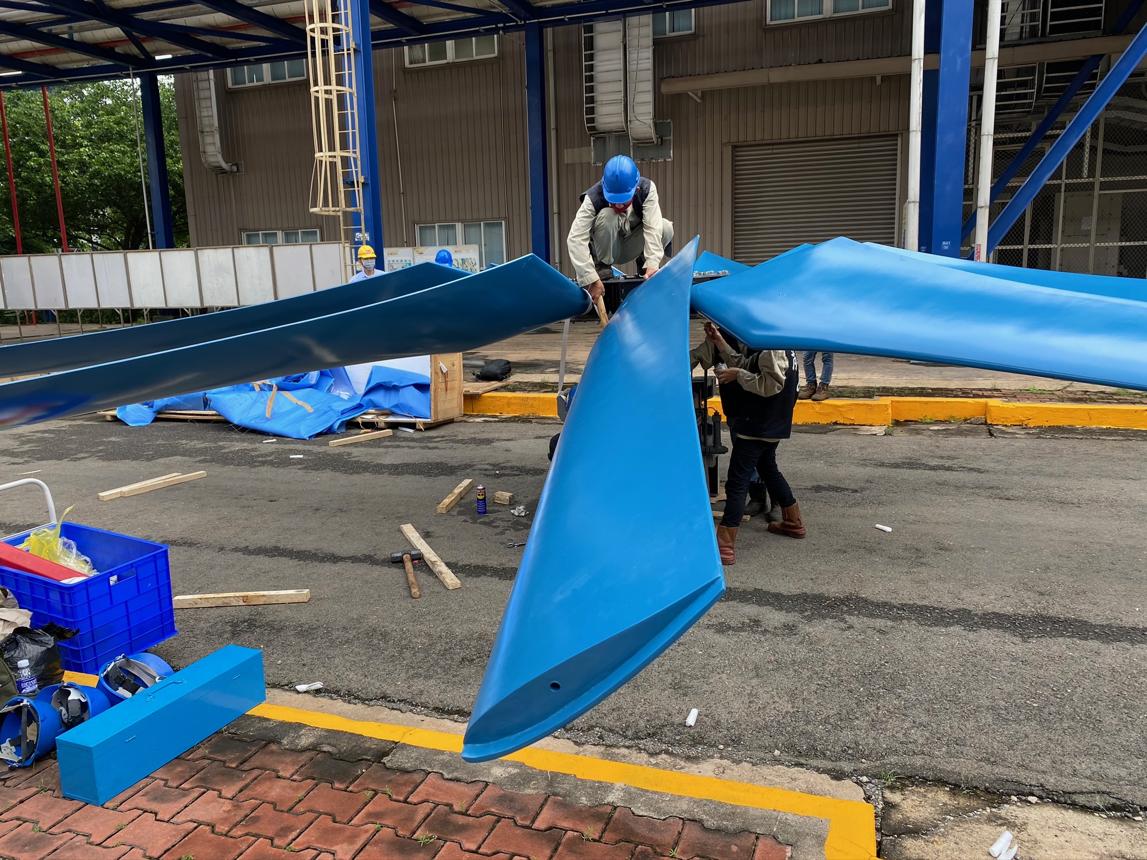
FRP fans use fiber-reinforced plastic materials and are widely considered for cooling tower environments.
These environments often involve moisture, chemical exposure, and corrosion risks.
The main benefits of FRP fan blades include:
Lightweight construction.
Good corrosion resistance.
Flexible aerodynamic design.
Reduced rotating mass in suitable configurations.
Potentially lower maintenance requirements than some conventional materials.
FRP fan blades can be manufactured in different sizes and aerodynamic profiles to meet specific cooling tower requirements.
When purchasing FRP fans, buyers should evaluate resin quality, fiber reinforcement, manufacturing consistency, mechanical strength, and operating temperature limits.
4.4 Adjustable-Pitch Cooling Tower Fans
Adjustable-pitch fans allow the blade angle to be changed to meet different operating requirements.
This flexibility can be useful when cooling loads vary throughout the year.
For example, a cooling tower operating under lower seasonal loads may not need the same airflow as it does during peak summer conditions.
Adjusting the blade pitch can help match fan performance to actual demand.
However, pitch adjustment must follow the manufacturer's specifications. Incorrect adjustment can increase motor load, vibration, and mechanical stress.
5. Forced Draft vs. Induced Draft Cooling Tower Fans
Forced draft and induced draft cooling towers both use mechanical fans to move air, but their fan positions and airflow arrangements are different.
In a forced draft system, the fan is installed near the air inlet and pushes air into the tower.
In an induced draft system, the fan is normally installed near the air outlet and pulls air through the tower.
Here is a practical comparison:
| Comparison | Forced Draft | Induced Draft |
| Fan location | Near the air inlet | Near the air outlet |
| Air movement | Pushes air into the tower | Pulls air through the tower |
| Pressure arrangement | Positive pressure in the upstream air path | Negative pressure through much of the tower air path |
| Fan air conditions | Usually handles incoming ambient air | Handles warm, moist exhaust air |
| Maintenance access | Can be convenient depending on layout | Depends on fan deck and tower design |
| Air distribution | Depends strongly on inlet and internal arrangement | Depends on fan and exhaust arrangement |
| Common applications | Selected industrial and packaged towers | Many large industrial cooling towers |
5.1 Advantages of Forced Draft Systems
Forced draft systems can provide several practical benefits.
First, the fan and motor are often located near the base or side of the cooling tower, making access convenient in some designs.
Second, the fan generally handles incoming ambient air rather than saturated exhaust air. This can reduce moisture-related problems for certain mechanical components.
Third, centrifugal fan arrangements can be useful when the system requires higher external static pressure or ducted airflow.
5.2 Advantages of Induced Draft Systems
Induced draft systems are widely used in industrial cooling towers because their airflow arrangement can help reduce hot-air recirculation.
The fan pulls air through the fill and discharges warm, humid air at the top of the tower.
The higher discharge velocity can help move exhaust air away from the air inlets.
This arrangement is particularly useful for many large cooling tower installations.
5.3 Which Arrangement Is Better?
There is no universal winner.
Forced draft systems can offer convenient equipment access and flexible installation arrangements.
Induced draft systems often provide advantages in exhaust-air management and are widely used for larger industrial towers.
The best arrangement depends on:
6. Advantages of Forced Draft Cooling Tower Fans
Why do engineers choose forced draft cooling tower fans?
The answer usually comes down to installation flexibility, maintenance considerations, and system design requirements.
6.1 Convenient Maintenance Access
In some forced draft designs, the fan and motor are positioned near accessible air inlets.
This can make inspection and maintenance more convenient.
Technicians may be able to inspect fan blades, motors, bearings, and drive components without accessing an elevated fan deck.
Actual accessibility still depends on the tower structure and installation arrangement.
6.2 Flexible Installation and System Design
Forced draft arrangements can be integrated into different equipment layouts.
This flexibility is useful for packaged cooling towers and applications where available installation space is limited.
The fan can be selected according to the required airflow, pressure, and structural arrangement.
6.3 Suitable for Different Industrial Environments
With appropriate materials and protective measures, forced draft fans can operate in various industrial environments.
FRP blades, corrosion-resistant hardware, and properly protected motors can help improve equipment durability.
However, material and protection levels should always match actual environmental conditions.
6.4 Reduced Moisture Exposure for Fan Components
In many forced draft designs, the fan handles relatively dry incoming air instead of warm, saturated exhaust air.
This can reduce certain moisture-related problems involving motors and mechanical components.
However, ambient humidity, rainwater, condensation, and installation conditions still need to be considered.
7. Limitations and Challenges of Forced Draft Cooling Towers
Although forced draft cooling tower fans offer several advantages, they also have limitations.
One important concern is hot-air recirculation.
Because the fan pushes air into the tower, the discharged warm and moist air may return to the air inlet if the tower is poorly positioned or surrounding airflow is restricted.
This can increase entering air temperature and reduce cooling performance.
Other potential challenges include:
Uneven air distribution.
Fan inlet turbulence.
Higher-than-expected static pressure.
Noise and vibration.
Corrosion or moisture damage.
Increased energy consumption caused by poor fan selection.
Ice accumulation under certain cold-weather operating conditions.
A good cooling tower design must consider the fan, fill, air inlet, exhaust arrangement, and surrounding environment as one complete system.
8. How to Choose the Right Forced Draft Cooling Tower Fan
Selecting the correct forced draft cooling tower fan is one of the most important decisions in a cooling tower project.
A fan that looks suitable on paper may perform poorly after installation if its operating point does not match the system.
Here are six important factors to consider before placing an order.
8.1 Determine the Required Airflow
Start by identifying the required airflow volume.
Airflow is commonly expressed in cubic meters per hour (m³/h) or cubic meters per second (m³/s).
The required airflow depends on:
Do not select a fan based only on the diameter of an existing fan. The existing equipment may have been incorrectly sized or may operate under different conditions.
8.2 Calculate Static Pressure
Next, determine the total system pressure loss.
Consider resistance from the inlet, fill, drift eliminator, internal structures, and air passages.
The selected fan must deliver the required airflow at the calculated static pressure.
A fan performance curve is essential because it shows how airflow, pressure, power, and efficiency change with operating conditions.
The selected operating point should fall within the manufacturer's recommended operating range.
8.3 Select the Correct Fan Diameter
Fan diameter affects airflow capacity, rotational speed, and installation requirements.
Before selecting a fan, measure:
For replacement projects, dimensional compatibility is especially important.
Even a small difference in fan diameter or hub structure may create installation problems.
8.4 Choose Suitable Blade Materials
Material selection affects service life, maintenance requirements, and operating reliability.
Common options include:
| Material | Main Characteristics | Important Considerations |
| FRP | Lightweight and corrosion-resistant | Resin and reinforcement quality |
| Aluminum alloy | Lightweight and relatively strong | Corrosion protection |
| Stainless steel | Strong and corrosion-resistant in suitable grades | Weight and cost |
| Reinforced engineering plastics | Lightweight and flexible in design | Temperature and mechanical limits |
For many industrial cooling tower applications, FRP is worth considering because of its balance of weight, corrosion resistance, and design flexibility.
8.5 Match the Motor and Drive System
The motor must provide sufficient power for the selected fan operating point.
Important specifications include:
Rated power (kW).
Voltage.
Frequency.
Rotational speed.
Insulation class.
Protection rating.
Operating environment.
Also consider whether direct drive or belt drive is more suitable.
An undersized motor may overheat or trip under heavy operating conditions. An oversized motor may increase initial and operating costs without providing meaningful benefits.
8.6 Consider Actual Operating Conditions
A fan operating in a coastal chemical plant may face very different conditions from one installed in an indoor HVAC system.
Before finalizing the design, evaluate:
A reliable fan specification should reflect actual operating conditions rather than ideal laboratory conditions.
9. Common Forced Draft Cooling Tower Fan Problems
Even a well-designed fan requires proper operation and maintenance.
Here are some common problems industrial operators should watch for.
9.1 Insufficient Airflow
Low airflow can result from:
Check actual airflow and pressure conditions before replacing the fan.
9.2 Excessive Noise and Vibration
Abnormal vibration may indicate:
Fan imbalance.
Loose mounting bolts.
Blade damage.
Shaft misalignment.
Bearing wear.
Structural resonance.
Stop the equipment when vibration reaches unsafe levels and investigate the cause before restarting.
9.3 Motor Overheating
Motor overheating may be related to excessive mechanical load, poor ventilation, electrical problems, or bearing damage.
Check operating current against the motor nameplate and manufacturer's specifications.
9.4 Fan Blade Damage
Fan blades can deteriorate due to fatigue, impact, corrosion of associated hardware, improper installation, or long-term exposure to harsh conditions.
Cracked, deformed, or loose blades should never be ignored.
Damaged blades can affect balance and create serious mechanical risks.
10. Forced Draft Cooling Tower Fan Maintenance Guide
Regular maintenance helps extend fan service life and reduce unexpected downtime.
A practical maintenance program should include the following activities.
10.1 Regular Blade Inspection
Inspect blades for cracks, surface damage, deformation, and loose connections.
Check blade pitch and confirm that all blades are installed according to the approved design.
Do not make unapproved changes to blade angles.
10.2 Motor and Bearing Maintenance
Inspect motor temperature, operating current, bearing condition, and lubrication requirements.
For belt-driven systems, check belt tension, alignment, and pulley wear.
Follow the manufacturer's lubrication and replacement intervals.
10.3 Cleaning and Corrosion Protection
Remove accumulated dust, debris, and other deposits from the fan and surrounding structures.
Check exposed metal components for corrosion.
For FRP blades, inspect the surface for cracks, impact damage, and signs of material deterioration.
10.4 Check Vibration and Mechanical Balance
Monitor vibration during operation and compare measurements with the manufacturer's limits and applicable standards.
If abnormal vibration occurs, investigate the cause rather than simply tightening components or changing blade angles.
Safety reminder: Always isolate electrical power, apply lockout/tagout procedures, and verify that the fan has completely stopped before inspection or maintenance.
11. How to Improve Fan Efficiency and Reduce Energy Consumption
Cooling tower fans can consume a significant amount of electricity during continuous industrial operation.
Fortunately, several practical improvements can help reduce energy consumption.
Optimize blade pitch. Incorrect blade angles can increase power consumption without delivering useful cooling improvements.
Check fan balance. An unbalanced fan creates additional mechanical loads and may shorten bearing and motor service life.
Reduce unnecessary airflow resistance. Clean blocked louvers and maintain the fill and drift eliminator to keep air passages in good condition.
Consider variable-frequency drives (VFDs). When the system design allows variable-speed operation, a VFD can adjust fan speed according to actual cooling demand.
Use efficient fan blades. Proper aerodynamic profiles can improve airflow performance and reduce the power required to achieve a target operating point.
Maintain the complete cooling tower system. Clean fill, proper water distribution, and suitable drift eliminators all contribute to effective cooling performance.
Remember, energy efficiency is not determined by the fan alone. The entire cooling tower system must work together.
12. When Should You Replace or Retrofit a Cooling Tower Fan?
How do you know when your existing fan needs replacement?
Some warning signs are easy to recognize:
Repeated blade cracks or structural damage.
Increasing vibration.
Frequent motor overloads.
Persistent insufficient airflow.
Excessive energy consumption.
Increasing maintenance costs.
Difficulty obtaining replacement parts.
A retrofit may be worthwhile when the existing fan design is outdated or no longer matches the cooling tower's operating requirements.
For example, replacing old fan blades with properly engineered FRP blades may reduce rotating mass and improve corrosion resistance.
However, a retrofit should never be based on material replacement alone.
Engineers should verify fan diameter, blade geometry, hub compatibility, rotational speed, motor power, system resistance, and structural loading before installation.
The goal is not simply to install a new fan. It is to achieve reliable airflow and suitable cooling performance.
13. Why Choose a Reliable Cooling Tower Fan Manufacturer?
A cooling tower fan is a critical rotating component. Its quality directly influences operating stability, maintenance requirements, and energy consumption.
Choosing a reliable manufacturer can help reduce technical and purchasing risks.
Before selecting a supplier, consider the following factors.
Engineering capability: Can the manufacturer evaluate airflow, static pressure, fan diameter, and blade design?
Material quality: Does the supplier provide clear information about FRP materials, reinforcement, and manufacturing processes?
Customization: Can the manufacturer produce components according to project dimensions and installation requirements?
Quality control: Are dimensions, balance, and mechanical quality checked before delivery?
Technical support: Can the supplier help with installation, troubleshooting, and replacement requirements?
Product compatibility: Can the supplier evaluate whether the replacement components are suitable for the existing cooling tower?
A low purchase price does not always mean a low total cost. Product quality, compatibility, and service life should all be part of the purchasing decision.
14. Power Tower Cooling Technology (Shaoxing) Co.,Ltd – Your Cooling Tower Component Partner
When purchasing cooling tower components, finding a supplier that understands the complete cooling process can make a real difference.
Power Tower Cooling Technology (Shaoxing) Co.,Ltd focuses on cooling tower components and related products, including cooling tower fill and other supporting cooling tower solutions.
Official website: https://www.coolingtowerpart.com
For customers working on cooling tower maintenance, replacement, or performance improvement projects, selecting compatible components is essential.
When evaluating forced draft cooling tower fan requirements, buyers should prepare the following information:
Existing fan diameter.
Required airflow volume.
Required static pressure.
Fan rotational speed.
Motor power.
Blade material requirements.
Hub and mounting dimensions.
Cooling tower model.
Operating temperature and environmental conditions.
Providing these details makes it easier to evaluate technical requirements before selecting replacement or customized components.
For cooling tower operators, selecting suitable fan components and fill materials can contribute to more stable airflow, effective heat exchange, and reliable long-term operation.
Whether you are planning a new cooling tower project or upgrading an existing installation, Power Tower Cooling Technology (Shaoxing) Co.,Ltd can be a supplier to consider for your cooling tower component requirements.
Visit https://www.coolingtowerpart.com to learn more about the company's products and solutions.
15. Frequently Asked Questions About Forced Draft Cooling Tower Fans
15.1 Is a Forced Draft Cooling Tower Fan Better Than an Induced Draft Fan?
Not necessarily.
Forced draft fans push air into the cooling tower, while induced draft fans pull air through the tower.
Each arrangement has advantages and limitations. The right choice depends on tower design, installation space, airflow requirements, maintenance conditions, and the risk of hot-air recirculation.
15.2 What Type of Fan Is Commonly Used in Forced Draft Cooling Towers?
Axial and centrifugal fans can both be used in forced draft cooling towers.
Axial fans are suitable for many applications requiring large airflow volumes, while centrifugal fans can be useful when higher external static pressure is required.
The final selection should be based on system resistance and the required operating point.
15.3 How Do I Calculate the Required Fan Airflow?
Required airflow depends on cooling capacity, water flow rate, temperature conditions, ambient wet-bulb temperature, and cooling tower design.
For accurate selection, engineers should calculate the required thermal performance and determine the corresponding air volume.
It is not recommended to estimate airflow based only on fan diameter.
15.4 Can FRP Fan Blades Be Used in Forced Draft Cooling Towers?
Yes.
FRP fan blades can be used in suitable forced draft cooling tower applications.
They offer lightweight construction, corrosion resistance, and flexible aerodynamic design.
However, material formulation, blade strength, operating temperature, and mechanical design must meet the application's requirements.
15.5 How Often Should a Forced Draft Cooling Tower Fan Be Inspected?
Inspection frequency depends on operating hours, environmental conditions, manufacturer recommendations, and equipment criticality.
As a practical starting point, operators can perform routine visual checks during regular equipment inspections and schedule more detailed inspections at planned maintenance intervals.
Vibration, blade condition, motor temperature, and mounting hardware should receive particular attention.
15.6 What Is the Difference Between Forced Draft Counterflow and Forced Draft Crossflow Cooling Towers?
The main difference is the direction of airflow through the fill.
In a forced draft counterflow cooling tower, air moves upward while water flows downward.
In a forced draft crossflow cooling tower, air moves horizontally through the fill while water flows downward.
The appropriate configuration depends on tower dimensions, available installation space, thermal requirements, and pressure losses.
16. Conclusion
A forced draft cooling tower fan is an important component in mechanical cooling systems. By pushing air into the cooling tower, it supports the heat and mass transfer process that removes unwanted heat from circulating water.
However, selecting the right fan involves more than choosing a blade diameter or motor power.
Airflow, static pressure, blade design, material selection, motor compatibility, installation conditions, and operating requirements must all be considered.
Axial fans are suitable for many high-airflow applications, while centrifugal fans can serve systems requiring different pressure characteristics. FRP fan blades are also worth considering where lightweight construction and corrosion resistance are important.
For industrial buyers, the best approach is to evaluate the complete cooling tower system before making a purchasing decision.
Power Tower Cooling Technology (Shaoxing) Co.,Ltd provides cooling tower component solutions through its official website:
https://www.coolingtowerpart.com
Choosing suitable components and maintaining them correctly can help improve cooling tower reliability, reduce unnecessary operating costs, and support long-term industrial performance.
If you are planning a cooling tower upgrade or looking for suitable replacement components, start by evaluating your existing equipment specifications and actual operating conditions. A well-matched cooling tower system is always a better investment than simply choosing the largest or most powerful fan.


