Fiberglass Cooling Tower Fan Stack: Structure And Performance
A fiberglass cooling tower fan stack is an important structural component of modern industrial cooling towers. It is designed to guide hot air discharged by the cooling tower fan, improve airflow direction, and support stable fan operation. With the increasing demand for durable, lightweight, and corrosion-resistant cooling tower components, Fiberglass Reinforced Plastic (FRP) fan stacks have become a popular choice for industrial cooling applications.
Compared with traditional metal structures, fiberglass cooling tower fan stacks offer several advantages, including excellent corrosion resistance, flexible manufacturing options, relatively low weight, and a high strength-to-weight ratio. These characteristics make them suitable for power plants, chemical processing facilities, HVAC systems, manufacturing plants, and other industrial cooling installations.
However, the performance of a fiberglass cooling tower fan stack depends on more than its material. Its structural design, aerodynamic profile, dimensions, laminate thickness, manufacturing quality, and installation accuracy all influence its overall effectiveness.
This article explores the structure, materials, working principles, performance characteristics, and industrial applications of fiberglass cooling tower fan stacks. It also explains how proper design and material selection can help improve cooling tower reliability and operating efficiency.
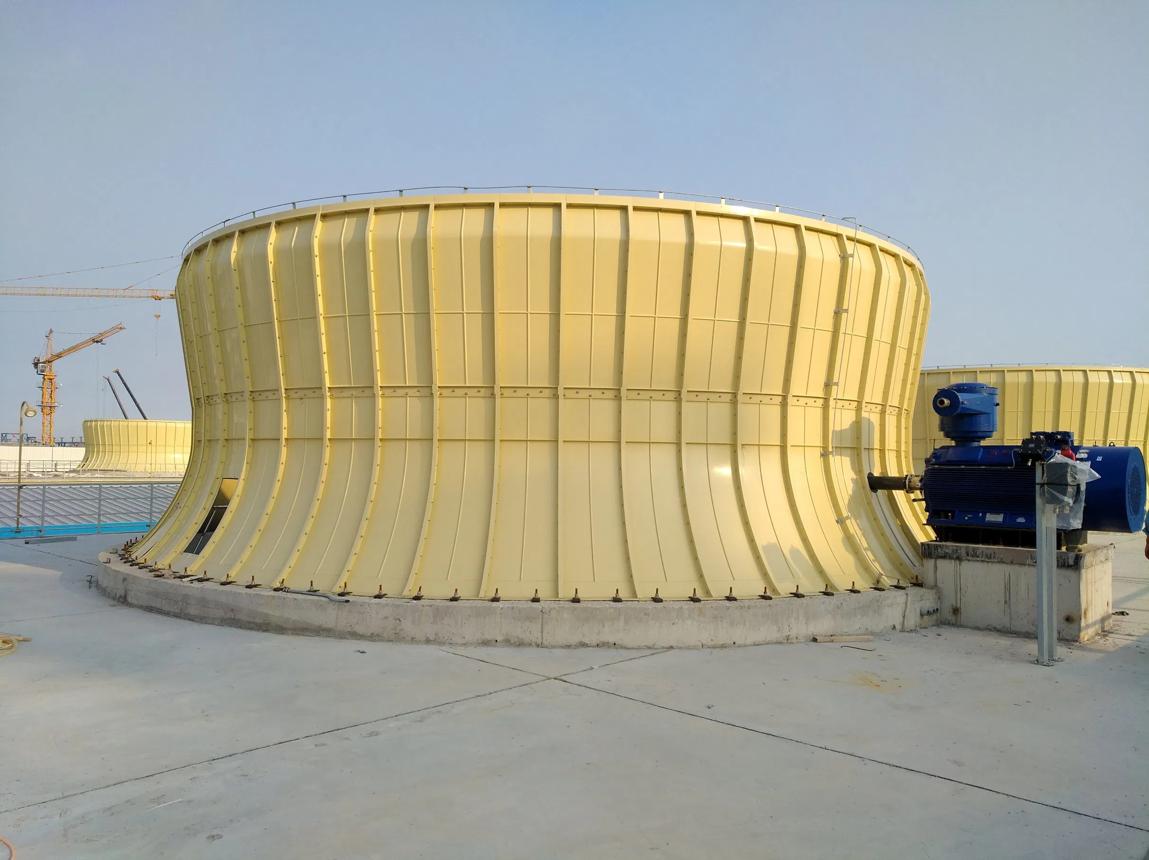
1. What Is a Fiberglass Cooling Tower Fan Stack?
A fiberglass cooling tower fan stack is a specially designed enclosure installed around the fan assembly at the top of a cooling tower. It creates a controlled discharge passage that directs warm, moisture-laden air away from the cooling tower.
The fan stack is sometimes called a cooling tower fan cylinder, fan shroud, or FRP fan stack, depending on its design and application.
1.1 Main Functions of a Cooling Tower Fan Stack
The fan stack performs several important functions in the cooling tower air-handling system.
Directing Exhaust Airflow
The primary function is to guide air discharged by the fan toward the atmosphere.
A properly designed stack helps establish a more organized discharge pattern and can reduce unnecessary airflow disturbances around the fan outlet.
Supporting Aerodynamic Performance
The internal geometry of the fan stack influences the airflow passing through the fan system.
A suitable inlet and outlet profile can help reduce local turbulence and avoid unnecessary flow resistance.
Protecting the Fan Assembly
The stack forms a protective enclosure around the rotating fan blades.
It also helps maintain the intended clearance between the blade tips and the surrounding structure.
Providing Structural Integration
The fan stack connects with the cooling tower's upper structure through appropriate flanges, brackets, or support arrangements.
Its mounting design must accommodate the loads and environmental conditions specified for the installation.
1.2 Where Is the Fan Stack Installed?
Most cooling tower fan stacks are installed above the fan deck or around the fan discharge opening.
The exact installation arrangement depends on the cooling tower configuration.
Induced-draft cooling towers commonly use fan stacks above the fan assembly.
Mechanical-draft cooling towers use different fan enclosure arrangements depending on their design.
Industrial replacement projects may require customized stacks to match existing equipment.
2. Structure of a Fiberglass Cooling Tower Fan Stack
The structural design of an FRP cooling tower fan stack directly affects its strength, stability, and service performance.
Although the overall shape is commonly cylindrical or slightly tapered, the detailed construction varies according to fan diameter, tower configuration, and engineering requirements.
2.1 Cylindrical or Tapered Stack Body
The main body is the largest structural section of the fan stack.
It provides the airflow passage and forms the primary enclosure around the fan.
Cylindrical Design
A cylindrical fan stack offers a relatively straightforward structure and can be suitable for many conventional cooling tower applications.
Its dimensions are determined by the fan diameter, required clearance, airflow arrangement, and installation conditions.
Tapered Design
Some fan stacks use a tapered profile to create a more specialized airflow passage.
The diameter may vary between the lower inlet and upper outlet sections.
The effectiveness of a tapered design depends on the specific fan and cooling tower configuration. It should be evaluated through appropriate aerodynamic design rather than assuming that every tapered shape improves efficiency.
2.2 Reinforced Fiberglass Wall Structure
The wall structure is responsible for maintaining the fan stack's shape and resisting external loads.
FRP is a composite material made by combining fiberglass reinforcement with a resin matrix.
Fiberglass Reinforcement Layer
Fiberglass provides the primary reinforcement and contributes to the mechanical strength of the structure.
Common reinforcement forms include:
Different reinforcement arrangements can be used to meet specific structural requirements.
Resin Matrix
The resin binds the fiberglass reinforcement together and helps protect the fibers from environmental exposure.
Common resin systems include polyester and vinyl ester.
The appropriate choice depends on temperature, moisture, chemical exposure, and expected operating conditions.
2.3 Flanges and Connection Structures
Flanges are important connection components that allow the fan stack to be installed securely on the cooling tower structure.
Main Flange Requirements
A properly designed flange should provide:
Accurate bolt-hole positioning.
Sufficient connection strength.
Appropriate thickness.
Good dimensional consistency.
Compatibility with the supporting structure.
Incorrect flange dimensions can cause installation difficulties and additional adjustment work.
2.4 Reinforcement Ribs and Structural Supports
Large fiberglass fan stacks may require additional reinforcement depending on their dimensions and loading conditions.
Why Are Reinforcement Ribs Necessary?
Reinforcement ribs can improve local stiffness and help distribute structural loads.
They may be incorporated into the design to address:
The number, position, and dimensions of reinforcement elements should be determined through engineering evaluation.
3. Materials Used in Fiberglass Cooling Tower Fan Stacks
Material selection is one of the most important factors affecting the performance and durability of an FRP fan stack.
The quality of the fiberglass, resin, and protective surface layer determines how well the finished product performs under industrial conditions.
3.1 Fiberglass Reinforcement Materials
Fiberglass is widely used in cooling tower components because it combines relatively low weight with good mechanical properties.
Benefits of Fiberglass Reinforcement
High strength-to-weight ratio.
Good dimensional stability when properly designed.
Resistance to many environmental conditions.
Flexibility in composite manufacturing.
Compatibility with different resin systems.
The reinforcement arrangement should be selected according to the required mechanical performance rather than material quantity alone.
3.2 Polyester Resin
Polyester resin is commonly used in general-purpose FRP products.
It can provide a practical balance between manufacturing cost, mechanical properties, and environmental resistance.
Typical Applications
Polyester-based fiberglass fan stacks may be suitable for conventional industrial cooling tower environments where the operating conditions are compatible with the selected resin system.
3.3 Vinyl Ester Resin
Vinyl ester resin is often considered when improved chemical resistance and durability are required.
When Should Buyers Consider Vinyl Ester?
It may be appropriate for installations involving more aggressive chemical exposure or demanding environmental conditions.
However, resin selection should always be based on the actual chemical environment, temperature, and design requirements.
3.4 Surface Protection and Gel Coat
The exterior surface of an FRP fan stack may receive a gel coat or protective coating.
This layer helps improve surface appearance and provides additional protection against environmental exposure.
Important Surface Properties
A suitable surface protection system can help reduce premature deterioration during long-term outdoor operation.
4. How Does a Fiberglass Cooling Tower Fan Stack Work?
The cooling tower fan stack works together with the fan assembly to establish the airflow discharge path.
Understanding this relationship is essential when selecting a suitable fan stack for a particular cooling tower.
4.1 Airflow Discharge Process
In an induced-draft cooling tower, the fan draws air through the tower and discharges warm, moisture-laden air upward.
The fan stack surrounds the discharge area and helps direct this air away from the tower.
Main Airflow Stages
Air enters the cooling tower through the air inlet openings.
Air passes through the heat exchange section.
The fan moves the warm air upward.
Air travels through the fan stack.
The stack guides the discharged air toward the atmosphere.
The fan stack is therefore an important part of the overall airflow arrangement.
4.2 Reducing Airflow Disturbances
Airflow disturbances can occur when the fan stack has unsuitable geometry, incorrect dimensions, or poor installation alignment.
A properly designed structure can help maintain a more consistent airflow passage.
Factors Influencing Airflow
These factors should be evaluated as an integrated system.
4.3 Maintaining Appropriate Fan Blade Clearance
The distance between the fan blade tips and the inner surface of the fan stack is an important installation parameter.
Why Is Blade Clearance Important?
Insufficient clearance can create a risk of mechanical contact when the fan rotates or when structural deformation occurs.
Excessive clearance may also affect the intended aerodynamic arrangement.
The correct clearance depends on fan design, operating speed, structural tolerances, and manufacturer recommendations.
5. Performance Advantages of Fiberglass Cooling Tower Fan Stacks
FRP fan stacks offer several practical advantages for industrial cooling tower applications.
Their performance characteristics make them an attractive alternative to some conventional metal structures.
5.1 Excellent Corrosion Resistance
Cooling towers operate in humid environments where water droplets, chemicals, and atmospheric contaminants may accelerate corrosion.
Fiberglass does not experience conventional electrochemical rusting like ordinary carbon steel.
Benefits in Industrial Environments
Reduced risk of rust-related deterioration.
Suitable for many humid cooling tower environments.
Lower need for corrosion-related surface maintenance.
Good resistance to selected chemicals when the resin is properly specified.
Actual chemical resistance depends on resin type, concentration, temperature, and exposure duration.
5.2 Lightweight Construction
Compared with many metallic structures, FRP fan stacks can offer a significant weight advantage.
Why Does Lower Weight Matter?
A lighter structure can provide several practical benefits:
Easier transportation.
More convenient handling.
Reduced lifting requirements.
Simplified installation planning.
Potentially lower loads on supporting structures.
For replacement projects, weight reduction may also help simplify the installation process, subject to structural verification.
5.3 High Strength-to-Weight Ratio
Although fiberglass is relatively lightweight, properly engineered composite structures can provide suitable mechanical strength.
The final structural performance depends on reinforcement type, laminate thickness, resin properties, and manufacturing quality.
Structural Performance Considerations
A manufacturer should evaluate:
5.4 Flexible Design and Customization
FRP can be molded into different shapes and dimensions, making it suitable for customized cooling tower fan stacks.
Available Customization Options
Different stack diameters.
Customized heights.
Various wall thicknesses.
Special flange arrangements.
Reinforced structural sections.
Customized colors and finishes.
This flexibility is especially useful when replacing fan stacks on older cooling towers.
5.5 Lower Routine Maintenance Requirements
FRP fan stacks generally require less corrosion-related maintenance than conventional unprotected steel structures.
However, they should still be inspected periodically.
Recommended Inspection Items
Regular inspection helps maintain safe operating conditions.
6. Key Factors Affecting Fiberglass Cooling Tower Fan Stack Performance
Not all fiberglass fan stacks provide the same performance.
Several design and manufacturing factors influence their suitability for industrial applications.
6.1 Stack Diameter
The internal diameter must match the cooling tower fan arrangement and required blade-tip clearance.
What Happens If the Diameter Is Incorrect?
An unsuitable diameter may affect airflow distribution, installation compatibility, and mechanical clearance.
Therefore, the fan diameter and stack dimensions should be confirmed before production.
6.2 Stack Height
Stack height influences the discharge arrangement and must be considered together with the fan and cooling tower design.
Important Design Considerations
Cooling tower configuration.
Fan discharge characteristics.
Surrounding structures.
Wind conditions.
Air recirculation considerations.
Maintenance accessibility.
A taller stack does not automatically produce better cooling tower performance. Its dimensions should be determined according to the complete system design.
6.3 Wall Thickness
Wall thickness influences the stiffness, weight, and structural capacity of the FRP fan stack.
How Should Wall Thickness Be Selected?
It should be determined according to the stack diameter, height, material properties, support arrangement, and expected loading conditions.
Using insufficient laminate thickness may lead to excessive deformation, while unnecessary material increases can add weight and cost.
6.4 Manufacturing Quality
Even a well-designed fan stack can perform poorly if its manufacturing quality is inconsistent.
Important manufacturing considerations include:
Uniform fiberglass distribution.
Controlled resin content.
Consistent laminate thickness.
Proper curing.
Accurate dimensions.
High-quality surface finishing.
6.5 Installation Accuracy
Correct installation is essential for achieving the intended performance of the fan stack.
Installation Checks
Before operation, confirm:
Correct mounting position.
Secure flange connections.
Proper alignment.
Appropriate fan blade clearance.
No loose structural components.
No interference with rotating equipment.
7. Fiberglass Fan Stack vs. Traditional Metal Fan Stack
When choosing a cooling tower fan stack, buyers often compare fiberglass with traditional metal materials.
Both options can be suitable depending on the operating environment, structural requirements, and project budget.
7.1 Material Comparison
| Comparison Factor | Fiberglass Fan Stack | Metal Fan Stack |
| Weight | Generally lightweight | Depends on metal type and thickness |
| Corrosion resistance | Good with suitable resin selection | Depends on alloy or protective coating |
| Design flexibility | High | Depends on fabrication method |
| Maintenance | Generally low corrosion-related maintenance | May require coating or corrosion protection |
| Customization | Suitable for complex molded shapes | Suitable for fabricated configurations |
| Initial cost | Depends on design and production volume | Depends on material and fabrication |
7.2 Which Material Is Better for Industrial Cooling Towers?
FRP is often attractive for installations where corrosion resistance, reduced weight, and customized dimensions are important.
Metal structures may remain suitable for projects with specific structural, temperature, or fabrication requirements.
How Should Buyers Decide?
Consider the following factors:
Operating environment.
Structural loading.
Fan stack dimensions.
Expected service life.
Maintenance resources.
Initial investment.
Total lifecycle cost.
The best material is the one that meets the project's technical and economic requirements.
8. Industrial Applications of Fiberglass Cooling Tower Fan Stacks
Fiberglass cooling tower fan stacks are used in various industries where reliable heat rejection is essential.
8.1 Power Generation Plants
Power plants rely on cooling systems to remove excess heat from industrial processes.
Application Benefits
FRP fan stacks can provide corrosion-resistant structures with relatively low weight, making them suitable for many cooling tower installations.
8.2 Chemical and Petrochemical Industries
Chemical processing facilities may expose cooling tower components to humid environments and chemical contaminants.
Material Selection Considerations
Resin selection is particularly important in these applications because chemical exposure can influence composite durability.
8.3 HVAC and Commercial Buildings
Large commercial buildings use cooling towers to support central air-conditioning systems.
FRP fan stacks can provide a practical solution for outdoor installations where weight and corrosion resistance are important.
8.4 Manufacturing and Industrial Processing
Factories in steel, textile, food processing, paper, and other industries may operate cooling towers continuously.
A properly designed fiberglass fan stack can help support reliable fan discharge arrangements and reduce corrosion-related maintenance concerns.
9. How to Choose a High-Quality Fiberglass Cooling Tower Fan Stack
Selecting the right product requires evaluating both the manufacturer and the technical specifications.
9.1 Check Material Specifications
Ask the manufacturer to provide information about:
9.2 Confirm Dimensional Compatibility
For new installations and replacement projects, provide accurate technical information.
Essential Dimensions
Fan diameter.
Stack internal diameter.
Overall stack height.
Flange dimensions.
Bolt-hole spacing.
Mounting configuration.
9.3 Evaluate Manufacturing Experience
Choose suppliers with experience producing FRP cooling tower components.
Ask about previous projects, customized products, manufacturing equipment, and quality inspection procedures.
9.4 Request Technical Drawings
Before manufacturing, review and approve drawings showing all critical dimensions and connection details.
This step can reduce errors and improve installation compatibility.
9.5 Compare Quality and Total Cost
Do not select a supplier based exclusively on the lowest quotation.
Compare the product specifications, manufacturing quality, inspection records, packaging, delivery arrangements, and technical support.
10. Manufacturing and Quality Control of FRP Cooling Tower Fan Stacks
Manufacturing consistency is essential for producing durable fiberglass fan stacks.
A professional production process should include material inspection, controlled fabrication, curing, finishing, and final quality checks.
10.1 Material Preparation
Fiberglass reinforcement and resin should be selected according to the approved product specifications.
Material Preparation Checks
Verify raw material specifications.
Check material storage conditions.
Prepare reinforcement according to the design.
Confirm resin compatibility.
10.2 Lamination and Curing
During lamination, fiberglass reinforcement is combined with resin to form the composite structure.
The manufacturing team should control the resin application, reinforcement arrangement, laminate thickness, and curing conditions.
10.3 Trimming and Surface Finishing
After curing, the product is trimmed to the required dimensions.
The manufacturer should inspect the surface and remove unacceptable defects.
10.4 Final Product Inspection
Before shipment, the completed fan stack should undergo dimensional and visual inspections.
Important Inspection Points
For projects with special structural requirements, additional engineering verification and testing may be necessary.
11. Maintenance Tips for Extending Fan Stack Service Life
Although fiberglass cooling tower fan stacks are designed for demanding environments, proper maintenance remains important.
11.1 Perform Regular Visual Inspections
Inspect the stack periodically for cracks, surface damage, and signs of structural deterioration.
11.2 Check Mounting Connections
Loose bolts or damaged mounting points can affect structural stability.
Inspect the flange connections and supporting structure according to the maintenance schedule.
11.3 Monitor Fan Vibration
Abnormal vibration may result from fan imbalance, bearing problems, misalignment, or other mechanical issues.
The fan assembly and its supporting structure should be inspected if unusual vibration occurs.
11.4 Keep the Airflow Passage Clear
Remove accumulated debris and foreign materials that may obstruct airflow or interfere with the fan assembly.
11.5 Repair Surface Damage Promptly
Small areas of damage should be evaluated and repaired using compatible FRP repair materials and suitable procedures.
More serious structural damage requires professional assessment before the equipment returns to service.
12. Future Trends in Fiberglass Cooling Tower Fan Stack Design
As industrial cooling systems continue to develop, fiberglass fan stack manufacturing is also evolving.
Several trends are influencing product design and manufacturing.
12.1 Improved Composite Materials
Manufacturers are exploring improved resin systems and fiberglass reinforcement arrangements to enhance durability and structural performance.
12.2 More Accurate Customized Manufacturing
Digital measurement, improved mold design, and advanced production controls can help manufacturers produce more consistent customized fan stacks.
12.3 Lightweight Structural Optimization
Optimized composite structures can help balance mechanical strength, product weight, and material consumption.
12.4 Better Integration with High-Efficiency Fans
Cooling tower fan systems increasingly emphasize coordinated design.
Fan blades, hubs, motors, gearboxes, and fan stacks should be evaluated as an integrated system to achieve reliable operation.
13. Conclusion: Why Choose a Fiberglass Cooling Tower Fan Stack?
A fiberglass cooling tower fan stack is an important component for directing airflow and supporting the operation of industrial cooling towers.
Its lightweight construction, corrosion resistance, structural flexibility, and customization potential make FRP a practical material for many cooling tower applications.
However, product performance depends on more than the material itself. Stack geometry, wall thickness, reinforcement design, resin selection, manufacturing quality, and installation accuracy all play important roles.
When purchasing a fiberglass cooling tower fan stack, industrial buyers should carefully evaluate the manufacturer's engineering capabilities, material specifications, quality control procedures, and experience with customized cooling tower components.
Selecting a properly designed and manufactured FRP fan stack can help improve equipment compatibility, reduce corrosion-related maintenance, and support reliable long-term cooling tower operation.


