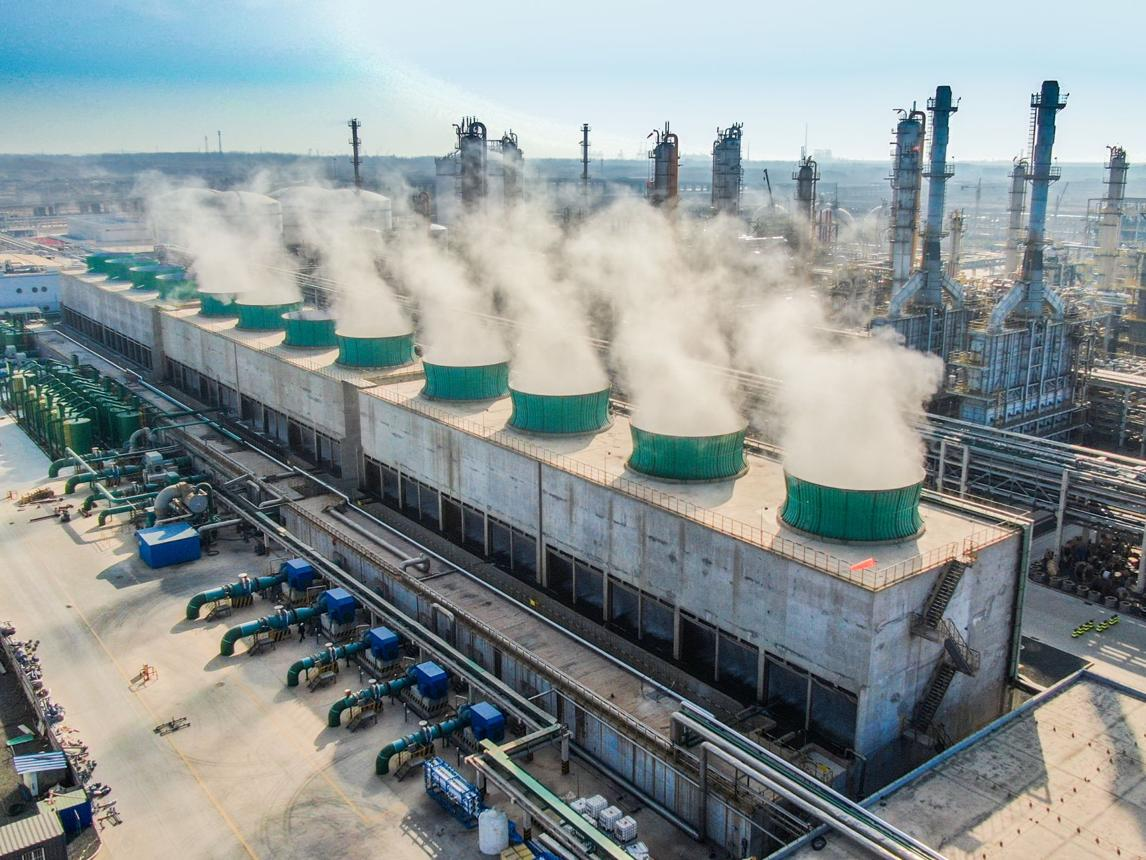
1. Introduction to Cooling Tower Fans
Have you ever wondered what keeps an industrial cooling tower moving thousands of cubic meters of air every hour? The answer is its fan system.
A cooling tower fan is one of the most important components in a mechanical cooling tower. It creates the airflow needed to transfer heat from circulating water into the atmosphere. Without sufficient airflow, the cooling tower cannot perform as designed, even if its water distribution system and fill media are in excellent condition.
However, not all cooling tower fans use the same drive arrangement. Depending on the tower design, operating requirements, and installation conditions, a fan may use a direct drive or a belt drive system.
Both options have practical advantages. Direct drive offers a relatively simple mechanical arrangement, while belt drive provides flexibility in speed adjustment and equipment configuration.
So, which type should you choose? Let's explore how these systems work and what you should consider before purchasing a replacement cooling tower fan.
2. What Is a Cooling Tower Fan?
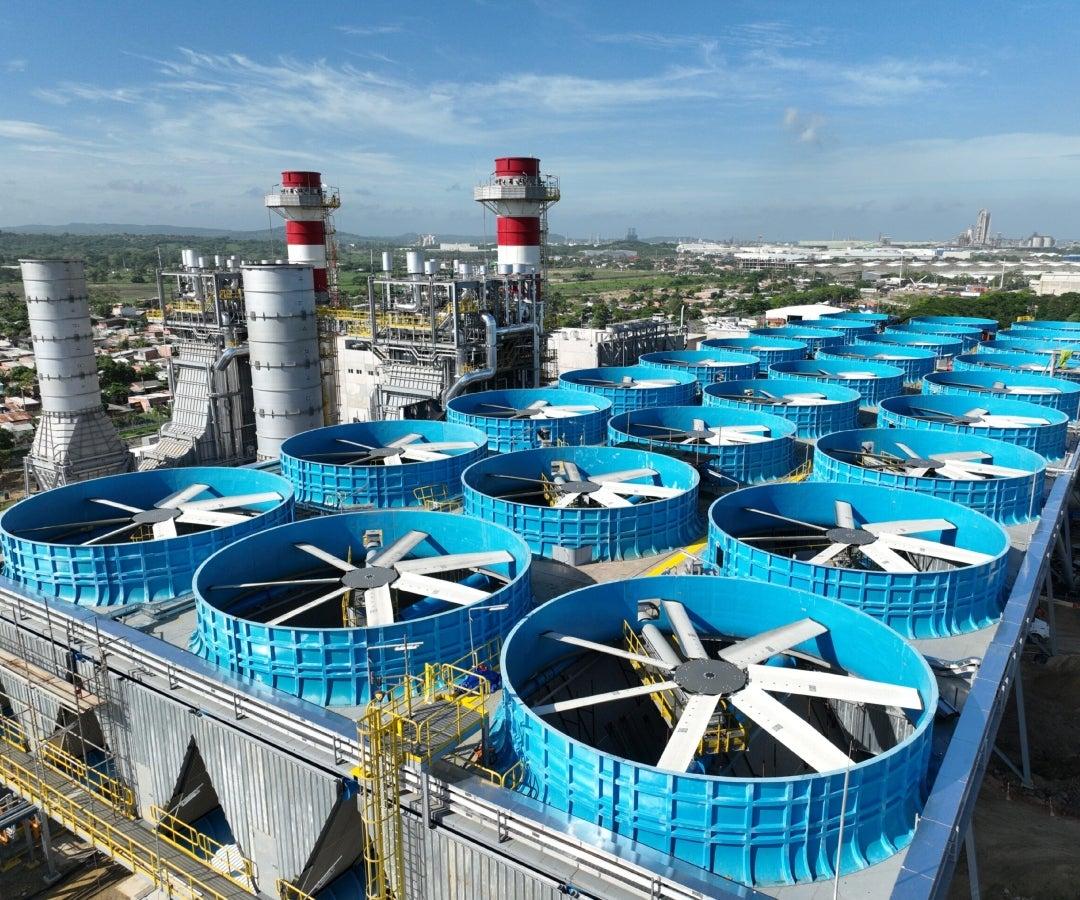
A cooling tower fan is a rotating air-moving device installed in a mechanical-draft cooling tower. Its primary job is to move air through the tower so that heat can be removed from the circulating water.
Most industrial cooling towers use axial fans. These fans move air mainly along the direction of the fan shaft, making them suitable for applications that require large airflow volumes.
A typical cooling tower fan assembly may include:
The exact configuration depends on the cooling tower structure and manufacturer.
2.1 How Cooling Tower Fans Work
The operating principle is straightforward.
Warm water enters the cooling tower and is distributed over the fill media. At the same time, the fan moves air through the tower. As the water flows across the fill surfaces, it comes into contact with the moving air.
A small portion of the water evaporates, removing heat from the remaining water. The cooled water collects in the basin and returns to the industrial process.
The fan helps maintain the airflow needed for this heat and mass transfer process.
Think of the fan as the breathing system of a cooling tower. If airflow becomes restricted, the tower may struggle to remove heat efficiently.
2.2 Why Fan Performance Matters
A poorly selected or incorrectly operated fan can affect the entire cooling system.
Common consequences include:
Insufficient airflow
Reduced cooling performance
Higher motor operating current
Excessive vibration
Increased energy consumption
Unplanned maintenance
Premature component failure
The fan must therefore be selected according to the tower's required airflow, static pressure, operating speed, and mechanical design.
A larger fan or a more powerful motor does not automatically guarantee better cooling. The complete system must work together.
3. Main Types of Cooling Tower Fans
Cooling tower fans can be classified by airflow direction, blade design, and drive arrangement.
For industrial applications, axial and centrifugal fans are two important categories.
3.1 Axial Flow Cooling Tower Fans
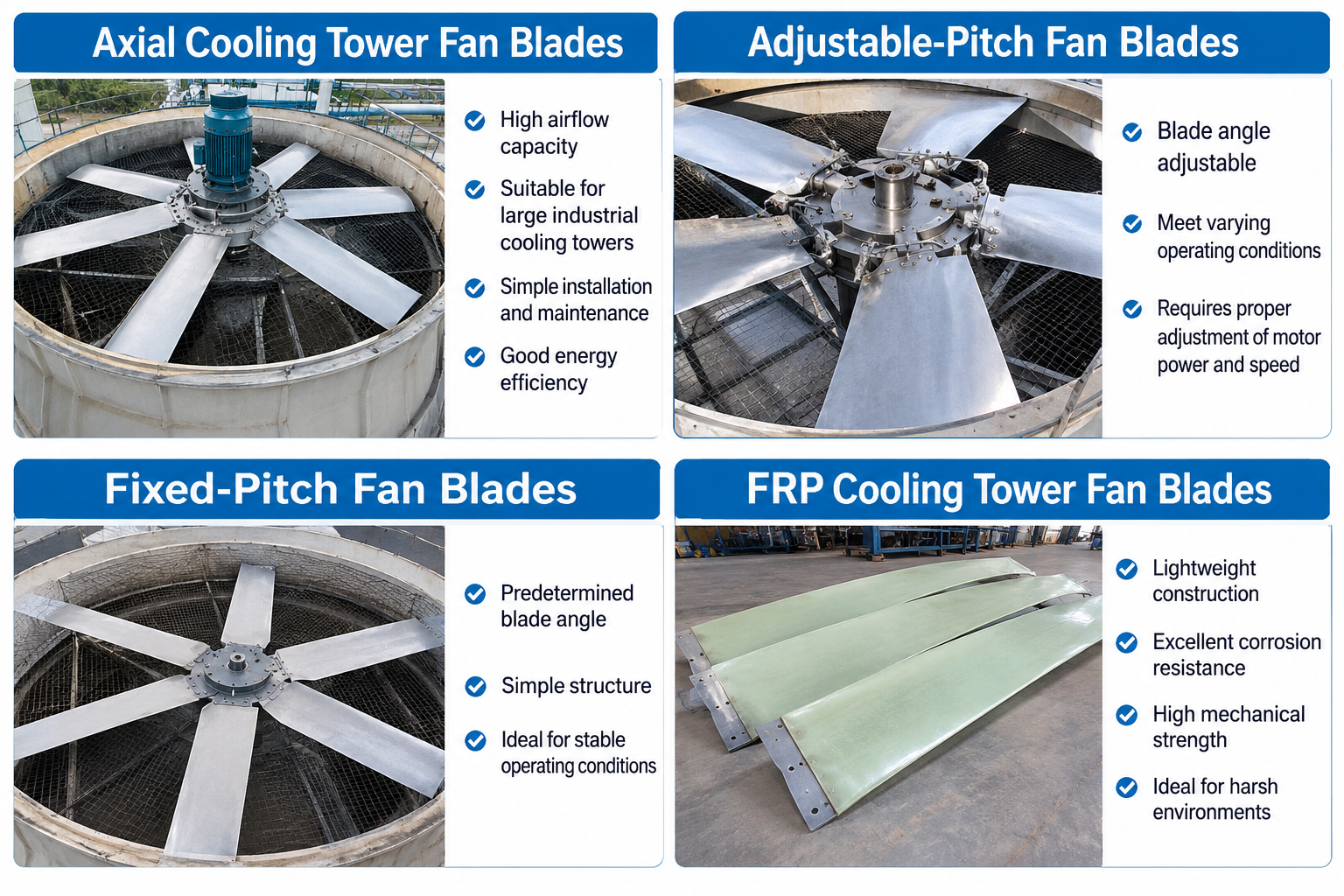
<PRIVATE_PERSON>Axial flow fans are widely used in industrial cooling towers because they can move large volumes of air through relatively short airflow paths.
Their blades rotate around a central hub and move air parallel to the fan shaft.
Common features include:
High-volume airflow capability
Relatively compact axial arrangement
Multiple blade materials and profiles
Compatibility with different drive configurations
Applications in induced-draft and forced-draft cooling towers
The fan diameter, blade profile, pitch angle, rotational speed, and system resistance all influence its operating performance.
Axial fans are commonly selected when the cooling tower requires substantial airflow with an appropriate pressure capability.
3.2 Centrifugal Cooling Tower Fans
Centrifugal fans move air through a rotating impeller. Air enters near the center and is discharged outward by centrifugal force.
Compared with axial fans, centrifugal fans are often considered where the system requires different pressure characteristics or a particular duct arrangement.
Their selection depends on airflow, static pressure, installation space, noise requirements, and operating conditions.
For many large industrial cooling tower applications, axial fans remain a common choice. However, the final selection should always follow the equipment design.
4. Direct Drive Cooling Tower Fans
<PRIVATE_PERSON>Direct drive cooling tower fans connect the motor directly to the fan assembly without using a belt-and-pulley transmission.
The motor shaft drives the fan directly, or through a specifically designed direct coupling arrangement, depending on the equipment configuration.
This design reduces the number of transmission components between the motor and the fan.
4.1 How Direct Drive Fans Work
In a direct drive arrangement, the motor provides rotational power to the fan hub.
The motor speed and fan speed are closely related. If a variable-frequency drive (VFD) is used, the fan speed can be controlled by adjusting the motor's operating frequency within the approved operating range.
The system generally includes:
Because there is no belt transmission, there is no belt tension adjustment or pulley alignment requirement.
However, direct drive does not mean maintenance-free. Motor bearings, electrical connections, blade condition, hub fasteners, and vibration still require regular inspection.
4.2 Advantages of Direct Drive
Fewer transmission components
A direct drive system eliminates belts and pulleys, reducing the number of mechanical parts that require routine adjustment or replacement.
No belt slippage
Because power is not transmitted through a belt, belt slippage is not an operating concern.
Potentially lower routine maintenance
There is no need for regular belt tension adjustment or belt replacement. This can simplify maintenance planning.
Compact mechanical arrangement
Depending on the motor and fan design, direct drive can reduce the space required for transmission components.
Suitable for compatible speed-control systems
When the motor and control system are designed for variable-speed operation, direct drive can provide flexible fan-speed control.
4.3 Limitations of Direct Drive
Direct drive also has limitations.
First, the motor must be suitable for the fan's operating speed and load. You cannot assume that any standard motor can directly drive any cooling tower fan.
Second, changing the fan speed may require compatible electrical controls and a motor designed for the intended operating conditions.
Third, motor access and replacement can be more complicated in some tower configurations.
Before selecting direct drive, confirm motor specifications, mounting dimensions, fan operating speed, and mechanical compatibility.
5. Belt Drive Cooling Tower Fans
Belt drive cooling tower fans use belts and pulleys to transfer power from the motor to the fan shaft.
This arrangement has been used in many industrial mechanical systems because it offers flexibility in drive configuration and speed selection.
5.1 How Belt Drive Fans Work
A typical belt drive system includes:
When the motor rotates, the motor pulley drives the belt. The belt transfers power to the fan pulley, causing the fan to rotate.
The pulley diameters determine the speed relationship between the motor and the fan.
The approximate speed relationship is:
[
N_f = N_m \times \frac{D_m}{D_f}
]
Where:
This simplified relationship assumes no belt slip. Actual performance depends on the belt type, pulley geometry, and operating conditions.
5.2 Advantages of Belt Drive
Flexible speed configuration
Different pulley ratios can provide different fan speeds while using a suitable motor speed.
Convenient component replacement
Belts and pulleys can often be inspected and replaced without replacing the entire fan assembly.
Established industrial technology
Belt drives are familiar to many maintenance teams, and replacement belts are available in a range of types and sizes.
Useful for certain retrofit projects
Where the existing tower was designed around a belt drive, maintaining the original configuration may be more practical than changing the complete drive system.
Potentially flexible installation
The motor and fan can be positioned according to the mechanical layout, provided the drive geometry and structural requirements are satisfied.
5.3 Limitations of Belt Drive
Belt drive systems require regular maintenance.
Belts can stretch, wear, crack, or lose tension over time. Incorrect tension can cause slippage, overheating, premature belt failure, or excessive loading on bearings.
Pulley misalignment can also create vibration and uneven belt wear.
In addition, belt transmission introduces mechanical losses. The actual efficiency depends on belt type, alignment, tension, and operating conditions.
For this reason, a belt drive system should be inspected regularly rather than waiting until a belt breaks.
6. Direct Drive vs. Belt Drive: Key Differences
Which drive type is better?
The answer depends on the cooling tower's design and operating requirements. Neither arrangement is automatically superior for every project.
| Comparison | Direct Drive | Belt Drive |
| Power transmission | Direct motor-to-fan arrangement | Belt and pulley transmission |
| Transmission components | Fewer | More |
| Belt maintenance | Not required | Required |
| Speed configuration | Depends on motor and control system | Can be configured through pulley ratio |
| Mechanical losses | No belt transmission losses | Includes belt transmission losses |
| Routine inspection | Motor, hub, blades, mounting | Motor, belts, pulleys, bearings, blades |
| Installation | Depends on motor and fan arrangement | Requires correct pulley alignment and belt geometry |
| Retrofit suitability | Requires compatible motor and structure | Often suitable where an existing belt system is retained |
Which Type Should You Choose?
Choose direct drive when the motor, fan speed, mounting arrangement, and control system are compatible with the application.
Consider belt drive when the existing tower uses a belt transmission, when the required speed ratio suits a pulley arrangement, or when retaining the current mechanical configuration is the practical solution.
For replacement projects, the existing equipment design is often the best starting point.
7. How to Choose the Right Drive Type
Selecting a drive system requires more than comparing purchase prices. You should consider the operating conditions, maintenance resources, installation layout, and long-term operating costs.
7.1 Cooling Capacity and Airflow
Start with the cooling tower's required duty.
Confirm the design airflow and the pressure resistance of the complete air path. The fan must be capable of delivering the required performance under the actual operating conditions.
Consider the condition of the fill, drift eliminators, louvers, air inlets, and fan cylinder. These components influence system resistance.
A drive system should be selected to operate the fan at the required duty point without exceeding motor or mechanical limits.
7.2 Motor Power and Fan Speed
Check the motor nameplate before selecting a fan or drive arrangement.
Important information includes:
The fan's required speed and power must be compatible with the motor.
For a belt drive, confirm the pulley ratio, belt specification, and transmission capacity. For direct drive, verify the motor's speed, torque, and mounting compatibility.
7.3 Installation Space
Installation space can influence the choice of drive type.
A direct drive arrangement may reduce the space required for belts and pulleys, but it still needs adequate motor access and structural support.
A belt drive needs sufficient space for the motor, pulleys, belts, adjustment, and maintenance access.
Always check the actual dimensions of the fan deck and supporting structure before ordering replacement equipment.
7.4 Maintenance and Operating Costs
Look beyond the initial purchase price.
Direct drive may reduce routine transmission maintenance because there are no belts to tension or replace. Belt drive requires periodic inspection and belt maintenance but may offer practical advantages when retaining an existing system.
Compare:
A reliable selection should consider the complete service life of the equipment.
8. Important Cooling Tower Fan Parameters
Before purchasing a cooling tower fan, prepare the main technical parameters. Accurate information helps the manufacturer evaluate compatibility.
8.1 Fan Diameter and Blade Quantity
Fan diameter is measured across the outer tips of opposing blades.
The number of blades depends on the fan design. Different blade counts may be used for different diameters, operating speeds, and aerodynamic requirements.
When replacing an existing fan, record the original diameter and blade quantity. Do not change either parameter without confirming the effect on performance and mechanical loading.
8.2 Blade Pitch Angle
Blade pitch is the angle at which the blade is installed relative to the fan's reference plane.
Pitch influences airflow and power demand. A higher pitch may increase the aerodynamic load, but the actual result depends on the blade profile and fan operating conditions.
For adjustable-pitch fans, all blades should be set according to the manufacturer's specified procedure.
Never adjust pitch simply to increase airflow without checking motor current and fan operating limits.
8.3 Airflow and Static Pressure
Airflow is commonly measured in cubic meters per hour (m³/h) or cubic meters per second (m³/s).
Static pressure represents the resistance the fan must overcome to move air through the cooling tower.
Both parameters are necessary for proper fan selection.
A fan with a high nominal airflow rating may not provide the required airflow if the actual system resistance is higher than expected.
8.4 Motor and Drive Specifications
For direct drive, confirm the motor speed, output power, shaft or coupling arrangement, and mounting details.
For belt drive, also confirm:
Motor pulley diameter
Fan pulley diameter
Belt type and quantity
Belt length
Center distance
Pulley alignment
Required belt tension
These details help prevent installation problems and reduce the risk of premature mechanical failure.
9. Cooling Tower Fan Materials
Cooling tower fan blades may be manufactured from several materials.
FRP (Fiber-Reinforced Plastic) is commonly considered because it combines relatively low weight with good corrosion resistance in many industrial environments.
Aluminum alloy provides a lightweight metal option and can be suitable for applications requiring specific mechanical properties.
Stainless steel offers good strength and resistance to many corrosive conditions, although its weight and grade selection need careful consideration.
The right material depends on:
For composite blades, confirm the resin system, reinforcement, construction, and permitted operating limits. For metal blades, confirm the alloy grade and surface treatment.
10. Installation and Commissioning
A correctly selected fan can still perform poorly if installation is incorrect.
Before installation, isolate the electrical supply and follow the site's lockout/tagout procedure. Confirm that the fan cannot start unexpectedly.
During installation:
Inspect the fan deck and support structure.
Confirm the fan diameter and blade configuration.
Check the hub, motor, and drive components.
Verify pulley alignment and belt tension for belt drive systems.
Confirm mounting and coupling arrangements for direct drive systems.
Set blade pitch according to the approved specification.
Check blade-tip clearance.
Complete required balance and fastener checks.
Reinstall all protective guards.
After installation, conduct controlled commissioning.
Monitor vibration, noise, motor current, and fan operation. Stop the equipment if abnormal vibration, mechanical interference, or unexpected electrical loading occurs.
Commissioning should follow the equipment manufacturer's instructions and applicable site safety requirements.
11. Cooling Tower Fan Maintenance
Regular maintenance helps reduce unexpected breakdowns and maintain stable operation.
11.1 Direct Drive Maintenance
For direct drive fans, inspect:
Motor bearings
Electrical connections
Motor temperature
Fan hub fasteners
Blade surface condition
Vibration levels
Mounting structure
Although direct drive eliminates belt maintenance, it does not eliminate the need for mechanical and electrical inspections.
11.2 Belt Drive Maintenance
Belt drive fans need additional attention.
Check the belts for cracks, glazing, fraying, and abnormal wear. Inspect pulley grooves and alignment. Confirm belt tension according to the manufacturer's instructions.
Avoid excessive belt tension. Over-tightening can increase bearing loads and shorten component life.
Replace belts using the specified type and size. Where multiple belts operate together, follow the manufacturer's replacement recommendations to maintain consistent transmission performance.
11.3 General Fan Maintenance
Both drive types require regular checks of:
Maintenance frequency should be based on operating hours, environment, manufacturer recommendations, and inspection results.
12. Common Fan Problems and Solutions
| Problem | Possible Cause | Recommended Action |
| Insufficient airflow | Incorrect pitch, speed, or system blockage | Check fan settings and airflow path |
| Excessive vibration | Imbalance, loose fasteners, damaged blade | Stop and inspect the fan assembly |
| Belt slipping | Incorrect tension, worn belt, pulley misalignment | Inspect and correct the belt drive |
| Motor overheating | Excessive load, electrical issue, poor ventilation | Check motor loading and electrical conditions |
| Abnormal noise | Loose components, bearing problems, interference | Inspect the complete mechanical system |
| Uneven belt wear | Pulley misalignment or incorrect tension | Verify alignment and belt condition |
| Blade damage | Fatigue, impact, corrosion, or material deterioration | Assess repair or replacement requirements |
Do not continue operating a fan with serious blade damage or abnormal vibration. A damaged rotating assembly can create significant safety risks.
13. How to Select a Cooling Tower Fan Manufacturer
A dependable cooling tower fan manufacturer should understand more than the product dimensions.
The supplier should be able to review your operating requirements and help identify a suitable fan configuration.
Before purchasing, consider the following:
Technical support: Can the supplier review your cooling tower model, fan dimensions, and motor specifications?
Product information: Are material details, drawings, and relevant technical parameters available?
Drive compatibility: Can the supplier evaluate direct drive or belt drive requirements?
Replacement experience: Can the supplier help identify replacement components for an existing cooling tower?
Quality control: Can the supplier explain its inspection and product verification procedures?
After-sales communication: Can the supplier provide installation information and technical assistance?
A professional supplier should ask for the necessary technical information before recommending a replacement. Be cautious of suppliers who promise universal compatibility without checking the actual equipment.
14. Power Tower Cooling Tower Fan Solutions
Power Tower Cooling Technology (Shaoxing) Co.,Ltd focuses on cooling tower components and replacement-related products.
Company website: https://www.coolingtowerpart.com
For customers sourcing cooling tower fans, fan components, or replacement parts, selecting the correct configuration starts with understanding the existing equipment.
Power Tower recommends preparing the following information when requesting a quotation:
Cooling tower manufacturer and model
Fan diameter
Number of fan blades
Existing fan material
Motor power and rotational speed
Direct drive or belt drive arrangement
Hub and mounting dimensions
Existing fan photographs
Required airflow or cooling capacity, if available
Operating environment
If you are considering changing from belt drive to direct drive, or the other way around, the project requires additional engineering checks.
The motor, support structure, fan hub, operating speed, and electrical controls may all need to be evaluated. A drive conversion should not be treated as a simple component replacement.
By providing accurate equipment information, customers can make the selection process more efficient and reduce the risk of ordering incompatible products.
15. Frequently Asked Questions
15.1 What Is the Difference Between Direct Drive and Belt Drive Cooling Tower Fans?
Direct drive transfers motor power to the fan without a belt transmission. Belt drive uses pulleys and belts to transfer power from the motor to the fan.
Direct drive has fewer transmission components, while belt drive offers flexibility in speed configuration through pulley ratios.
15.2 Which Cooling Tower Fan Drive Type Is More Efficient?
There is no universal answer. Direct drive avoids belt transmission losses, while belt drive performance depends on belt condition, tension, alignment, and design.
The overall system efficiency also depends on fan selection, motor efficiency, operating point, and cooling tower resistance.
15.3 Can I Replace a Belt Drive Fan with a Direct Drive Fan?
Potentially, but it requires engineering evaluation.
You must verify the motor speed and power, fan hub, support structure, mechanical loading, mounting arrangement, and electrical controls.
A direct drive conversion should be designed and approved for the specific cooling tower.
15.4 How Often Should Cooling Tower Fan Belts Be Replaced?
There is no single replacement interval for every application.
Inspect belts regularly and replace them when they show signs of cracking, glazing, fraying, or other deterioration. Follow the belt manufacturer's and cooling tower manufacturer's maintenance recommendations.
15.5 What Information Is Needed to Purchase a Cooling Tower Fan?
Prepare the cooling tower model, fan diameter, blade quantity, motor power, RPM, drive type, hub dimensions, and operating requirements.
Photographs and original technical drawings are also useful.
15.6 Are FRP Cooling Tower Fans Suitable for Industrial Applications?
FRP fan blades are used in many industrial cooling tower applications because of their relatively low weight and corrosion resistance.
However, the material construction and mechanical limits must match the actual operating environment and fan design.
15.7 Does a Bigger Cooling Tower Fan Always Provide Better Cooling?
No. A larger fan may increase airflow under certain conditions, but it can also change motor loading, mechanical stress, and system performance.
The fan must be selected according to the cooling tower's required duty and operating resistance.
16. Conclusion
Cooling tower fans play a central role in industrial heat rejection. Their performance affects airflow, cooling capacity, energy consumption, and equipment reliability.
Direct drive and belt drive systems both have practical applications. Direct drive offers a simpler transmission arrangement with fewer mechanical components. Belt drive provides flexibility through pulley ratios and can be a practical option for existing cooling towers designed around this configuration.
Before choosing a cooling tower fan, check the fan diameter, blade quantity, pitch angle, airflow, static pressure, motor power, rotational speed, and drive arrangement.
Most importantly, select the fan as part of the complete cooling tower system rather than treating it as an independent component.
For cooling tower fan and replacement component inquiries, contact Power Tower Cooling Technology (Shaoxing) Co.,Ltd through www.coolingtowerpart.com. Providing your equipment model and technical parameters is the best first step toward finding a suitable solution.


