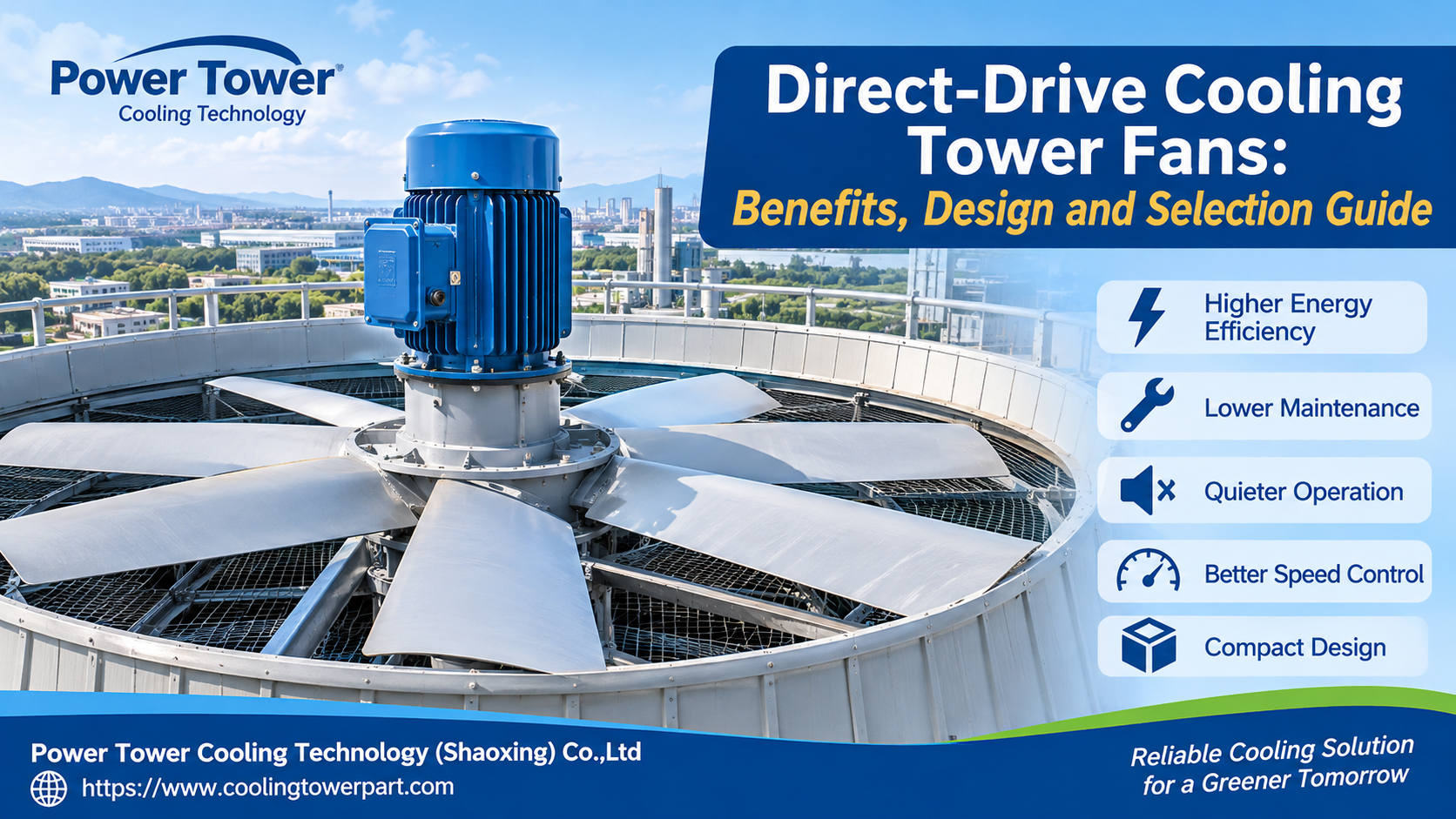
Direct-drive cooling tower fans are becoming an attractive option for industrial cooling systems that require reliable airflow, efficient operation, and reduced mechanical maintenance. Unlike traditional belt-driven or gearbox-driven fans, a direct-drive system transfers power from the motor to the fan without using a conventional belt-and-pulley transmission or a separate reduction gearbox.
This simpler design can reduce the number of mechanical components, eliminate certain transmission losses, and make routine maintenance easier. When combined with a suitable motor and speed-control system, direct-drive cooling tower fans can also help facilities respond more effectively to changing cooling loads.
But are direct-drive fans suitable for every cooling tower? What makes them different from traditional fan systems? And how should you choose the right model for your industrial application?
In this guide, we will explain how direct-drive cooling tower fans work, explore their main advantages, compare different drive systems, and discuss important selection and maintenance considerations.
1. What Is a Direct-Drive Cooling Tower Fan?
A direct-drive cooling tower fan is a fan assembly in which the motor transfers rotational power directly to the fan hub and blades.
In a traditional belt-driven system, the motor rotates a pulley, which drives a belt connected to another pulley. The fan then receives power through this transmission arrangement. A gearbox-driven system uses a reduction gearbox to adjust the relationship between motor speed and fan speed.
A direct-drive system removes these conventional transmission stages. The motor is connected directly to the fan assembly through a suitable shaft or hub arrangement.
This design reduces the number of mechanical components between the motor and fan. It can also simplify the overall drive arrangement, especially in installations where maintenance access is limited.
However, direct drive does not automatically mean variable-speed operation. Direct drive describes how mechanical power reaches the fan, while variable speed describes how the fan's rotational speed is controlled. A direct-drive fan can operate at a fixed speed or use a compatible electronic speed-control system.
2. How Do Direct-Drive Cooling Tower Fans Work?
To understand the benefits of direct-drive cooling tower fans, it helps to look at their operating principle.
A cooling tower removes heat from circulating water by bringing the water into contact with moving air. As water flows through the fill, the fan moves air through the tower. Heat and a portion of the water transfer into the air, helping reduce the temperature of the circulating water.
In a direct-drive arrangement, the motor generates rotational torque and transfers it directly to the fan hub. The hub rotates the blades, which create the airflow required by the cooling tower.
The complete process involves several coordinated components:
The motor supplies the rotational power.
The fan hub connects the motor to the blades.
The fan blades generate airflow.
The fan cylinder or fan stack helps guide airflow.
The control system manages motor operation where speed control is installed.
The support structure holds the assembly in its operating position.
Each component affects overall performance. A high-efficiency motor alone cannot guarantee an efficient cooling tower if the fan blades are poorly selected or the airflow path creates excessive resistance.
For this reason, the motor, fan, hub, and tower structure should be evaluated as one integrated system.
3. Main Components of a Direct-Drive Cooling Tower Fan
A direct-drive fan may look mechanically simple, but every component needs to match the operating requirements.
3.1 Direct-Drive Motor
The motor provides the torque required to rotate the fan. Depending on the design, direct-drive systems may use induction motors, permanent-magnet motors, or other suitable motor technologies.
Motor selection should consider rated power, torque, rotational speed, voltage, frequency, efficiency, insulation, enclosure protection, and operating temperature.
Cooling towers often operate in humid environments with water droplets and possible chemical exposure. The motor should therefore have suitable protection for the actual installation conditions.
3.2 Fan Blades
Fan blades convert rotational energy into airflow. Their geometry, pitch angle, diameter, number, and material all influence performance.
FRP (fiber-reinforced plastic) fan blades are commonly considered for cooling tower applications because they can offer relatively low weight, corrosion resistance, and design flexibility.
Other materials may also be suitable depending on the operating environment and mechanical requirements.
The correct blade design must match the required airflow and pressure. Incorrect blade pitch can increase motor load, create vibration, and reduce cooling performance.
3.3 Fan Hub
The fan hub connects the blades to the rotating motor assembly. It must withstand rotational forces, starting torque, operating vibration, and environmental exposure.
In a direct-drive system, the motor-to-hub connection is particularly important because there is no separate belt or gearbox transmission stage.
Buyers should confirm the hub dimensions, material, fastener specifications, allowable rotational speed, and installation method.
3.4 Fan Cylinder and Support Structure
The fan cylinder helps guide airflow through the cooling tower. Its diameter, height, shape, and clearance around the blades can influence airflow behavior.
The support structure must safely carry the motor and fan assembly under both static and dynamic operating loads.
A compact direct-drive design should still provide sufficient clearance for inspection, cleaning, and component replacement.
4. Direct-Drive vs. Belt-Drive Cooling Tower Fans
Belt-driven cooling tower fans are widely used in industrial cooling systems. They are familiar to maintenance teams and can provide a practical solution for many installations.
However, belt-driven systems require regular attention to belt condition, tension, pulley alignment, and wear.
Direct-drive fans remove the conventional belt-and-pulley transmission arrangement. This reduces the number of components that require adjustment or replacement.
Here is a practical comparison:
| Comparison | Direct-Drive Fan | Belt-Drive Fan |
| Power transmission | Motor connects directly to fan | Belts and pulleys transfer power |
| Belt replacement | Not required | Required when belts wear |
| Pulley alignment | No belt-pulley alignment | Requires regular inspection |
| Mechanical components | Fewer transmission components | More transmission components |
| Speed adjustment | Motor speed control or motor selection | Pulley ratio or compatible speed control |
| Maintenance | Motor and fan inspections remain necessary | Includes belt, pulley, motor, and fan inspections |
| Retrofit requirements | May require structural and electrical changes | Often compatible with existing arrangements |
4.1 Power Transmission Efficiency
A belt drive can experience transmission losses due to belt friction and slip. A direct-drive system eliminates these belt-related losses.
However, actual energy performance depends on the entire system, including motor efficiency, fan aerodynamic performance, control equipment, and operating conditions.
Therefore, direct drive should not be assumed to deliver a specific percentage of energy savings without engineering calculations or measured operating data.
4.2 Maintenance Requirements
Belt-driven fans require periodic belt inspection, tension adjustment, and replacement when necessary.
Direct-drive fans remove these belt-related tasks. This can reduce maintenance workload, especially when the fan assembly is installed in a difficult-to-access location.
However, direct-drive systems are not maintenance-free. Motors, bearings, fan blades, hubs, electrical connections, and support structures still require regular inspection.
5. Direct-Drive vs. Gearbox-Driven Cooling Tower Fans
Gearbox-driven cooling tower fans use a gearbox to adjust motor speed to the fan's required rotational speed.
This arrangement is common in large industrial cooling towers where high power transmission capacity and a specific fan speed are required.
A gearbox introduces additional components, including gears, bearings, seals, and lubricating oil. These components need appropriate inspection and maintenance.
Direct-drive fans eliminate the separate reduction gearbox. This can simplify the mechanical arrangement and remove gearbox-related maintenance activities.
However, the motor in a direct-drive arrangement must be capable of providing the torque and rotational speed required by the fan.
For large fans and demanding applications, engineers must carefully evaluate motor performance, bearing loads, structural support, and thermal conditions.
Neither drive arrangement is universally better. The correct solution depends on the cooling tower's design, fan dimensions, required airflow, and operating conditions.
6. Main Benefits of Direct-Drive Cooling Tower Fans
Why are industrial operators considering direct-drive cooling tower fans?
The main reasons include simpler mechanical construction, fewer transmission components, easier maintenance planning, and the possibility of improved energy performance.
Let's examine these benefits in more detail.
6.1 Improved Energy Performance
Energy consumption is an important operating cost for industrial cooling towers. Fans often operate for long periods, so even relatively small improvements in system efficiency can become meaningful over time.
Direct-drive systems eliminate belt-related transmission losses and avoid the losses associated with a separate reduction gearbox.
When paired with a properly selected high-efficiency motor and suitable speed control, they may reduce total fan energy consumption.
Variable-speed operation can provide additional opportunities for energy savings.
Under ideal fan-law conditions:
Airflow varies approximately in proportion to rotational speed.
Pressure varies approximately with the square of rotational speed.
Power varies approximately with the cube of rotational speed.
For example, reducing fan speed can significantly reduce power demand under suitable operating conditions.
However, actual energy savings depend on the system resistance, motor efficiency, fan design, control strategy, and cooling load. Engineers should calculate expected performance using the actual operating data rather than relying on simplified estimates alone.
6.2 Reduced Mechanical Maintenance
One of the most practical advantages of direct-drive cooling tower fans is the reduction in transmission components.
Without conventional belts and pulleys, operators no longer need to perform routine belt-tension adjustments or replace worn belts.
Without a separate gearbox, there is no gearbox oil to change or gearbox lubrication system to maintain.
This can simplify maintenance planning and reduce the number of spare transmission parts required on site.
However, the motor, bearings, fan blades, hub, and mounting structure still need regular inspection.
6.3 Lower Noise and Vibration Potential
Belt vibration, pulley misalignment, and gearbox meshing can contribute to mechanical noise.
A direct-drive system removes these particular noise sources. When correctly engineered and balanced, it may offer smoother mechanical operation.
Still, direct drive does not automatically guarantee low noise.
Fan blade design, rotational speed, airflow turbulence, motor characteristics, structural resonance, and installation quality all influence the sound level.
If noise is an important project requirement, ask the supplier for sound data at the specified operating point.
6.4 Better Speed Control
Direct-drive fans can be integrated with compatible variable-speed control systems.
A variable frequency drive (VFD), when suitable for the selected motor, can adjust rotational speed according to cooling demand.
For example, during periods of lower heat load, the fan may operate at a reduced speed. When process temperatures increase, the control system can raise fan speed within the approved operating range.
This helps match airflow to actual cooling requirements instead of operating continuously at full speed.
The motor and controller must be compatible, and the system must operate within the manufacturer's minimum and maximum speed limits.
6.5 Compact Mechanical Design
A direct-drive arrangement may require less space than a conventional drive system because it does not need a separate belt-and-pulley transmission or reduction gearbox.
This can be useful when designing new cooling towers or upgrading existing equipment with limited installation space.
However, a compact layout must still provide enough space for electrical connections, motor cooling, inspection, and component replacement.
7. Common Applications of Direct-Drive Cooling Tower Fans
Direct-drive cooling tower fans can be considered for a wide range of industrial and commercial applications.
Common applications include:
Manufacturing plants: Production equipment and process machinery often generate heat that must be removed continuously. Reliable cooling tower airflow helps maintain stable process temperatures.
HVAC systems: Commercial buildings, industrial facilities, and large air-conditioning systems use cooling towers to reject heat from chillers.
Power facilities: Cooling towers support heat rejection in different power-generation and auxiliary cooling processes.
Chemical processing: Chemical plants often require dependable cooling for process equipment, heat exchangers, and production systems. Material compatibility and corrosion protection are especially important.
Food and beverage production: Cooling water is used in various manufacturing and utility processes. Equipment selection should account for hygiene-related requirements where relevant.
Data centers: Cooling infrastructure must respond to changing heat loads while maintaining dependable operation. Fan speed control may be useful in suitable cooling tower designs.
The suitability of a direct-drive fan depends on the actual airflow requirement, fan diameter, operating hours, site environment, and cooling tower configuration.
8. How to Select the Right Direct-Drive Cooling Tower Fan
Selecting a direct-drive cooling tower fan requires more than matching the motor's rated power.
The fan must provide the required airflow against the actual system resistance while remaining within its mechanical and electrical operating limits.
Before requesting a quotation, collect the cooling tower's technical information and define the required operating conditions.
8.1 Determine the Required Airflow
Start with the cooling tower's thermal duty.
Important operating information includes:
Circulating-water flow rate
Hot-water inlet temperature
Cold-water outlet temperature
Design wet-bulb temperature
Required heat-rejection capacity
Cooling tower configuration
These values help engineers determine the required airflow and assess whether the proposed fan can meet the cooling duty.
Avoid selecting a fan based only on the nominal cooling tower capacity. Two towers with similar water flow rates may require different fan arrangements because their fill, air paths, and design conditions differ.
8.2 Check Static Pressure and System Resistance
Airflow must be considered together with system resistance.
The fill, drift eliminators, louvers, air inlets, fan cylinder, and other internal components all affect pressure loss.
A fan that produces a high airflow under free-air conditions may not deliver the same airflow when installed in a complete cooling tower.
Ask the supplier for fan performance data at the required operating point.
The selected fan should deliver the required airflow against the actual system pressure without exceeding its approved operating limits.
8.3 Consider Motor Power and Speed
Motor selection should consider:
If variable-speed operation is planned, review the complete operating range rather than checking only the design point.
Motor cooling, bearing loads, resonance, and minimum stable speed may limit the usable speed range.
8.4 Evaluate Environmental Conditions
Cooling towers operate in challenging environments.
Moisture, water spray, chemical treatment agents, temperature changes, and outdoor exposure can affect the service life of motors and fan components.
Confirm the required enclosure protection, corrosion resistance, coating system, electrical insulation, and material compatibility.
If the cooling water contains chemicals that may create aggressive airborne conditions, discuss these conditions with the equipment supplier before selecting materials.
8.5 Confirm Structural and Electrical Compatibility
The fan assembly must fit the cooling tower's structural arrangement.
Check:
The structure must safely support static and dynamic loads.
For retrofit projects, confirm dimensions and operating data on site rather than relying only on old drawings.
9. Direct-Drive Cooling Tower Fan Retrofit
Replacing an existing belt-driven or gearbox-driven fan with a direct-drive system may be attractive when maintenance costs are high or when the existing drive arrangement is difficult to service.
However, a retrofit is an engineering project, not simply a motor replacement.
Before making changes, evaluate the existing fan diameter, required airflow, operating speed, available installation space, support structure, electrical supply, and cooling tower operating conditions.
In some installations, the existing fan blades may be suitable for reuse with a redesigned drive arrangement. In other cases, the fan, hub, motor support, and control system may all need modification.
A proper retrofit assessment should include:
Inspection of the existing cooling tower and fan assembly.
Measurement of fan diameter and installation dimensions.
Review of existing motor and drive data.
Calculation of required airflow and pressure.
Evaluation of motor torque and speed requirements.
Structural assessment of the proposed mounting arrangement.
Electrical and control-system compatibility checks.
Comparison of installation costs and expected operating benefits.
A well-planned retrofit can improve maintainability and may reduce energy use, but the expected results should be supported by engineering calculations.
10. Installation and Commissioning
Correct installation is essential for safe and reliable operation.
Before installation, isolate electrical power and follow the site's lockout/tagout procedures.
Confirm that the motor support, hub, blades, fasteners, and guards are installed according to the approved drawings and manufacturer's instructions.
Important installation checks include:
Correct fan blade orientation
Correct blade pitch angle
Adequate blade-to-cylinder clearance
Secure hub connections
Correct fastener torque
Proper motor mounting
Safe electrical connections
Correct direction of rotation
Electrical work should be completed by qualified personnel.
During commissioning, verify the direction of rotation, motor current, vibration, noise, and operating speed.
Where possible, measure airflow or confirm fan performance using an appropriate engineering method.
Record baseline readings so future inspections can identify changes in operating conditions.
Never operate the fan above its approved speed or with missing safety guards.
11. Maintenance Best Practices
Direct-drive cooling tower fans can reduce certain mechanical maintenance tasks, but regular inspection remains essential.
A practical maintenance program should include the following activities.
11.1 Inspect Fan Blades
Check blades for cracks, deformation, erosion, surface damage, and unusual deposits.
Damaged blades can affect airflow and create imbalance.
If a blade requires replacement, use a compatible component and follow the manufacturer's balancing and installation procedures.
11.2 Check the Fan Hub and Fasteners
Inspect the hub for corrosion, damage, and loose connections.
Check fasteners according to the manufacturer's specified torque requirements.
Do not randomly tighten components without following the approved maintenance procedure.
11.3 Monitor Motor Condition
Check motor temperature, bearing condition, electrical connections, and operating current.
Unusual temperature increases or changes in vibration may indicate developing problems.
11.4 Inspect the Control System
For variable-speed installations, review VFD alarms, operating records, and speed settings.
Confirm that control parameters remain within the motor and fan manufacturer's approved limits.
11.5 Check the Support Structure
Inspect motor supports, fan decks, mounting frames, and other structural components for corrosion, cracks, and fatigue.
Any structural damage should be assessed before the equipment returns to service.
Maintenance intervals should follow the equipment supplier's recommendations and the facility's operating experience.
12. Common Direct-Drive Cooling Tower Fan Problems
Even a well-designed direct-drive fan can develop operating problems.
The first step is to identify whether the issue is mechanical, electrical, aerodynamic, or control-related.
12.1 Low Airflow
Low airflow may result from:
Check the actual operating speed and compare it with the approved design data.
Inspect the fill, drift eliminators, louvers, and air inlets for blockage.
12.2 Excessive Vibration
Vibration may be caused by fan imbalance, damaged blades, loose fasteners, bearing problems, or structural resonance.
Stop the equipment if vibration exceeds the manufacturer's safe operating limits.
Inspect the fan assembly and support structure before restarting.
Do not attempt to solve serious vibration problems simply by changing blade pitch or tightening random fasteners without an engineering assessment.
12.3 Motor Overheating
Motor overheating can result from overload, poor ventilation, high ambient temperature, incorrect electrical supply, bearing problems, or unsuitable speed-control settings.
Check motor current against its rated values and review controller alarms.
Confirm that the motor operates within its specified speed and temperature range.
12.4 Unexpected Noise
New or unusual noise may indicate blade damage, loose components, bearing wear, airflow turbulence, or electrical problems.
Compare the noise with commissioning records and investigate any sudden change.
If the source cannot be identified safely, stop the fan and arrange an inspection by qualified personnel.
13. Factors Affecting Direct-Drive Cooling Tower Fan Costs
The price of a direct-drive cooling tower fan depends on several technical and commercial factors.
The most important include:
Fan diameter: Larger fan assemblies generally require different motor and structural arrangements.
Airflow requirements: Higher airflow and pressure requirements can influence fan design, motor selection, and overall equipment cost.
Motor technology: Different motor types have different performance characteristics and price levels.
Control equipment: A variable-speed system may require additional controllers, electrical components, and commissioning work.
Blade material: FRP and other blade materials have different manufacturing and performance characteristics.
Hub and support design: Custom connections and structural modifications can affect project cost.
Environmental protection: Special corrosion protection and enclosure requirements may increase the equipment price.
Installation requirements: Retrofit projects may involve structural changes, electrical upgrades, labor, commissioning, and production downtime.
When comparing quotations, look beyond the initial equipment price. Consider expected energy consumption, maintenance requirements, spare-part availability, warranty conditions, and technical support.
A lower purchase price does not always mean a lower total cost of ownership.
14. Why Choose a Reliable Cooling Tower Parts Supplier?
The performance of a cooling tower depends on more than its fan drive system.
Fan blades, hubs, fill, drift eliminators, and other components all influence airflow, heat transfer, and long-term operating reliability.
Choosing a supplier with cooling tower parts experience can help buyers review component compatibility and replacement requirements.
Power Tower Cooling Technology (Shaoxing) Co.,Ltd focuses on cooling tower parts and related replacement components.
For product information and further details, visit:
Website: https://www.coolingtowerpart.com
When evaluating a direct-drive fan project, customers should provide the existing cooling tower model, fan dimensions, operating conditions, and relevant drawings.
This information helps determine which components may be suitable for the project.
Before placing an order, buyers should confirm the supplier's current product scope, technical specifications, delivery arrangements, and support capabilities.
A reliable supplier should be willing to discuss the technical requirements rather than recommend a product based only on nominal motor power.
15. Frequently Asked Questions About Direct-Drive Cooling Tower Fans
Q1: What is the main advantage of a direct-drive cooling tower fan?
The main advantage is its simpler mechanical power transmission. By removing conventional belts, pulleys, or a separate gearbox, the system can reduce certain maintenance tasks and mechanical transmission losses.
Q2: Are direct-drive cooling tower fans more energy efficient?
They can be, particularly when a suitable high-efficiency motor and speed-control system are used.
Actual savings depend on the complete fan system, operating point, motor efficiency, and control strategy.
Q3: Do direct-drive cooling tower fans require maintenance?
Yes. Motors, bearings, fan blades, hubs, fasteners, electrical connections, and support structures still require regular inspection.
Direct drive reduces certain transmission-related maintenance tasks, but it does not eliminate routine maintenance.
Q4: Can I replace a belt-driven cooling tower fan with a direct-drive fan?
In some cases, yes.
However, the motor, fan hub, support structure, airflow requirements, electrical system, and available installation space must be checked before a retrofit.
Q5: Can direct-drive cooling tower fans use a VFD?
Many direct-drive AC motor systems can use a compatible VFD.
Permanent-magnet and electronically commutated motors may require specific controllers. Always follow the motor manufacturer's instructions.
Q6: Are direct-drive fans suitable for large cooling towers?
They can be suitable for certain large cooling tower applications, but motor torque, fan diameter, structural loads, and operating speed must be carefully engineered.
Q7: What information should I provide when requesting a quotation?
Provide the cooling tower model, fan diameter, required airflow, operating speed, motor data, water flow rate, temperature conditions, site environment, and available drawings or photographs.
The more complete the technical information, the easier it is to evaluate a suitable replacement or upgrade solution.
16. Conclusion
Direct-drive cooling tower fans offer a practical alternative to conventional belt-driven and gearbox-driven arrangements.
Their simpler mechanical layout can reduce transmission-related maintenance and eliminate certain mechanical losses. When combined with suitable motor technology and speed control, they may also help improve energy performance under variable cooling loads.
However, direct drive is not automatically the best solution for every cooling tower.
Proper selection requires a clear understanding of airflow, system resistance, motor torque, fan geometry, environmental conditions, structural compatibility, and operating requirements.
Before investing in a new fan or retrofit, evaluate the complete cooling tower system and compare lifecycle costs.
If you are reviewing cooling tower fan components or planning a replacement project, Power Tower Cooling Technology (Shaoxing) Co.,Ltd provides cooling tower parts information at www.coolingtowerpart.com.
A carefully selected and properly maintained fan system can help your cooling tower deliver reliable performance over the long term.
SEO Information
SEO Title: Direct-Drive Cooling Tower Fans: Benefits & Selection Guide
Focus Keyword: Direct-Drive Cooling Tower Fans
Secondary Keywords:
Direct drive cooling tower fan
Cooling tower fan drive systems
Belt drive vs. direct drive fan
Cooling tower fan retrofit
Industrial cooling tower fan
Cooling tower fan motor
Cooling tower fan efficiency
Suggested URL Slug:
direct-drive-cooling-tower-fans-benefits-design-selection
Meta Description:
Learn how direct-drive cooling tower fans work, compare drive systems, and choose the right fan for efficient industrial cooling.
Suggested Featured Image ALT:
Direct-drive cooling tower fan system for industrial cooling applications
Suggested Internal Links:
Cooling Tower Fan Types
Cooling Tower Fan Blade Materials
Cooling Tower Fan Balancing
Cooling Tower Fan Replacement
Cooling Tower Fan Maintenance
Cooling Tower Fill Selection Guide


