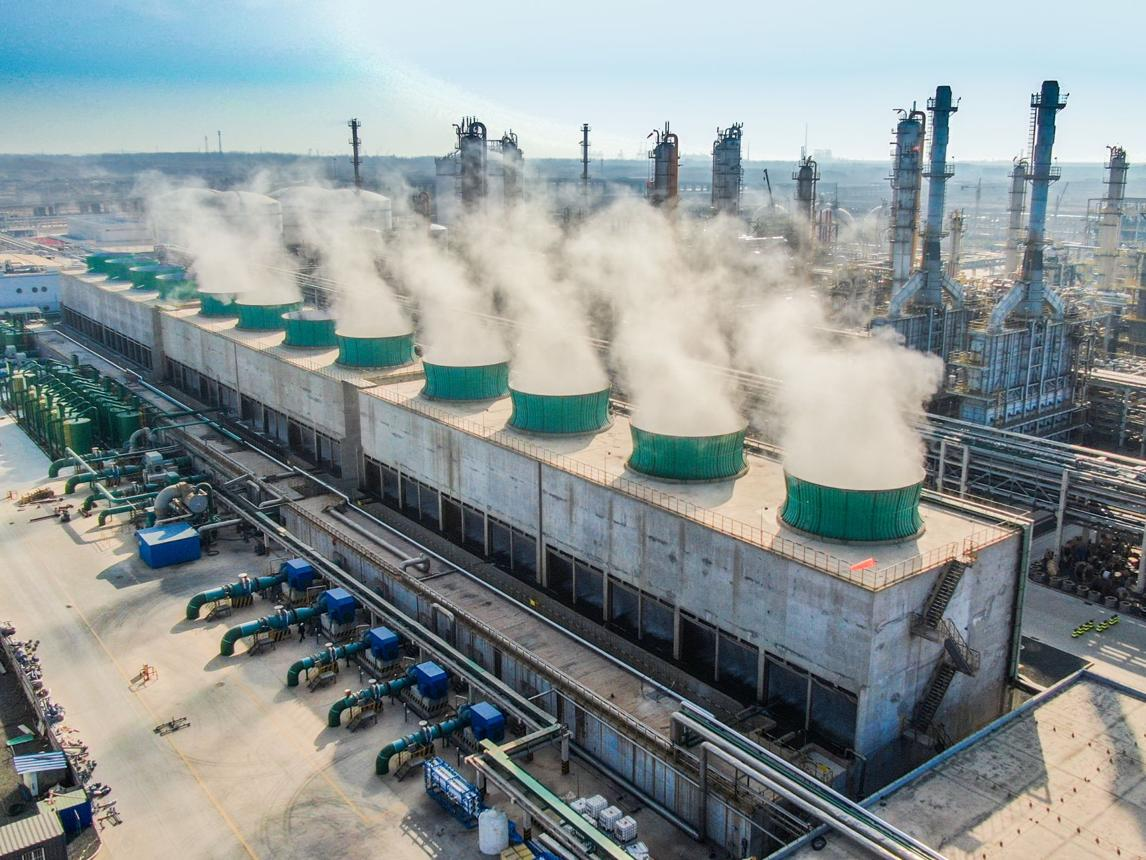
1. Introduction: Why Fan Blade Selection Matters
A cooling tower motor fan blade may look like a simple component, but it has a major influence on the performance of an entire cooling tower. It moves large volumes of air through the tower, helping heat transfer take place between the circulating water and the surrounding air.
Think of the fan blade as the engine's working hand. If its shape, material, or operating angle is unsuitable, the whole system may have to work harder to achieve the required cooling effect.
Choosing the right blade is therefore about more than finding a product with the correct diameter. You also need to consider material strength, corrosion resistance, blade pitch, rotational speed, motor power, airflow requirements, and compatibility with the existing fan hub.
Whether you are building a new cooling tower or replacing old blades, this guide explains the key selection points in practical language.
2. What Is a Cooling Tower Motor Fan Blade?
A cooling tower fan blade is an aerodynamic component installed around a central hub. In most mechanical-draft cooling towers, the fan is an axial-flow type. Its blades rotate to draw or push air through the tower.
As air passes through the fill section, it comes into contact with circulating water. A portion of the water evaporates, carrying heat away. The cooled water then returns to the industrial process or cooling system.
Fan blades are usually designed with a curved or twisted airfoil profile rather than a simple flat surface. This shape helps generate airflow while controlling aerodynamic resistance and power consumption.
2.1 How the Fan Blade Works with the Motor and Drive System
The fan blade does not operate independently. It is part of a mechanical system that may include:
Electric motor
Gearbox or belt-and-pulley drive
Drive shaft and coupling, depending on the design
Fan hub
Individual fan blades
Fan cylinder or stack
Support structure and safety guards
The motor supplies rotational power. The drive system transfers that power to the fan hub, and the blades convert rotation into airflow.
If one component is incorrectly selected, the other components may be affected. For example, an unsuitable blade pitch can increase the load on the motor. A blade that is too heavy may increase mechanical loading on the hub and drive system.
2.2 The Difference Between a Fan Blade and a Complete Fan Assembly
A fan blade is only one part of the complete fan assembly.
When purchasing replacement blades, you need to determine whether your project requires individual blades, a complete hub-and-blade assembly, or a full fan replacement.
This distinction matters because different fan systems use different mounting arrangements. Some have individually adjustable blades, while others use fixed-pitch or model-specific connections.
Never assume that a blade from another cooling tower will fit simply because the diameter looks similar.
3. Common Cooling Tower Fan Blade Materials
Material selection affects blade weight, corrosion resistance, mechanical strength, maintenance requirements, and service life. Several materials are commonly used in industrial cooling tower applications.
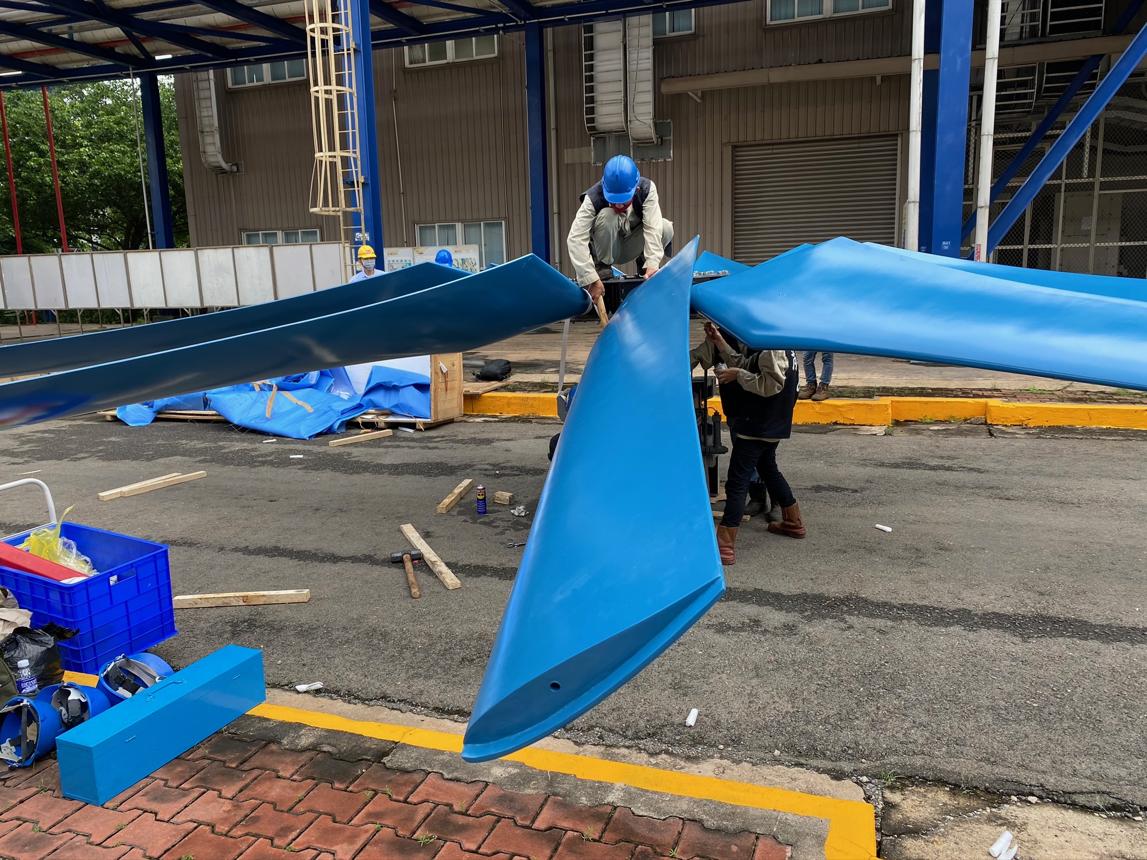
3.1 FRP Fan Blades
<PRIVATE_PERSON> (Fiber-Reinforced Plastic), commonly called FRP, is widely used in cooling tower components, including fan blades.
FRP combines a resin matrix with reinforcing fibers. The fibers provide structural strength, while the resin helps bind the material and protect it from the surrounding environment.
Main advantages include:
Good corrosion resistance in many industrial environments
Relatively low weight compared with many metal alternatives
Design flexibility for aerodynamic blade profiles
Electrical insulation properties
Potentially reduced maintenance associated with corrosion
FRP is worth considering when the cooling tower operates in a humid, chemically exposed, or coastal environment.
However, FRP is not a single standardized material. Its performance depends on the resin system, fiber type, fiber orientation, manufacturing process, thickness, and protective surface treatment.
For this reason, buyers should request material specifications rather than relying on the general term "FRP."
3.2 Aluminum Alloy Fan Blades
Aluminum alloy is another established choice for cooling tower fan blades.
Its relatively low density makes it useful where a metal blade is required without the weight of heavier steel alternatives. Properly designed aluminum blades can also provide good mechanical performance and aerodynamic stability.
Typical advantages include:
Good strength-to-weight characteristics
Relatively easy handling and installation
Good machinability and manufacturing flexibility
Suitable for many industrial fan designs
Potentially straightforward inspection and maintenance
However, aluminum is not immune to corrosion. Its suitability depends on the alloy, surface treatment, water chemistry, airborne contaminants, and operating environment.
In aggressive chemical or marine conditions, the material and protective treatment should be evaluated carefully before selection.
3.3 Stainless Steel Fan Blades
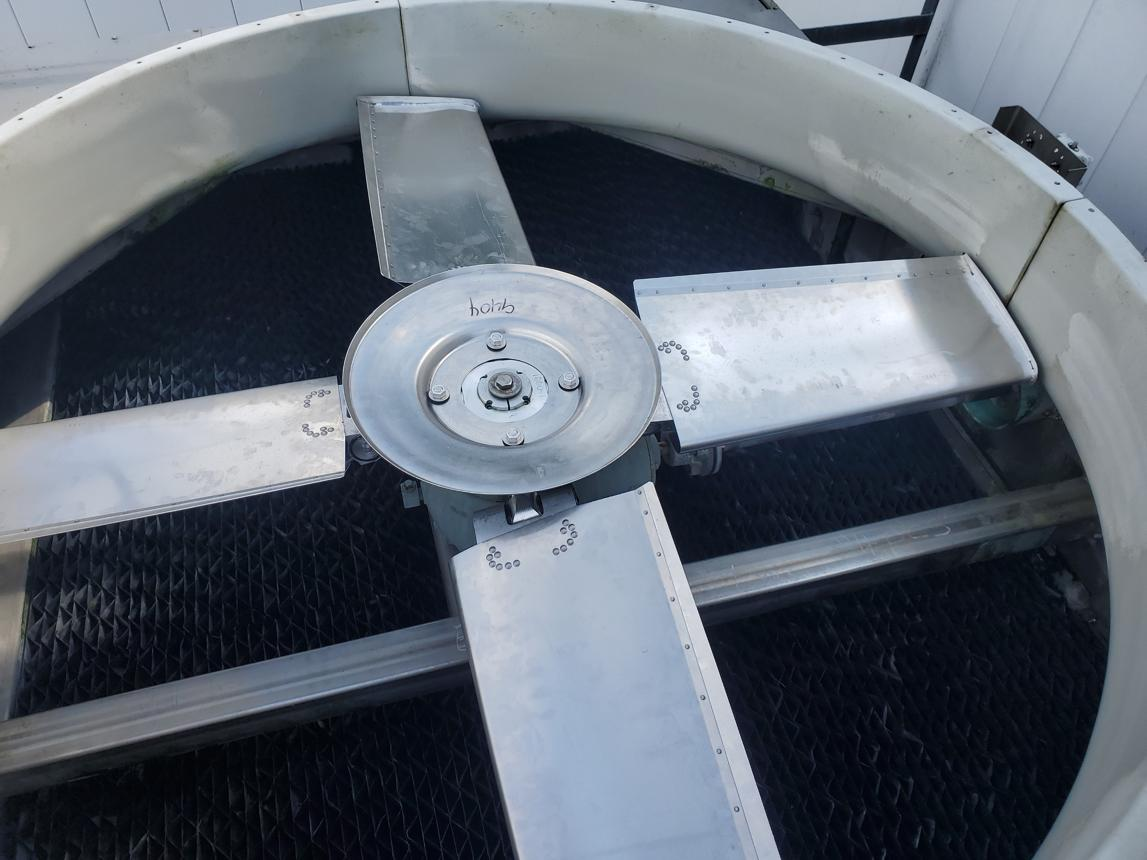
Stainless steel offers useful mechanical strength and corrosion resistance. It may be considered for special industrial applications where the operating environment requires a metal component with enhanced resistance to corrosion.
Different grades provide different levels of corrosion resistance. For example, 304 and 316 stainless steels are not interchangeable in every environment.
Potential advantages include:
Good mechanical strength
Resistance to many forms of corrosion
Durable metal construction
Suitability for certain demanding industrial environments
The main consideration is weight. Stainless steel is generally heavier than FRP and aluminum, so the fan hub, bearings, drive system, and motor load must be checked.
It is also important to remember that stainless steel is not completely corrosion-proof. Chlorides, chemical exposure, deposits, and unsuitable operating conditions can still cause problems.
3.4 Other Composite and Plastic Materials
Some fan systems use specialized composite materials, including glass-reinforced epoxy and other engineered polymer systems.
These materials can be developed for specific strength, weight, corrosion, and temperature requirements.
The important point is to evaluate the actual material specification. Two blades described as composite may have very different mechanical properties and operating limits.
4. How to Choose the Right Fan Blade Material
There is no single material that is best for every cooling tower. The right choice depends on the tower design, operating environment, performance requirements, and maintenance plan.
4.1 Corrosion and Chemical Exposure
Cooling towers operate in wet environments. Their fan blades may also be exposed to airborne chemicals, industrial gases, salt, dust, and water droplets.
Before selecting a material, consider:
Is the cooling tower installed near the coast?
Does the surrounding air contain chemical contaminants?
Is the circulating water treated with chemicals that could affect nearby components?
Are there acidic or alkaline substances in the operating environment?
Does the tower experience frequent wetting and drying?
FRP may be attractive in many corrosive environments, while aluminum or stainless steel may be suitable in other applications. The actual decision should be based on material compatibility and the manufacturer's operating limits.
4.2 Blade Weight and Mechanical Loading
Blade weight is not just a transportation or installation issue. It affects the mechanical system.
Heavier blades can increase loads on the fan hub and associated components. They may also affect starting torque, vibration behavior, and the mechanical design requirements.
When changing from one material to another, do not assume the new blades can use the original hub without verification.
The manufacturer or a qualified fan engineer should check the complete assembly, including the blade mass, center of gravity, rotational speed, hub capacity, and operating loads.
4.3 Temperature, UV, and Weather Conditions
Cooling tower fan blades may operate outdoors under sunlight, rain, humidity, and temperature changes.
For FRP blades, UV resistance depends on the resin system and protective surface treatment. For metal blades, temperature and weather exposure can influence corrosion and coating performance.
Ask the supplier about:
Permitted operating temperature range
UV protection
Moisture resistance
Surface coating or gelcoat requirements
Resistance to the chemicals present at the site
These details are especially important for cooling towers operating continuously throughout the year.
4.4 Maintenance and Life-Cycle Cost
A low purchase price does not always mean a low operating cost.
A material that requires frequent coating repair, corrosion treatment, or replacement may cost more over its service life than a higher-priced alternative.
Compare the total cost, including:
Initial purchase price
Transportation and installation
Inspection frequency
Cleaning and repair requirements
Expected replacement interval
Potential downtime and production interruption
The best material is the one that meets the technical requirements while delivering a reasonable total cost over the intended service period.
5. Key Cooling Tower Fan Blade Parameters
Material is only one part of the selection process. You also need accurate technical parameters to ensure the replacement blade works with the existing cooling tower.
The following parameters should be confirmed before placing an order.
5.1 Fan Diameter
Fan diameter is the overall diameter measured across the rotating blade tips.
It is one of the first dimensions buyers usually provide, but it is not enough by itself to identify a compatible fan.
A replacement fan with an incorrect diameter may have insufficient clearance or interfere with the fan cylinder. It can also change airflow and mechanical loading.
When measuring, confirm the measurement method and compare it with the original equipment drawing whenever possible.
5.2 Number of Blades
The number of blades affects the aerodynamic design and the way the fan operates.
A fan may use different blade counts depending on its diameter, hub design, rotational speed, and performance requirements.
More blades do not automatically mean more airflow. The complete aerodynamic design determines the result.
When replacing blades individually, maintain the original blade count and follow the fan manufacturer's installation and balancing requirements.
5.3 Blade Pitch Angle
Blade pitch is the angle at which each blade is installed relative to the fan's reference plane.
It has a significant influence on airflow and motor load.
A higher pitch angle may increase airflow demand and motor power.
A lower pitch angle may reduce airflow and motor loading.
Unequal pitch angles can cause uneven aerodynamic loading and vibration.
The relationship is not identical for every fan design. The correct pitch must be based on the fan manufacturer's instructions or an approved engineering calculation.
Do not increase the pitch simply because you want more cooling. If the motor becomes overloaded, the result may be overheating, higher electricity consumption, or equipment damage.
5.4 Rotational Speed and Tip Speed
Rotational speed is usually expressed in revolutions per minute (RPM).
Fan tip speed is the linear speed of the outer blade tip. It depends on both fan diameter and rotational speed.
The relationship is:
[
V = \frac{\pi D N}{60}
]
Where:
(V) = blade tip speed in meters per second
(D) = fan diameter in meters
(N) = rotational speed in RPM
For example, a fan with a diameter of 3 meters operating at 300 RPM has a calculated tip speed of approximately 47.1 meters per second.
This is a mathematical example, not a recommended operating value. Actual permitted speed must follow the fan design, material limits, mechanical ratings, and manufacturer specifications.
5.5 Airflow and Static Pressure
Airflow describes the volume of air moved by the fan over a period of time. It is commonly expressed in cubic meters per hour (m³/h) or cubic meters per second (m³/s).
Static pressure represents the resistance the fan must overcome as air moves through the cooling tower.
The fan must be selected for the actual system operating point, not just a theoretical airflow value.
Fill condition, drift eliminators, louvers, air inlets, fan cylinder design, and internal obstructions can all influence system resistance.
A blade designed for one fan system may not deliver the same performance in another tower.
5.6 Motor Power and Operating Current
Motor power is a critical parameter when selecting or adjusting fan blades.
The motor must be capable of handling the power required by the fan under the intended operating conditions.
Before changing blade material, pitch, diameter, or design, check:
Motor rated power
Rated voltage and frequency
Rated current
Operating RPM
Service factor and duty requirements
Drive arrangement
Actual operating current under normal conditions
If a replacement blade increases aerodynamic load, the motor may draw more current. This can lead to overload protection trips or excessive motor temperature.
The final fan selection should be checked against the motor's allowable operating limits.
5.7 Hub Connection and Mounting Dimensions
Even a well-designed blade is unsuitable if it cannot be securely connected to the hub.
Important connection details include:
Hub model and type
Blade root dimensions
Bolt-hole diameter and spacing
Mounting angle or pitch adjustment arrangement
Fastener grade and material
Blade orientation
Required installation clearances
For replacement projects, photographs and dimensional drawings can help the manufacturer identify the correct connection arrangement.
6. How to Match Fan Blades with the Motor
Matching a fan blade to a motor requires more than checking whether the motor can rotate the fan.
The fan, motor, gearbox or belt drive, hub, and tower airflow system must work together.
Start by confirming the existing fan's diameter, RPM, blade count, and pitch. Then review the motor nameplate and the fan's operating requirements.
Next, check the actual operating current and compare it with the motor's rated values. If the existing fan is already operating close to the motor's limit, changing the blade design or pitch may create an overload risk.
For a replacement or retrofit, a qualified engineer should verify the fan's aerodynamic performance and mechanical compatibility.
A useful rule is simple: never treat a fan blade replacement as an isolated component change when it affects the operating load of the complete fan system.
7. Fixed-Pitch vs. Adjustable-Pitch Fan Blades
Cooling tower fans may use fixed-pitch or adjustable-pitch blade arrangements.
Fixed-pitch blades have a set installation angle. They can be suitable when the operating conditions are relatively stable and the fan has been correctly selected for the required duty.
Adjustable-pitch blades allow the blade angle to be set within the design limits of the fan assembly. This can help the system meet different operating requirements, but adjustment must be carried out carefully.
| Comparison | Fixed-pitch blades | Adjustable-pitch blades |
| Blade angle | Predetermined | Adjustable within design limits |
| Adjustment after installation | Usually limited | Possible according to the design |
| Application | Stable operating conditions | Applications requiring approved adjustment |
| Maintenance | Inspect blade condition and mounting | Also inspect adjustment and locking mechanisms |
| Selection | Match the specified fan duty | Follow manufacturer pitch settings |
Neither type is automatically more efficient. The right choice depends on the cooling tower design and operating requirements.
8. Fan Blade Replacement: What to Check Before Ordering
Ordering the wrong fan blade can cause unnecessary costs and project delays. Before requesting a quotation, prepare as much technical information as possible.
A useful information checklist includes:
Cooling tower manufacturer and model
Fan diameter
Number of blades
Existing blade material
Blade length and root dimensions
Hub type and mounting details
Motor power and RPM
Existing blade pitch angle, if available
Operating environment
Photographs of the complete fan and individual blade connections
If you do not have the original technical drawing, clear photographs and accurate measurements can help the supplier begin the identification process.
However, photographs alone cannot confirm every engineering requirement. Critical dimensions and operating parameters should still be verified.
9. Installation and Commissioning Considerations
Correct installation is essential for safe and reliable fan operation.
Before work begins, isolate the electrical supply, apply the site's lockout/tagout procedure, and confirm that the fan cannot start unexpectedly. Only trained personnel should perform installation and commissioning.
During installation, pay attention to the following:
Confirm that each blade matches the approved specification.
Inspect the hub and mounting surfaces for cracks, corrosion, or deformation.
Use the specified fasteners and tightening procedure.
Set blade pitch according to the manufacturer's instructions.
Check blade-tip clearance around the fan cylinder.
Verify that all blades have the correct orientation.
Complete the required static or dynamic balance checks.
Reinstall all guards and safety devices before operation.
After installation, conduct commissioning according to the equipment manufacturer's procedure.
Check for abnormal vibration, unusual noise, unexpected motor current, and mechanical interference. If any abnormal condition appears, stop the equipment and investigate before returning it to normal service.
10. Cooling Tower Fan Blade Maintenance Tips
Even high-quality fan blades need regular inspection. A small crack, loose fastener, or damaged leading edge can develop into a more serious problem if ignored.
10.1 Inspect Blade Surfaces Regularly
Look for cracks, deformation, surface damage, corrosion, and signs of impact.
For FRP blades, pay attention to cracks, exposed fibers, delamination, and damaged protective coatings.
For metal blades, check for corrosion, dents, coating damage, and signs of fatigue.
10.2 Check Blade Fasteners and Hub Connections
Loose fasteners can cause movement, vibration, and uneven loading.
Inspect bolts, nuts, washers, and blade-root connections according to the manufacturer's maintenance schedule.
Do not replace fasteners with an arbitrary grade or material. The specified fastener type and tightening procedure should be followed.
10.3 Monitor Vibration and Noise
A change in fan vibration or operating noise may indicate an imbalance, damaged blade, loose connection, bearing issue, or another mechanical problem.
Record vibration trends where monitoring equipment is available. A sudden change deserves investigation rather than being treated as normal operating noise.
10.4 Keep the Fan Area Clean
Remove accumulated dirt, leaves, and other debris when it is safe to do so.
Foreign material can obstruct airflow or create uneven loading if it becomes attached to rotating components.
Cleaning procedures should be compatible with the blade material and protective coating.
10.5 Check Blade Pitch and Alignment
For adjustable-pitch fans, confirm that the blades remain at their specified angles.
Unequal pitch settings can create uneven airflow and loading. Any adjustment should follow the manufacturer's procedure and should be completed by qualified personnel.
11. Common Fan Blade Selection Mistakes
Some replacement problems begin before the new blades arrive. Avoid these common mistakes:
Choosing by diameter alone: Two fans with the same diameter may have different blade profiles, hub connections, pitch settings, and performance characteristics.
Ignoring motor capacity: A blade change can alter the fan's power demand. Always verify the motor's operating limits.
Selecting material only by price: A cheaper material may not suit the site's corrosion, UV, or mechanical requirements.
Changing blade pitch without calculation: Increasing pitch can raise motor load and may cause overload.
Mixing incompatible blades: Different blade weights, profiles, or mounting details can create uneven loading and balance problems.
Skipping commissioning checks: Correct installation should be followed by inspection and controlled testing.
The safest approach is to select the complete fan configuration based on the actual cooling tower duty and the manufacturer's technical requirements.
12. How to Select a Reliable Cooling Tower Fan Blade Manufacturer
A reliable supplier should do more than provide a price based on a short product description.
Look for a manufacturer or supplier that can review your existing fan information and help verify the replacement requirements.
Useful questions include:
Can you confirm the blade material and its technical properties?
Can you provide dimensional drawings?
Can you verify compatibility with the existing hub?
Are the permitted RPM and pitch limits documented?
What inspection and balancing procedures are used?
Can you provide installation and maintenance guidance?
What information is needed to evaluate a replacement project?
A professional supplier should be willing to clarify technical limitations rather than promise that every blade is interchangeable.
13. Power Tower Cooling Tower Fan Blade Solutions
Power Tower Cooling Technology (Shaoxing) Co.,Ltd provides cooling tower components and replacement-related products through its website:
https://www.coolingtowerpart.com
For customers looking for cooling tower motor fan blades or related replacement components, the first step is to identify the existing fan configuration and operating requirements.
When contacting Power Tower, prepare the following information if available:
Cooling tower brand and model
Fan diameter and blade quantity
Existing blade material
Motor power and rotational speed
Hub photographs and connection dimensions
Blade pitch information
Operating environment and maintenance concerns
This information helps the supplier understand the application and assess which replacement options may be suitable.
Rather than choosing a blade based on appearance or price alone, buyers should confirm the material, dimensions, mechanical compatibility, and operating parameters before ordering.
For industrial cooling tower operators, a correctly selected fan blade is an important part of maintaining stable airflow and dependable equipment operation.
14. Frequently Asked Questions
14.1 Which Material Is Best for Cooling Tower Fan Blades?
There is no universal best material. FRP is often considered for its low weight and corrosion resistance. Aluminum alloy offers a metal option with a favorable strength-to-weight balance. Stainless steel may suit certain demanding environments but requires careful consideration of its higher weight.
The final choice depends on the fan design, operating environment, and manufacturer's specifications.
14.2 Are FRP Fan Blades Better Than Aluminum Blades?
Not in every application. FRP may provide advantages in corrosive environments and weight reduction. Aluminum may be appropriate where a metal blade design is preferred.
Compare the complete blade specifications, not just the material name.
14.3 Does a Larger Fan Blade Always Produce More Airflow?
No. Airflow depends on the complete fan design, including diameter, blade profile, pitch, rotational speed, and system resistance.
A larger blade may also require more power and may not fit the existing fan cylinder or hub.
14.4 Can I Increase the Fan Blade Pitch to Improve Cooling?
Only if the fan manufacturer or a qualified engineer confirms that the adjustment is within the permitted operating range.
Increasing pitch can increase motor load. Check motor current, fan performance, and mechanical limits before making any change.
14.5 How Do I Know When a Cooling Tower Fan Blade Needs Replacement?
Common warning signs include cracks, deformation, severe corrosion, delamination, damaged blade roots, and abnormal vibration.
A qualified inspection should determine whether repair is acceptable or replacement is necessary.
14.6 What Information Should I Send When Ordering Replacement Blades?
Provide the cooling tower model, fan diameter, blade count, existing material, motor RPM and power, hub dimensions, blade photographs, and operating conditions.
The more accurate the information, the easier it is to evaluate compatibility.
15. Conclusion
Selecting a cooling tower motor fan blade requires a balance between material performance, aerodynamic requirements, mechanical compatibility, and operating cost.
FRP, aluminum alloy, and stainless steel each have advantages and limitations. The correct option depends on the environment and the complete fan system.
Before purchasing replacement blades, verify the fan diameter, blade count, pitch angle, RPM, airflow requirements, motor capacity, and hub connection. Then confirm the installation and balancing requirements with the manufacturer.
For cooling tower component sourcing and replacement inquiries, contact Power Tower Cooling Technology (Shaoxing) Co.,Ltd through www.coolingtowerpart.com. Providing accurate equipment information will help make the selection process more efficient and reduce the risk of ordering incompatible parts.


