Cooling Tower Motor Fan Blade Design: What Buyers Should Know
Cooling tower motor fan blade design is one of the most important factors affecting the performance, energy efficiency, and reliability of an industrial cooling tower. Although fan blades may appear to be simple rotating components, their aerodynamic shape, structural configuration, material selection, and installation parameters all play a significant role in overall cooling system performance.
A well-designed cooling tower motor fan blade does more than generate airflow. It must balance air volume, static pressure, mechanical strength, vibration control, noise reduction, and energy consumption while operating continuously in a humid and potentially corrosive environment.
For cooling tower manufacturers, equipment operators, and industrial buyers, understanding the fundamentals of fan blade design is essential when purchasing new fan assemblies or replacing existing blades.
In this guide, we will explore the key elements of cooling tower motor fan blade design, explain how different design parameters influence performance, and highlight what buyers should consider before placing an order.
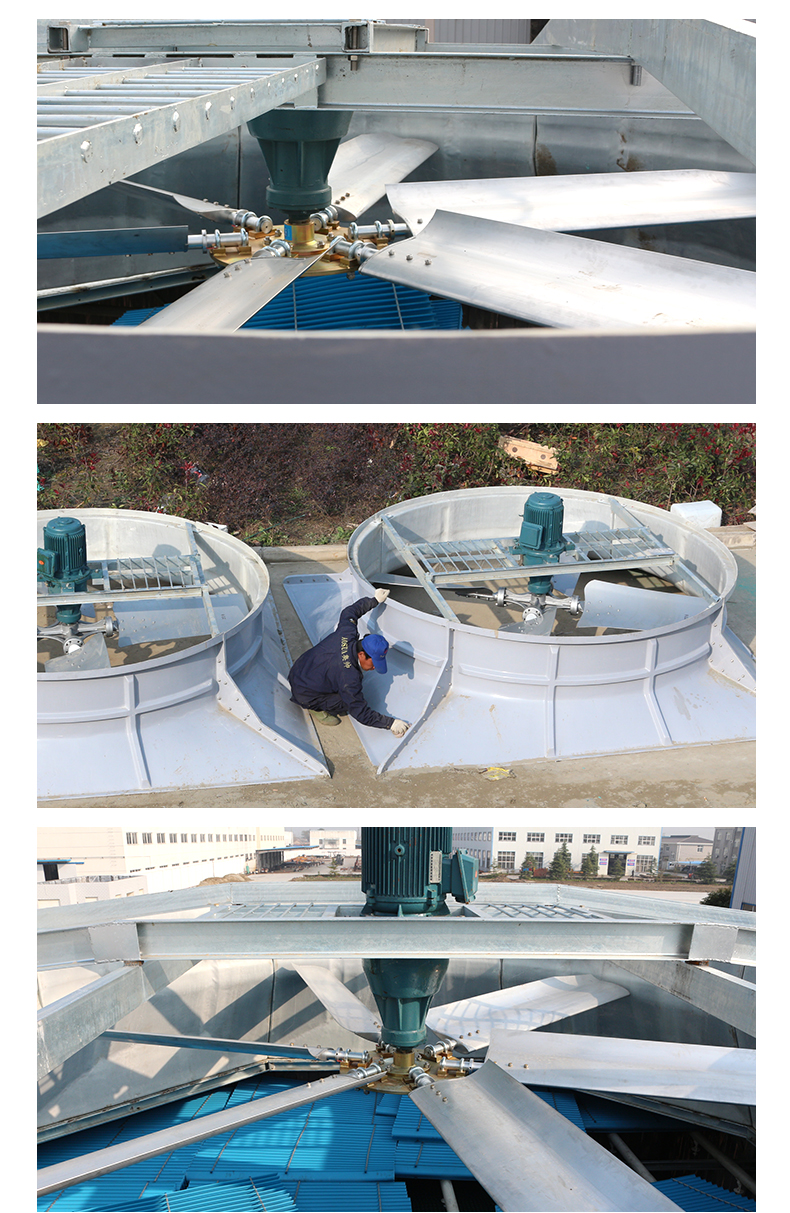
1. Why Is Cooling Tower Motor Fan Blade Design Important?
The cooling tower fan is responsible for moving air through the cooling tower, allowing hot circulating water to release heat through evaporation and convection.
The motor supplies mechanical power, while the fan blades convert rotational energy into airflow.
The design of the fan blades determines how efficiently this energy is converted into useful airflow.
1.1 The Relationship Between Fan Blade Design and Cooling Efficiency
Cooling tower performance depends on several factors, including water flow, air volume, heat load, ambient conditions, and fill performance.
Fan blade geometry influences how much air can pass through the cooling tower under a specific operating condition.
A properly designed blade can help:
Maintain the required airflow volume.
Overcome the resistance of the cooling tower system.
Improve air distribution through the fill.
Reduce unnecessary aerodynamic losses.
Optimize motor power consumption.
Maintain stable operating conditions.
Why Is Airflow Distribution Important?
Generating a large volume of air is not the only objective. Air should also be distributed appropriately across the cooling tower fill.
Uneven airflow may create areas with insufficient air-water contact, reducing heat exchange effectiveness.
Therefore, cooling tower motor fan blade design should consider both airflow quantity and airflow distribution.
1.2 The Connection Between Fan Blade Design and Motor Performance
The fan motor must provide sufficient torque and power to drive the fan under actual operating conditions.
If the blade design creates excessive aerodynamic loading, the motor may consume more electricity than expected.
An appropriately engineered blade helps match the fan's aerodynamic characteristics with the motor's operating range.
This is particularly important for large industrial cooling towers that operate for extended periods.
2. Key Design Elements of Cooling Tower Motor Fan Blades
Several design parameters determine the aerodynamic and mechanical performance of cooling tower fan blades.
Understanding these parameters helps buyers evaluate product specifications and communicate more effectively with manufacturers.
2.1 Blade Length and Fan Diameter
Blade length is directly related to the overall fan diameter.
A larger fan diameter generally provides the potential to move more air, but the final airflow also depends on rotational speed, blade geometry, pitch, and system resistance.
How Does Fan Diameter Affect Performance?
A larger fan diameter can increase the swept area and support higher airflow capacity at an appropriate rotational speed.
However, increasing fan diameter also introduces additional engineering considerations:
Buyers should never assume that a larger fan automatically provides better cooling performance.
The fan diameter must be matched to the cooling tower's original engineering design.
2.2 Blade Chord Width
Blade chord width refers to the distance between the leading edge and trailing edge of a blade.
It is an important geometric parameter affecting aerodynamic loading and airflow generation.
What Happens When Blade Width Changes?
A wider blade may increase the aerodynamic area, but it can also increase drag and power requirements.
A narrower blade may reduce aerodynamic resistance but may not provide sufficient airflow under certain operating conditions.
The optimal chord width depends on the fan diameter, rotational speed, blade profile, and required performance.
2.3 Blade Pitch Angle
Blade pitch angle determines the orientation of the blade relative to its rotational plane.
It influences the angle at which the blade interacts with incoming air.
Why Is the Correct Pitch Angle Important?
If the pitch angle is too small, the fan may not generate sufficient airflow.
If the pitch angle is too large, aerodynamic loading and motor power requirements may increase significantly.
An appropriately selected pitch angle helps balance airflow performance and energy consumption.
For adjustable-pitch cooling tower fans, pitch settings should follow the manufacturer's engineering specifications.
2.4 Blade Tip Design
The blade tip is an important area in aerodynamic design because air pressure differences between the two sides of the blade can contribute to tip leakage and vortex formation.
How Does Tip Geometry Influence Fan Performance?
An appropriately designed blade tip can help manage airflow near the blade end and reduce unnecessary aerodynamic losses.
Depending on the fan design, manufacturers may optimize:
Tip shape.
Tip clearance.
Blade curvature.
Local chord width.
Pressure distribution.
For large-diameter cooling tower fans, tip design deserves particular attention because the blade tip operates at a higher tangential velocity than the blade root.
3. Aerodynamic Design: How to Improve Cooling Tower Fan Efficiency
Aerodynamic design is at the heart of cooling tower motor fan blade development.
The objective is to generate the required airflow and pressure while minimizing unnecessary resistance and energy losses.
3.1 Airfoil Profile Design
<Insert Image: Airfoil Cooling Tower Fan Blade Profile>
Airfoil blades feature a streamlined cross-sectional shape designed to produce aerodynamic lift and generate airflow.
Unlike simple flat-profile blades, airfoil designs can provide more efficient aerodynamic performance when properly engineered.
Main Benefits of Airfoil Blade Design
Improved aerodynamic efficiency.
Reduced unnecessary drag.
Better airflow performance.
Potential reduction in operating power.
Improved noise characteristics under suitable conditions.
Why Do Manufacturers Use Airfoil Profiles?
Airfoil profiles allow engineers to control pressure distribution around the blade surface.
This helps optimize airflow generation and reduce aerodynamic losses.
However, the effectiveness of an airfoil depends on its geometry, operating speed, airflow conditions, and system resistance.
3.2 Twisted Blade Design
<Insert Image: Twisted Cooling Tower Fan Blade>
A cooling tower fan blade does not rotate at the same linear speed along its entire length.
The blade tip travels faster than the blade root because the tip is farther from the rotational axis.
Twisted blade designs compensate for this difference by changing the local blade angle along the radial direction.
Advantages of Twisted Blade Geometry
More consistent aerodynamic loading.
Better utilization of the blade's radial length.
Improved airflow characteristics.
Potentially higher aerodynamic efficiency.
A properly designed twisted blade helps different sections of the blade work together more effectively.
3.3 Blade Curvature and Surface Finish
Blade curvature influences the aerodynamic characteristics and structural behavior of the fan.
Surface quality is also important because irregularities can affect airflow and create additional aerodynamic resistance.
What Should Buyers Look For?
When evaluating blade manufacturing quality, consider:
Consistent blade curvature.
Smooth leading and trailing edges.
Uniform surface finish.
Accurate geometric dimensions.
Consistent blade profiles across the complete fan assembly.
For composite blades, surface defects and manufacturing inconsistencies should be carefully inspected.
4. Structural Design: Making Fan Blades Strong and Reliable
Aerodynamic efficiency alone is not enough. Cooling tower motor fan blades must also withstand continuous mechanical loading and environmental exposure.
During operation, fan blades experience centrifugal forces, aerodynamic forces, vibration, and changing environmental conditions.
4.1 Blade Root Design
<Insert Image: Cooling Tower Fan Blade Root Connection>
The blade root is the connection area between the blade and the fan hub.
It is a critical structural region because mechanical loads are transferred through this connection.
Important Blade Root Design Considerations
A poorly designed blade root may become a source of stress concentration and mechanical failure.
4.2 Blade Stiffness and Deflection
During operation, fan blades may deform slightly under aerodynamic and centrifugal loading.
Excessive deformation can affect blade clearance, aerodynamic performance, and mechanical safety.
Why Is Blade Stiffness Important?
Proper blade stiffness helps maintain the intended aerodynamic geometry under operating loads.
Engineers should evaluate blade deflection, natural frequencies, and structural strength under the expected operating conditions.
4.3 Vibration and Dynamic Balance
Fan vibration can result from uneven blade mass, installation errors, mechanical defects, or aerodynamic imbalance.
How Does Blade Design Affect Vibration?
Consistent blade dimensions and weight distribution help improve fan balance.
Manufacturers should pay attention to:
A complete fan assembly should be checked according to the applicable manufacturer's specifications and engineering standards.
5. Choosing the Right Material for Cooling Tower Motor Fan Blade Design
Material selection directly affects blade weight, strength, corrosion resistance, manufacturing methods, and service life.
Different materials are suitable for different cooling tower environments.
5.1 FRP Cooling Tower Motor Fan Blades
<Insert Image: FRP Cooling Tower Motor Fan Blades>
FRP (Fiberglass Reinforced Plastic) is widely used in cooling tower fan blade manufacturing.
It combines fiberglass reinforcement with a resin matrix to produce a lightweight composite structure.
Advantages of FRP Blade Materials
Lightweight construction.
Good corrosion resistance.
Good mechanical strength.
Low maintenance requirements.
Flexible aerodynamic design.
Good resistance to moisture and many industrial environments.
What Makes FRP Suitable for Cooling Towers?
Cooling towers often operate in environments with continuous moisture exposure and potential chemical contamination.
Compared with many conventional metal materials, appropriately formulated FRP composites offer good corrosion resistance and can reduce the overall weight of the fan assembly.
However, resin selection, fiber orientation, manufacturing quality, and ultraviolet protection should all be considered.
5.2 Aluminum Alloy Fan Blades
Aluminum alloy provides a good strength-to-weight ratio and is relatively easy to machine and fabricate.
Main Characteristics
Lightweight metal construction.
Good mechanical strength.
Good dimensional stability.
Convenient manufacturing.
Recyclability.
However, aluminum may require appropriate protection in aggressive chemical environments.
5.3 Stainless Steel Fan Blades
Stainless steel is suitable for applications requiring high mechanical strength and good corrosion resistance.
Main Characteristics
High mechanical strength.
Good structural rigidity.
Resistance to many corrosive environments.
Relatively high material weight.
Higher material and fabrication costs in many cases.
Material grade should be selected according to actual chemical exposure and operating conditions.
5.4 How to Compare Different Fan Blade Materials
| Material | Weight | Corrosion Resistance | Main Consideration |
| FRP | Lightweight | Good to excellent, depending on resin and environment | Composite quality |
| Aluminum alloy | Lightweight | Moderate to good, depending on alloy and environment | Surface protection |
| Stainless steel | Heavy | Good, depending on grade | Weight and cost |
| Carbon steel | Heavy | Requires protection | Corrosion maintenance |
The best material is not necessarily the most expensive one. Buyers should evaluate the complete operating environment and total lifecycle cost.
6. How Cooling Tower Motor Fan Blade Design Affects Energy Consumption
Energy consumption is a major concern for industrial cooling tower operators.
Since cooling tower fans may operate for many hours each day, even small improvements in fan efficiency can create meaningful long-term savings.
6.1 Reducing Aerodynamic Resistance
A well-designed blade profile can reduce unnecessary drag and improve airflow generation.
This allows the fan to deliver the required airflow with a more favorable power requirement.
6.2 Matching Blade Design with Motor Power
The fan and motor should be considered as one integrated system.
An incorrectly selected blade may increase the aerodynamic load beyond the motor's intended operating range.
Important Parameters to Match
Required airflow.
Static pressure.
Fan rotational speed.
Motor rated power.
Drive-system capacity.
Operating conditions.
Buyers should request performance information for the complete fan assembly rather than evaluating blade specifications in isolation.
6.3 Variable-Speed Operation and Fan Performance
Some cooling tower systems use variable-frequency drives (VFDs) to adjust fan speed according to cooling demand.
This allows the fan to operate at different speeds instead of running continuously at full speed.
How Does Blade Design Work with VFD Control?
Fan blade geometry determines the aerodynamic characteristics of the fan, while the VFD controls rotational speed.
The combination can help match airflow with changing cooling loads.
However, the fan must be checked for mechanical limitations, vibration, and motor operating conditions across the intended speed range.
7. Noise Reduction in Cooling Tower Motor Fan Blade Design
Operating noise is another important consideration, especially for cooling towers installed near commercial buildings, residential areas, and industrial workplaces.
Fan noise generally includes aerodynamic noise and mechanical noise.
7.1 Aerodynamic Noise
Aerodynamic noise is generated by airflow interaction with the blade surface, pressure fluctuations, turbulence, and other flow-related effects.
Design Methods for Reducing Aerodynamic Noise
Optimizing airfoil geometry.
Improving blade tip design.
Reducing unnecessary turbulence.
Maintaining appropriate operating speed.
Improving airflow uniformity.
7.2 Mechanical Noise and Vibration
Mechanical noise may result from unbalanced fan assemblies, worn bearings, loose connections, or structural vibration.
Why Is Proper Balancing Important?
A balanced fan assembly helps reduce vibration and mechanical stress.
Manufacturing accuracy, installation quality, and regular inspection all contribute to reliable operation.
8. Common Cooling Tower Motor Fan Blade Design Mistakes Buyers Should Avoid
When purchasing cooling tower fan blades, buyers sometimes focus too heavily on price or appearance while overlooking important engineering parameters.
The following mistakes can lead to poor performance and unnecessary maintenance expenses.
8.1 Choosing Blades Based Only on Fan Diameter
Two blades with the same length may have completely different aerodynamic characteristics.
Blade profile, pitch, chord width, and operating speed must also be considered.
8.2 Ignoring the Existing Motor and Drive System
A replacement blade should be compatible with the existing motor, gearbox, hub, and drive configuration.
An unsuitable blade may create excessive mechanical or aerodynamic loading.
8.3 Overlooking Environmental Conditions
Material selection should consider humidity, water quality, chemical exposure, temperature, and ultraviolet radiation.
Choosing unsuitable materials may accelerate corrosion or material degradation.
8.4 Ignoring Manufacturing Quality
Poor manufacturing quality may result in uneven blade weight, inaccurate dimensions, surface defects, and structural weaknesses.
Buyers should evaluate the supplier's manufacturing processes and quality inspection procedures.
8.5 Focusing Only on Initial Purchase Price
A low purchase price does not necessarily mean a lower total cost.
Energy consumption, maintenance frequency, replacement intervals, and equipment downtime should all be included in the purchasing decision.
9. What Should Buyers Check Before Ordering Cooling Tower Motor Fan Blades?
Before placing an order, buyers should prepare the necessary technical information to help manufacturers provide a suitable blade solution.
9.1 Basic Fan Specifications
Provide the following information whenever possible:
Cooling tower model.
Fan diameter.
Number of blades.
Existing blade material.
Fan rotational speed.
Motor power.
Fan hub dimensions.
Rotational direction.
9.2 Operating Conditions
The operating environment is equally important.
Environmental Information
9.3 Required Performance Parameters
Buyers should also communicate the required fan performance.
Important parameters include:
If the existing fan specifications are incomplete, providing photographs, drawings, nameplate information, and existing component dimensions can help the manufacturer evaluate the application.
10. How to Identify a Reliable Cooling Tower Fan Blade Manufacturer?
Selecting a qualified manufacturer is just as important as choosing the correct blade design.
A professional cooling tower fan blade supplier should have the engineering capabilities and manufacturing experience necessary to produce reliable products.
10.1 Engineering and Customization Capabilities
A reliable manufacturer should be able to evaluate blade geometry, material selection, structural requirements, and fan compatibility.
What Customization Services Should Be Available?
Customized blade length.
Different blade profiles.
FRP material options.
Fixed-pitch and adjustable-pitch configurations.
Customized mounting connections.
Replacement blades for existing cooling tower models.
10.2 Material and Manufacturing Quality
For FRP cooling tower fan blades, buyers should pay attention to resin systems, fiberglass reinforcement, curing processes, and quality control.
Consistent manufacturing processes help ensure reliable mechanical performance and dimensional accuracy.
10.3 Product Testing and Quality Inspection
Professional manufacturers should have appropriate inspection procedures for their products.
Depending on the design, relevant quality checks may include:
10.4 Technical Support and After-Sales Service
Good technical support helps buyers confirm specifications, evaluate replacement compatibility, and resolve installation questions.
A supplier with strong technical communication capabilities can make the purchasing process more efficient and reduce the risk of selecting unsuitable products.
11. Frequently Asked Questions About Cooling Tower Motor Fan Blade Design
11.1 What Is the Most Important Factor in Cooling Tower Fan Blade Design?
There is no single factor that determines overall performance.
Aerodynamic profile, blade pitch, material, structural strength, fan diameter, and operating speed must work together to achieve the required airflow and reliability.
11.2 Which Blade Design Is More Efficient for Cooling Towers?
Airfoil blades with appropriately optimized geometry can provide high aerodynamic efficiency.
However, actual performance depends on the complete fan design, operating conditions, and cooling tower system resistance.
11.3 Why Are FRP Materials Widely Used for Cooling Tower Fan Blades?
FRP materials offer a combination of lightweight construction, good mechanical strength, corrosion resistance, and design flexibility.
These properties make them suitable for many humid industrial cooling tower environments.
11.4 Can Cooling Tower Motor Fan Blades Be Customized?
Yes. Manufacturers can provide customized fan blades according to fan diameter, blade length, pitch angle, material, hub configuration, and operating requirements.
Custom designs should be evaluated by qualified engineers to ensure compatibility and structural safety.
11.5 How Does Blade Pitch Affect Motor Power Consumption?
Changing blade pitch changes the aerodynamic loading on the fan.
An increase in pitch may increase airflow, but it can also increase fan power requirements.
Therefore, blade pitch should be selected according to the motor capacity, fan speed, and required operating conditions.
11.6 How Often Should Cooling Tower Fan Blades Be Inspected?
Inspection frequency depends on operating conditions and manufacturer recommendations.
Regular checks should focus on cracks, deformation, corrosion, delamination, loose fasteners, vibration, and blade balance.
12. Conclusion: Choose the Right Cooling Tower Motor Fan Blade Design
Cooling tower motor fan blade design involves much more than selecting a suitable blade shape. It requires a combination of aerodynamic engineering, structural analysis, material science, and system compatibility.
Blade length, chord width, pitch angle, airfoil profile, blade tip geometry, and root connection all influence fan performance.
At the same time, material selection plays a critical role in determining durability and resistance to harsh cooling tower environments. FRP cooling tower fan blades are particularly attractive for many industrial applications because of their lightweight construction, corrosion resistance, and design flexibility.
For buyers, the best approach is to evaluate the complete operating requirements rather than focusing on a single specification or purchase price.
Looking for professionally designed cooling tower motor fan blades? Contact our team to discuss your fan specifications, material requirements, and customization needs. We can help you identify a suitable fan blade solution for your cooling tower application.


