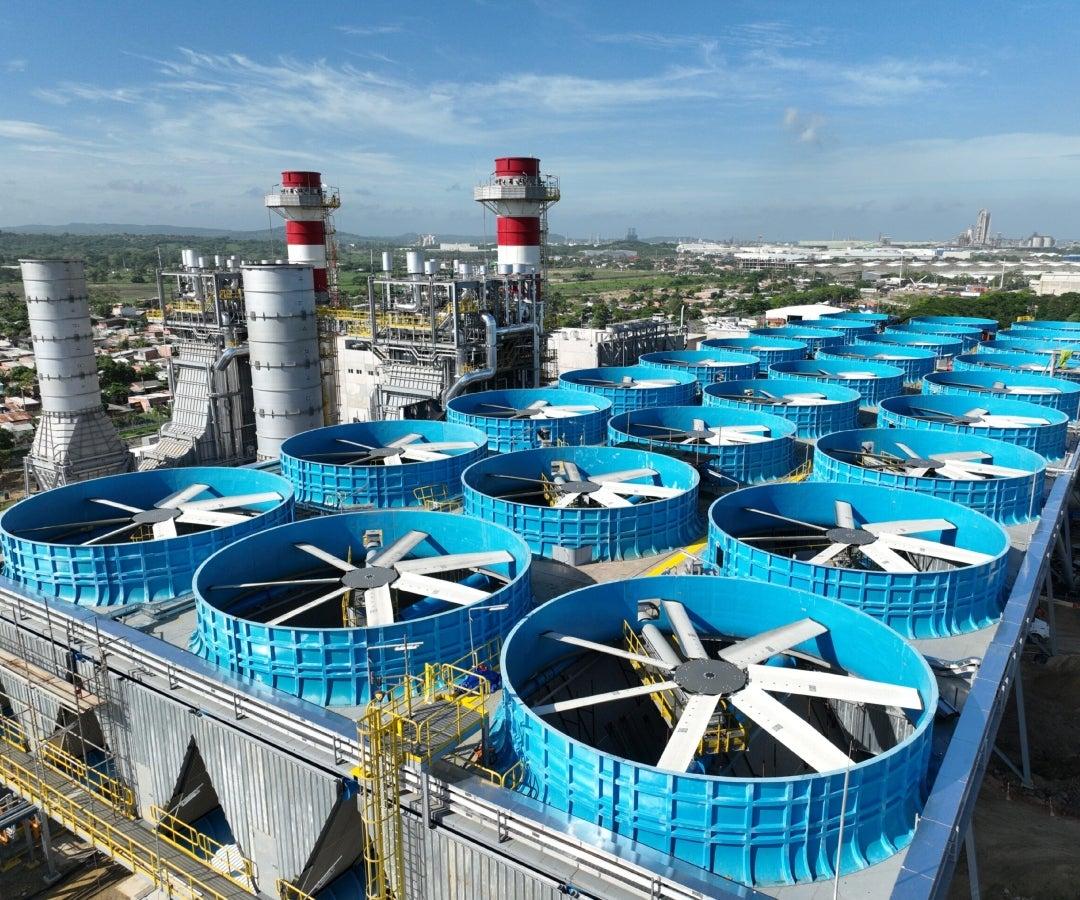
If you are selecting a cooling tower fan, replacing an old fan, or checking whether an existing cooling tower is moving enough air, one question matters right away: How do you calculate the CFM of a cooling tower fan?
CFM, or cubic feet per minute, is one of the most important airflow measurements for a cooling tower fan. It tells you how much air the fan moves through the tower over a given period.
But there is a catch.
Calculating cooling tower fan CFM is not simply a matter of measuring the fan diameter and multiplying a few numbers. The actual airflow depends on fan diameter, blade design, RPM, static pressure, air density, tower resistance, and the fan's operating point.
Why does that matter?
Because a fan that looks powerful on paper may deliver much less airflow once it is installed in a real cooling tower. On the other hand, an oversized fan can move more air than necessary while consuming unnecessary energy.
In this guide, we'll explain how to calculate CFM of a cooling tower fan, show practical formulas and examples, explain the relationship between CFM and static pressure, and discuss how to select a suitable cooling tower fan for industrial applications.
As a cooling tower component manufacturer, Power Tower Cooling Technology (Shaoxing) Co., Ltd. provides cooling tower components and customized fan solutions for industrial customers.
What Does CFM Mean in a Cooling Tower?
CFM stands for Cubic Feet per Minute.
In simple terms, it describes the volume of air passing through a fan in one minute.
For a mechanical-draft cooling tower, the fan creates airflow through the tower. That airflow supports heat and mass transfer between the circulating water and the surrounding air.
You can think of the fan as the lungs of the cooling tower.
The tower needs to breathe enough air to reject the required amount of heat. If the airflow is too low, the cooling tower may not achieve the required leaving-water temperature. If the airflow is unnecessarily high, fan power consumption can increase.
So the objective isn't simply to maximize CFM.
The objective is to achieve the required CFM at the required static pressure with reasonable energy consumption.
Why Does CFM Matter for Cooling Tower Performance?
A cooling tower depends on air movement to remove heat from circulating water.
The fan pulls or pushes air through the tower while water moves through the fill or heat-transfer surfaces. The interaction between air and water is what makes evaporative cooling possible.
If airflow is inadequate, the tower may lose cooling capacity.
If airflow is excessive, the system may consume more electricity than necessary.
This creates a balancing act.
For example, an industrial process cooling tower may require a much larger airflow than a small HVAC cooling tower. The required CFM depends on the thermal load, water flow, temperature range, wet-bulb conditions, tower construction, and fan system.
This is why the question should not simply be:
"What is the CFM of this fan?"
A better question is:
"What CFM will this fan deliver at the actual operating conditions of my cooling tower?"
The Basic Cooling Tower Fan CFM Formula
One basic way to estimate airflow is:
CFM = Air Velocity × Effective Flow Area
Where:
CFM = airflow in cubic feet per minute
Air Velocity = average air velocity in feet per minute
Effective Flow Area = area through which the air actually passes
For a circular fan opening, the geometric area can be estimated as:
Area = π × D² ÷ 4
where D is the fan diameter in feet.
Therefore:
CFM ≈ Air Velocity × π × D² ÷ 4
This is useful for a preliminary airflow estimate.
However, don't confuse geometric area with actual effective flow area. Fan hubs, structural members, tower geometry, inlet restrictions, fill, drift eliminators, and other components can affect the airflow.
Most importantly, the fan does not operate in free air.
The cooling tower creates resistance, and that resistance affects the actual operating CFM.
CFM From Air Velocity and Fan Area
Let's look at a simple example.
Suppose a cooling tower fan has a diameter of 10 feet.
The theoretical circular area is:
Area = 3.1416 × 10² ÷ 4
Area ≈ 78.54 ft²
Now suppose the average air velocity through the effective flow area is approximately 1,500 ft/min.
Then:
CFM = 1,500 × 78.54
CFM ≈ 117,810 CFM
So the preliminary airflow estimate is approximately 117,810 CFM.
Sounds straightforward, right?
But there is an important limitation.
This calculation assumes that the measured velocity represents the actual average velocity through the relevant flow area. It also does not by itself account for the fan curve, system resistance, air density, or measurement uncertainty.
So treat this as an airflow estimation method, not a complete cooling tower fan selection procedure.
Example of Air Velocity Calculation
Imagine an existing cooling tower has an 8-foot fan.
The fan area is:
Area = 3.1416 × 8² ÷ 4
Area ≈ 50.27 ft²
If the measured average air velocity is approximately 1,400 ft/min:
CFM = 1,400 × 50.27
CFM ≈ 70,378 CFM
That gives a preliminary airflow estimate of around 70,400 CFM.
For a real industrial project, however, you'd want to compare this estimate with fan performance data and the cooling tower's actual operating conditions.
Field airflow measurement can be valuable, but measurement location and methodology matter. For demanding applications, recognized fan testing methods and suitable measurement stations can provide more reliable results.
CFM From Cooling Tower Heat Load
Another approach is to start from the cooling tower's required heat rejection.
This is often more meaningful during the design stage because the fan airflow ultimately exists to support the tower's thermal duty.
For a simplified sensible-air calculation:
Q = 1.08 × CFM × ΔT
Therefore:
CFM = Q ÷ (1.08 × ΔT)
Where:
But there is an important warning.
A cooling tower is an evaporative heat-rejection device, not simply a sensible-air heat exchanger.
Evaporation and moisture transfer are fundamental to its operation. Wet-bulb temperature, humidity, water flow, range, approach, and tower fill characteristics all affect performance.
Therefore, this formula can be useful for understanding the relationship between heat transfer and airflow, but it should not replace a proper cooling tower thermal calculation.
Example Using Cooling Capacity
Suppose a simplified calculation gives a sensible heat transfer requirement of 10,000,000 BTU/hr, and the assumed air temperature rise is 15°F.
Then:
CFM = 10,000,000 ÷ (1.08 × 15)
CFM ≈ 617,284 CFM
This gives a theoretical airflow requirement of approximately 617,000 CFM.
However, a cooling tower designer would normally use more complete thermal and psychrometric information before selecting the fan.
This example is useful mainly for understanding the calculation concept.
What Factors Affect Cooling Tower Fan CFM?
Several factors determine the actual CFM of a cooling tower fan.
The major ones include:
Fan diameter
Fan blade geometry
Blade pitch
Number of blades
Fan RPM
Static pressure
Air density
Fan efficiency
Tower resistance
Fill resistance
Drift eliminator resistance
Inlet and outlet configuration
Ambient conditions
Fan installation geometry
Ignoring these variables can result in a misleading CFM estimate.
Let's look at the most important ones.
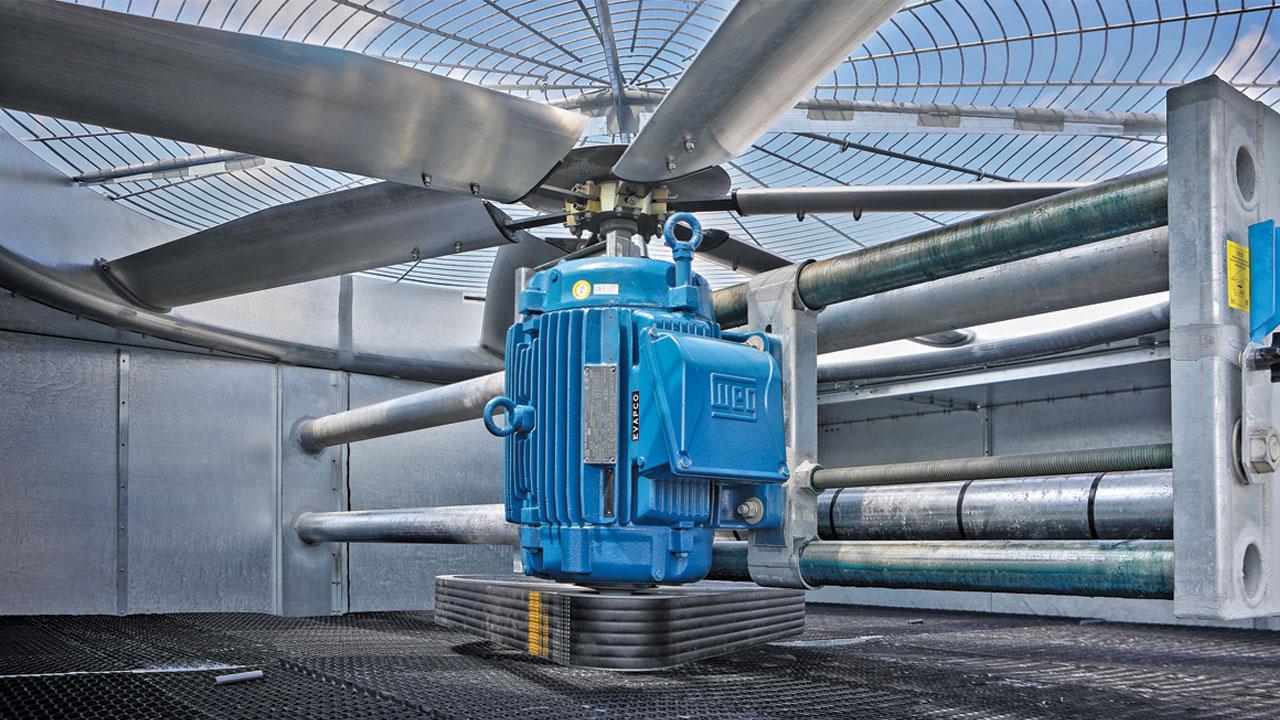
How Does Fan Diameter Affect CFM?
Fan diameter has a major influence on airflow potential.
The area of a circular fan opening increases with the square of the diameter.
The formula is:
A = πD² / 4
This means increasing the diameter can significantly increase the swept area.
For example:
An 8-foot diameter fan has an approximate circular area of:
50.27 ft²
A 10-foot fan has:
78.54 ft²
That's a substantial difference.
But larger does not automatically mean better.
A larger fan may require more installation space, stronger supporting structures, different drive components, and a larger initial investment.
The correct fan diameter must therefore be matched to the cooling tower design and required airflow.
How Does Fan Blade Design Affect CFM?
Fan blades are not just pieces of material attached to a hub.
They are aerodynamic components.
Blade profile, blade pitch, chord length, number of blades, hub geometry, and tip design can all affect airflow and efficiency.
Imagine a fan blade as an aircraft wing rotating around a hub.
The blade needs to generate useful airflow while controlling aerodynamic losses.
Changing the blade pitch can increase or decrease airflow. But increasing pitch can also increase aerodynamic loading and power requirements.
This is why simply changing blade angle to "get more CFM" can be a bad idea if the motor and drive system are not checked.
For custom cooling tower fans, the blade design should be evaluated together with the required CFM, static pressure, RPM, and motor power.
How Does Fan Speed and RPM Affect CFM?
For a geometrically similar fan operating under comparable conditions, the classical fan laws give a useful relationship between airflow and speed:
CFM₂ / CFM₁ ≈ RPM₂ / RPM₁
So:
CFM₂ = CFM₁ × RPM₂ / RPM₁
For example, suppose a fan produces 100,000 CFM at 300 RPM.
If its speed is increased to 330 RPM:
CFM₂ = 100,000 × 330 / 300
CFM₂ ≈ 110,000 CFM
So the theoretical airflow increase is about 10%.
But there's a catch.
Static pressure changes approximately with the square of speed, while power changes approximately with the cube of speed under the applicable fan-law assumptions.
That means increasing RPM can increase energy consumption much faster than it increases airflow.
So don't increase fan speed just because you want more CFM.
Always check the complete fan and drive system.
Why Is Static Pressure Important When Calculating CFM?
This is one of the most important concepts in cooling tower fan selection.
A fan does not operate in free air.
Air must pass through:
All of these contribute to system resistance.
The actual operating point occurs where the fan performance curve intersects the system resistance curve.
Think about riding a bicycle.
Riding downhill is easy.
Riding uphill requires more effort.
The fan faces a similar situation. Low system resistance allows easier airflow. Higher resistance requires more pressure from the fan.
Therefore, the useful specification is not simply:
"This fan is 150,000 CFM."
It should be closer to:
"This fan can deliver approximately 150,000 CFM at the required operating static pressure and speed."
That is a much more meaningful specification.
How Does Air Density Affect Cooling Tower Fan CFM?
Air density changes with temperature, pressure, altitude, and humidity.
A fan operating at high altitude, for example, encounters air with different density from standard sea-level conditions.
Similarly, very hot air has a lower density than colder air at comparable pressure.
This matters because fan performance calculations often distinguish between actual CFM and airflow referenced to standard conditions.
For general estimates, standard air conditions may be sufficient.
For critical industrial applications, however, the design should account for actual operating conditions.
This becomes particularly important when comparing fan performance across different sites.
How to Calculate Cooling Tower Fan Airflow Step by Step
If you need to determine the appropriate CFM for a cooling tower fan, follow a logical process.
Don't start by buying the largest fan you can find.
Start with the cooling requirement.
Step 1 — Determine the Required Heat Rejection
First, determine the amount of heat the cooling tower needs to reject.
For a water-side estimate in U.S. customary units, a commonly used approximation is:
Heat Rejection ≈ 500 × GPM × Range
Where:
For example, if a tower circulates 1,000 GPM and has a 10°F range:
Heat Rejection ≈ 500 × 1,000 × 10
≈ 5,000,000 BTU/hr
This gives you a starting point for determining the tower's thermal duty.
The actual design should also consider wet-bulb temperature, approach, evaporation, and other thermal parameters.
Step 2 — Determine the Required Airflow
Once the thermal duty is established, determine the airflow needed to support that cooling duty.
For a new cooling tower, the tower designer may already have a required airflow.
For an existing system, you may obtain airflow information from:
If you are replacing a fan, the existing fan's operating point can be an especially valuable starting point.
Step 3 — Calculate the Fan Area
For a circular fan:
Area = πD² / 4
Suppose the fan diameter is 12 feet.
Then:
Area = 3.1416 × 12² ÷ 4
Area ≈ 113.10 ft²
If the required airflow is 180,000 CFM, a simplified average velocity estimate would be:
Velocity = 180,000 ÷ 113.10
≈ 1,592 ft/min
This calculation helps connect the required airflow with the physical fan size.
However, it does not replace a fan performance curve.
Step 4 — Select the Correct Fan Operating Point
Now comes the part that matters most.
Match:
Required CFM + Required Static Pressure + Required RPM
against the manufacturer's fan performance data.
A fan curve can show how airflow changes with pressure at a particular speed.
This is much more reliable than selecting a fan from diameter alone.
For industrial cooling tower applications, the fan should also be checked for:
Motor loading
Shaft speed
Blade strength
Vibration
Noise
Material compatibility
Corrosion resistance
Mechanical compatibility
A good fan selection is a system decision, not just a CFM decision.
CFM vs. Static Pressure in Cooling Tower Fans
CFM and static pressure are closely related.
You can think of CFM as how much air moves, while static pressure represents how much resistance the fan must overcome.
A fan may deliver a high airflow under low resistance but significantly less airflow when resistance increases.
This explains why two cooling towers with identical fan diameters can have different actual airflow.
The fan, tower, fill, drift eliminator, and airflow path all work together.
In engineering terms, the stable operating point is determined by the intersection of the fan curve and system curve.
That's why a manufacturer should evaluate the complete operating condition when recommending a cooling tower fan.
How Does Fan Blade Angle Affect CFM?
Blade angle can have a significant effect on airflow.
A higher pitch can generally increase airflow and pressure generation, but it can also increase the aerodynamic load on the fan.
That means motor power can increase.
A lower pitch may reduce airflow and power demand.
The objective is to find the correct balance.
For adjustable-pitch fans, blade angle should be set according to the manufacturer's recommended operating range.
Never assume that increasing the blade angle will automatically improve cooling performance.
If the motor becomes overloaded, the "more airflow" strategy can quickly become an expensive mistake.
How Does Cooling Tower Fan RPM Affect CFM?
RPM is one of the easiest variables to change, especially when a variable-speed drive is installed.
The simplified fan law is:
CFM₂ = CFM₁ × RPM₂ / RPM₁
For example:
Initial condition:
New condition:
Then:
CFM₂ = 120,000 × 270 / 300
CFM₂ = 108,000 CFM
So a 10% reduction in RPM produces an approximately 10% reduction in airflow under the simplified fan-law relationship.
But power can fall much more sharply because fan power varies approximately with the cube of speed.
This is one reason variable-speed fan control can be valuable when cooling load changes.
How to Estimate CFM for an Existing Cooling Tower Fan
What if you have an old cooling tower and no original technical documentation?
Don't panic.
Start with what you can measure.
Record:
Fan diameter
Number of blades
Blade pitch
RPM
Motor power
Hub diameter
Fan rotation
Cooling tower dimensions
Water flow
Entering water temperature
Leaving water temperature
Ambient wet-bulb temperature
Also inspect the condition of the fan and tower.
A dirty or damaged fill can change system resistance. A damaged blade can change fan performance. A modified drift eliminator can also affect airflow resistance.
So if an old fan is underperforming, the problem may not always be the fan itself.
Using Fan Diameter and RPM
Fan diameter and RPM are useful for preliminary evaluation.
However, they are not enough to determine exact CFM.
Two fans may have:
and still produce different airflow.
Why?
Because blade geometry matters.
Blade pitch, airfoil shape, hub diameter, solidity, tip clearance, and aerodynamic efficiency can all influence performance.
So use diameter and RPM as starting information—not as the final answer.
Using Fan Performance Curves
A fan performance curve is one of the best tools for selecting a cooling tower fan.
It shows how the fan behaves under different pressure and airflow conditions.
For example, you might find that a fan delivers:
180,000 CFM at a lower static pressure
165,000 CFM at the design pressure
145,000 CFM at a higher system resistance
This information is far more useful than a single "maximum CFM" number.
When purchasing a replacement fan, ask the supplier for the performance information corresponding to your actual operating conditions.
Common Mistakes When Calculating Cooling Tower Fan CFM
Even a basic CFM calculation can go wrong if you overlook the system around the fan.
Here are some common mistakes.
Using Free-Air CFM Instead of Operating CFM
Free-air CFM can make a fan look extremely powerful.
But a cooling tower isn't free air.
The tower creates resistance.
Therefore, selecting a fan based only on free-air airflow can result in insufficient actual airflow after installation.
Always consider the CFM at the required operating static pressure.
Ignoring Air Density
Using standard air conditions for every project can also introduce errors.
If your cooling tower operates at high elevation, very high temperature, or other unusual atmospheric conditions, air density should be considered.
For a basic estimate, standard conditions may be acceptable.
For a critical industrial application, actual site conditions should be used.
Oversizing the Fan
Bigger is not always better.
An oversized fan can result in:
Higher initial cost
Larger motor requirements
Increased structural loading
More noise
Higher energy consumption
Potentially excessive airflow
Cooling tower fan energy is strongly affected by speed and operating point. The relationship between airflow, pressure, and power is therefore important when optimizing the system.
The goal is not maximum CFM.
The goal is the correct CFM.
How Does CFM Relate to Cooling Tower Efficiency?
CFM is important, but airflow alone does not determine cooling tower efficiency.
A cooling tower is a complete system.
Its performance depends on:
Airflow
Water flow
Fill condition
Water distribution
Wet-bulb temperature
Approach
Range
Fan efficiency
Motor efficiency
Drift eliminators
Tower geometry
Think of it like an orchestra.
The fan is one of the most important instruments, but it cannot perform the entire song by itself.
A huge fan cannot compensate for severely clogged fill or poor water distribution.
Likewise, excellent fill cannot compensate for insufficient airflow.
The best results come when all major components are properly matched.
Selecting a Cooling Tower Fan Based on CFM
When selecting a cooling tower fan, CFM should be one of your first specifications—but not your only specification.
You should evaluate:
Required CFM
Static pressure
Fan diameter
RPM
Blade pitch
Blade profile
Number of blades
Motor power
Fan efficiency
Material
Corrosion conditions
Installation dimensions
Noise requirements
Maintenance requirements
For industrial applications, material selection can be particularly important.
FRP, stainless steel, coated metal, and other materials may be considered depending on the environment and mechanical requirements.
The right material depends on the actual application.
Custom Cooling Tower Fan Solutions
Not every cooling tower uses a standard fan.
Older towers, retrofit projects, industrial cooling systems, and discontinued equipment may require a customized replacement.
A custom cooling tower fan can be developed around requirements such as:
Fan diameter
CFM
Static pressure
RPM
Blade geometry
Blade material
Hub configuration
Shaft dimensions
Mounting dimensions
Rotation direction
Motor specifications
This can be especially useful when the original fan is no longer available.
Instead of replacing an entire cooling tower because one component has become obsolete, a properly engineered replacement fan may provide a practical alternative.
What Information Is Needed for a Custom Cooling Tower Fan?
If you are contacting a manufacturer about a custom fan, provide as much information as you have.
Useful information includes:
Existing fan diameter
Required CFM
Static pressure
RPM
Motor power
Blade quantity
Blade angle
Hub diameter
Shaft size
Rotation direction
Installation dimensions
Cooling tower model
Operating temperature
Ambient conditions
Water flow
Existing fan photographs
Technical drawings
Don't worry if you don't have everything.
Clear photographs and basic measurements can often give a manufacturer a useful starting point.
For replacement projects, an old fan sample or detailed dimensional drawing can be especially valuable.
Why Choose Power Tower Cooling Technology?
Power Tower Cooling Technology (Shaoxing) Co., Ltd. specializes in cooling tower components and customized cooling tower solutions for industrial applications.
When customers need to evaluate a cooling tower fan, our approach is to look beyond a single CFM number.
We can consider information such as fan diameter, blade specifications, RPM, motor power, installation dimensions, operating conditions, and available drawings or photographs.
Our capabilities can support applications involving:
For a replacement fan, the objective is not simply to make a fan that physically fits.
The replacement should also be considered in relation to airflow, static pressure, mechanical compatibility, operating speed, and the overall cooling tower system.
Customers can learn more about Power Tower Cooling Technology and its cooling tower products at:
Power Tower Cooling Technology — coolingtowerpart.com
Final Conclusion
So, how do you calculate CFM of a cooling tower fan?
For a basic airflow estimate, you can use:
CFM = Air Velocity × Effective Flow Area
For a circular fan:
Area = πD² / 4
You can also use fan laws when evaluating changes in RPM:
CFM₂ / CFM₁ ≈ RPM₂ / RPM₁
But here's the most important point:
A cooling tower fan's actual CFM cannot be determined accurately from fan diameter alone.
The real operating airflow depends on the fan's performance curve and the resistance of the cooling tower system. Fan speed, blade design, static pressure, air density, fill condition, drift eliminators, and other factors all influence the final operating point.
If you are selecting a new fan, replacing an existing cooling tower fan, or developing a custom industrial fan, start with the thermal load and required airflow. Then match the fan to the required static pressure, RPM, motor power, and installation conditions.
And don't forget energy efficiency.
A fan that provides more airflow than necessary isn't necessarily a better fan. The best cooling tower fan is the one that provides the required airflow at the required pressure while using energy efficiently and operating reliably.
For customers looking for cooling tower fan replacement, custom cooling tower fans, fan blades, FRP fan solutions, or OEM/ODM manufacturing, Power Tower Cooling Technology (Shaoxing) Co., Ltd. can work from your project requirements, drawings, photographs, and existing fan information.
Because when you ask, "How much CFM does my cooling tower fan need?", the answer shouldn't come from the fan diameter alone.
It should come from the cooling tower's actual operating requirements.


