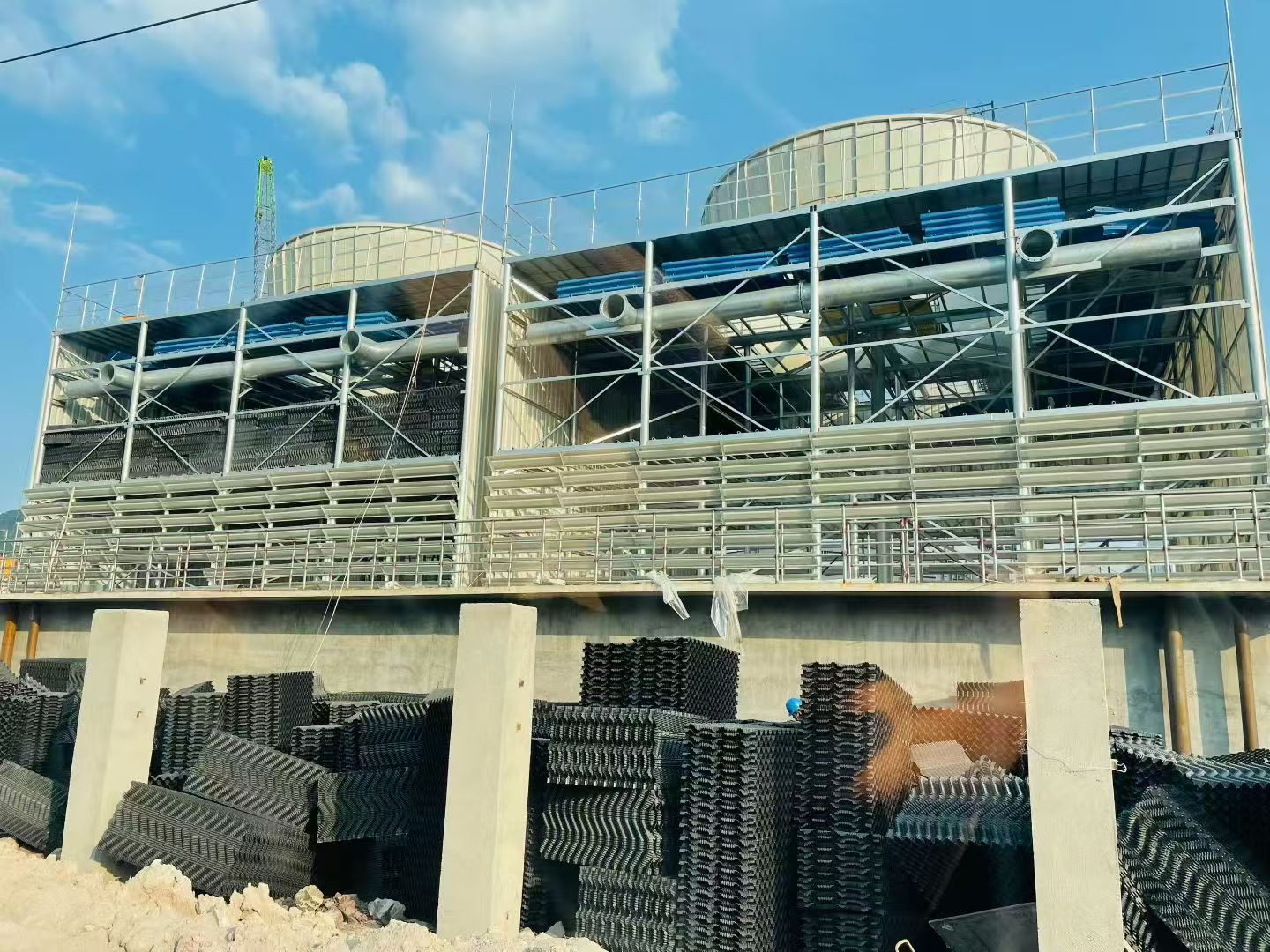
Cooling tower fill is one of the most important components inside a cooling tower. It increases the contact area between hot water and air, allowing heat to transfer more efficiently and helping the tower achieve the required outlet-water temperature.
Whether you are designing a new cooling tower, upgrading an existing system, or planning a cooling tower fill replacement, understanding fill types, materials, and operating principles is essential.
This guide explains what cooling tower fill is, how it works, the main types and materials, and how to select the right fill for an industrial or commercial application.
What Is Cooling Tower Fill?
Cooling tower fill, also called cooling tower packing or fill media, is the internal material installed between the water distribution system and the air inlet or outlet.
Its primary purpose is to increase the surface area and contact time between circulating water and air.
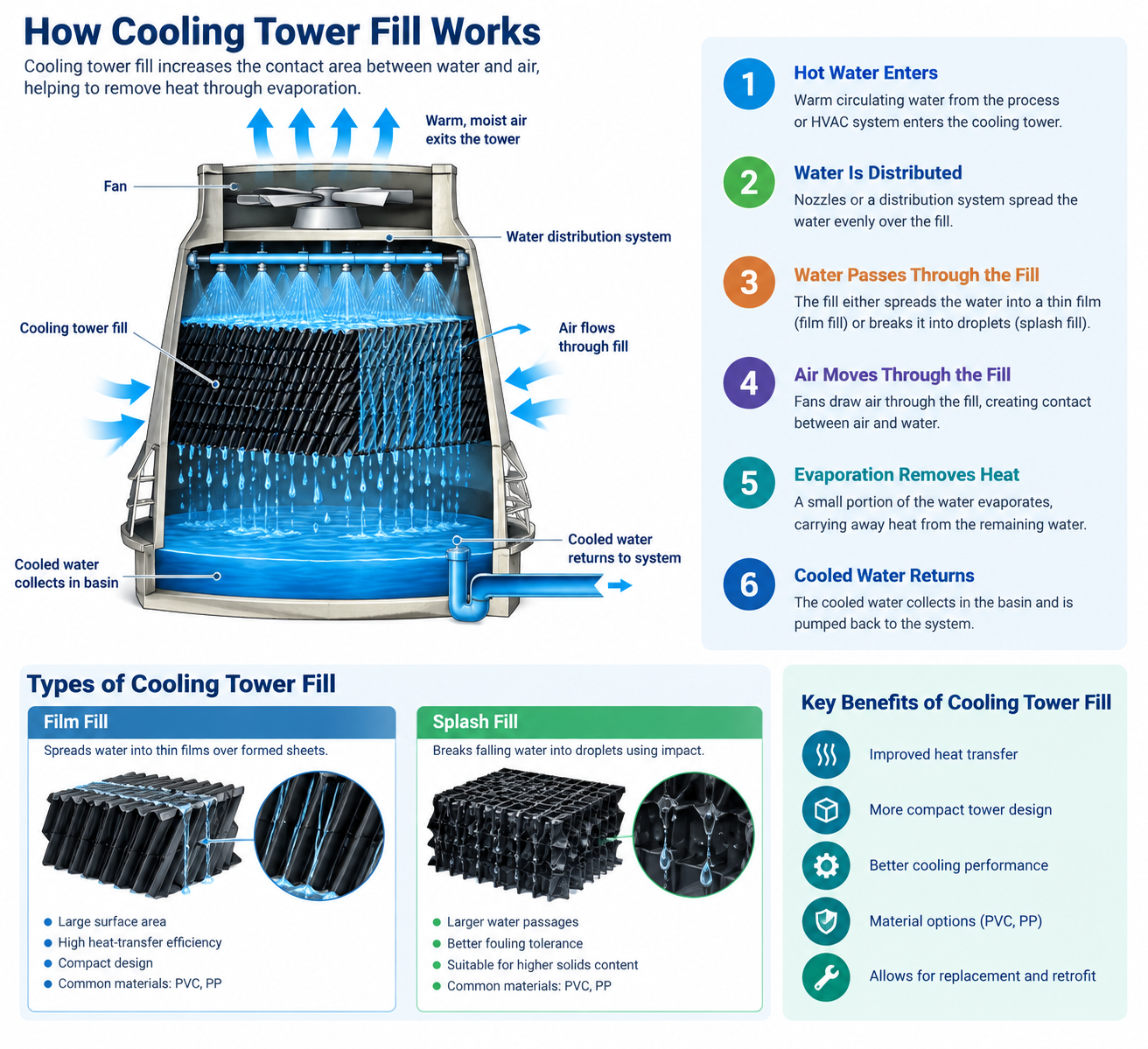
When hot water enters the cooling tower, it is distributed over the fill. As the water flows through the fill, it forms thin films or breaks into droplets. Air passes through the fill in the opposite or perpendicular direction, depending on the tower design.
Heat moves from the water to the air, while a small portion of the water evaporates. This evaporative process removes additional heat and lowers the temperature of the circulating water.
How Does Cooling Tower Fill Work?
The working principle of cooling tower fill is relatively simple:
Hot water → Water distribution → Cooling tower fill → Air-water contact → Heat and moisture transfer → Cooled water
Without fill media, water would have much less contact area with air. The fill creates a large effective surface area, improving the efficiency of the heat-transfer process.
The fill itself does not generate cooling. Instead, it provides the surface and geometry needed for efficient air-water interaction.
Main Types of Cooling Tower Fill
There are three common categories of cooling tower fill: film fill, splash fill, and hybrid fill.
1. Film Cooling Tower Fill
Film fill uses sheets with specially formed surfaces or channels. Water spreads across these surfaces and forms a relatively thin film.
The large wetted surface area provides efficient heat transfer.
Film fill is commonly used when:
High thermal efficiency is required
Water quality is relatively good
Compact tower design is important
Fine water distribution is available
PVC and PP are widely used for film fill manufacturing.
One limitation is that narrow channels can be more susceptible to fouling, scaling, algae, or suspended solids.
2. Splash Cooling Tower Fill
Splash fill uses bars, grids, sheets, or specially shaped elements to break falling water into smaller droplets.
Instead of spreading water into a continuous film, splash fill repeatedly changes the direction of the water and increases air-water contact.
Splash fill is often considered for applications with:
Because splash fill can have larger passages, it may provide better resistance to blockage than some film-fill designs.
3. Hybrid Cooling Tower Fill
Hybrid fill combines features of film and splash designs.
It can provide a balance between heat-transfer performance and resistance to fouling. Hybrid configurations are useful when water quality and thermal requirements make a single fill type less suitable.
Cooling Tower Fill Materials
The material used to manufacture cooling tower fill affects its durability, temperature resistance, chemical resistance, and service life.
PVC Cooling Tower Fill
PVC cooling tower fill is one of the most widely used options, particularly for film-fill applications.
PVC offers:
PVC film fill is commonly used in HVAC and industrial cooling towers where operating temperatures and water chemistry are within the material's recommended range.
PP Cooling Tower Fill
PP cooling tower fill, or polypropylene cooling tower fill, is another widely used option.
PP can offer good chemical resistance and is often selected for applications requiring higher temperature capability than conventional PVC can provide.
PP can be manufactured into film or splash-fill products depending on the tower design.
Other Materials
Specialized applications may use other plastics or materials where specific temperature, chemical, mechanical, or fire-performance requirements exist.
The material should always be selected according to the actual operating environment rather than simply based on price.
Film Fill vs Splash Fill
Choosing between film and splash fill is one of the most important decisions when selecting cooling tower fill.
| Feature | Film Fill | Splash Fill |
| Heat-transfer potential | High | Moderate to high |
| Clean-water applications | Excellent | Good |
| Fouling tolerance | Lower in narrow-channel designs | Generally higher |
| Suspended solids | More sensitive | More tolerant |
| Water distribution | Requires good distribution | Generally more forgiving |
| Maintenance | Can require careful cleaning | Often easier to access |
| Common materials | PVC, PP | PP, PVC and other plastics |
Actual performance depends on the fill geometry, tower design, airflow, water flow, operating conditions, and water treatment program.
Cooling Tower Fill in Counterflow and Crossflow Towers
Cooling tower fill must match the tower configuration.
Counterflow Cooling Tower Fill
In a counterflow tower, air generally moves upward while water flows downward through the fill.
This arrangement can provide efficient heat and mass transfer in a relatively compact footprint. Film fill is commonly used in counterflow applications where water quality is suitable.
Crossflow Cooling Tower Fill
In a crossflow tower, air generally moves horizontally across the falling water.
The fill must work with the tower's water distribution system and airflow path. Fill dimensions and orientation are especially important when replacing existing fill.
Why Is Cooling Tower Fill Important?
Properly selected fill can contribute to:
Improved heat-transfer efficiency
Lower circulating-water temperature
Stable cooling performance
Better use of tower volume
Reduced risk of excessive operating costs
Longer service life when matched to water quality
However, fill is only one part of the cooling tower system. Fans, motors, water distribution systems, drift eliminators, pumps, and water treatment all influence overall performance.
Factors That Affect Cooling Tower Fill Performance
Several operating factors should be considered when evaluating cooling tower fill.
Water Flow Rate
The fill must accommodate the required water loading. Excessive or insufficient water flow can affect how evenly the fill is wetted.
Airflow
Airflow determines how much air contacts the water. Fan performance and fill pressure drop therefore need to be considered together.
Water Quality
Poor water quality can lead to scaling, biological growth, and blockage. A fill designed for clean water may not be appropriate for heavily contaminated water.
Operating Temperature
The fill material must withstand the expected hot-water temperature and temperature fluctuations.
Fill Geometry
Sheet thickness, flute shape, surface area, spacing, and block dimensions all influence thermal and hydraulic performance.
Cooling Tower Fill Replacement
Cooling tower fill replacement is common during tower refurbishment and performance upgrades.
Before ordering replacement fill, verify:
Cooling tower type
Manufacturer and model
Existing fill dimensions
Fill material
Fill type
Fill height
Water flow rate
Operating temperature
Water quality
Support arrangement
A replacement product should fit the existing structure and work with the tower's water distribution and airflow systems.
Simply choosing a fill with the same material is not enough. The geometry and dimensions also need to be compatible.
How to Choose the Right Cooling Tower Fill
A practical selection process is:
1. Identify the tower design.
Determine whether the tower is counterflow or crossflow.
2. Evaluate water quality.
Check suspended solids, scaling, biological activity, and other contaminants.
3. Select the fill type.
Choose film, splash, or hybrid fill based on the thermal and maintenance requirements.
4. Select the material.
Compare PVC, PP, and other suitable materials according to temperature and chemical conditions.
5. Verify dimensions.
For replacement projects, measure the existing fill blocks and support structure.
6. Confirm thermal requirements.
Consider water flow, airflow, cooling range, approach temperature, and fill depth.
7. Review supplier specifications.
Ask for technical data before placing an order.
Cooling Tower Fill Maintenance
Regular maintenance can extend the useful life of cooling tower fill.
Recommended maintenance practices include:
Inspecting fill for cracks and deformation
Checking for scaling and biological growth
Removing accumulated dirt and debris
Monitoring water treatment
Checking water distribution uniformity
Inspecting fill supports
Monitoring cooling performance
The cleaning method should be appropriate for the fill material. Excessive mechanical force or unsuitable chemicals can damage plastic fill.
Frequently Asked Questions
What is the main purpose of cooling tower fill?
The main purpose of cooling tower fill is to increase the contact area and contact time between water and air, improving heat and mass transfer inside the cooling tower.
What is the difference between film fill and splash fill?
Film fill spreads water across structured surfaces to create a thin film and large wetted area. Splash fill breaks water into droplets through repeated splashing. Film fill can provide high thermal efficiency, while splash fill is often more tolerant of fouling and suspended solids.
What material is commonly used for cooling tower fill?
PVC and PP are two common materials. PVC is widely used for many film-fill applications, while PP is also used for both film and splash fill where its properties are suitable.
How long does cooling tower fill last?
Service life varies according to water quality, temperature, chemical exposure, maintenance, UV exposure, and operating conditions. Regular inspection is the best way to determine whether replacement is necessary.
Can cooling tower fill be replaced?
Yes. Many cooling towers can undergo fill replacement without replacing the entire tower. The replacement fill must be compatible with the existing tower structure, water distribution system, airflow, and operating conditions.
Conclusion
Cooling tower fill plays a critical role in the heat-transfer process by increasing the contact area between circulating water and air. Film fill, splash fill, and hybrid fill each have different characteristics, making them suitable for different operating conditions.
PVC and PP are widely used cooling tower fill materials, but the correct choice depends on water quality, temperature, chemical exposure, tower configuration, and thermal requirements.
For new installations and cooling tower fill replacement projects, selecting the correct fill type, material, geometry, and dimensions can help maintain reliable cooling performance and reduce maintenance problems.
Internal Links for Other CoolingTowerParts
Cooling Tower Nozzles
Cooling Tower Drift Eliminators
Cooling Tower Louvers
Cooling Tower Fan Blades
Cooling Tower Motors


