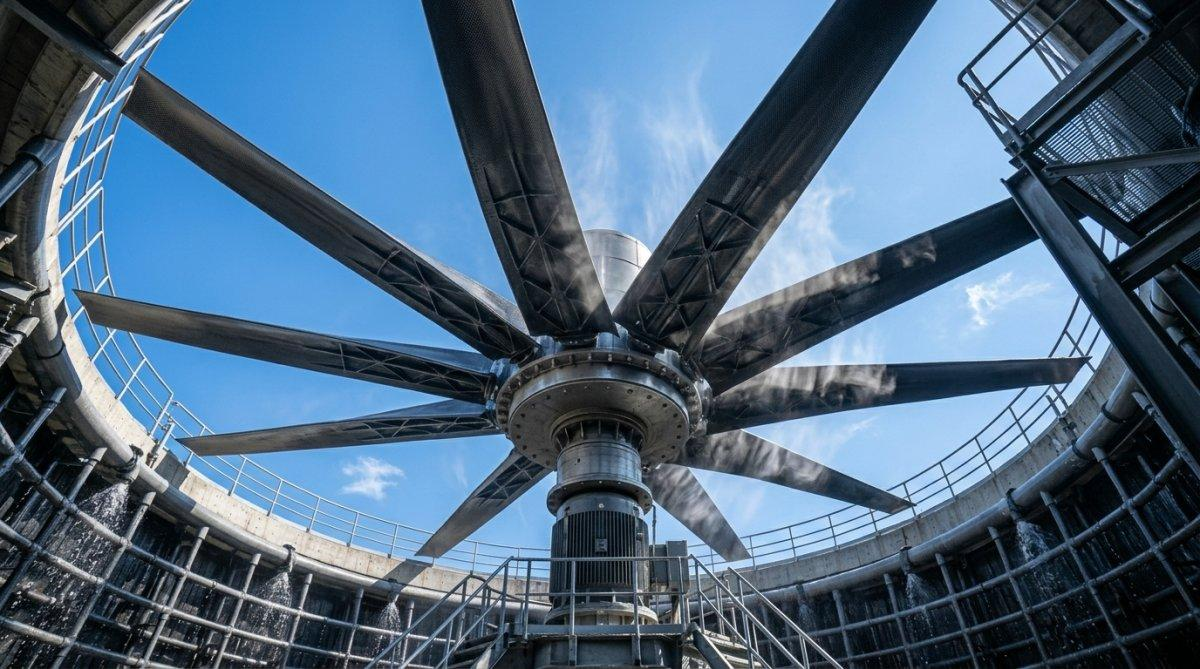
Cooling tower performance depends on more than water flow and temperature. The movement of air through the tower is equally important. If the airflow is too low, the cooling tower may struggle to remove the required heat. If it is unnecessarily high, the fan may consume more electricity than the system needs.
That is why cooling tower fan air flow calculation is an essential part of cooling tower design, fan selection, replacement, and performance optimization.
But how do you calculate the required airflow? Which formula should you use? And how can you determine whether an existing cooling tower fan is delivering enough air?
In this guide, we will explain the main calculation methods, introduce the important engineering parameters, and work through a practical example. We will also look at airflow units, fan selection, static pressure, blade angle, and common calculation mistakes.
Whether you are selecting a fan for a new cooling tower or evaluating an existing installation, understanding these principles will help you make a more informed decision.
Why Cooling Tower Fan Airflow Matters
A cooling tower removes heat from circulating water by bringing the water into contact with moving air. In a mechanical-draft cooling tower, the fan creates or assists the airflow needed for this process.
Think of the fan as the engine of the tower's air movement system. It does not remove heat directly. Instead, it moves air through the tower so that heat and moisture can transfer from the water into the air.
Correct airflow helps a cooling tower:
Maintain the required cold-water temperature.
Support stable heat rejection under changing loads.
Improve contact between air and water.
Reduce the risk of insufficient cooling.
Avoid unnecessary fan power consumption.
Maintain more consistent operating conditions.
Consider two situations. If the fan delivers less air than the tower requires, the cold-water temperature may rise, especially during hot weather or periods of heavy production. If the fan delivers significantly more air than necessary, electricity consumption and mechanical loading may increase without a proportional improvement in cooling performance.
The goal is not simply to maximize airflow. It is to provide the correct airflow at the required operating pressure.
Understanding Airflow in a Cooling Tower
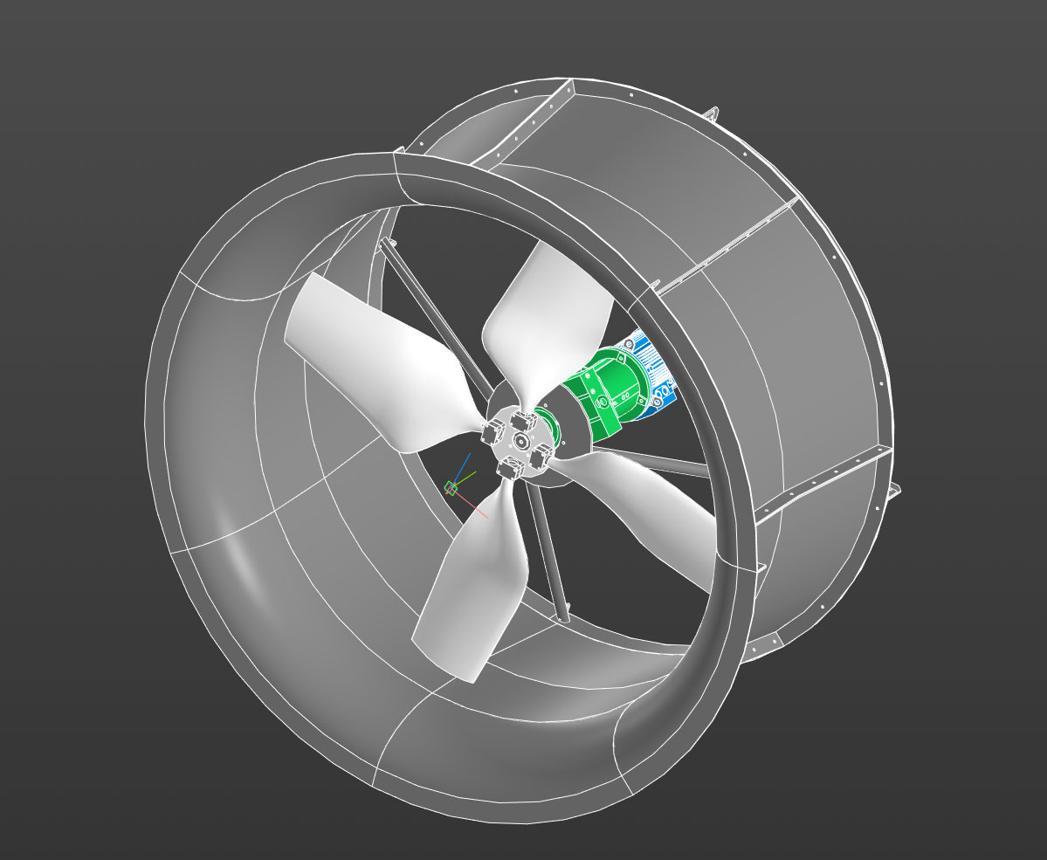
Cooling tower airflow refers to the amount of air passing through the tower over a specific period. Engineers may describe it using either mass flow or volumetric flow.
Common airflow units include:
m³/h: cubic meters per hour.
m³/s: cubic meters per second.
CFM: cubic feet per minute.
kg/s: kilograms of dry air per second.
These units describe related but different properties.
Volumetric airflow tells you how much space the moving air occupies. Mass airflow tells you how much air mass passes through the tower. Since air density changes with temperature, humidity, and atmospheric pressure, the two values are not interchangeable without a conversion.
The Relationship Between Airflow and Heat Rejection
When hot water enters a cooling tower, it is distributed through spray nozzles or over the fill. The moving air contacts the water, and a portion of the water evaporates. This evaporation removes energy from the remaining water, lowering its temperature.
The air absorbs both sensible heat and moisture as it passes through the tower. It then carries that energy away from the cooling system.
Generally, increasing air mass flow can support greater heat and mass transfer. However, the relationship is not unlimited or perfectly linear. Fill characteristics, water distribution, air humidity, contact time, and airflow distribution also influence cooling performance.
For this reason, airflow should be evaluated as part of the complete cooling tower heat and mass transfer process.
Required Airflow vs. Fan Capacity
These two terms are often confused.
Required airflow is the air volume or mass flow needed by the cooling tower under specified design conditions.
Fan capacity is the airflow a particular fan can deliver under a given operating condition.
A fan may have a rated airflow of 100,000 m³/h under a particular test condition. However, after installation, its actual airflow may be different because the tower creates resistance to the moving air.
This is why fan selection must consider both airflow and static pressure. A fan's free-air capacity alone is not enough to confirm that it will meet the cooling tower's requirements.
Key Parameters Needed for Cooling Tower Airflow Calculation
Before applying a formula, collect the correct design and operating information. A calculation based on incomplete data may produce a number, but that number may not represent the actual cooling tower requirement.
Cooling Tower Heat Load
Heat load is the amount of heat the cooling tower must remove from the circulating water. It is commonly expressed in kW or MW.
For water under typical operating conditions, the heat load can be estimated using:
Q = 1.163 × F × ΔT
Where:
The temperature difference, also called the cooling range, is:
ΔT = Hot-water temperature − Cold-water temperature
For example, if the circulating water flow rate is 500 m³/h and the cooling range is 5°C:
Q = 1.163 × 500 × 5
Q = 2,907.5 kW
The cooling tower must therefore reject approximately 2,907.5 kW of heat under these conditions.
This formula is a practical estimate based on water properties close to ordinary operating conditions. For more accurate engineering calculations, use the actual water density and specific heat capacity.
Water Flow Rate and Temperature Difference
Water flow rate and cooling range are two important inputs.
A higher water flow rate generally increases the total heat load when the temperature difference remains constant. Likewise, a larger cooling range increases the amount of heat that must be removed for the same water flow rate.
However, the cooling range alone does not determine the required airflow. Two cooling towers with the same water flow rate and temperature range may need different airflow because their fill, thermal design, ambient conditions, and tower configuration are different.
Air Temperature and Humidity
Air conditions have a major influence on evaporative cooling.
Important parameters include:
Dry-bulb temperature.
Wet-bulb temperature.
Relative humidity.
Atmospheric pressure.
Inlet air enthalpy.
Outlet air enthalpy.
Wet-bulb temperature is particularly important because it indicates the potential for evaporative cooling. A cooling tower operating in a hot, humid environment may perform differently from one working in a cooler, drier environment.
When using an enthalpy-based calculation, obtain the inlet and outlet air properties from the specified design conditions. Do not assume that one fixed enthalpy difference applies to every cooling tower.
Cooling Tower Fan Air Flow Calculation Formula
There are several ways to estimate or calculate cooling tower airflow. The appropriate method depends on the amount of design information available.
For a preliminary thermodynamic estimate, an air-side energy balance can be used:
Q ≈ ṁₐ × (h_out − h_in)
Rearranging:
ṁₐ ≈ Q ÷ (h_out − h_in)
Where:
Q = heat transferred in kW.
ṁₐ = dry-air mass flow rate in kg/s.
h_out = outlet moist-air enthalpy in kJ/kg dry air.
h_in = inlet moist-air enthalpy in kJ/kg dry air.
The calculated mass flow can then be converted into volumetric airflow using the specific volume of moist air:
V = ṁₐ × v
Where:
V = volumetric airflow in m³/s.
ṁₐ = dry-air mass flow rate in kg/s.
v = specific volume in m³/kg dry air.
To convert the result into m³/h:
Airflow (m³/h) = V (m³/s) × 3,600
An important engineering detail: this simplified balance is a preliminary estimate. A wet cooling tower involves both heat transfer and evaporation, so a rigorous design calculation must account for the water and air mass balances as well as their energy balance. The outlet air condition may need to be determined iteratively using psychrometric properties and the selected cooling tower thermal model.
Method 1: Calculate Airflow from Heat Load and Enthalpy Difference
This method estimates dry-air mass flow from the heat transferred and the enthalpy increase of the air. It is useful when the design air conditions are known or can be obtained from a thermal design calculation.
Step 1: Determine the Heat Load
First, calculate the heat load from the water flow rate and cooling range.
Assume:
Water flow rate: 500 m³/h.
Hot-water temperature: 37°C.
Cold-water temperature: 32°C.
Cooling range: 5°C.
The estimated heat load is:
Q = 1.163 × 500 × 5
Q = 2,907.5 kW
Step 2: Determine the Air Enthalpy Difference
Next, determine the inlet and outlet air enthalpies. These values can be obtained using a psychrometric chart or a suitable psychrometric calculation tool.
For illustration, assume:
The enthalpy difference is:
Δh = 90 − 60 = 30 kJ/kg dry air
These are example values, not universal cooling tower design conditions.
Step 3: Calculate Dry-Air Mass Flow
Using the simplified air-side energy balance:
ṁₐ ≈ 2,907.5 ÷ 30
ṁₐ ≈ 96.92 kg/s
The estimated dry-air mass flow is approximately 96.92 kg/s.
Step 4: Convert Mass Flow into Volumetric Airflow
To convert the mass flow into volumetric airflow, use the specific volume of moist air.
Assume a specific volume of 0.90 m³/kg dry air for this illustration.
V = 96.92 × 0.90
V = 87.23 m³/s
Convert the result into m³/h:
V = 87.23 × 3,600
V ≈ 314,028 m³/h
The preliminary estimate is approximately 314,000 m³/h.
This value demonstrates the calculation process. It should not be treated as a final fan selection specification without checking the complete tower heat and mass balance and the actual fan operating conditions.
Method 2: Estimate Airflow from Cooling Tower Design Data
Sometimes, detailed psychrometric data is unavailable. In that situation, the cooling tower manufacturer's thermal design information can provide a more practical starting point.
Useful information includes:
Rated heat rejection.
Circulating water flow.
Hot-water temperature.
Cold-water temperature.
Design wet-bulb temperature.
Tower type and fill arrangement.
Rated fan airflow.
Required fan static pressure.
Fan motor power.
A cooling tower manufacturer may provide the airflow requirement based on the complete tower design and its thermal performance.
This approach is generally more useful than applying a generic airflow-per-ton ratio.
There is no single fixed airflow value that applies to every cooling tower. Crossflow towers, counterflow towers, compact industrial towers, and large induced-draft towers can have different airflow requirements even when their heat loads are similar.
Practical Cooling Tower Fan Airflow Calculation Example
Let's put the calculation into a practical context.
Imagine an industrial facility needs to evaluate the airflow requirement for a cooling tower. The following operating and air-side values are assumed for a simplified example.
Example Input Data
Circulating water flow: 500 m³/h.
Hot-water temperature: 37°C.
Cold-water temperature: 32°C.
Water temperature difference: 5°C.
Inlet air enthalpy: 60 kJ/kg dry air.
Outlet air enthalpy: 90 kJ/kg dry air.
Moist-air specific volume: 0.90 m³/kg dry air.
Step-by-Step Calculation
Step 1: Calculate the heat load.
Q = 1.163 × 500 × 5
Q = 2,907.5 kW
Step 2: Calculate the enthalpy difference.
Δh = 90 − 60
Δh = 30 kJ/kg dry air
Step 3: Calculate dry-air mass flow.
ṁₐ ≈ 2,907.5 ÷ 30
ṁₐ ≈ 96.92 kg/s
Step 4: Calculate volumetric airflow.
V = 96.92 × 0.90
V = 87.23 m³/s
Step 5: Convert to hourly airflow.
V = 87.23 × 3,600
V ≈ 314,028 m³/h
Understanding the Result
The simplified calculation gives an estimated airflow of approximately 314,000 m³/h.
Does this mean you should immediately select a fan rated at exactly 314,000 m³/h?
No. The calculation provides an initial air-volume estimate. It does not yet include all the details needed for final fan selection.
You still need to consider:
Actual tower air resistance.
Fan efficiency.
Fan diameter.
Fan speed.
Blade design and pitch.
Air density under operating conditions.
Air leakage and airflow distribution.
Motor and drive arrangement.
The complete thermal design of the tower.
The final fan should be selected using its performance curve and the cooling tower system resistance curve.
CFM and m³/h Conversion for Cooling Tower Fans
Cooling tower fan suppliers may use different airflow units depending on the market.
CFM means cubic feet per minute. It is frequently used in the United States and other markets that use imperial units.
m³/h means cubic meters per hour. It is widely used in international industrial equipment specifications.
The approximate conversion formulas are:
1 m³/h ≈ 0.5886 CFM
1 CFM ≈ 1.699 m³/h
For example, if a cooling tower fan has an airflow of 100,000 m³/h:
100,000 × 0.5886 = 58,860 CFM
The airflow is approximately 58,860 CFM.
When comparing fan specifications, make sure the airflow values refer to comparable test conditions and static pressure. A number without its test conditions can be misleading.
How to Select a Cooling Tower Fan Based on Airflow
Once you have estimated the required airflow, the next step is selecting a suitable fan.
A fan should not be selected by airflow alone. Its performance depends on several interconnected factors.
Fan Diameter and Rotational Speed
Fan diameter and rotational speed influence the volume of air a fan can move.
A larger fan may deliver more airflow, but the result also depends on blade geometry, fan efficiency, installation conditions, and static pressure.
Increasing fan speed can increase airflow, but it can also increase power consumption and mechanical stress.
For a geometrically similar fan operating under comparable conditions, the fan affinity laws provide useful approximations:
Airflow: Q₂ / Q₁ = N₂ / N₁
Pressure: ΔP₂ / ΔP₁ = (N₂ / N₁)²
Power: P₂ / P₁ = (N₂ / N₁)³
Where:
Q = airflow.
N = rotational speed.
ΔP = pressure.
P = fan power.
For example, increasing fan speed by 10% may increase airflow by approximately 10%, while the theoretical power requirement may rise by about 33.1%.
These relationships are approximate. They should be applied only when the fan geometry and operating conditions make the affinity laws appropriate.
This is why simply increasing fan speed is not always the best solution.
Static Pressure and System Resistance
A fan must overcome resistance as air moves through the cooling tower. This resistance is commonly described using static pressure or pressure loss.
Sources of resistance include:
If system resistance is higher than expected, the fan may deliver less air than its free-air or low-resistance rating suggests.
When selecting a cooling tower fan, compare its performance curve with the system resistance curve. The point where these curves intersect is the fan's operating point. It indicates the airflow and pressure the fan is expected to deliver in the installed system.
Fan Blade Angle and Installation Conditions
Blade pitch is another important factor. The blade angle affects the amount of air moved and the power required by the fan.
Incorrect blade settings may cause insufficient airflow, excessive motor load, vibration, or unstable operation.
Installation conditions also matter. Check:
Even a well-designed fan can perform poorly if it is installed incorrectly.
Common Mistakes in Cooling Tower Airflow Calculation
Airflow calculations can look straightforward, but small mistakes can lead to incorrect fan selection.
Using a Fixed Airflow Value per Cooling Tower Ton
One common mistake is using a universal airflow-per-ton ratio.
Different cooling tower designs have different thermal characteristics. A fixed ratio may be useful as a rough screening reference only when supported by relevant design experience. It should not replace an engineering calculation or manufacturer's thermal data.
Confusing Mass Flow with Volumetric Flow
Mass flow is measured in kg/s, while volumetric flow is measured in m³/s or m³/h.
They are connected through air density or specific volume. You cannot use a mass-flow value directly as a volumetric-flow value without conversion.
Ignoring Air Humidity
Moist air behaves differently from dry air. Humidity affects air enthalpy, density, and the evaporation process.
Ignoring humidity can make the calculated airflow less representative of actual tower operation.
Selecting a Fan Based on Free-Air Capacity
A fan's free-air capacity does not necessarily represent its installed airflow.
The fan must overcome the resistance of the tower. Always check the performance curve at the required static pressure.
Ignoring Actual Operating Conditions
A cooling tower may operate at different loads throughout the year. If the design airflow is based on one set of conditions, check whether the fan can still provide suitable performance under other operating conditions.
How to Improve Cooling Tower Fan Airflow Efficiency
Correct fan selection is only one part of efficient cooling tower operation. Maintenance and system optimization are equally important.
Clean the Fill and Drift Eliminators
Dirty or clogged fill can restrict airflow and reduce effective heat transfer. Drift eliminators can also accumulate deposits, increasing pressure loss.
Inspect and clean these components according to the manufacturer's maintenance recommendations. If the fill is damaged or badly deteriorated, evaluate whether replacement is necessary.
Check Fan Blade Pitch
Incorrect blade pitch may reduce airflow or increase motor power consumption.
Inspect blade settings regularly, especially after fan replacement or maintenance work. Follow the fan manufacturer's specifications rather than adjusting blade angles by guesswork.
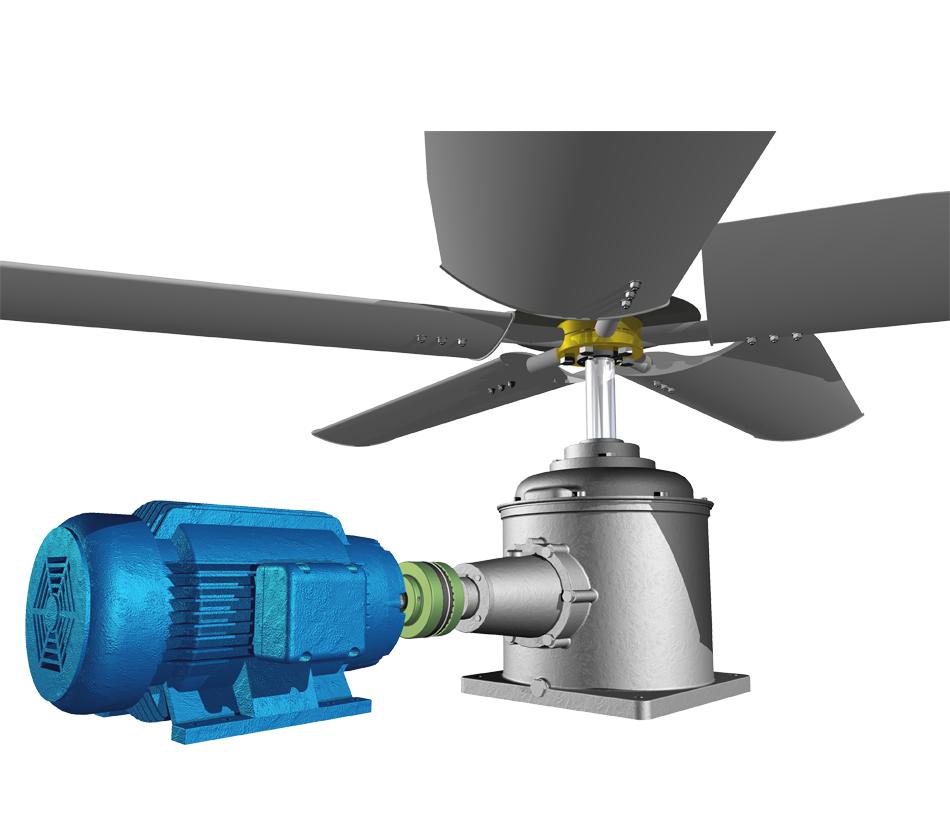
Inspect the Fan Drive System
For belt-driven fans, check belt tension, pulley alignment, and belt wear.
For gearbox-driven fans, inspect lubrication, vibration, bearing condition, and abnormal noise.
A damaged or poorly maintained drive system can affect fan speed, reliability, and overall performance.
Consider Variable Frequency Drives
A variable frequency drive (VFD) allows fan speed to be adjusted according to cooling demand.
Instead of running at full speed continuously, the fan can operate at a lower speed when the cooling load or ambient conditions allow it.
Because fan power often changes approximately with the cube of speed under comparable conditions, variable-speed control can offer significant energy-saving potential.
However, VFD settings should be checked against motor limits, fan mechanical limits, minimum airflow requirements, and the cooling tower's control strategy.
Cooling Tower Fan Airflow Troubleshooting
If the cooling tower cannot achieve the expected cold-water temperature, airflow should be one of the items investigated.
A systematic inspection is more effective than immediately replacing the fan.
High cold-water temperature: Possible causes include insufficient airflow, excessive heat load, poor water distribution, or unsuitable ambient conditions. Check the fan operation and actual system load.
Low airflow: Possible causes include incorrect fan speed, high system resistance, or damaged fan components. Inspect the drive system, fill, drift eliminators, and air inlets.
High motor current: Possible causes include excessive fan load or incorrect blade pitch. Check motor current and blade settings against the manufacturer's specifications.
Abnormal vibration: Possible causes include fan imbalance, mechanical damage, or alignment problems. Inspect the blades, hub, bearings, and drive arrangement.
Uneven airflow: Possible causes include air leakage, obstructions, or poor airflow distribution. Inspect the tower structure and air inlets.
Reduced cooling performance: Possible causes include poor water distribution, dirty fill, or inadequate airflow. Check nozzles, fill condition, water quality, and fan operation.
Where possible, use suitable instruments to measure airflow, fan speed, pressure, motor current, and vibration. Visual inspection alone cannot always confirm whether the fan is delivering its design airflow.
When Should You Replace or Upgrade a Cooling Tower Fan?
A fan upgrade may be worth considering when the existing fan cannot meet the required cooling performance or when its energy consumption has become excessive.
Common reasons include:
The original fan is damaged or deteriorated.
The fan cannot deliver the required airflow.
The existing fan has poor efficiency.
The motor or gearbox requires frequent maintenance.
The cooling tower has undergone a capacity upgrade.
The original fan is no longer suitable for current operating conditions.
Before replacing a fan, confirm the tower's actual thermal load and system resistance.
A replacement fan must match the existing installation as well as the required performance. Important information includes:
Existing fan diameter.
Number of blades.
Blade material.
Fan rotational speed.
Motor power and speed.
Drive type.
Required airflow.
Required static pressure.
Fan cylinder dimensions.
Installation and connection details.
A larger fan or a fan with a higher rated airflow is not automatically a better choice. The replacement must operate safely within the tower's mechanical and aerodynamic limits.
Why Choose Power Tower Cooling Technology?
Choosing the right cooling tower components is important for maintaining stable operation and long-term equipment performance.
Power Tower Cooling Technology (Shaoxing) Co.,Ltd focuses on cooling tower components and related products, supporting customers who need practical solutions for cooling tower maintenance, replacement, and equipment improvement.
Website: https://www.coolingtowerpart.com
When evaluating cooling tower fan or component requirements, prepare detailed technical information before requesting a quotation. For fan-related projects, this may include:
Existing fan dimensions.
Required airflow and static pressure.
Motor and drive information.
Operating speed.
Cooling tower type.
Installation photographs.
Existing equipment drawings.
For fill or other cooling tower component replacement, provide the existing component dimensions, material requirements, operating conditions, and equipment model.
The more complete the technical information, the easier it is to evaluate compatibility and identify a suitable replacement solution.
Whether you are maintaining an existing cooling tower or planning a component upgrade, a clear understanding of airflow and system requirements is a good starting point.
Frequently Asked Questions
How Do You Calculate Cooling Tower Fan Airflow?
A preliminary calculation can be made using the heat load and the enthalpy increase of the air:
ṁₐ ≈ Q ÷ (h_out − h_in)
You can then convert the dry-air mass flow into volumetric airflow using the specific volume of moist air.
For accurate wet cooling tower design, use a complete thermal and mass-transfer calculation rather than relying on this simplified equation alone.
What Is the Unit of Cooling Tower Fan Airflow?
Common units include m³/h, m³/s, CFM, and kg/s of dry air.
When comparing specifications, make sure you are comparing the same type of airflow measurement under comparable conditions.
What Is the Difference Between CFM and m³/h?
CFM means cubic feet per minute, while m³/h means cubic meters per hour.
The approximate conversion is:
1 m³/h = 0.5886 CFM
Does a Larger Cooling Tower Fan Always Provide Better Cooling?
No. A larger fan may move more air, but cooling performance also depends on fan efficiency, static pressure, water distribution, fill design, and ambient wet-bulb temperature.
An oversized fan may consume more electricity without delivering a proportional improvement in cooling performance.
What Happens if Cooling Tower Airflow Is Too Low?
Insufficient airflow can reduce heat and mass transfer inside the tower.
Possible results include higher cold-water temperatures, reduced heat rejection, and poor cooling performance during peak loads.
However, similar symptoms can also result from poor water distribution, clogged fill, excessive heat load, or unsuitable operating conditions.
Can I Increase Cooling Tower Airflow by Changing the Blade Angle?
In some cases, adjusting the blade angle can change fan airflow.
However, the adjustment also affects fan power, motor load, and mechanical stress. Always follow the fan manufacturer's blade-setting limits and verify motor current after adjustment.
How Do I Know Whether My Existing Fan Has Enough Airflow?
Compare the measured or verified operating airflow with the cooling tower's required design airflow.
Also check fan speed, static pressure, motor current, cooling water temperatures, and ambient wet-bulb conditions.
A complete performance assessment is more reliable than judging airflow from the fan's appearance or motor power alone.
Conclusion
Cooling tower fan air flow calculation is an important part of cooling tower design, fan selection, and equipment optimization.
The basic process starts with calculating the water-side heat load. You then evaluate the air-side enthalpy difference, estimate the required dry-air mass flow, and convert it into volumetric airflow.
But the calculation is only the beginning.
Actual fan performance depends on static pressure, system resistance, fan diameter, blade angle, rotational speed, and installation conditions. A fan with a high rated airflow may not deliver the expected air volume once installed in a real cooling tower.
The best approach is to combine thermal calculations with fan performance data and actual operating measurements.
For cooling tower maintenance or component replacement projects, Power Tower Cooling Technology (Shaoxing) Co.,Ltd provides cooling tower component solutions through its website: https://www.coolingtowerpart.com.
Calculate the airflow carefully, select the fan according to its actual operating point, and maintain the entire air movement system. These steps can help your cooling tower achieve more reliable cooling performance and better energy efficiency.


