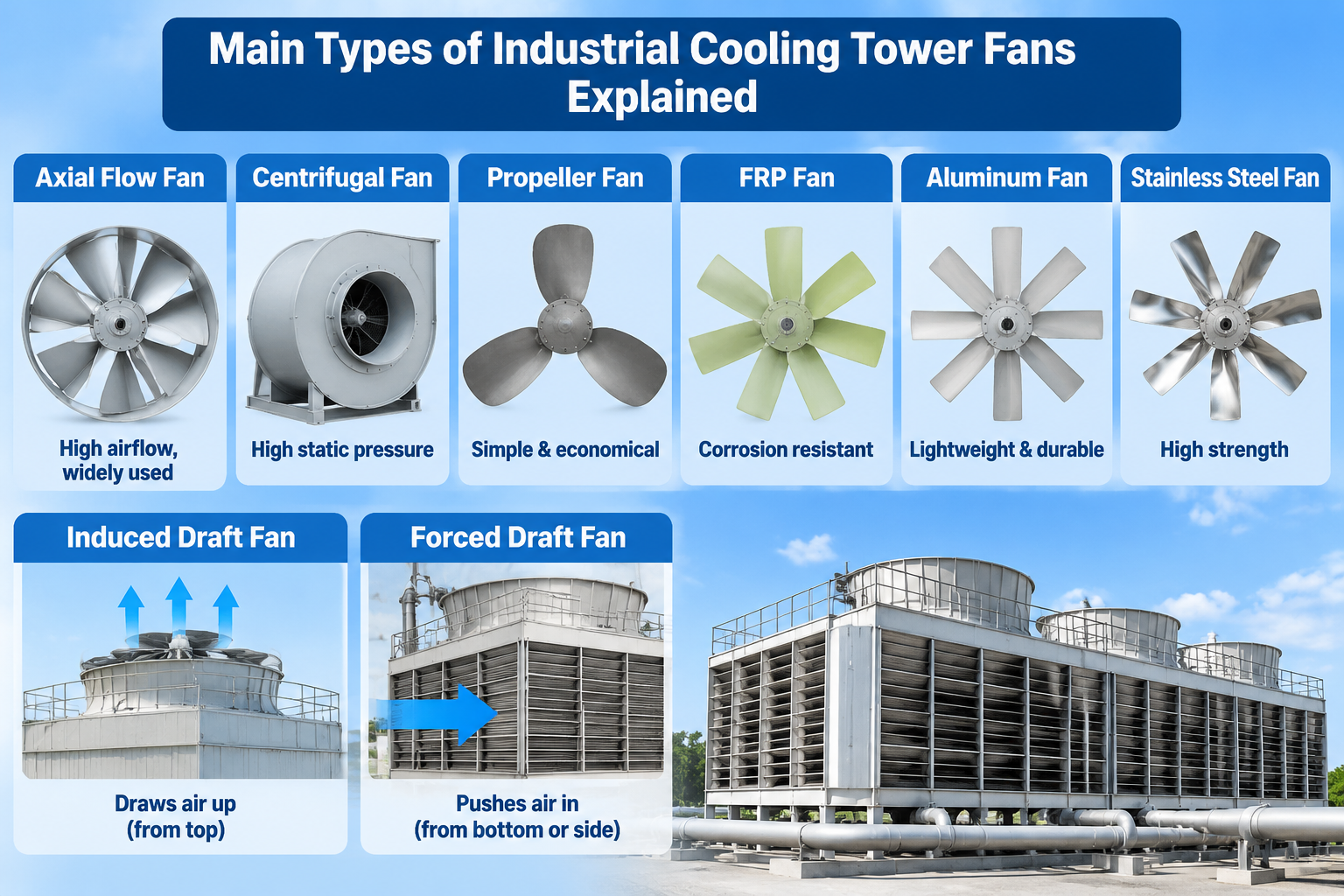
Industrial cooling tower fans play an important role in heat rejection systems. They move large volumes of air through a cooling tower, allowing hot circulating water to release heat through evaporation and air movement. The fan directly affects cooling tower performance, energy consumption, operating stability, and maintenance costs.
However, not all industrial cooling tower fans have the same design. Different fan types are suitable for different cooling tower structures, airflow requirements, operating conditions, and industrial applications.
In this guide, we explain the main types of industrial cooling tower fans, their working principles, advantages, disadvantages, and applications. This information can help engineers, maintenance teams, and industrial buyers select the right cooling tower fan for their projects.
Main Types of Industrial Cooling Tower Fans Explained
1. Axial Flow Cooling Tower Fans
Axial flow fans are among the most widely used industrial cooling tower fans. They move air parallel to the fan shaft, producing high airflow at relatively low pressure.
Most large industrial cooling towers use axial fans because they can handle the substantial airflow volumes required for effective heat rejection.
Main Features
High airflow capacity
Relatively low operating pressure
Good energy efficiency when properly selected
Suitable for large cooling tower installations
Available in FRP, aluminum alloy, and other materials
Axial cooling tower fans typically have multiple blades connected to a central hub. The blades may have adjustable pitch angles to optimize airflow and power consumption.
Applications
Axial fans are commonly used in:
2. Centrifugal Cooling Tower Fans
Centrifugal fans operate differently from axial fans. Air enters through the center of the rotating impeller and moves outward through centrifugal force.
Unlike axial fans, centrifugal fans discharge air perpendicular to the fan shaft. They can generate higher static pressure, making them suitable for systems with greater airflow resistance.
Main Features
Higher static pressure capability
Suitable for ducted airflow systems
Stable operation under certain high-resistance conditions
Available in forward-curved and backward-curved designs
Applications
Centrifugal cooling tower fans are commonly found in smaller cooling towers, enclosed ventilation systems, and installations where airflow must pass through additional resistance.
Although they are not as common as axial fans in large industrial cooling towers, they remain useful for specialized applications.
3. Propeller Cooling Tower Fans
Propeller fans are a type of axial fan featuring relatively simple blade structures. They generate airflow by rotating around a central shaft.
Their straightforward design makes them economical and relatively easy to maintain.
Main Features
Propeller fans are commonly used in smaller industrial cooling towers and packaged cooling equipment.
However, their performance depends heavily on blade design, fan diameter, rotational speed, and installation conditions.
4. FRP Cooling Tower Fans
FRP (Fiberglass Reinforced Plastic) cooling tower fans are widely used in industrial cooling towers because of their corrosion resistance and lightweight construction.
FRP fan blades are manufactured using fiberglass reinforcement and resin systems. This combination provides good mechanical strength while reducing the overall fan weight.
Main Advantages
Excellent corrosion resistance
Lightweight construction
Good strength-to-weight ratio
Reduced maintenance requirements
Suitable for humid and chemically aggressive environments
FRP cooling tower fans are particularly suitable for chemical plants, power stations, wastewater treatment facilities, and coastal industrial environments.
When selecting an FRP fan, buyers should consider blade dimensions, resin properties, operating temperature, rotational speed, and structural strength.
5. Aluminum Alloy Cooling Tower Fans
Aluminum alloy fans are another popular option for industrial cooling tower applications.
They combine relatively low weight with good mechanical strength. Aluminum blades can also be manufactured with different aerodynamic profiles to meet specific airflow requirements.
Main Advantages
Aluminum alloy fans are commonly used in industrial cooling towers where stable airflow and manageable maintenance are important.
However, corrosion protection and material compatibility should be evaluated when operating in aggressive environments.
6. Stainless Steel Cooling Tower Fans
Stainless steel cooling tower fans are designed for applications requiring high mechanical strength and resistance to corrosion.
Depending on the stainless steel grade and operating environment, these fans can provide reliable service under demanding industrial conditions.
Main Advantages
High mechanical strength
Good corrosion resistance with suitable grades
Resistance to many industrial operating environments
Suitable for specialized heavy-duty applications
Stainless steel fans may be used in chemical processing, marine environments, and certain industrial cooling systems.
Their disadvantages include higher weight and potentially higher manufacturing and installation costs.
7. Induced Draft vs. Forced Draft Cooling Tower Fans
In addition to fan construction and materials, industrial cooling tower fans can also be classified according to their installation position and airflow arrangement.
Induced Draft Cooling Tower Fans
An induced draft fan is installed near the top of the cooling tower. It draws air upward through the tower and discharges warm, moist air into the atmosphere.
Advantages:
More uniform airflow distribution
Reduced air recirculation when properly designed
Suitable for large industrial cooling towers
Widely used in mechanical-draft cooling towers
Forced Draft Cooling Tower Fans
A forced draft fan is generally installed near the air inlet at the bottom or side of the cooling tower. It pushes outside air into the tower.
Advantages:
Fan and drive components can be located outside the wet airflow
Easier access for certain maintenance operations
Suitable for some packaged and compact cooling towers
The choice between induced draft and forced draft depends on tower configuration, operating conditions, airflow requirements, and maintenance considerations.
8. Comparison of Different Industrial Cooling Tower Fans
The following table summarizes the main characteristics of common industrial cooling tower fan types.
| Fan Type | Main Advantages | Typical Applications |
| Axial flow fan | High airflow, good efficiency | Large industrial cooling towers |
| Centrifugal fan | High static pressure | High-resistance airflow systems |
| Propeller fan | Simple, economical design | Small and medium cooling towers |
| FRP fan | Lightweight, corrosion-resistant | Chemical and coastal industries |
| Aluminum fan | Lightweight, good strength | Industrial cooling systems |
| Stainless steel fan | High strength, corrosion resistance | Specialized industrial applications |
Note that axial, centrifugal, and propeller describe airflow or fan design, while FRP, aluminum, and stainless steel describe materials. These categories can overlap. For example, an FRP cooling tower fan is often an axial-flow fan.
9. How to Choose the Right Industrial Cooling Tower Fan
Selecting the right industrial cooling tower fan requires more than comparing blade materials or purchase prices. Buyers should evaluate the complete operating system.
Consider the following factors:
1. Airflow requirements
Determine the required airflow volume based on cooling tower capacity, thermal load, and design conditions.
2. Static pressure
Check the resistance created by fill media, drift eliminators, louvers, and other internal components.
3. Fan diameter and blade design
The fan diameter, blade profile, blade number, and pitch angle affect airflow, efficiency, and power consumption.
4. Operating speed and motor power
Ensure that the fan is compatible with the motor, gearbox, drive shaft, and transmission system.
5. Operating environment
Consider humidity, temperature, chemical exposure, dust, and corrosion risks when selecting fan materials.
6. Maintenance and replacement costs
Evaluate spare parts availability, installation requirements, service life, and long-term operating costs.
For replacement projects, measure the existing fan diameter, hub dimensions, blade configuration, rotation direction, and operating speed before ordering.
10. Industrial Cooling Tower Fan Maintenance Tips
Regular maintenance helps maintain airflow performance and prevent unexpected equipment failures.
Recommended maintenance practices include:
Inspect fan blades for cracks, corrosion, deformation, and surface damage.
Check blade pitch angles and ensure consistent settings.
Inspect the fan hub and blade mounting bolts.
Monitor vibration and unusual operating noise.
Check gearbox oil levels and lubrication conditions.
Inspect motor bearings and drive components.
Verify fan alignment and clearance.
Clean accumulated dirt and debris from fan blades.
If excessive vibration, reduced airflow, or unusual noise occurs, stop and inspect the equipment according to the manufacturer's safety procedures.
Conclusion
Industrial cooling tower fans are available in different designs and materials to meet various cooling requirements. Axial flow fans are widely used in large industrial cooling towers, while centrifugal fans are suitable for applications requiring higher static pressure. FRP, aluminum alloy, and stainless steel fans offer different advantages in terms of weight, strength, and corrosion resistance.
Choosing the right cooling tower fan requires careful consideration of airflow capacity, static pressure, fan diameter, blade pitch, material properties, and operating conditions.
For industrial cooling tower fan replacement or retrofit projects, working with an experienced manufacturer can help ensure proper fan selection and reliable long-term performance.
Power Tower Cooling Technology (Shaoxing) Co.,Ltd supplies industrial cooling tower fan blades and replacement components, including customized FRP and aluminum alloy fan solutions. Contact our team with your existing fan dimensions, operating parameters, and application requirements to discuss a suitable replacement solution.
Frequently Asked Questions (FAQs)
1. What are the main types of industrial cooling tower fans?
The main types include axial flow fans, centrifugal fans, and propeller fans. Industrial cooling tower fans are also available in FRP, aluminum alloy, and stainless steel materials.
2. Which fan is most commonly used in industrial cooling towers?
Axial flow fans are among the most commonly used because they provide high airflow at relatively low static pressure.
3. What is the difference between FRP and aluminum cooling tower fans?
FRP fans offer excellent corrosion resistance and a good strength-to-weight ratio. Aluminum fans provide good mechanical strength and relatively low weight. The best choice depends on operating conditions and project requirements.
4. What is the difference between induced draft and forced draft fans?
Induced draft fans draw air through the cooling tower and discharge it from the top. Forced draft fans push outside air into the cooling tower, typically through side or bottom air inlets.
5. How often should industrial cooling tower fans be inspected?
Inspection frequency depends on operating hours, environmental conditions, and manufacturer recommendations. Regular visual inspections and scheduled vibration, alignment, and mechanical checks are essential.
6. Can an industrial cooling tower fan be customized?
Yes. Manufacturers can customize fan diameter, blade number, pitch angle, hub dimensions, and materials according to cooling tower design and operating requirements.
Recommended internal links for CoolingTowerPart.com:


