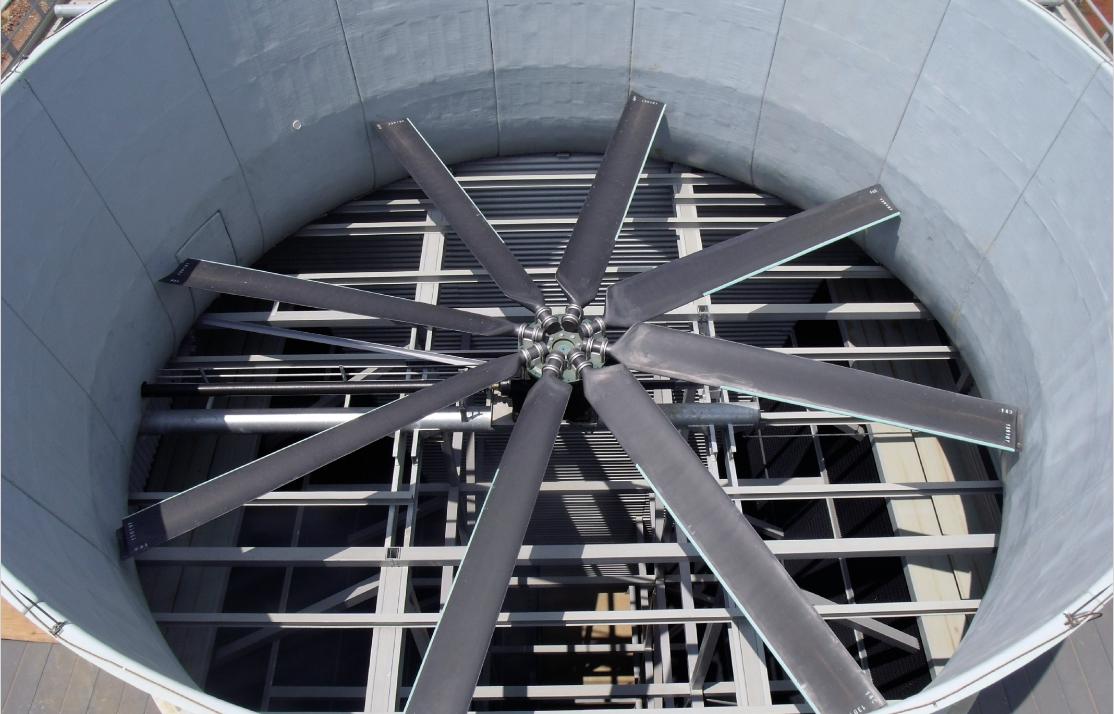
An industrial cooling tower fan is a critical component of a cooling tower system. It creates the airflow required to remove heat from circulating water and maintain efficient cooling performance. The fan design directly affects airflow volume, heat transfer efficiency, energy consumption, noise levels, and overall cooling tower reliability.
Understanding industrial cooling tower fan design, structure, and working principles helps engineers, maintenance technicians, and industrial buyers select the right fan for new installations, replacement projects, and cooling tower upgrades.
This guide explains the main components, fan structures, operating principles, design considerations, and maintenance requirements of industrial cooling tower fans.
1. What Is an Industrial Cooling Tower Fan?
An industrial cooling tower fan is a mechanical air-moving device installed in a cooling tower. Its primary function is to move large volumes of air through the tower, allowing heat to transfer from hot circulating water to the surrounding atmosphere.
Most large industrial cooling towers use axial fans because they can deliver high airflow at relatively low operating costs.
Depending on the cooling tower configuration, fans may be installed at the top or bottom of the tower. Their position determines whether the system uses induced-draft or forced-draft airflow.
2. Main Components of an Industrial Cooling Tower Fan
A complete industrial cooling tower fan assembly consists of several important components.
2.1 Fan Blades
Fan blades generate airflow by rotating around a central hub. Their aerodynamic profile, blade angle, diameter, and material determine airflow capacity and operating efficiency.
Common fan blade materials include:
FRP (Fiberglass Reinforced Plastic): Lightweight, corrosion-resistant, and suitable for large industrial cooling towers.
Aluminum Alloy: Lightweight and offers good mechanical strength.
Stainless Steel: Provides high mechanical strength and corrosion resistance in selected operating environments.
ABS Plastic: Lightweight and suitable for certain smaller cooling tower applications.
Blade pitch adjustment allows operators to optimize airflow and motor load according to actual operating conditions.
2.2 Fan Hub
The fan hub connects individual blades to the rotating shaft or drive assembly. It transfers mechanical torque to the blades and maintains their positioning during operation.
A properly designed hub provides structural stability and helps reduce vibration.
2.3 Fan Drive System
The fan drive system transfers power from the motor to the fan.
Common configurations include:
Direct-drive systems
Belt-driven systems
Gearbox-driven systems
The appropriate drive arrangement depends on fan diameter, rotational speed, motor power, and cooling tower design.
2.4 Electric Motor
The motor provides the mechanical energy required to rotate the fan. Industrial cooling tower fans commonly use three-phase electric motors.
Motor selection should consider power requirements, voltage, frequency, protection rating, insulation class, operating environment, and energy efficiency.
2.5 Fan Stack or Fan Cylinder
The fan stack surrounds the fan and guides airflow through the cooling tower.
A properly designed fan stack reduces airflow losses, improves air distribution, and helps prevent discharged hot, moist air from recirculating into the air inlet.
FRP fan stacks are widely used because of their lightweight construction and resistance to moisture and chemical corrosion.
2.6 Supporting Structure and Safety Components
The fan assembly also includes supporting beams, mounting brackets, vibration monitoring devices, and protective guards where required.
These components help maintain alignment, structural stability, and safe operation.
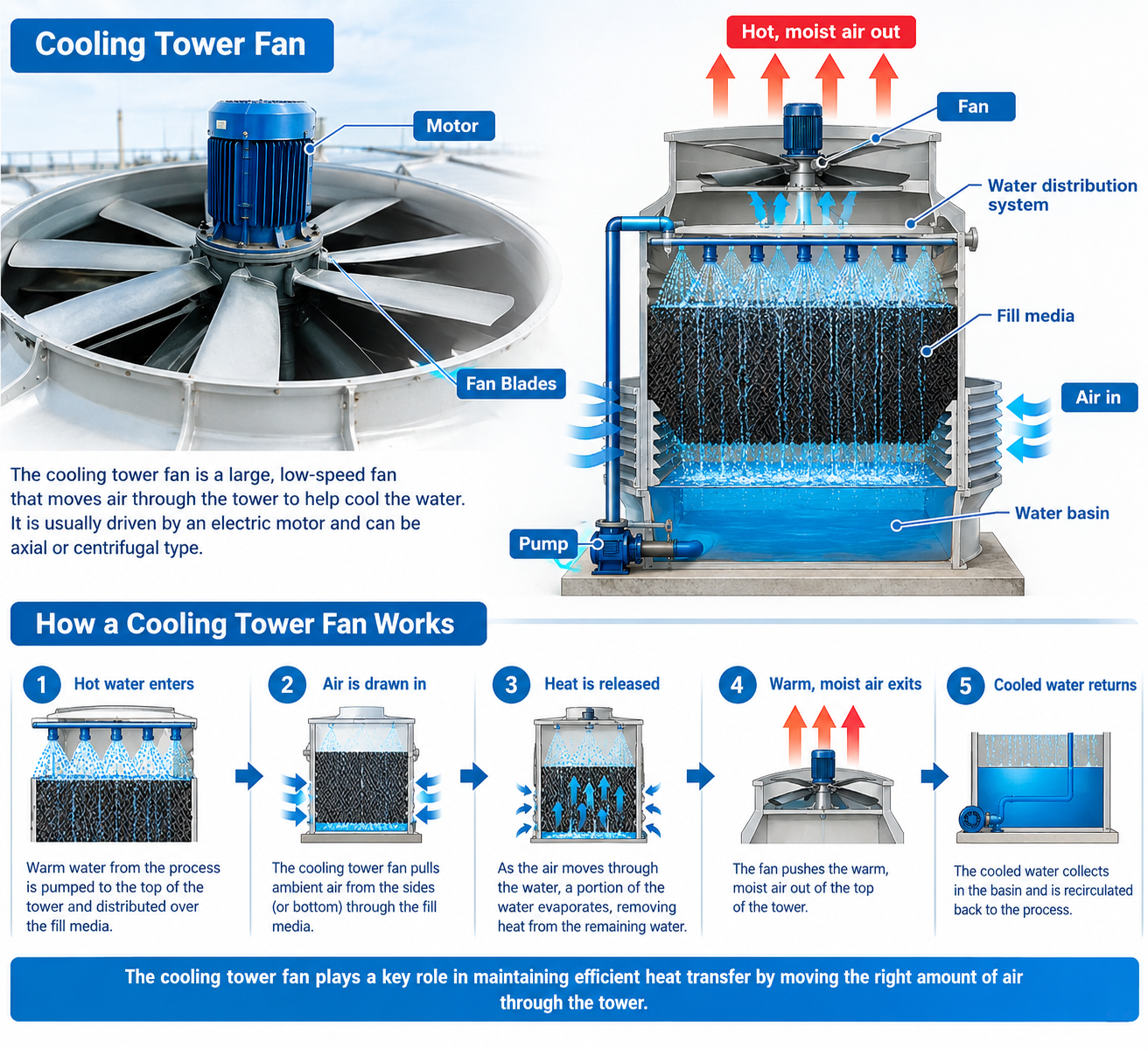
3. How Does an Industrial Cooling Tower Fan Work?
4. Common Industrial Cooling Tower Fan Designs
Different cooling tower configurations require different fan arrangements.
4.1 Axial Cooling Tower Fans
Axial fans move air parallel to the fan shaft. They are widely used in industrial cooling towers because they can handle large airflow volumes with relatively low pressure requirements.
Advantages include:
High airflow capacity
Good aerodynamic efficiency
Relatively low energy consumption
Suitable for large cooling tower installations
Available in different diameters and blade configurations
4.2 Centrifugal Cooling Tower Fans
Centrifugal fans move air radially outward through a rotating impeller. They can generate higher static pressure than typical axial fan designs.
They are more commonly used in applications requiring higher airflow resistance or specialized ventilation arrangements.
4.3 Induced-Draft Fan Design
In an induced-draft cooling tower, the fan is installed near the top of the tower. It pulls air upward through the fill and discharges warm, humid air into the atmosphere.
This arrangement helps reduce hot-air recirculation and provides relatively uniform airflow through the tower.
4.4 Forced-Draft Fan Design
In a forced-draft cooling tower, the fan is generally installed near the air inlet. It pushes outside air into the tower.
This design can simplify access to certain fan components, although airflow distribution and hot-air recirculation must be carefully considered.
5. Important Factors in Industrial Cooling Tower Fan Design
Proper fan design requires balancing airflow performance, mechanical strength, and energy consumption.
5.1 Airflow Volume
Airflow volume, usually measured in CFM or m³/h, determines how much air passes through the cooling tower.
The required airflow depends on cooling capacity, water flow rate, entering and leaving water temperatures, and ambient conditions.
5.2 Fan Diameter and Blade Pitch
Fan diameter determines the swept area, while blade pitch affects the aerodynamic loading and airflow generated by the fan.
Incorrect blade pitch may result in insufficient airflow, excessive motor current, or reduced fan efficiency.
5.3 Rotational Speed
Fan speed influences airflow and power consumption.
For a geometrically similar fan operating under comparable conditions, the fan affinity laws provide useful approximations:
Airflow is proportional to rotational speed.
Static pressure is proportional to rotational speed squared.
Power is proportional to rotational speed cubed.
These relationships are important when evaluating variable-frequency drive (VFD) control and energy-saving opportunities.
5.4 Material Selection
Industrial cooling tower fans operate in humid, corrosive environments.
FRP and properly selected aluminum alloys are common choices. Material selection should consider corrosion resistance, weight, mechanical strength, fatigue performance, and operating temperature.
5.5 Vibration and Structural Balance
Fan imbalance, blade damage, shaft misalignment, and loose connections can cause excessive vibration.
Good aerodynamic design, accurate balancing, and reliable mounting structures are essential for long-term operation.
6. How to Improve Industrial Cooling Tower Fan Efficiency
Several measures can improve cooling tower fan performance:
Optimize blade pitch: Adjust blade angles according to design airflow and motor load.
Use efficient fan blades: Select aerodynamic blade profiles to reduce unnecessary power consumption.
Maintain proper alignment: Check the motor, gearbox, shaft, and fan assembly.
Clean the fan and air passages: Remove dirt and deposits that restrict airflow.
Inspect the fan stack: Repair damaged or deformed FRP structures.
Monitor motor performance: Check current, temperature, and operating conditions regularly.
Consider VFD control: Adjust fan speed according to actual cooling demand.
These improvements can reduce electricity costs while maintaining the required cooling capacity.
7. Common Industrial Cooling Tower Fan Problems
| Problem | Possible Cause | Recommended Solution |
| Insufficient airflow | Incorrect blade pitch or low fan speed | Check pitch and rotational speed |
| Excessive vibration | Fan imbalance or loose bolts | Balance fan and tighten connections |
| High motor current | Excessive blade loading | Verify blade pitch and motor load |
| Unusual noise | Bearing damage or mechanical interference | Inspect bearings and clearances |
| Reduced cooling efficiency | Dirty fill or poor airflow | Clean fill and inspect fan performance |
| Blade damage | Fatigue, corrosion, or impact | Repair or replace damaged blades |
Regular inspections help identify these problems before they cause unexpected equipment downtime.
8. How to Select the Right Industrial Cooling Tower Fan
When purchasing a replacement industrial cooling tower fan, buyers should evaluate more than just the fan diameter.
Important selection criteria include:
Required airflow volume and static pressure
Fan diameter and rotational speed
Number of blades and blade pitch
Motor power and drive configuration
Blade and hub materials
Operating temperature and environmental conditions
Fan stack dimensions and installation clearance
Dynamic balancing and vibration requirements
Compatibility with the existing cooling tower
For replacement projects, providing the original fan drawings, equipment model, operating parameters, and installation dimensions helps manufacturers recommend a suitable replacement.
9. Industrial Cooling Tower Fan Manufacturer and Replacement Supplier
Choosing an experienced industrial cooling tower fan manufacturer is important for maintaining reliable cooling tower operation.
A professional supplier should provide customized fan blades, FRP fan assemblies, fan hubs, fan stacks, and compatible drive components.
For industrial replacement and retrofit projects, buyers should confirm:
Product dimensions and technical drawings
Material specifications
Airflow and power performance
Balancing and quality inspection procedures
Installation support and replacement guidance
Delivery schedules and after-sales service
CoolingTowerPart.com provides industrial cooling tower replacement components and customized solutions for different cooling tower configurations. Buyers can contact the supplier with equipment drawings and technical requirements to discuss suitable replacement options.
10. Conclusion
Industrial cooling tower fan design combines aerodynamic performance, mechanical structure, material selection, and airflow management. Fan blades, hubs, motors, drive systems, and fan stacks work together to create the airflow required for efficient evaporative cooling.
Understanding these components and their working principles helps industrial operators improve cooling performance, reduce energy consumption, and extend equipment service life.
For replacement or upgrading projects, selecting a properly engineered industrial cooling tower fan is essential for achieving reliable and efficient operation.
Frequently Asked Questions (FAQ)
1. What type of fan is commonly used in industrial cooling towers?
Axial fans are the most common choice for large industrial cooling towers because they provide high airflow at relatively low static pressure.
2. What are the main components of a cooling tower fan?
The main components include fan blades, fan hub, motor, drive system, fan stack, and supporting structure.
3. How does a cooling tower fan improve heat transfer?
The fan moves air through the fill media, increasing air-water contact and supporting evaporation, which removes heat from circulating water.
4. Which material is best for industrial cooling tower fan blades?
FRP is widely used because it offers a favorable combination of low weight, corrosion resistance, and mechanical strength. The final choice depends on operating conditions.
5. How often should industrial cooling tower fans be inspected?
Inspection frequency depends on operating conditions and manufacturer recommendations. Regular checks should include blade condition, vibration, fasteners, bearings, alignment, and motor performance.
Recommended internal links for CoolingTowerPart.com:


