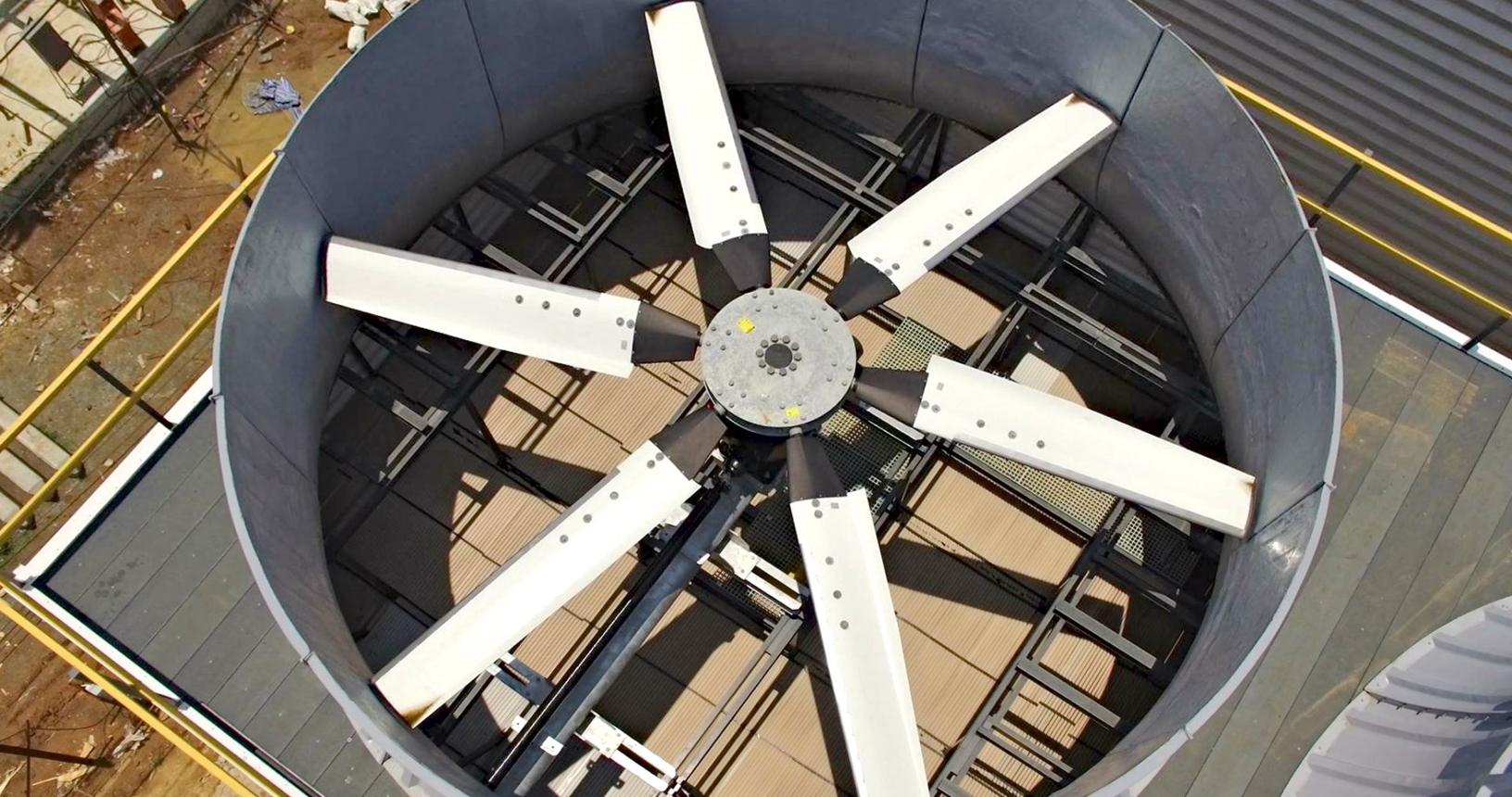
Industrial cooling tower fans play an important role in removing heat from circulating water and maintaining stable operating temperatures in industrial facilities. Based on their installation position and airflow arrangement, mechanical-draft cooling towers are generally classified into two main types: induced draft and forced draft.
Although both systems use fans to move air through the cooling tower, their airflow direction, fan location, operating characteristics, maintenance requirements, and applications are different.
Understanding induced draft vs. forced draft industrial cooling tower fans can help engineers, plant operators, and equipment buyers choose the right cooling tower configuration for their projects.
In this guide, we compare their working principles, advantages, disadvantages, applications, and selection considerations.
1. What Is an Induced Draft Cooling Tower Fan?
An induced draft cooling tower fan is installed near the top of the cooling tower. It pulls outside air through the tower and discharges warm, humid air upward into the atmosphere.
This design creates negative pressure inside the cooling tower, drawing air through the air inlets, fill media, and other internal components.
How Does an Induced Draft Fan Work?
The operating process generally follows these steps:
Outside air enters through the cooling tower air inlets.
The fan draws air upward through the fill media.
Hot circulating water flows downward over the fill surfaces.
Air and water come into contact, supporting heat and mass transfer.
A portion of the water evaporates, removing heat from the remaining water.
Warm, humid air is discharged through the fan stack.
This arrangement is widely used in large industrial mechanical-draft cooling towers.
Advantages of Induced Draft Cooling Tower Fans
1. Reduced air recirculation
The elevated discharge position helps release warm, humid air above the cooling tower, reducing the potential for discharged air to return to the air inlets when properly designed and located.
2. More uniform airflow
A properly designed induced-draft system can provide effective airflow distribution through the cooling tower fill.
3. Good thermal performance
Induced-draft cooling towers are suitable for large industrial applications requiring substantial heat rejection capacity.
4. Suitable for large installations
They are commonly used in power plants, petrochemical facilities, chemical plants, and large manufacturing operations.
Disadvantages of Induced Draft Fans
Fan equipment is generally located at the top of the tower, making maintenance access more challenging.
Fan blades and drive components may operate in warm, humid air.
Fan stack and structural supports require proper design and inspection.
Replacement work may require specialized lifting equipment and safety procedures.
2. What Is a Forced Draft Cooling Tower Fan?
A forced draft cooling tower fan is generally installed near the bottom or side air inlet of the cooling tower.
Instead of pulling air through the tower, it pushes outside air into the cooling tower under positive pressure.
The incoming air travels through the internal fill section, where it contacts circulating hot water and supports heat transfer.
How Does a Forced Draft Fan Work?
The operating process generally includes:
Outside air enters the fan inlet.
The fan pushes air into the cooling tower.
Air moves through the fill media and contacts falling water.
Heat and moisture transfer from the water to the air.
Warm, humid air exits through the tower outlet.
Forced-draft cooling towers are commonly used in packaged cooling equipment and certain industrial cooling applications.
Advantages of Forced Draft Cooling Tower Fans
1. Convenient maintenance access
The fan and drive system are often located outside the main wet section, which can make inspection and maintenance easier.
2. Reduced exposure to saturated exhaust air
Depending on the design, the fan and motor can operate in relatively dry incoming air rather than warm, humid discharge air.
3. Flexible installation
Forced-draft arrangements can be suitable for compact cooling tower designs and specific installation requirements.
4. Accessible drive components
Motor, bearings, and other mechanical components may be easier to reach for inspection and replacement.
Disadvantages of Forced Draft Fans
Positive pressure inside the tower can encourage air leakage through openings.
Discharged humid air may recirculate into the air inlet under unfavorable site conditions.
Airflow distribution must be carefully designed.
Fan performance can be affected by inlet obstructions and system resistance.
3. Induced Draft vs. Forced Draft Cooling Tower Fans: Key Differences
The biggest difference between these two cooling tower fan arrangements is the location of the fan and how air moves through the tower.
| Comparison | Induced Draft | Forced Draft |
| Fan location | Near the top | Near the air inlet |
| Airflow method | Pulls air through the tower | Pushes air into the tower |
| Internal pressure | Generally negative | Generally positive |
| Air discharge | Usually upward | Through the tower outlet |
| Maintenance access | Often more challenging | Often more convenient |
| Fan environment | Warm, humid exhaust-side conditions | Relatively dry inlet-side conditions |
| Typical applications | Large industrial cooling towers | Packaged and specialized cooling towers |
| Air recirculation | Reduced with proper discharge design | Requires careful inlet and outlet arrangement |
Both configurations can provide effective cooling when properly engineered. Actual performance depends on tower geometry, airflow resistance, ambient conditions, and fan selection.
4. Which Cooling Tower Fan Is More Energy Efficient?
Energy efficiency is an important consideration when selecting industrial cooling tower fans.
Neither induced draft nor forced draft is automatically more energy efficient in every application.
Fan power consumption depends on several factors:
For comparable operating conditions, fan efficiency and correct system matching are more important than simply choosing induced or forced draft.
Variable-frequency drives (VFDs) can also help reduce electricity consumption by adjusting fan speed according to cooling demand.
For example, during periods of lower heat load or cooler ambient conditions, reducing fan speed may maintain the required cooling water temperature while using less power.
5. Applications of Induced Draft and Forced Draft Cooling Towers
Different industrial facilities have different cooling requirements.
Induced Draft Cooling Tower Applications
Induced-draft cooling towers are widely used in:
They are particularly suitable for applications requiring large airflow volumes and substantial heat rejection capacity.
Forced Draft Cooling Tower Applications
Forced-draft cooling towers are commonly used in:
Packaged industrial cooling towers
Small and medium-sized cooling systems
Certain HVAC installations
Specialized industrial process cooling
Equipment cooling systems
Their configuration can be useful where accessible mechanical components and compact installation are priorities.
6. How to Choose Between Induced Draft and Forced Draft Fans
Before selecting a cooling tower fan arrangement, buyers and engineers should evaluate the following factors.
1. Cooling capacity
Determine the required heat rejection capacity, water flow rate, and operating temperature range.
2. Installation space
Consider the available space, tower height, fan location, and surrounding structures.
3. Ambient conditions
Temperature, humidity, wind direction, and wet-bulb temperature can influence cooling tower performance.
4. Maintenance requirements
Evaluate access to fan blades, motors, gearboxes, bearings, and other mechanical components.
5. Energy consumption
Compare fan power requirements, expected operating hours, and potential VFD control.
6. Air recirculation
Evaluate fan discharge direction, air inlet location, and surrounding structures to minimize the recirculation of warm, humid air.
7. Replacement compatibility
For existing cooling towers, replacement fans should match the original fan diameter, hub dimensions, blade configuration, rotation direction, operating speed, and drive arrangement.
Consulting an experienced cooling tower fan manufacturer can help ensure proper equipment selection.
7. Maintenance Tips for Industrial Cooling Tower Fans
Regardless of whether a cooling tower uses induced draft or forced draft fans, regular maintenance is essential.
Recommended maintenance practices include:
Inspect fan blades for cracks, corrosion, and deformation.
Check blade pitch angles and mounting bolts.
Monitor vibration and abnormal operating noise.
Inspect fan hubs and drive shafts.
Check gearbox oil levels and lubrication.
Inspect motor bearings and electrical connections.
Check fan stack condition and structural supports.
Clean air inlets and remove obstructions.
Verify fan alignment and blade clearance.
For induced-draft systems, pay particular attention to components exposed to warm, humid exhaust air.
For forced-draft systems, inspect the inlet area, fan housing, and surrounding air passages for blockages and contamination.
Always follow manufacturer maintenance procedures and lockout/tagout requirements before servicing rotating equipment.
Conclusion
Induced draft and forced draft industrial cooling tower fans both support heat rejection by moving air through cooling tower fill media. However, they differ in fan location, airflow direction, pressure conditions, maintenance access, and typical applications.
Induced-draft fans are widely used in large industrial cooling towers because they draw air through the tower and discharge warm, humid air upward. Forced-draft fans push outside air into the tower and can provide convenient access to mechanical components.
The best choice depends on cooling capacity, installation conditions, energy requirements, maintenance priorities, and overall cooling tower design.
CoolingTowerPart.com supplies industrial cooling tower fan blades, FRP fans, aluminum alloy fans, fan hubs, and customized replacement components for industrial cooling tower projects. Contact our team with your fan dimensions, technical drawings, or existing equipment specifications to discuss suitable replacement solutions.
Frequently Asked Questions (FAQs)
1. What is the main difference between induced draft and forced draft cooling tower fans?
An induced-draft fan is installed near the top of the cooling tower and pulls air through the system. A forced-draft fan is installed near the air inlet and pushes outside air into the tower.
2. Which is better: induced draft or forced draft cooling towers?
Neither is universally better. Induced draft is widely used in large industrial cooling towers, while forced draft is suitable for certain packaged and specialized cooling applications.
3. Are induced draft cooling tower fans more energy efficient?
Not necessarily. Energy efficiency depends on fan design, airflow requirements, static pressure, motor efficiency, and operating conditions.
4. Why are induced draft fans installed at the top of cooling towers?
Top-mounted fans pull air through the tower and discharge warm, humid air upward, helping reduce the potential for exhaust air recirculation.
5. What materials are used for industrial cooling tower fan blades?
Common materials include FRP (fiberglass reinforced plastic), aluminum alloy, and stainless steel. The choice depends on corrosion exposure, mechanical strength, weight, and operating conditions.
6. Can an induced draft cooling tower fan be replaced with a forced draft fan?
Not as a simple component replacement. The two arrangements have different airflow paths, structural configurations, and pressure characteristics. Changing between them generally requires substantial cooling tower redesign.
Recommended internal links for CoolingTowerPart.com:


