Industrial cooling tower fans are essential for maintaining efficient heat transfer in industrial cooling systems. They create the airflow required to remove heat from circulating water and discharge it into the atmosphere. Without sufficient airflow, cooling towers cannot achieve their designed thermal performance.
In industries such as power generation, petrochemicals, steel manufacturing, chemical processing, and HVAC, cooling tower fans help maintain stable water temperatures and support continuous production.
But how do industrial cooling tower fans actually improve heat transfer? What role do fan blades, airflow, and fan speed play in cooling efficiency?
This article explains how industrial cooling tower fans work, their influence on heat rejection, and how to select the right fan for your cooling tower.
1. Understanding Heat Transfer in Cooling Towers
An industrial cooling tower removes unwanted heat from circulating water by bringing hot water into contact with cooler ambient air.
The process mainly involves two heat transfer mechanisms.
Evaporative heat transfer
A small percentage of the circulating water evaporates when it comes into contact with moving air. Evaporation requires energy, which is taken from the remaining water. As a result, the water temperature decreases.
This is the primary cooling mechanism in most conventional wet cooling towers.
Sensible heat transfer
Heat also transfers directly from warmer water to cooler air through the temperature difference between them.
Both mechanisms work together to reduce the temperature of circulating water before it returns to industrial equipment.
The cooling tower fan plays an important role by maintaining the airflow needed for these processes.
2. How Industrial Cooling Tower Fans Improve Heat Transfer
Industrial cooling tower fans improve heat rejection by controlling airflow through the cooling tower.
Here are five important ways they contribute to cooling performance.
2.1 Increase Airflow Volume
The primary function of a cooling tower fan is to move large volumes of air through the tower.
As air passes through the fill media, it comes into contact with falling water. Adequate airflow supports evaporation and heat exchange.
If airflow is insufficient, the cooling tower may experience:
Higher cooling water temperatures
Reduced heat rejection capacity
Poor cooling performance
Increased thermal stress on industrial equipment
Selecting the correct fan diameter, blade profile, and rotational speed helps achieve the required airflow.
2.2 Improve Evaporation
Evaporation is responsible for most of the heat removal in conventional wet cooling towers.
When air moves across the water film on the fill surface, moisture transfers from the water into the air.
The fan continuously supplies relatively dry ambient air and removes humid air from the tower.
This helps maintain the conditions required for effective evaporative cooling.
2.3 Improve Air-Water Contact
Cooling tower fill media increases the contact area between circulating water and air.
The fan supplies airflow through the fill, allowing heat and moisture to transfer more effectively.
However, airflow must be distributed properly. Uneven airflow can create poorly ventilated areas and reduce overall thermal performance.
Fan selection, fan stack design, blade pitch, and air inlet configuration all influence airflow distribution.
2.4 Remove Warm and Humid Air
As air passes through the cooling tower, it absorbs heat and moisture.
If warm, humid air is not discharged effectively, cooling performance can deteriorate.
The fan removes this air and helps introduce fresh ambient air into the cooling tower.
This continuous air exchange supports stable heat rejection.
2.5 Maintain Stable Cooling Water Temperatures
Industrial production equipment often requires cooling water within a specific operating temperature range.
By maintaining sufficient airflow, cooling tower fans help the tower meet its required thermal load.
Stable cooling water temperatures can support reliable operation in:
3. Main Types of Industrial Cooling Tower Fans
Different cooling tower designs require different fan configurations.
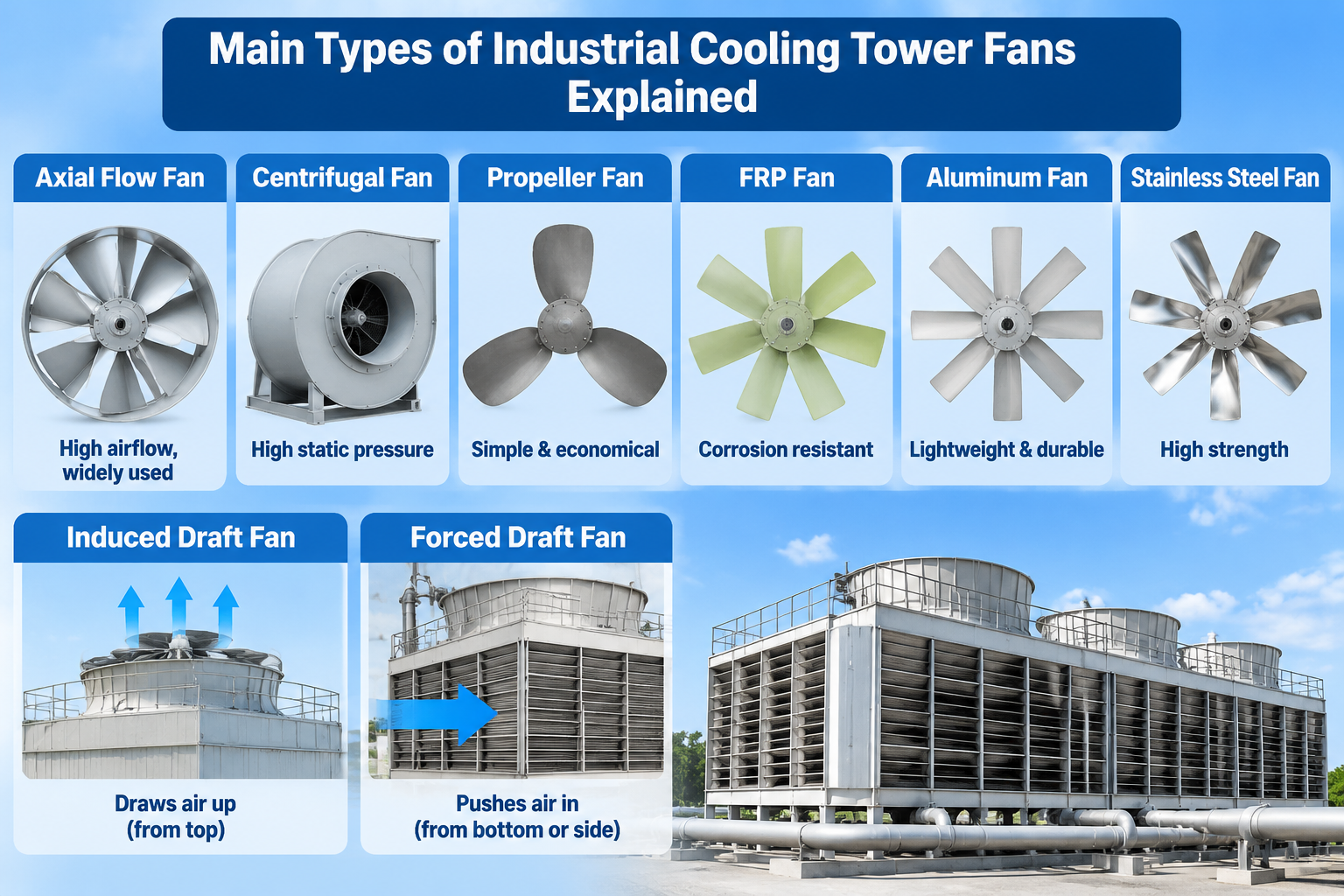
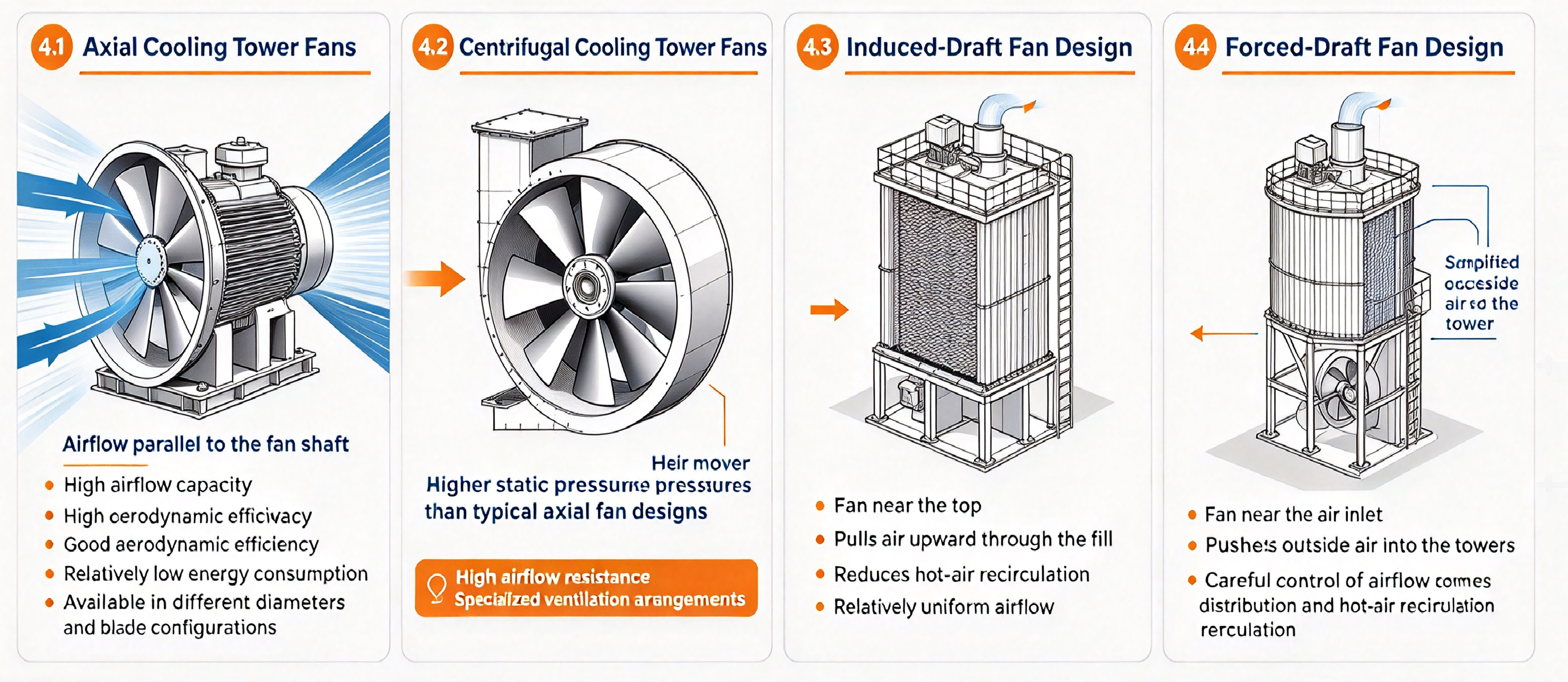
Axial Flow Cooling Tower Fans
<caption>Widely used in large industrial cooling towers</caption>
Axial fans move air parallel to the fan shaft. They provide high airflow at relatively low static pressure.
Main advantages:
High airflow capacity
Good energy efficiency when properly selected
Relatively simple construction
Suitable for large cooling tower installations
Axial cooling tower fans are commonly manufactured using FRP or aluminum alloy blades.
Centrifugal Cooling Tower Fans
Centrifugal fans draw air into the center of a rotating impeller and discharge it outward.
They can generate higher static pressure and are suitable for certain cooling systems with greater airflow resistance.
They are commonly found in packaged cooling towers and specialized ventilation applications.
Induced-Draft Cooling Tower Fans
Induced-draft fans are installed near the top of the cooling tower. They pull air through the fill and discharge warm, humid air upward.
This configuration is widely used in large industrial cooling towers.
Forced-Draft Cooling Tower Fans
Forced-draft fans are generally installed near the air inlet. They push outside air into the cooling tower.
This arrangement can provide convenient access to fan and drive components, depending on the tower design.
4. Important Factors Affecting Cooling Tower Fan Performance
Several factors influence how effectively an industrial cooling tower fan supports heat transfer.
| Factor | Influence on Cooling Performance |
| Airflow volume | Affects air-water heat and mass transfer |
| Fan diameter | Influences airflow capacity |
| Blade pitch angle | Affects airflow and power demand |
| Fan rotational speed | Controls airflow and energy consumption |
| Fill condition | Determines effective air-water contact |
| Water distribution | Influences cooling uniformity |
| Wet-bulb temperature | Limits achievable cooling water temperature |
| Fan stack design | Influences airflow discharge efficiency |
These factors should be evaluated together. A powerful fan cannot fully compensate for blocked fill media, poor water distribution, or incorrect cooling tower design.
5. How Fan Speed Affects Heat Transfer and Energy Consumption
Fan speed is one of the most important operating parameters in a mechanical-draft cooling tower.
Increasing rotational speed generally increases airflow, which can improve cooling performance when the tower is airflow-limited.
However, higher fan speed also requires significantly more electrical power.
According to the fan affinity laws, under comparable operating conditions:
Airflow is proportional to fan speed.
Fan pressure is proportional to the square of fan speed.
Fan power is proportional to the cube of fan speed.
For example, increasing fan speed by 10% can theoretically increase airflow by approximately 10%, but power demand may increase by approximately 33%.
This explains why many industrial facilities use variable-frequency drives (VFDs) to adjust fan speed according to cooling demand.
Proper speed control helps balance cooling performance and electricity consumption.
6. How to Select the Right Industrial Cooling Tower Fan
Choosing the right cooling tower fan is important for achieving the required thermal performance.
Consider these factors before purchasing:
1. Required airflow capacity
Determine the airflow needed to meet the cooling tower's design heat load.
2. Fan diameter and blade configuration
Check fan diameter, blade number, aerodynamic profile, and pitch angle.
3. Material selection
FRP blades offer excellent corrosion resistance and relatively low weight. Aluminum alloy blades provide good mechanical strength and lightweight construction.
4. Motor power and rotational speed
Ensure that the fan matches the motor's rated power, operating speed, and electrical specifications.
5. Operating environment
Consider humidity, temperature, chemical exposure, dust, and corrosion risks.
6. Replacement compatibility
For replacement projects, verify the existing fan diameter, hub dimensions, blade pitch, rotation direction, mounting arrangement, and operating speed.
Working with an experienced cooling tower fan manufacturer can help avoid compatibility problems and unnecessary installation costs.
7. Maintenance Practices to Improve Cooling Tower Heat Transfer
Regular maintenance helps maintain airflow and prevent unexpected equipment failures.
Recommended maintenance practices include:
Inspect fan blades for cracks, deformation, and corrosion.
Check fan hub bolts and blade connections.
Verify blade pitch angles.
Monitor fan vibration and unusual noise.
Inspect gearbox lubrication and oil condition.
Check motor bearings and electrical connections.
Inspect fan stack structure and fan clearance.
Clean blocked air inlets and fill media.
Monitor cooling water inlet and outlet temperatures.
If cooling performance decreases, inspect the entire cooling tower system rather than replacing the fan immediately.
8. Signs Your Industrial Cooling Tower Fan Needs Replacement
A damaged or inefficient fan can reduce airflow, increase energy consumption, and affect heat rejection.
Common warning signs include:
Depending on the damage, repair, individual blade replacement, or complete fan replacement may be required.
Conclusion
Industrial cooling tower fans improve heat transfer by maintaining airflow, supporting evaporation, increasing air-water contact, and removing warm, humid air.
However, cooling tower performance depends on more than fan capacity. Blade design, fan speed, fill condition, water distribution, ambient wet-bulb temperature, and overall system configuration all influence heat rejection.
Selecting the right industrial cooling tower fan and maintaining its components can improve cooling efficiency, reduce energy consumption, and extend equipment service life.
CoolingTowerPart.com supplies industrial cooling tower fan blades, FRP cooling tower fans, aluminum alloy fans, fan hubs, and customized replacement components. Contact our team with your cooling tower specifications, technical drawings, or existing fan dimensions to discuss suitable replacement solutions.
Frequently Asked Questions (FAQs)
1. How do industrial cooling tower fans improve heat transfer?
They move air through the cooling tower, supporting evaporation and sensible heat transfer. They also remove warm, humid air and maintain the airflow required for continuous cooling.
2. Does increasing fan speed improve cooling tower efficiency?
Increasing fan speed generally increases airflow and may improve cooling capacity. However, it also increases electricity consumption. The ideal speed depends on cooling demand and operating conditions.
3. Which cooling tower fan is best for industrial applications?
Axial flow fans are widely used in large industrial cooling towers because they provide high airflow at relatively low static pressure. The best choice depends on the tower design and required operating conditions.
4. What is the relationship between airflow and heat rejection?
Adequate airflow supports evaporation and heat transfer between water and air. Insufficient airflow can reduce cooling capacity and increase the temperature of circulating water.
5. What materials are used for industrial cooling tower fan blades?
Common materials include FRP (fiberglass reinforced plastic), aluminum alloy, and stainless steel. Material selection depends on corrosion resistance, mechanical strength, weight, and operating conditions.
6. How can I improve cooling tower heat transfer performance?
Maintain proper fan airflow, clean fill media, ensure uniform water distribution, inspect drift eliminators, optimize fan blade pitch, and monitor cooling water temperatures.
Recommended internal links for CoolingTowerPart.com:


