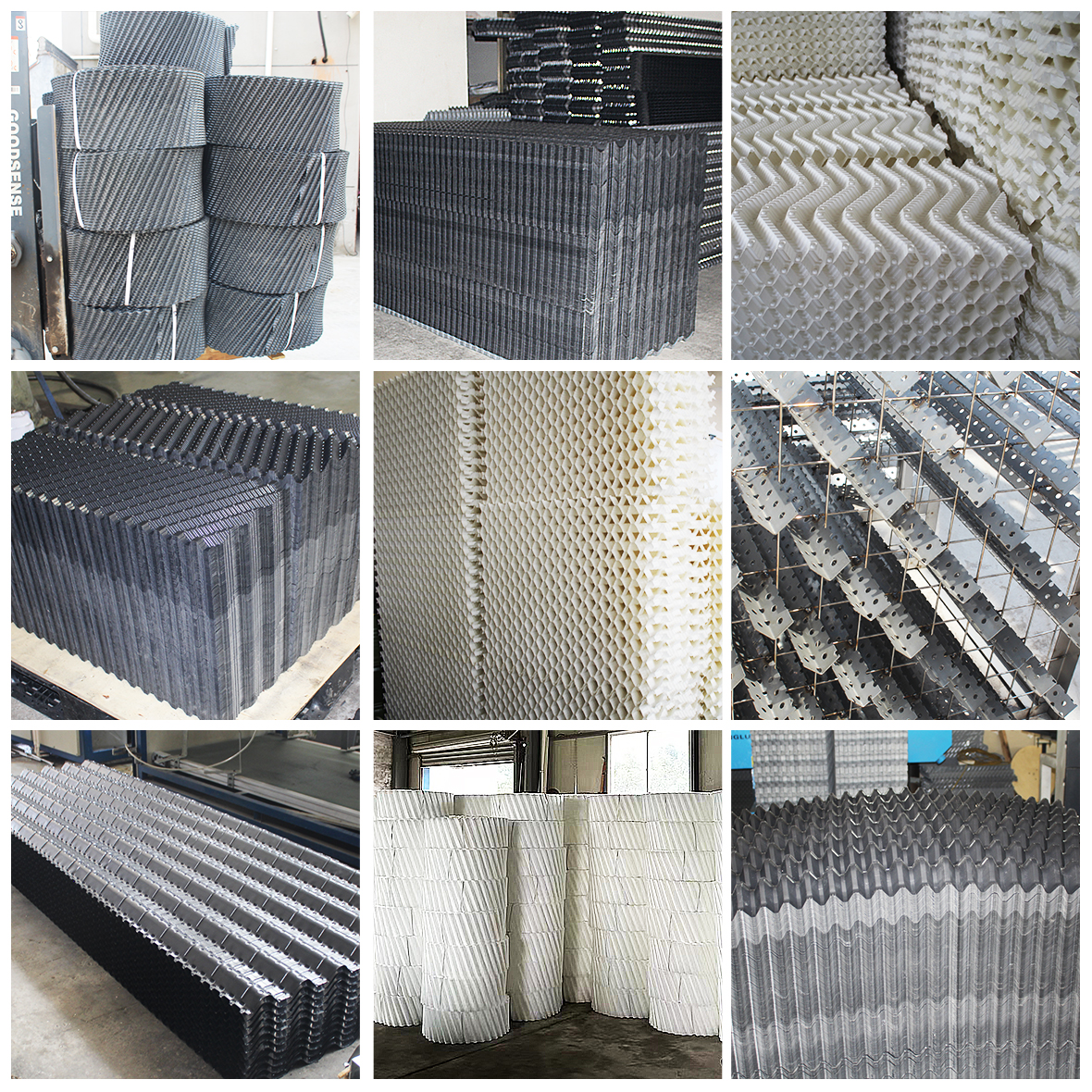
Choosing the right fill for cooling tower applications is important for heat-transfer performance, maintenance, and equipment service life. Cooling tower fill creates a larger contact area between circulating water and air, helping the tower remove heat through evaporation.
Among the most widely used materials are PVC and polypropylene (PP). Other materials and fill constructions may also be suitable for specific operating conditions.
But which material should you choose? The answer depends on water quality, operating temperature, fill type, tower design, thermal requirements, and maintenance conditions.
This guide compares PVC cooling tower fill, PP cooling tower fill, and other fill materials to help industrial buyers make a practical selection.
What Is Cooling Tower Fill?
Cooling tower fill, also called cooling tower fill media, is installed inside a cooling tower to improve the interaction between hot water and moving air.
Without fill, water would fall relatively quickly through the tower. Fill slows and spreads the water, increasing the effective contact area and contact time.
There are two primary fill designs:
Material selection and fill geometry work together. A high-quality material cannot compensate for a fill design that is unsuitable for the tower's operating conditions.
PVC Cooling Tower Fill
PVC cooling tower fill is one of the most common choices for film-fill applications.
PVC sheets can be formed into corrugated, embossed, or otherwise structured surfaces that create extensive water-air contact area.
Advantages of PVC Fill
PVC cooling tower fill offers several practical benefits:
Good heat-transfer performance
High effective surface area
Relatively low weight
Good chemical resistance under suitable conditions
Cost-effective manufacturing
Widely available for replacement projects
Suitable for many commercial and industrial towers
PVC is particularly common in film-fill installations where water quality is reasonably well controlled.
Limitations of PVC Fill
PVC film fill typically contains relatively narrow passages. If the circulating water contains significant amounts of sediment, scale, algae, or other contaminants, these passages can become blocked.
Therefore, PVC film fill often works best with:
PVC also has operating-temperature limitations that should be checked before installation.
PP Cooling Tower Fill
Polypropylene (PP) cooling tower fill is another widely used option.
PP is used in both film-fill and splash-fill designs. It is particularly attractive for applications requiring greater resistance to elevated temperatures or certain chemical environments.
Advantages of PP Fill
Common benefits include:
Good chemical resistance
Higher temperature capability than many PVC applications
Good durability
Low density
Suitable for film and splash fill
Available in industrial cooling tower configurations
PP splash fill is especially common in applications where water contains suspended solids or where fouling resistance is important.
Limitations of PP Fill
PP is not automatically the best choice for every tower.
Buyers should consider:
The actual performance depends on the complete fill design, not simply whether the material is PVC or PP.
PVC vs. PP Cooling Tower Fill
The following table provides a general comparison.
| Feature | PVC Fill | PP Fill |
| Common application | Film fill | Film and splash fill |
| Heat-transfer performance | High | High |
| Temperature resistance | Suitable for many standard applications | Generally better suited to higher-temperature applications |
| Chemical resistance | Good | Very good for many applications |
| Weight | Lightweight | Lightweight |
| Fouling resistance | Depends on fill design | Often used in open splash configurations |
| Water quality tolerance | Best with controlled water quality for narrow-passage film fill | Strong option for challenging conditions when used as splash fill |
| Cost | Often economical | Can be higher depending on design |
| Common use | HVAC and industrial cooling | Industrial/process cooling and higher-temperature applications |
These are general characteristics. Specific grades, sheet designs, thicknesses, and operating conditions can produce different results.
Other Cooling Tower Fill Materials
Although PVC and PP dominate many applications, other materials may be used for specialized requirements.
HDPE Cooling Tower Fill
High-density polyethylene (HDPE) may be used in selected cooling tower fill applications.
It offers good impact resistance and chemical resistance and can be considered where specific mechanical or chemical requirements exist.
However, its suitability should be evaluated against the tower's thermal requirements and operating temperature.
FRP Components
Fiberglass-reinforced plastic (FRP) is more commonly associated with cooling tower structural components, supports, grids, louvers, and other equipment rather than conventional high-surface-area film fill.
FRP can provide excellent corrosion resistance and structural durability in appropriate applications.
Metal Fill
Metallic fill has been used in certain specialized cooling systems, but it is less common than plastic fill for many modern evaporative cooling towers.
Metal can offer mechanical strength and temperature capability, but corrosion, weight, cost, and water chemistry must be carefully considered.
For most conventional cooling tower fill replacement projects, plastic materials such as PVC and PP are more common.
Material Selection Also Depends on Fill Type
Comparing materials without considering fill geometry can lead to the wrong purchasing decision.
PVC Film Fill
PVC film fill is widely used where high surface area and efficient heat transfer are required.
It is generally most appropriate when water quality can be controlled.
PP Film Fill
PP film fill offers similar structured-film principles while providing material characteristics that can be advantageous at higher operating temperatures or under certain chemical conditions.
PP Splash Fill
PP splash fill is commonly selected for industrial applications where fouling resistance and water-quality tolerance are important.
Its open structure reduces the risk of narrow passages becoming blocked.
How to Choose the Right Fill for Cooling Tower
When selecting fill for cooling tower replacement, consider the complete operating environment.
1. Check Operating Temperature
Determine the normal and maximum water temperature.
The fill material must be suitable for the actual operating range.
2. Analyze Water Quality
Check:
Hardness
Suspended solids
Biological activity
pH
Chemical treatment
Scale-forming potential
Poor water quality may favor splash fill over closely spaced film fill.
3. Determine Thermal Requirements
Consider the required:
Cooling range
Approach
Water flow
Airflow
Heat-rejection capacity
The fill should be matched to the tower's thermal duty.
4. Check Tower Configuration
Confirm whether the tower is:
Crossflow
Counterflow
Induced draft
Forced draft
Fill geometry and installation configuration must be compatible with the existing tower.
5. Consider Maintenance
A fill that provides excellent initial thermal performance may not be economical if it becomes heavily fouled under actual operating conditions.
Consider how frequently the tower can be inspected and cleaned.
Cooling Tower Fill Replacement: What Buyers Should Check
Before purchasing replacement fill, collect as much information as possible.
Important specifications include:
| Specification | Information Required |
| Fill type | Film, splash, or hybrid |
| Material | PVC, PP, or other |
| Tower type | Crossflow or counterflow |
| Fill dimensions | Length × width × height |
| Sheet thickness | Existing or required thickness |
| Sheet spacing | Existing configuration |
| Operating temperature | Normal and maximum |
| Water flow | Circulating-water rate |
| Water quality | Solids, scale, biological fouling |
| Support system | Existing structure and spacing |
| Thermal duty | Required cooling performance |
Photos of the existing fill can also help suppliers identify the correct configuration.
For retrofit projects, an OEM-compatible or aftermarket cooling tower fill replacement should be evaluated based on both physical compatibility and thermal requirements.
PVC or PP: Which Should You Choose?
There is no universal answer.
PVC cooling tower fill can be an economical and effective choice for many standard film-fill applications where water quality is controlled.
PP cooling tower fill can be advantageous when higher temperature resistance, chemical resistance, or splash-fill construction is required.
The final decision should consider the tower design and operating conditions rather than material price alone.
Frequently Asked Questions
Is PVC or PP better for cooling tower fill?
Both materials have important applications. PVC is widely used for film fill, while PP is used for both film and splash fill. The better choice depends on temperature, water chemistry, fouling risk, and thermal requirements.
Is PP cooling tower fill suitable for high temperatures?
PP generally offers higher temperature capability than PVC in many applications, but the actual allowable temperature depends on the specific product and design. Always check the manufacturer's specifications.
Why is PVC commonly used for film fill?
PVC can be formed into structured sheets with a large effective surface area and offers a practical combination of thermal performance, chemical resistance, weight, and cost.
Which cooling tower fill is best for dirty water?
Splash fill is often considered for water containing higher levels of suspended solids because its open structure can be more tolerant of fouling than closely spaced film fill.
Can PVC and PP fill be used in the same cooling tower?
Different fill materials may be used in a tower under certain designs, but compatibility with the tower's thermal, structural, and operating requirements must be confirmed before installation.
Conclusion
Selecting the right fill for cooling tower applications requires more than choosing between PVC and PP. Fill type, water quality, operating temperature, airflow, water loading, thermal duty, and maintenance requirements all influence the appropriate solution.
PVC cooling tower fill is widely used for film-fill applications where high surface area and controlled water quality are important. PP cooling tower fill offers useful temperature and chemical-resistance characteristics and is widely used for both film and splash applications.
For industrial cooling tower replacement projects, the best approach is to evaluate the complete operating environment and match the fill geometry and material to the existing tower.
CoolingTowerPart.com supplies PVC film fill, PP film fill, PP splash fill, hybrid fill, and cooling tower fill replacement solutions for industrial and commercial applications.
Internal Links for Other CoolingTowerParts
Cooling Tower Nozzles
Cooling Tower Drift Eliminators
Cooling Tower Louvers
Cooling Tower Fan Blades
Cooling Tower Motors


