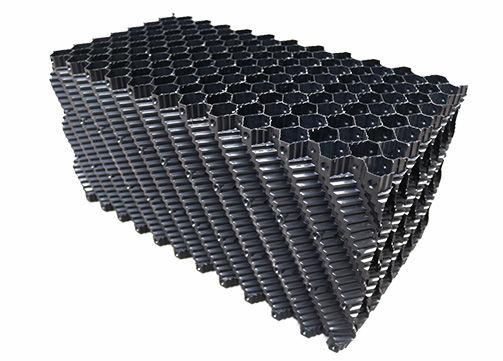
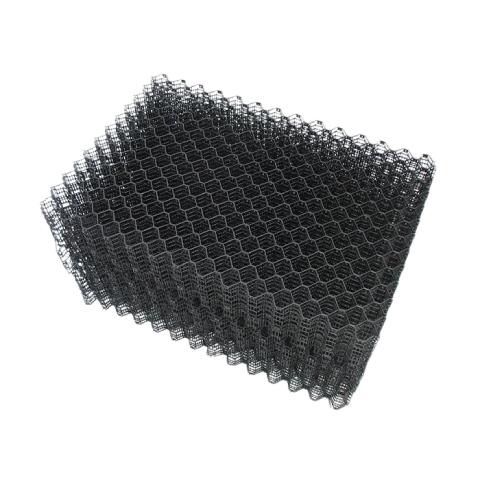
Fill pack in cooling towers is the heat-transfer media installed inside a cooling tower to increase contact between hot circulating water and air. It is one of the most important components in a cooling tower because it directly affects heat transfer efficiency, water evaporation, airflow, and overall tower performance.
Instead of allowing water to fall freely from the distribution system to the cold-water basin, a cooling tower fill pack spreads water over a large surface area. Air flowing through the fill removes heat from the water, primarily through evaporation.
Cooling tower fill packs are commonly manufactured from PVC or polypropylene (PP) and are available in film-fill and splash-fill designs.
How Does Cooling Tower Fill Pack Work?
The basic operating principle is simple:
Hot water enters the cooling tower.
The water distribution system spreads the water over the fill.
Water flows across or falls through the fill pack.
Air moves through the fill in either crossflow or counterflow.
Heat and a small amount of water are transferred to the air.
Cooled water collects in the basin and returns to the process.
The fill pack creates a large air-water contact area without requiring the cooling tower to become excessively large.
A properly selected fill can therefore improve the tower's cooling capacity while helping maintain an efficient footprint.
Main Types of Cooling Tower Fill Pack
There are two major categories of cooling tower fill: film fill and splash fill.
Film Fill
Film fill uses closely spaced sheets with specially designed surfaces. Water forms a thin film over the sheets while air passes through the channels.
The large wetted surface area provides efficient heat and mass transfer.
Common film-fill configurations include:
Film fill is widely used in industrial and HVAC cooling towers where relatively clean circulating water is available.
Splash Fill
Splash fill breaks falling water into smaller droplets as it moves through a series of splash bars or grids.
Common splash-fill designs include:
Splash fill is often considered for applications where water contains suspended solids or where resistance to fouling and clogging is important.
Cooling Tower Fill Pack Materials
PVC Cooling Tower Fill
PVC cooling tower fill is widely used because PVC offers a useful combination of cost, rigidity, chemical resistance, and ease of fabrication.
PVC film fill is commonly selected for conventional cooling-water applications. It can be formed into different flute patterns to control water distribution and airflow.
PP Cooling Tower Fill
PP cooling tower fill is another common choice, particularly when higher temperature resistance or specific chemical resistance is required.
Polypropylene is commonly used for splash fill and can also be used in certain film-fill applications.
The correct material depends on operating temperature, water chemistry, biological control program, and tower design.
Film Fill vs. Splash Fill
| Feature | Film Fill | Splash Fill |
| Heat-transfer surface | High | Moderate |
| Water distribution | Thin film | Droplets |
| Typical material | PVC, PP | PP, PVC |
| Fouling resistance | Depends on flute design | Generally good |
| Suspended solids tolerance | Lower for fine-flute designs | Generally higher |
| Typical application | Clean water | Dirtier or industrial water |
The choice should not be based on heat-transfer area alone. Water quality, temperature, airflow, cleaning requirements, and tower configuration all need to be considered.
Why Is Fill Pack Important in a Cooling Tower?
The fill pack has a direct influence on cooling tower thermal performance.
1. Improves Heat Transfer
More effective contact between air and water improves heat and mass transfer.
2. Increases Effective Surface Area
The fill creates a much larger contact area than an open tower would provide.
3. Supports Compact Tower Design
Efficient fill can help achieve the required cooling performance within a practical tower size.
4. Influences Water Distribution
The fill must work together with the nozzles and distribution system to maintain effective wetting.
5. Affects Pressure Drop
Fill geometry influences airflow resistance. A design with excessive pressure drop can increase fan requirements and affect tower operation.
Where Is Cooling Tower Fill Pack Used?
Cooling tower fill packs are used in many industries and systems, including:
HVAC and air-conditioning systems
Power generation
Chemical processing
Petrochemical plants
Steel manufacturing
Food and beverage production
Data centers
Plastic manufacturing
Industrial process cooling
District cooling systems
Both crossflow cooling towers and counterflow cooling towers can use specialized fill configurations.
How to Choose the Right Cooling Tower Fill Pack
Selecting the right cooling tower fill pack requires more than matching dimensions.
Consider Cooling Tower Type
First identify whether the tower is crossflow or counterflow. Fill geometry and installation arrangements vary between the two designs.
Check Water Temperature
Operating temperature affects material selection. Higher-temperature applications may require a suitable PP formulation or specialized high-temperature fill.
Evaluate Water Quality
This is critical.
If the circulating water contains high levels of suspended solids, biological growth, oil, or other contaminants, a fine-flute film fill may be vulnerable to blockage.
For challenging water conditions, a low-clogging film fill or splash fill may be more appropriate.
Confirm Dimensions
Check:
Fill block length
Width
Height
Sheet thickness
Flute angle
Flute spacing
Support arrangement
Correct dimensions are essential for a replacement project.
Consider Airflow and Pressure Drop
The fill should provide the required heat-transfer performance without creating unnecessary airflow resistance.
Check Compatibility
For replacement projects, compare the new fill with the existing tower design, including water loading, airflow direction, support structure, and distribution system.
Cooling Tower Fill Pack Replacement
Over time, fill packs can become damaged, deformed, brittle, scaled, or clogged.
Typical signs that cooling tower fill replacement may be required include:
Reduced cooling capacity
Increased approach temperature
Uneven water distribution
Blocked fill passages
Broken or collapsed fill sheets
Excessive biological growth
Scale accumulation
Increased pressure drop
Before replacement, inspect the fill and determine whether cleaning can restore performance. Severely damaged or degraded fill should generally be replaced rather than repeatedly cleaned.
For replacement projects, measure the existing fill carefully and confirm the operating conditions before ordering.
How to Maintain Cooling Tower Fill Pack
Regular maintenance can extend fill service life and maintain cooling performance.
Inspect the Fill Regularly
Look for cracks, deformation, blockage, scale, and biological deposits.
Maintain Water Treatment
Proper chemical treatment helps control scale, corrosion, and biological growth.
Clean When Necessary
Cleaning frequency depends on water quality and operating conditions. Avoid aggressive cleaning methods that can damage PVC or PP sheets.
Check Water Distribution
Blocked or damaged nozzles can create dry areas and overloaded sections of fill. Inspect the distribution system together with the fill.
Monitor Cooling Performance
Track parameters such as:
Hot-water temperature
Cold-water temperature
Temperature range
Approach
Water flow
Fan operation
Pressure drop
Changes in these parameters can help identify fill or distribution problems.
Cooling Tower Fill Pack for Replacement Projects
When buying cooling tower fill pack, B2B buyers should request technical information rather than purchasing based only on price.
Important information includes:
For industrial cooling towers, it is also useful to provide photos, drawings, existing fill dimensions, and tower model information to the supplier.
FAQ About Fill Pack in Cooling Towers
What is the purpose of fill pack in a cooling tower?
The purpose of cooling tower fill is to increase air-water contact and improve evaporative heat transfer.
What material is cooling tower fill made from?
The most common materials are PVC and polypropylene (PP). The appropriate material depends on temperature, water chemistry, and application.
What is the difference between film fill and splash fill?
Film fill spreads water into thin films over sheets, while splash fill repeatedly breaks falling water into droplets. Film fill generally provides high heat-transfer efficiency, while splash fill is often considered for applications with higher fouling potential.
How often should cooling tower fill be replaced?
There is no universal replacement interval. Service life depends on water quality, temperature, chemical treatment, UV exposure, mechanical conditions, and maintenance.
Can cooling tower fill be cleaned?
Yes. Cleaning may restore performance when deposits or biological growth are the main problem. However, damaged, brittle, or severely deformed fill may require replacement.
Conclusion
Fill pack in cooling towers is a critical component for efficient heat transfer. PVC and PP film fills are widely used where high surface area and efficient air-water contact are required, while splash fill can provide an alternative for applications with greater fouling concerns.
Choosing the right fill requires consideration of cooling tower design, water quality, operating temperature, airflow, water loading, pressure drop, and existing fill dimensions. Proper inspection, water treatment, and cleaning can also help maintain cooling tower performance.
For a replacement project, CoolingTowerPart.com can help B2B buyers evaluate PVC cooling tower fill, PP cooling tower fill, film fill, splash fill, and customized cooling tower fill packs based on tower requirements.
Internal Links for Other CoolingTowerParts
Cooling Tower Fill
Cooling Tower Nozzles
Cooling Tower Drift Eliminators
Cooling Tower Louvers
Cooling Tower Fan Blades
Cooling Tower Motors