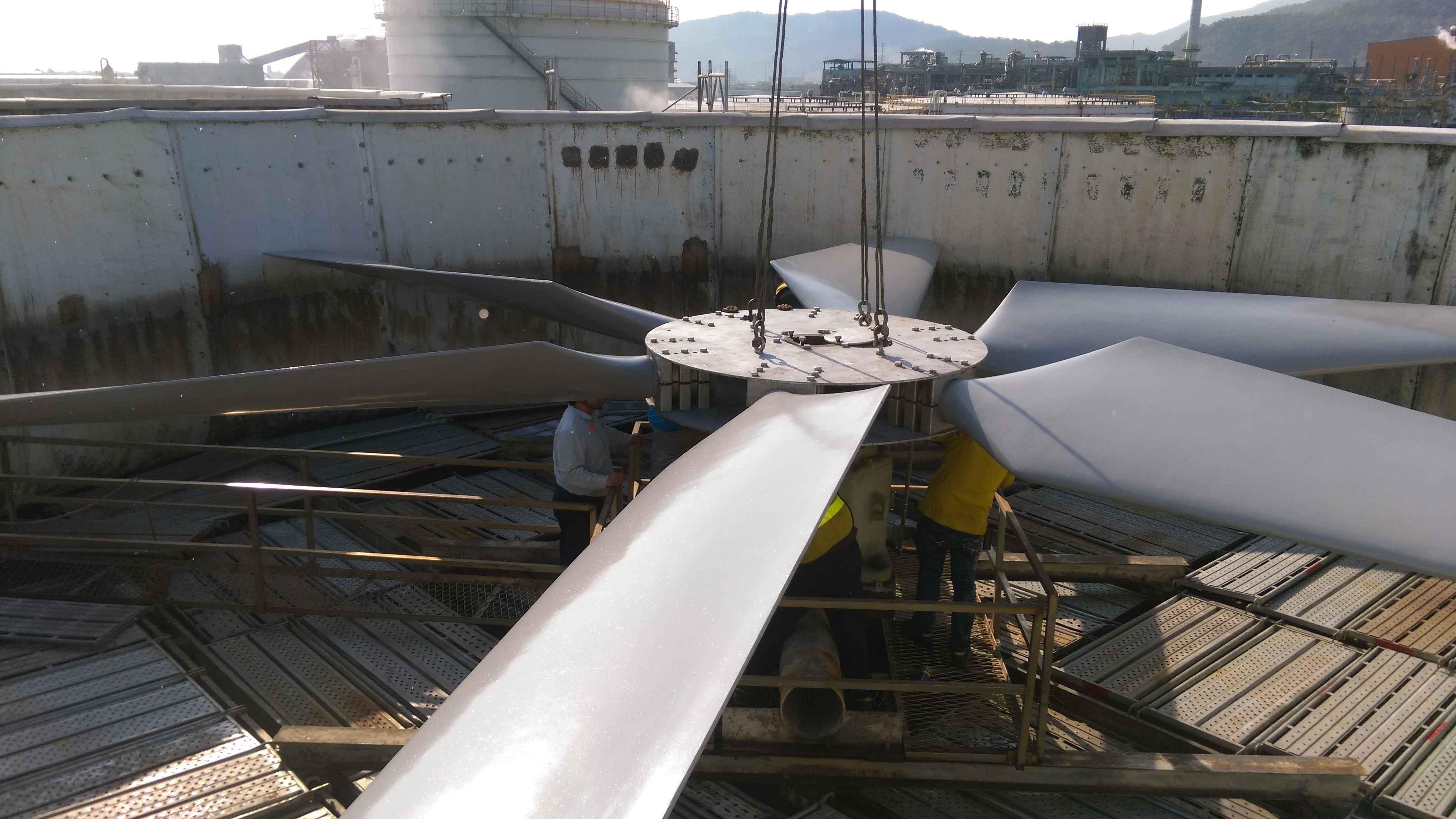
A cooling tower fan stack plays an important role in directing airflow, improving fan performance, and maintaining efficient heat rejection. However, after years of industrial operation, existing fan stacks may suffer from corrosion, structural damage, vibration, air leakage, or reduced mechanical reliability.
For facilities operating aging cooling towers, a fiberglass cooling tower fan stack retrofit can be a practical solution. Replacing an old steel, concrete, or damaged fiberglass fan stack with a properly engineered FRP structure can improve corrosion resistance, reduce structural weight, and extend equipment service life.
This guide explains when to retrofit a cooling tower fan stack, the advantages of FRP materials, important design considerations, installation procedures, and how to select a reliable replacement manufacturer.
1. What Is a Fiberglass Cooling Tower Fan Stack Retrofit?
A fiberglass cooling tower fan stack retrofit involves replacing or upgrading an existing cooling tower fan cylinder with a new fiberglass reinforced plastic (FRP) structure.
The fan stack surrounds the cooling tower fan and guides discharged air upward and away from the cooling tower. Its shape and dimensions influence airflow distribution and overall fan system performance.
The objective is to improve structural reliability while maintaining compatibility with the existing cooling tower fan system.
2. When Should an Industrial Cooling Tower Fan Stack Be Retrofitted?
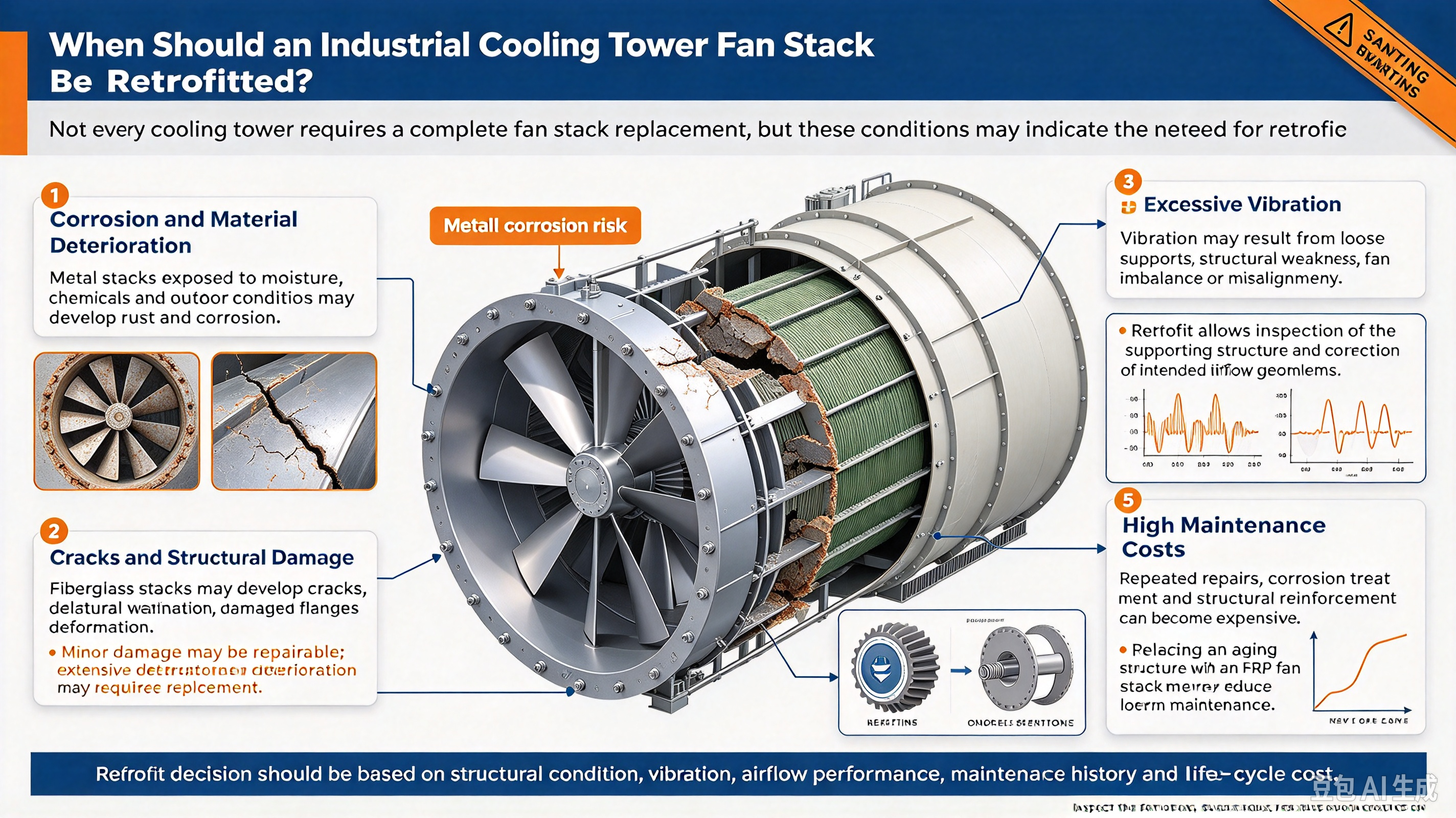
Not every cooling tower requires a complete fan stack replacement. However, several conditions indicate that a retrofit may be necessary.
Corrosion and Material Deterioration
Metal fan stacks exposed to moisture, chemicals, and outdoor environments may experience rust and corrosion. Over time, corrosion can weaken structural sections and increase maintenance costs.
FRP fan stacks provide excellent corrosion resistance in many cooling tower environments.
Cracks and Structural Damage
Existing fiberglass fan stacks may develop cracks, delamination, damaged flanges, or deformation due to aging, improper installation, and external loading.
Minor damage may be repairable, but extensive structural deterioration may require replacement.
Excessive Vibration
Fan stack vibration can result from loose supports, structural weakness, fan imbalance, or mechanical misalignment.
A retrofit provides an opportunity to inspect the supporting structure and correct installation problems.
Poor Airflow Performance
An incorrectly sized or damaged fan stack may disturb airflow and reduce fan system efficiency.
A properly designed replacement can restore the intended airflow geometry.
High Maintenance Costs
Repeated repairs, corrosion treatment, and structural reinforcement can become expensive. Replacing an aging structure with an FRP fan stack may reduce long-term maintenance requirements.
3. Benefits of FRP Cooling Tower Fan Stack Retrofit
Fiberglass reinforced plastic is widely used in industrial cooling tower structures because of its lightweight construction and corrosion resistance.
Key benefits include:
1. Excellent Corrosion Resistance
FRP materials resist moisture, many industrial chemicals, and common cooling tower environmental conditions. This makes them suitable for demanding industrial applications.
2. Lightweight Construction
Compared with many traditional metal structures, FRP fan stacks have a lower structural weight. This can reduce loads on existing support structures, subject to engineering verification.
3. Improved Service Life
Properly manufactured and installed FRP structures can provide long-term performance with less corrosion-related maintenance.
4. Customized Dimensions
FRP fan stacks can be manufactured to match different cooling tower configurations, fan diameters, stack heights, and mounting arrangements.
5. Easier Transportation and Installation
Their relatively low weight can simplify handling and installation, particularly for large industrial retrofit projects.
4. Important Design Considerations Before Retrofitting
A successful fiberglass cooling tower fan stack retrofit begins with accurate measurements and engineering evaluation.
Fan Stack Dimensions
Confirm the following dimensions:
The replacement should match the existing installation requirements or an approved revised design.
Fan Diameter and Clearance
The new fan stack must provide adequate clearance between the rotating fan blade tips and the internal stack wall.
Insufficient clearance can cause blade contact, while excessive clearance may affect aerodynamic performance.
Clearance requirements should follow the fan manufacturer's specifications.
Structural Strength
Evaluate wind loading, vibration, fan operating conditions, support spacing, and connection strength.
The FRP structure must be designed for the actual operating and environmental conditions.
Material Selection
Common FRP construction uses glass fiber reinforcement combined with a suitable resin system.
Resin selection should consider operating temperature, UV exposure, chemical conditions, and expected service environment.
Existing Support Compatibility
Inspect the existing steel or concrete support structure before installation. Confirm that its dimensions, strength, and mounting arrangement are suitable for the replacement fan stack.
5. Fiberglass Cooling Tower Fan Stack Retrofit: Step-by-Step Process
A structured installation process helps minimize downtime and avoid costly installation mistakes.
Step 1: Inspect the Existing Cooling Tower
Examine the existing fan stack, fan assembly, support structure, mounting flanges, and surrounding equipment.
Document corrosion, cracks, deformation, and alignment problems.
Step 2: Measure the Existing Structure
Record the fan stack dimensions and fan assembly specifications.
Take photographs and prepare drawings showing the existing mounting configuration.
Step 3: Design the Replacement FRP Fan Stack
Work with an experienced FRP manufacturer to confirm dimensions, material specifications, wall thickness, flange design, and structural requirements.
Custom fabrication should account for the actual site conditions.
Step 4: Remove the Existing Fan Stack
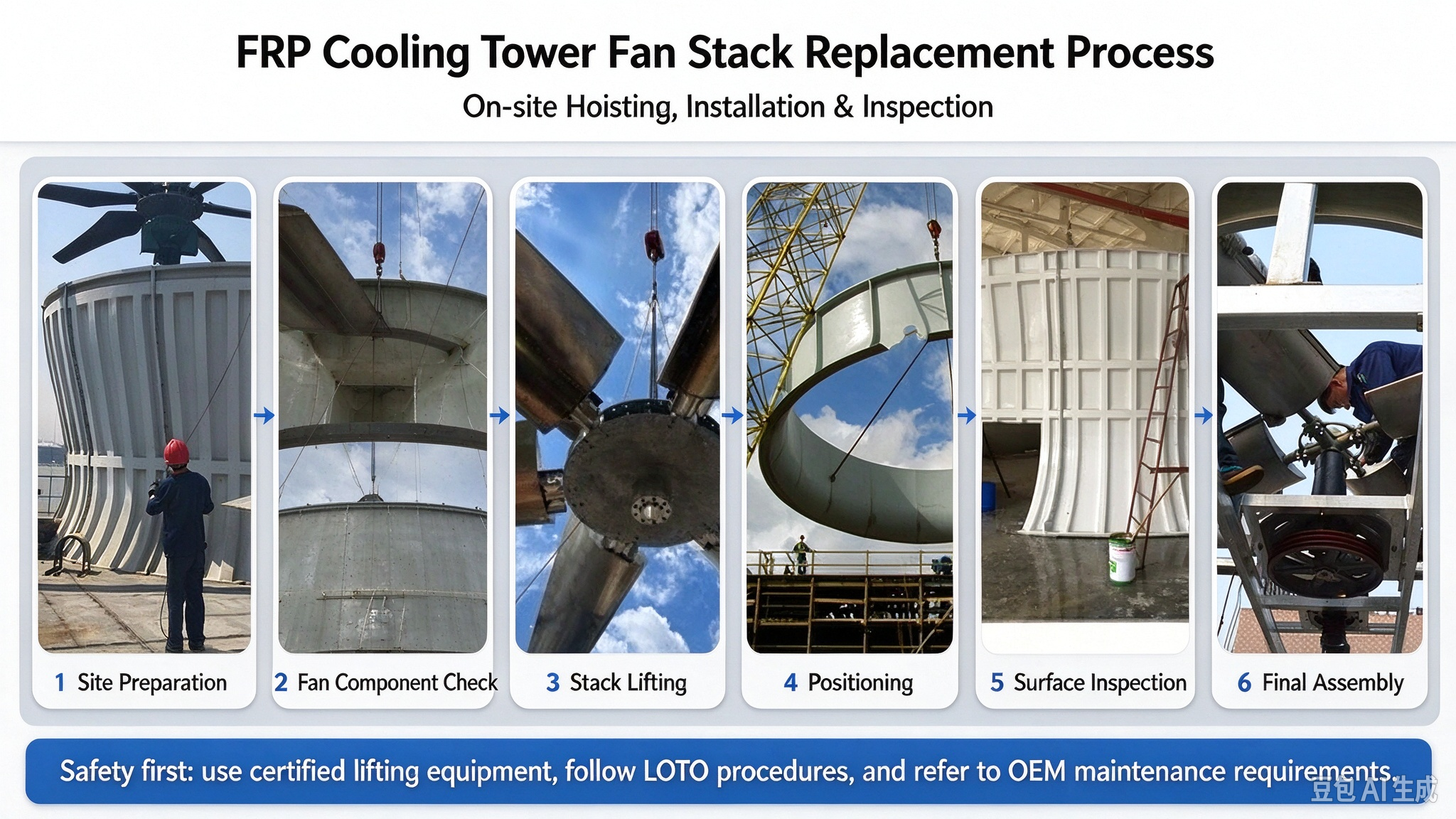
Before dismantling, shut down the cooling tower, isolate electrical power, and apply appropriate lockout/tagout procedures.
Use suitable lifting equipment to remove the existing structure safely.
Step 5: Prepare the Supporting Structure
Clean the mounting surfaces and inspect structural supports.
Repair damaged steelwork or concrete supports before installing the new FRP fan stack.
Step 6: Install the New FRP Fan Stack
Position the replacement structure using suitable lifting equipment.
Align the stack with the fan centerline and secure all mounting connections according to the approved installation drawings.
Step 7: Check Fan Clearance and Alignment
Measure radial clearance between the fan blade tips and the inside wall of the stack at multiple positions.
Check fan alignment, blade pitch, mounting bolts, and support connections.
Step 8: Commission the Cooling Tower
After installation, conduct a controlled startup.
Monitor vibration, unusual noise, airflow conditions, and fan operating parameters. Verify that the fan operates without interference.
6. Common Retrofit Problems and Solutions
| Common Problem | Possible Cause | Recommended Solution |
| New stack does not fit | Incorrect measurements | Verify dimensions before fabrication |
| Uneven fan clearance | Centerline misalignment | Recheck fan and stack alignment |
| Flange connection problems | Incorrect hole spacing | Confirm flange drawings and bolt patterns |
| Excessive vibration | Loose supports or fan imbalance | Inspect supports and fan assembly |
| Air leakage | Poor sealing at connections | Install suitable sealing materials |
| FRP cracking | Improper support or installation stress | Review structural design and mounting |
Accurate engineering and site measurements can prevent many of these problems.
7. How to Choose a Fiberglass Cooling Tower Fan Stack Manufacturer
Selecting an experienced manufacturer is important for industrial retrofit projects.
Before placing an order, evaluate:
FRP manufacturing experience: Look for experience producing industrial cooling tower fan stacks.
Customization capability: The manufacturer should accommodate different diameters, heights, and flange configurations.
Material quality: Confirm fiberglass reinforcement, resin selection, and UV protection.
Engineering support: Ask whether technical drawings and installation recommendations are available.
Quality inspection: Check dimensional accuracy, laminate quality, and connection details.
Export experience: For overseas projects, confirm packaging, shipping arrangements, and technical documentation.
For international buyers, a direct FRP fan stack manufacturer can also provide customized replacement solutions for industrial cooling tower maintenance contractors, distributors, and EPC companies.
8. FRP Fan Stack Retrofit vs. Complete Cooling Tower Replacement
A fan stack retrofit is generally more targeted than replacing an entire cooling tower.
| Comparison | Fan Stack Retrofit | Complete Tower Replacement |
| Project scope | Fan stack and related components | Entire cooling tower |
| Initial investment | Usually lower | Usually higher |
| Installation time | Often shorter | Usually longer |
| Existing equipment | Retained where suitable | Replaced |
| Application | Localized structural deterioration | Extensive equipment deterioration |
However, if the cooling tower has serious problems with its basin, casing, fill, distribution system, or structural supports, a broader renovation may be more appropriate.
9. Conclusion
A fiberglass cooling tower fan stack retrofit is an effective option for industrial facilities looking to replace aging, corroded, or damaged fan cylinders without necessarily replacing the entire cooling tower.
FRP fan stacks offer corrosion resistance, lightweight construction, customized dimensions, and reduced corrosion-related maintenance.
Successful retrofitting depends on accurate measurements, proper material selection, structural evaluation, correct fan clearance, and professional installation.
CoolingTowerPart.com provides customized fiberglass cooling tower fan stack replacement solutions for industrial cooling tower maintenance, renovation, and retrofit projects. Contact our team with your fan diameter, stack dimensions, mounting drawings, and operating requirements to discuss a suitable replacement.
Frequently Asked Questions (FAQs)
1. What is a cooling tower fan stack retrofit?
It involves replacing or upgrading an existing cooling tower fan cylinder, often using a new FRP structure, while retaining suitable existing cooling tower equipment.
2. Why use FRP for cooling tower fan stack replacement?
FRP offers corrosion resistance, lightweight construction, weather resistance, and flexible customization for industrial cooling tower applications.
3. Can an FRP fan stack replace an existing steel fan stack?
Yes. A properly engineered FRP fan stack can replace an existing steel structure, provided its dimensions, mounting arrangement, structural strength, and fan clearance meet project requirements.
4. How long does a cooling tower fan stack retrofit take?
The duration depends on stack dimensions, site accessibility, lifting requirements, fabrication lead time, and installation complexity. A site-specific project schedule should be prepared before work begins.
5. What information is needed to order a customized FRP fan stack?
Buyers should provide fan diameter, stack height, inside diameter, outside diameter, flange dimensions, mounting hole positions, material requirements, and available installation drawings.
Recommended internal links for CoolingTowerPart.com:


