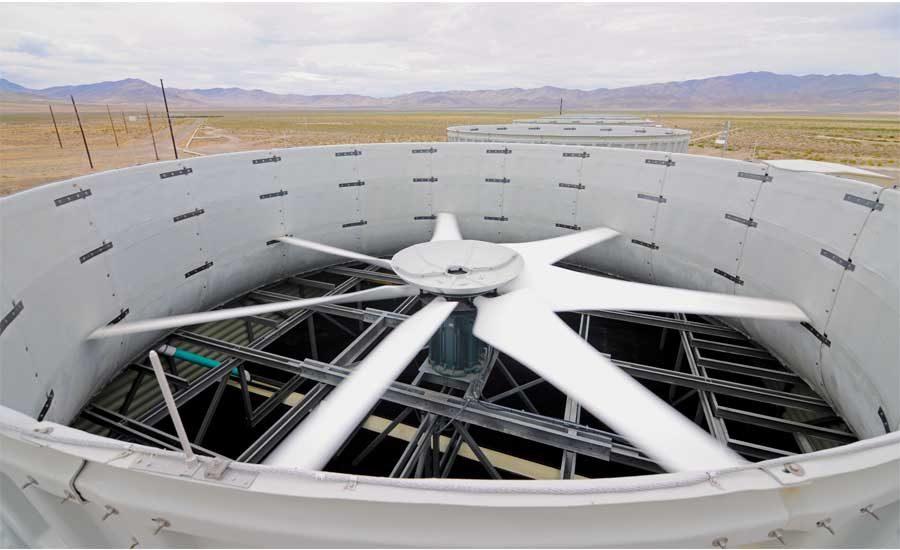
Proper fiberglass cooling tower fan stack alignment and fan clearance are essential for maintaining cooling tower efficiency, reducing vibration, and extending fan system service life. The fan stack, also called an FRP cooling tower fan cylinder, guides airflow through the cooling tower. If the fan stack is incorrectly aligned or the clearance between the fan blades and stack is insufficient, the system may experience airflow losses, excessive noise, vibration, and mechanical damage.
Whether installing a new FRP cooling tower fan stack or replacing an existing structure, checking alignment and fan clearance should be an important part of commissioning and maintenance.
This guide explains fan stack alignment requirements, blade-to-stack clearance, measurement methods, common problems, and best practices.
1. Why Cooling Tower Fan Stack Alignment Matters
A fiberglass cooling tower fan stack must be properly positioned around the fan assembly to ensure smooth airflow and safe operation.
Incorrect alignment can cause several problems:
Reduced airflow efficiency: An improperly positioned fan stack can disturb airflow and reduce fan performance.
Excessive vibration: Uneven clearance may contribute to aerodynamic imbalance and vibration.
Fan blade damage: Insufficient clearance increases the risk of blade contact with the fiberglass stack.
Increased energy consumption: Poor airflow conditions may require additional fan power to achieve the required cooling capacity.
Premature component failure: Continuous vibration and mechanical stress can shorten the service life of fan blades, bearings, and support structures.
Correct alignment helps maintain consistent airflow and reliable cooling tower operation.
2. Understanding Fiberglass Cooling Tower Fan Stack Clearance
Fan clearance refers to the distance between the outer tips of the cooling tower fan blades and the inside surface of the fiberglass fan stack.
This distance is important because the fan blades rotate at high speed. Adequate clearance prevents physical contact while helping maintain efficient airflow.
Two important measurements should be considered:
Radial clearance: The distance between each fan blade tip and the inside wall of the fan stack.
Axial clearance: The vertical distance between the fan blade assembly and nearby structural components or other equipment, where applicable.
Radial clearance is particularly important for induced-draft cooling tower fans because the fan operates inside the fan cylinder.
The required clearance depends on fan diameter, blade design, rotational speed, stack geometry, operating temperature, and manufacturer specifications. There is no single clearance value suitable for every cooling tower.
3. How to Check Cooling Tower Fan Stack Alignment
Before starting the cooling tower, inspect the fiberglass fan stack and fan assembly carefully.
Step 1: Inspect the FRP Fan Stack
Check the fiberglass structure for:
Cracks, deformation, or damaged laminate.
Uneven mounting surfaces.
Loose bolts and connection points.
Distorted or damaged flange sections.
Signs of structural movement.
A damaged or deformed fan stack should be repaired or replaced before final alignment.
Step 2: Check the Fan Stack Centerline
Identify the centerline of the fan stack and compare it with the centerline of the fan hub and drive assembly.
The fan should be positioned centrally within the stack.
Use suitable measuring equipment, such as a laser alignment tool, plumb line, or measuring tape, depending on the installation.
Step 3: Measure Radial Fan Clearance
Measure the distance between the fan blade tips and the inside wall of the fiberglass fan stack.
Take measurements at multiple positions around the fan circumference.
Record the results for every blade position and compare them with the fan manufacturer's specified clearance.
Large differences between measurements may indicate:
Step 4: Check Fan Blade Pitch and Position
Incorrect fan blade pitch can affect airflow, power consumption, and fan loading.
Check that all blades are installed according to the manufacturer's specifications. Confirm that blade pitch angles are consistent and that the fan hub is properly secured.
Step 5: Inspect Mounting and Support Structures
Check the fiberglass fan stack support structure, mounting brackets, and connecting bolts.
Loose supports can allow the stack to move during operation, changing the clearance between the fan blades and stack.
Tighten fasteners according to the specified torque requirements.
4. Common Fiberglass Fan Stack Alignment Problems
Several installation and operating conditions can affect fan stack alignment.
| Problem | Possible Cause | Recommended Solution |
| Uneven radial clearance | Stack or fan centerline misalignment | Recheck centerlines and reposition |
| Fan blade contact | Insufficient clearance or structural movement | Stop operation and inspect |
| Excessive vibration | Fan imbalance or loose supports | Check balance and mounting |
| Irregular airflow | Incorrect fan position or stack deformation | Inspect fan and stack geometry |
| Increasing noise | Blade interference or mechanical looseness | Inspect blade tips and connections |
| Repeated clearance changes | Structural deformation or thermal movement | Evaluate supports and operating conditions |
Identifying these problems early helps prevent expensive equipment damage.
5. Factors Affecting Fan Clearance
Several factors should be considered when determining the correct clearance for an FRP cooling tower fan stack.
Fan Diameter
Larger cooling tower fans require careful clearance measurement because small alignment errors can become significant around a large rotating assembly.
Fan Blade Design
Axial fan blades may have different shapes, tip profiles, and operating characteristics. The required clearance depends on the specific fan design.
Fiberglass Stack Deformation
FRP fan stacks are lightweight and corrosion-resistant, but improper support, installation stress, or external loading can cause deformation.
Operating Temperature
Temperature changes may affect the dimensions of the fan assembly and surrounding structure. The installation should account for expected operating conditions.
Fan Vibration
Excessive vibration can cause changes in the relative position of the fan and stack. Dynamic movement should be considered when evaluating operating clearance.
6. Best Practices for Fiberglass Cooling Tower Fan Stack Installation
To achieve reliable alignment and adequate fan clearance, follow these recommendations:
Check foundation and support levels: Ensure the fan stack support structure is level and stable.
Verify stack dimensions: Confirm the inside diameter, height, and mounting dimensions before installation.
Position the fan centrally: Align the fan hub and stack centerlines.
Measure clearance at multiple points: Do not rely on a single measurement.
Follow fan manufacturer specifications: Use the specified radial and axial clearance values.
Secure all connections: Tighten mounting bolts and support connections correctly.
Inspect after installation: Recheck alignment before commissioning.
Monitor operating conditions: Check vibration, noise, and fan performance during startup.
For large industrial cooling towers, professional installation and alignment inspections are recommended.
7. Maintenance and Regular Clearance Inspection
Even correctly installed fiberglass cooling tower fan stacks require regular inspection.
Maintenance personnel should periodically check:
Fan blade tip clearance.
Fan stack roundness and structural condition.
Fan shaft and gearbox alignment.
Fan hub and blade connections.
Support structure and mounting bolts.
Abnormal vibration and operating noise.
Signs of FRP cracking or deformation.
Inspections should also be performed after fan replacement, gearbox maintenance, structural repairs, or significant vibration events.
Always isolate electrical power, apply lockout/tagout procedures, and verify that the fan has completely stopped before performing measurements or maintenance.
8. Why Choose a Fiberglass Cooling Tower Fan Stack?
Fiberglass reinforced plastic (FRP) fan stacks are widely used in industrial cooling towers because of their combination of structural strength, low weight, and corrosion resistance.
Key advantages include:
Corrosion resistance: Suitable for humid environments and exposure to cooling tower water.
Lightweight construction: Reduces structural loading and simplifies transportation and installation.
Weather resistance: Suitable for outdoor industrial applications.
Custom dimensions: Can be manufactured to match different cooling tower fan diameters and configurations.
Low maintenance: Requires less corrosion-related maintenance than many conventional metal structures.
For replacement projects, buyers should confirm the fan stack diameter, height, flange dimensions, material thickness, mounting arrangement, and fan clearance requirements before ordering.
9. Selecting a Replacement FRP Cooling Tower Fan Stack
When purchasing a replacement fiberglass cooling tower fan stack, selecting a product based only on its outside dimensions is not sufficient.
Consider the following technical information:
| Specification | Information to Confirm |
| Material | FRP / fiberglass reinforced plastic |
| Stack diameter | Inside and outside diameter |
| Stack height | Overall cylinder height |
| Wall thickness | Designed structural thickness |
| Mounting | Flange and support configuration |
| Fan compatibility | Fan diameter and blade arrangement |
| Clearance | Required blade-tip clearance |
| Surface finish | Resin and UV protection requirements |
A reliable manufacturer should be able to provide customized FRP fan stacks for cooling tower repair, replacement, and retrofit projects.
10. Conclusion
Correct fiberglass cooling tower fan stack alignment and fan clearance are essential for safe operation, efficient airflow, and long-term equipment reliability.
By checking the fan and stack centerlines, measuring radial clearance at multiple positions, inspecting support structures, and following manufacturer specifications, operators can reduce vibration, prevent blade interference, and improve cooling tower performance.
For industrial cooling tower replacement projects, choosing a properly engineered FRP fan stack with accurate dimensions and compatible mounting arrangements is equally important.
Contact Power Tower Cooling Technology (Shaoxing) Co.,Ltd for customized fiberglass cooling tower fan stacks and replacement solutions designed to match different industrial cooling tower requirements.
Frequently Asked Questions (FAQs)
1. What is the correct clearance between a cooling tower fan blade and fan stack?
The correct clearance depends on fan diameter, blade design, operating speed, and stack geometry. Always follow the fan manufacturer's recommended clearance rather than using a universal value.
2. How do you measure cooling tower fan stack clearance?
Measure the distance between each fan blade tip and the inside wall of the fan stack. Take measurements at multiple positions around the circumference and compare the results.
3. What causes uneven cooling tower fan clearance?
Common causes include fan shaft misalignment, incorrect fan positioning, uneven stack installation, bent blades, and FRP stack deformation.
4. Can a misaligned fiberglass fan stack cause vibration?
Yes. Misalignment can contribute to uneven airflow, aerodynamic disturbance, and mechanical interference, potentially increasing vibration and noise.
5. When should a cooling tower fan stack be realigned?
Alignment should be checked during initial installation, after fan or gearbox replacement, following structural repairs, and whenever abnormal vibration or blade clearance changes are detected.
Recommended internal links for CoolingTowerPart.com:


