
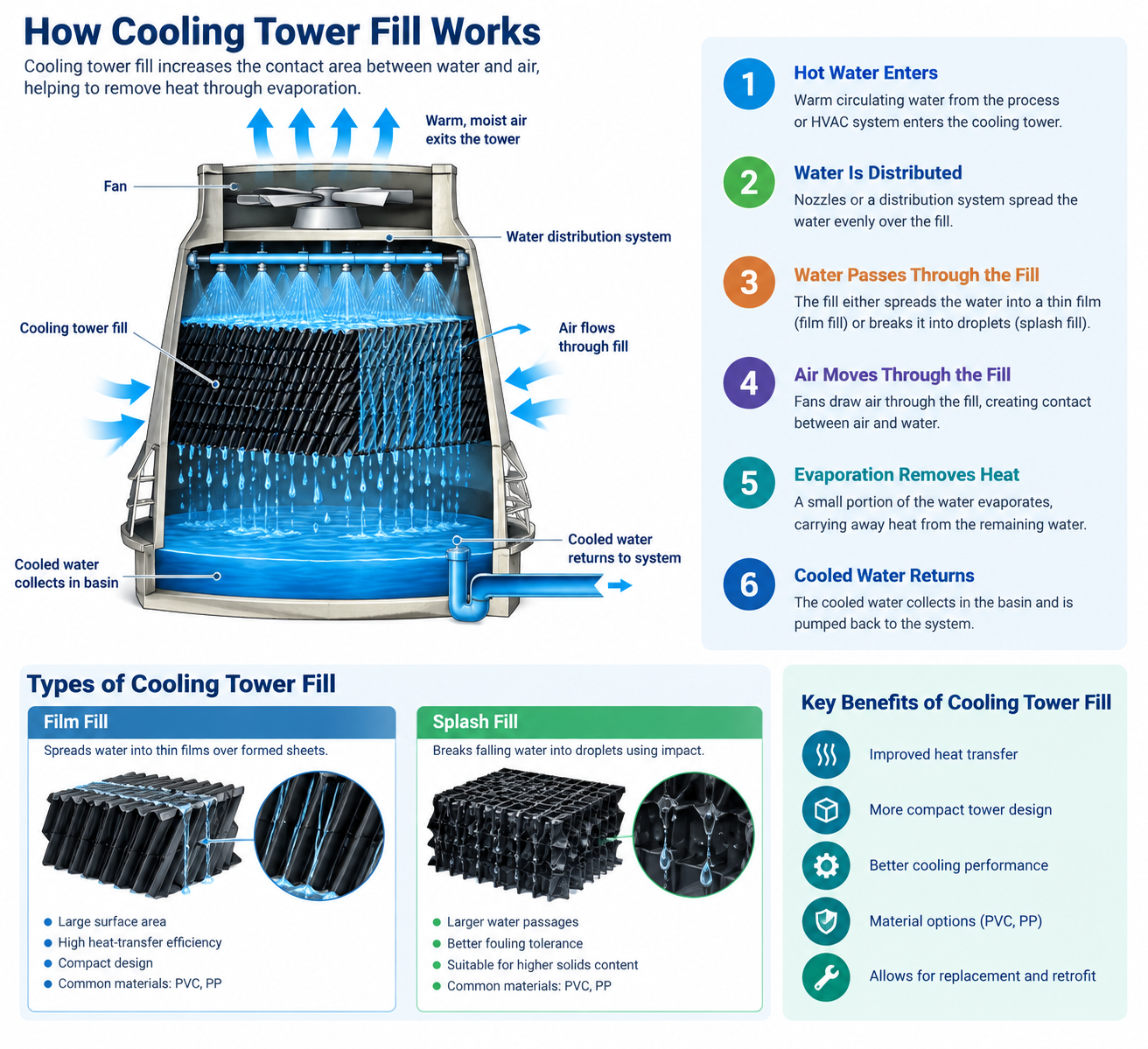
Cooling tower fill is a key component inside an evaporative cooling tower. Its job is to increase the contact area between circulating water and air, making heat and mass transfer more effective. The right fill can help a cooling tower achieve its required cooling performance, while the wrong type may lead to fouling, maintenance problems, or poor thermal performance.
The three main cooling tower fill types are film fill, splash fill, and hybrid fill. Each uses a different method to improve water-air contact and has different advantages for specific operating conditions.
This guide explains how each type works, where it is commonly used, and how to select the right cooling tower fill media for your application.
What Is Cooling Tower Fill?
Cooling tower fill, also called cooling tower packing or fill media, is installed inside the tower between the water distribution system and the air path.
Hot water enters the cooling tower and is distributed over the fill. Air moves through the fill at the same time. The fill increases the effective surface area and contact time between the two streams.
A small portion of the water evaporates. This evaporation removes heat from the circulating water, while sensible heat is also transferred from the water to the air.
The basic process is:
Hot water → Water distribution → Cooling tower fill → Air-water contact → Heat transfer and evaporation → Cooled water
Why Cooling Tower Fill Type Matters
Different fill designs affect:
For example, a film fill with narrow channels can provide a large wetted surface area, but those channels may be more sensitive to suspended solids. Splash fill has larger openings and can be more tolerant of dirty water.
Therefore, fill selection should consider the entire cooling tower system rather than thermal performance alone.
1. Film Cooling Tower Fill
Film fill is one of the most widely used cooling tower fill types. It consists of structured sheets or surfaces that spread water into a thin film.
The sheets are normally formed with corrugations, flutes, or other surface patterns. These structures increase the wetted surface area while controlling water and airflow.
How Film Fill Works
Water flows across the surface of the fill sheets and forms a thin film. Air passes over or between the sheets.
The large surface area allows heat and moisture to transfer efficiently between water and air.
Film fill is commonly manufactured from PVC or PP.
Advantages of Film Fill
High heat-transfer efficiency
Large effective surface area
Compact design
Relatively lightweight
Suitable for many HVAC applications
Suitable for properly treated industrial water
Limitations of Film Fill
The small passages found in many film-fill designs can be susceptible to:
Scale
Algae
Dirt
Suspended solids
Biological growth
For this reason, film fill generally requires appropriate water treatment and regular inspection.
Typical Film Fill Applications
Film cooling tower fill is commonly used in:
HVAC cooling towers
Commercial buildings
Power and process cooling
Manufacturing plants
Clean industrial water systems
Counterflow cooling towers
Crossflow cooling towers
The exact fill geometry should be selected according to the tower's water and airflow conditions.
2. Splash Cooling Tower Fill
Splash fill works differently from film fill. Instead of spreading water into a thin continuous film, splash fill repeatedly breaks water into droplets.
Splash fill can consist of bars, grids, modules, or specially shaped plastic elements.
How Splash Fill Works
As water falls through the fill, it strikes the fill elements and changes direction. This breaks the water into smaller droplets and increases contact between water and air.
The repeated splashing process also helps distribute water throughout the fill area.
Advantages of Splash Fill
Splash cooling tower fill can offer:
Good resistance to fouling
Larger water passages
Better tolerance of suspended solids
Easier inspection in many designs
Good durability
Suitability for challenging water conditions
These characteristics make splash fill useful for industrial applications where water quality is difficult to control.
Limitations of Splash Fill
Compared with high-performance film fill, some splash-fill configurations may require more tower volume to achieve the same thermal duty.
Performance also depends heavily on the fill arrangement, water distribution, airflow, and tower design.
Typical Splash Fill Applications
Splash fill is often considered for:
Industrial cooling towers
Wastewater cooling
Process cooling
High-fouling applications
Towers with suspended solids
Applications where maintenance access is important
PP is commonly used for modern splash fill because of its mechanical and chemical properties.
3. Hybrid Cooling Tower Fill
Hybrid cooling tower fill combines characteristics of film and splash designs.
The objective is to balance thermal performance with resistance to fouling and maintenance requirements.
Hybrid designs vary considerably between manufacturers, so the specific geometry and performance data should always be checked before purchasing.
Advantages of Hybrid Fill
Depending on the design, hybrid fill may provide:
A balance between thermal performance and fouling resistance
Improved flexibility for difficult applications
Good water distribution
Reduced sensitivity to certain contaminants
Compatibility with specific retrofit projects
Hybrid fill can be useful when neither conventional film nor splash fill fully meets the application's requirements.
Film vs Splash vs Hybrid Cooling Tower Fill
The following table provides a general comparison:
| Feature | Film Fill | Splash Fill | Hybrid Fill |
| Heat-transfer potential | High | Moderate to high | High, depending on design |
| Fouling tolerance | Moderate to low | Generally high | Moderate to high |
| Suspended solids | More sensitive | More tolerant | Depends on design |
| Water passages | Smaller | Larger | Variable |
| Maintenance | Requires good water treatment | Generally easier in difficult water | Application dependent |
| Tower volume | Often compact | May require more volume | Variable |
| Common materials | PVC, PP | PP, PVC | PVC, PP |
| Typical use | Clean/treated water | Difficult water | Mixed requirements |
These are general characteristics. Actual performance depends on the manufacturer's design, fill depth, water loading, airflow, and operating conditions.
PVC vs PP Cooling Tower Fill
Material selection is another important part of cooling tower fill selection.
PVC Cooling Tower Fill
PVC cooling tower fill is widely used because it offers a combination of chemical resistance, low weight, formability, and cost efficiency.
PVC is particularly common in film-fill applications.
PP Cooling Tower Fill
PP cooling tower fill is made from polypropylene and is widely used in both film and splash configurations.
PP can provide good chemical resistance and may be suitable for applications requiring higher temperature capability than conventional PVC.
The correct material should be selected according to the actual operating conditions and manufacturer's specifications.
How to Choose the Right Cooling Tower Fill Type
There is no universal fill type for every cooling tower. Consider the following factors before purchasing.
1. Water Quality
Water containing suspended solids, dirt, algae, or heavy scale may require a more fouling-tolerant fill.
Clean and properly treated water can be suitable for many film-fill designs.
2. Cooling Requirements
Check:
The fill must be evaluated as part of the complete tower system.
3. Tower Configuration
Determine whether the tower is:
Counterflow
Crossflow
Forced draft
Induced draft
Fill geometry and installation must match the tower design.
4. Operating Temperature
Check the maximum and continuous operating temperatures against the selected material's specifications.
5. Maintenance Requirements
If frequent cleaning is difficult, consider the fouling characteristics of the fill and the quality of the circulating water.
6. Replacement Dimensions
For a cooling tower fill replacement, verify:
A replacement fill should not be selected based only on appearance or material.
Cooling Tower Fill Maintenance
Regular maintenance is essential for maintaining cooling performance.
Inspect the fill for:
Scale
Algae
Dirt
Cracks
Deformation
Blockage
Biological growth
A suitable water treatment program can help reduce scaling and biological fouling.
Cleaning methods should match the fill material. Excessive water pressure, aggressive chemicals, or improper tools can damage plastic fill.
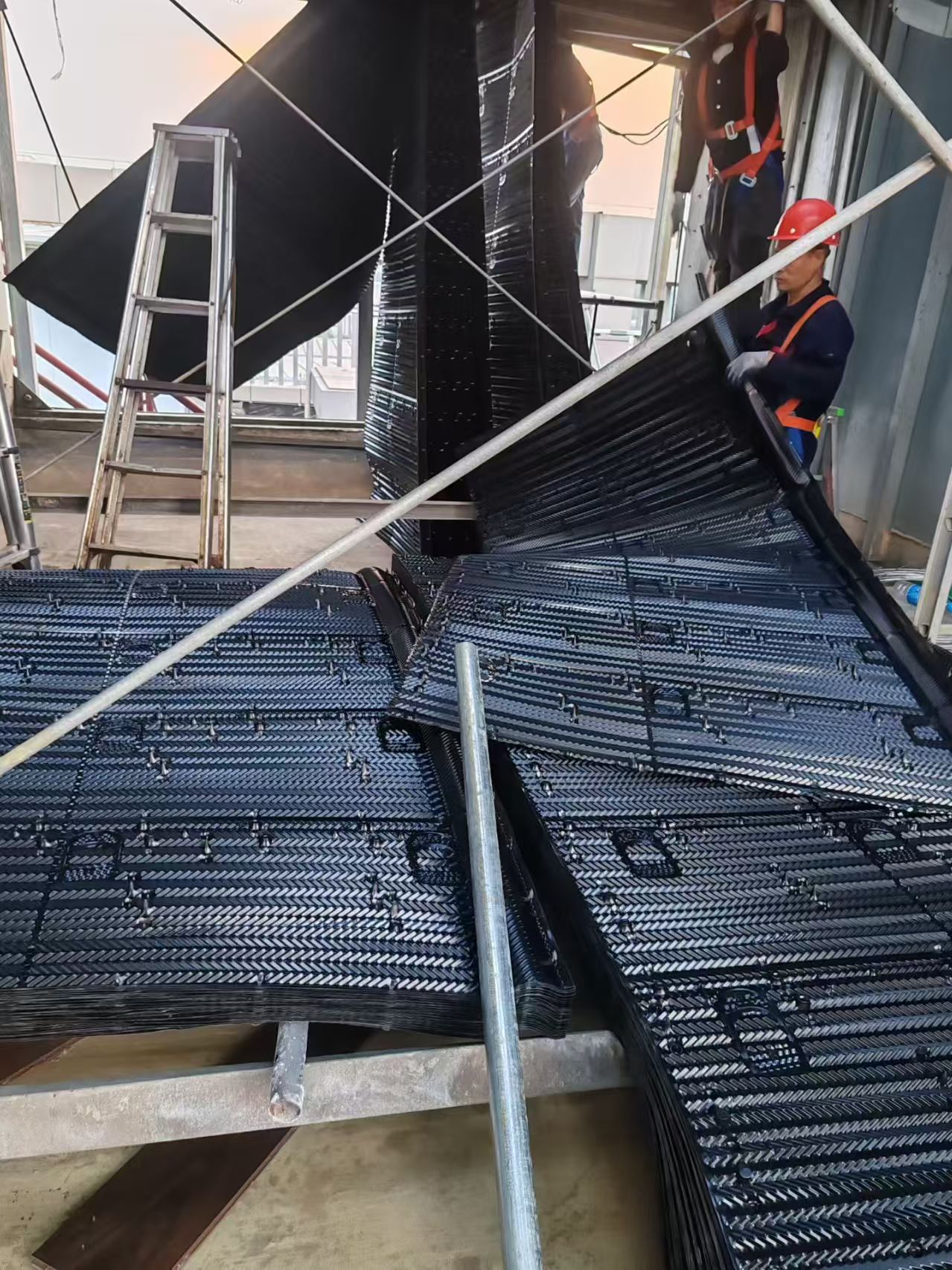
Cooling Tower Fill Replacement
Fill may eventually require replacement because of physical damage, aging, fouling, deformation, or declining thermal performance.
Before ordering replacement fill, identify the tower model and inspect the existing installation.
A good replacement assessment should include:
Existing fill type
Fill dimensions
Tower configuration
Water quality
Operating temperature
Water flow
Airflow
Fill support structure
Current cooling performance
In some retrofit projects, newer fill geometry can improve performance, but compatibility with the existing tower must be verified.
Frequently Asked Questions
Which cooling tower fill is most efficient?
Film fill can provide high heat-transfer performance because it creates a large wetted surface area. Actual efficiency depends on fill geometry, water distribution, airflow, and operating conditions.
Is splash fill better for dirty water?
Splash fill is often more tolerant of suspended solids and fouling because many designs have larger passages. However, the appropriate choice depends on the specific water quality and tower design.
What is hybrid cooling tower fill?
Hybrid fill combines features of film and splash fill to balance thermal performance, water distribution, and fouling resistance.
Is PVC or PP better for cooling tower fill?
Both materials are widely used. PVC is common for film fill, while PP is used for both film and splash applications. The correct material depends on temperature, water chemistry, and other operating conditions.
When should cooling tower fill be replaced?
Fill should be evaluated for replacement when it is severely damaged, deformed, heavily fouled, or no longer supports the required cooling performance. Regular inspection helps identify deterioration early.
Conclusion
Understanding the different cooling tower fill types is essential when designing, upgrading, or maintaining a cooling tower.
Film fill is widely used where high heat-transfer efficiency and good water quality are available. Splash fill can be suitable for applications with higher fouling potential or suspended solids. Hybrid fill provides another option when a balance between thermal performance and fouling resistance is required.
PVC and PP are common fill materials, but the best selection depends on water quality, temperature, tower configuration, thermal requirements, and maintenance conditions.
For cooling tower fill replacement, always verify fill dimensions, geometry, support structure, water distribution, and operating conditions before ordering.
Internal Links for Other CoolingTowerParts
Cooling Tower Nozzles
Cooling Tower Drift Eliminators
Cooling Tower Louvers
Cooling Tower Fan Blades
Cooling Tower Motors


