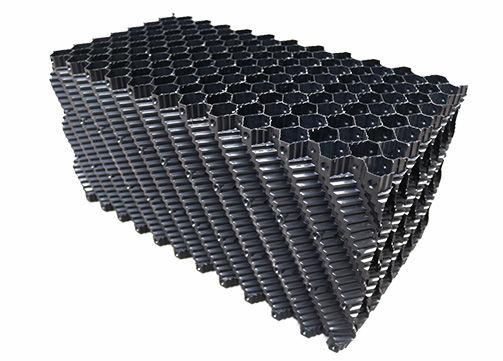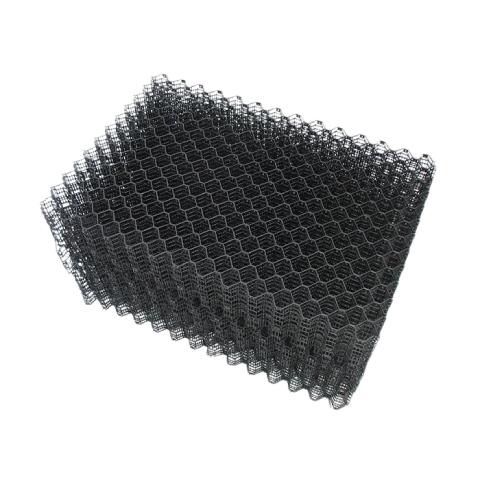
Cooling tower fill is one of the most important components in a cooling tower. It increases the contact area between hot process water and moving air, helping transfer heat more efficiently. However, choosing the right cooling tower fill material is just as important as choosing the right fill type.
The most common materials include PVC and PP cooling tower fill, but other options are available for demanding industrial applications. Material selection affects thermal performance, chemical resistance, operating temperature, service life, maintenance, and replacement cost.
This guide explains the most common cooling tower fill materials, their advantages, limitations, and applications.
What Is Cooling Tower Fill?
Cooling tower fill is the heat-transfer media installed inside a cooling tower. Water flows over or through the fill while air moves in the opposite direction or across the water flow.
The fill creates a large wetted surface area, allowing more effective contact between air and water. This improves evaporation and heat transfer without requiring a much larger cooling tower.
Cooling tower fill is commonly divided into three main types:
Film fill
Splash fill
Hybrid fill
Both film and splash fill can be manufactured from different plastics or other materials depending on operating conditions.
Why Cooling Tower Fill Material Matters
The material used for cooling tower fill directly influences its performance and durability.
When selecting fill material, industrial buyers should consider:
Operating water temperature
Chemical composition of the circulating water
Biological fouling risk
Suspended solids and debris
UV exposure
Mechanical strength
Fire-retardant requirements
Expected service life
Cleaning requirements
Replacement cost
A material that performs well in a clean industrial water system may not be suitable for a wastewater or high-temperature application.
PVC Cooling Tower Fill
PVC cooling tower fill is one of the most widely used options for industrial and commercial cooling towers.
PVC, or polyvinyl chloride, can be formed into thin sheets with corrugated or structured surfaces. These sheets are commonly used for film-fill applications.
Advantages of PVC Fill
PVC cooling tower fill offers several benefits:
Good heat-transfer performance
Relatively low material cost
Lightweight construction
Good chemical resistance
Easy fabrication
Large available range of profiles and dimensions
Suitable for many industrial cooling towers
PVC film fill can provide a large surface area within a relatively compact volume, making it a popular choice for applications where cooling efficiency and installation space are important.
PVC Cooling Tower Fill Applications
PVC fill is commonly used in:
For many standard-temperature applications, PVC is a practical balance between thermal performance and cost.
PP Cooling Tower Fill
PP cooling tower fill, made from polypropylene, is another widely used material. PP is particularly useful when higher chemical resistance, toughness, or temperature resistance is required.
PP can be manufactured as film fill or splash fill depending on the cooling tower design.
Advantages of PP Cooling Tower Fill
Key advantages include:
Good chemical resistance
Higher temperature capability than many standard PVC applications
Good impact resistance
Lightweight construction
Good resistance to moisture
Suitable for aggressive industrial environments
PP is often considered when the circulating water contains chemicals or when operating conditions are more demanding.
PP Cooling Tower Fill Applications
PP cooling tower fill can be used in:
Industrial process cooling
Chemical processing
Wastewater applications
High-temperature cooling systems
Cooling towers with challenging water chemistry
Industrial retrofit projects
When selecting PP fill, buyers should still verify the actual operating temperature, chemical exposure, fill design, and manufacturer's specifications.
PVC vs. PP Cooling Tower Fill
PVC and PP are both popular choices, but they are not interchangeable in every application.
| Feature | PVC Fill | PP Fill |
| Material cost | Generally economical | Generally higher |
| Heat-transfer performance | Excellent for many applications | Excellent when properly designed |
| Chemical resistance | Good | Very good |
| Temperature resistance | Suitable for standard applications | Generally better for higher-temperature service |
| Weight | Lightweight | Lightweight |
| Common use | Commercial and industrial towers | Industrial and demanding applications |
| Fill types | Mainly film, also other designs | Film and splash |
| Maintenance | Relatively easy | Relatively easy |
The best choice depends on the cooling tower design and operating conditions rather than material price alone.
Other Cooling Tower Fill Materials
Although PVC and PP dominate many modern cooling tower applications, other materials may be used in specific systems.
Polyethylene Fill
Polyethylene, particularly HDPE, offers good impact resistance and chemical resistance. It can be considered for certain splash-fill applications and demanding environments.
However, it is less commonly selected than PVC or PP for conventional high-efficiency film fill.
FRP Cooling Tower Fill Components
Fiberglass-reinforced plastic, or FRP, is better known for structural cooling tower components than for conventional film-fill sheets.
FRP may be used for:
Supports
Grating
Structural members
Walkways
Fill-support systems
Its strength and corrosion resistance make it useful in aggressive environments.
Wood Cooling Tower Fill
Wood was historically used in some cooling towers, particularly large industrial systems. Modern plastic fill has largely replaced it in many applications because plastics can offer more consistent performance, lower maintenance, and longer service life under suitable conditions.
Wood may still appear in specialized or legacy cooling tower designs.
Ceramic Fill
Ceramic materials can withstand certain harsh environments and high temperatures. However, ceramic fill is heavier and more fragile than plastic fill, limiting its use in many conventional cooling towers.
It may be considered where extreme temperature or chemical conditions make conventional plastic materials unsuitable.
Film Fill vs. Splash Fill Material
Material selection should not be separated from fill design.
Film Fill
Film fill spreads water into a thin film over a large surface area. It provides high heat-transfer efficiency and is commonly manufactured from PVC or PP.
Film fill is suitable for relatively clean water systems where plugging and fouling can be controlled.
Splash Fill
Splash fill breaks water into droplets as it falls through the fill. It is often preferred where water contains suspended solids, biological material, or other contaminants.
Splash fill can be manufactured from PP, PVC, or other suitable materials depending on the design.
For dirty-water applications, PP splash fill for cooling towers is often considered because of its mechanical strength and chemical resistance.
How to Choose the Right Cooling Tower Fill Material
Choosing the right cooling tower fill material requires more than comparing PVC and PP prices.
1. Check Operating Temperature
Confirm the normal and maximum circulating-water temperatures. Temperature can significantly affect the long-term performance of plastic fill.
2. Evaluate Water Chemistry
Check pH, dissolved chemicals, oil contamination, chlorides, and other substances in the circulating water.
3. Consider Fouling Risk
If the system has high suspended solids or biological growth, splash fill may be more suitable than fine-pitch film fill.
4. Match the Existing Fill Design
For replacement projects, check:
A material change alone does not guarantee compatibility.
5. Consider Fire Requirements
Some installations require flame-retardant or specific fire-performance characteristics. Always check project specifications and applicable regulations.
6. Compare Total Cost
The cheapest fill is not necessarily the lowest-cost solution. Consider expected service life, cleaning frequency, pressure drop, thermal performance, replacement labor, and downtime.
Cooling Tower Fill Replacement: PVC or PP?
For a cooling tower fill replacement, the original fill material is a useful starting point, but it should not be the only consideration.
A replacement supplier should review the cooling tower model, fill dimensions, water temperature, water quality, airflow, and required thermal performance.
For example, replacing an existing PVC film fill with a PP product may be technically possible, but the new fill must have the correct geometry and performance characteristics.
For retrofit projects, accurate measurements and engineering confirmation are essential.
Benefits of Choosing the Right Fill Material
The correct cooling tower fill material can help provide:
Efficient heat transfer
Stable cooling performance
Better resistance to chemical attack
Longer service life
Reduced maintenance
Lower replacement frequency
Better compatibility with operating water
Improved overall cooling tower reliability
Because fill represents a major heat-transfer surface inside the tower, the material and design should be treated as an important engineering decision.
Cooling Tower Fill Material FAQs
What is the most common cooling tower fill material?
PVC is one of the most widely used materials for cooling tower film fill. PP is also widely used, particularly in industrial and more demanding applications.
Is PP better than PVC for cooling tower fill?
Neither material is universally better. PVC can be highly suitable for standard applications, while PP may offer advantages in higher-temperature or chemically demanding environments. The correct choice depends on operating conditions.
How long does PVC cooling tower fill last?
Service life varies according to water quality, temperature, UV exposure, fouling, cleaning practices, and mechanical conditions. Regular inspection helps determine when replacement is necessary.
Can PVC and PP cooling tower fill be used interchangeably?
Not automatically. Fill geometry, temperature rating, chemical compatibility, thermal performance, and tower design must all be checked before changing materials.
What is the best fill material for dirty water?
Splash fill is often considered for water containing high levels of suspended solids or biological contaminants because its open structure can be less prone to blockage than fine film fill. The final selection should be based on the actual water quality and tower design.
Conclusion
PVC and PP cooling tower fill are the two most important materials to consider for many modern cooling tower applications. PVC provides a cost-effective solution for a wide range of standard film-fill systems, while PP offers strong chemical resistance, toughness, and suitability for more demanding industrial conditions.
Other materials, including polyethylene, FRP, wood, and ceramic, may also have specialized applications.
When purchasing or replacing cooling tower fill, do not choose material based on price alone. Consider water chemistry, temperature, fouling risk, fill type, thermal performance, dimensions, and expected service life. Matching the material and fill design to the actual cooling tower operating conditions is the key to reliable and efficient cooling.
Internal Links for Other CoolingTowerParts
Cooling Tower Nozzles
Cooling Tower Drift Eliminators
Cooling Tower Louvers
Cooling Tower Fan Blades
Cooling Tower Motors