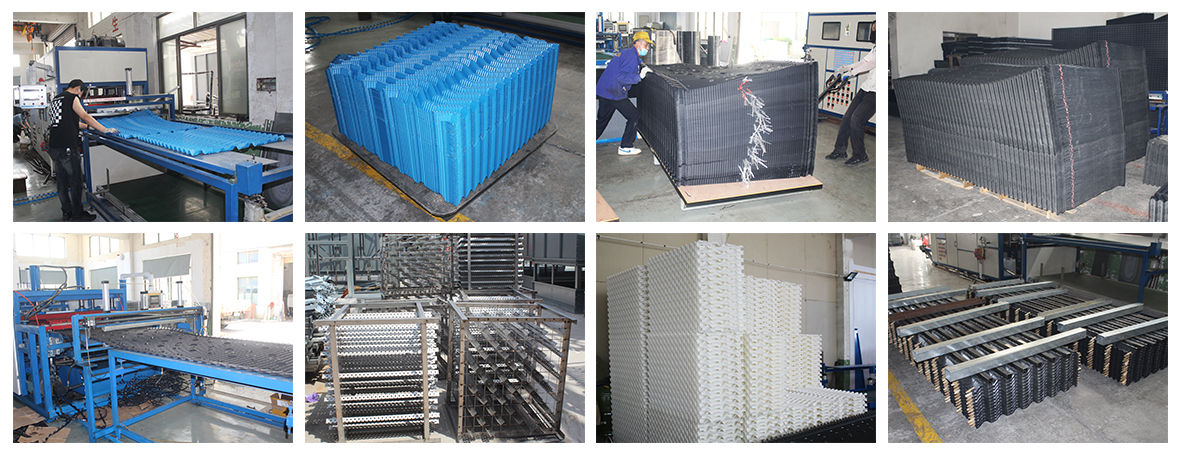
Cooling tower fill is a critical component in an evaporative cooling tower. It increases the contact area between water and air, allowing heat to transfer more effectively and helping the cooling tower reduce circulating-water temperature.
Whether you are purchasing a new cooling tower, upgrading an existing system, or planning a cooling tower fill replacement, understanding fill types, materials, applications, and maintenance requirements can help you make a better purchasing decision.
This guide covers everything you need to know about cooling tower fill.
What Is Cooling Tower Fill?
Cooling tower fill, also called cooling tower packing or fill media, is the material installed inside a cooling tower to improve water-air contact.
Hot circulating water enters the tower through the distribution system and flows over or through the fill. At the same time, air passes through the fill. The fill increases the available surface area, allowing heat and moisture to transfer between water and air.
A small portion of the water evaporates during the process. This evaporation removes heat from the remaining water, which is then collected in the cold-water basin and returned to the cooling system.
Without suitable fill media, the tower would require significantly more space to achieve the same level of heat transfer.
How Does Cooling Tower Fill Work?
The basic cooling process can be summarized as:
Hot water → Water distribution → Cooling tower fill → Air-water contact → Heat and moisture transfer → Cooled water
The fill does not create cooling by itself. Instead, its surface structure helps distribute water and increase contact between water and air.
Depending on the fill design, water may:
The goal is to maximize effective contact between air and water while keeping pressure drop and maintenance requirements within acceptable limits.
Why Is Cooling Tower Fill Important?
The fill has a major influence on cooling tower performance.
Properly selected cooling tower fill media can help:
Increase heat-transfer efficiency
Reduce required tower volume
Maintain the desired cold-water temperature
Improve cooling capacity
Support stable tower operation
Make better use of available airflow
However, fill selection must match the rest of the cooling tower system. Fan capacity, water distribution, airflow, water quality, and operating conditions also affect performance.
Main Types of Cooling Tower Fill
There are three major categories of cooling tower fill.
1. Film Cooling Tower Fill
Film fill consists of closely spaced sheets or structured surfaces that spread water into thin films.
Because a large wetted surface area is created, film fill can provide high heat-transfer efficiency.
Film fill is commonly used for:
HVAC cooling towers
Industrial process cooling
Clean or properly treated water
Compact cooling tower designs
Applications requiring high thermal performance
One consideration is fouling. Narrow passages can become blocked by scale, algae, dirt, or suspended solids if water treatment is inadequate.
2. Splash Cooling Tower Fill
Splash fill uses bars, grids, or other structures to break water into droplets as it falls through the tower.
Splash fill is commonly considered for applications where water contains more suspended solids or where fouling resistance is important.
Potential advantages include:
Larger water passages
Better tolerance of suspended solids
Easier inspection and cleaning
Suitability for challenging industrial water conditions
3. Hybrid Cooling Tower Fill
Hybrid fill combines characteristics of film and splash fill.
It can be used when the application requires a balance between thermal efficiency, fouling resistance, and maintenance requirements.
The appropriate design depends on the cooling tower and operating conditions.
Cooling Tower Fill Materials
The material of the fill affects its temperature resistance, chemical resistance, durability, and service life.
PVC Cooling Tower Fill
PVC cooling tower fill is widely used, particularly for film-fill applications.
PVC provides a useful combination of:
PVC is commonly used in HVAC and industrial cooling towers where water temperature and chemical conditions are within the material's recommended limits.
PP Cooling Tower Fill
PP cooling tower fill is made from polypropylene and is also widely used for industrial applications.
PP offers good chemical resistance and can provide higher temperature capability than standard PVC in some applications.
PP can be used for both film and splash-fill designs.
Other Cooling Tower Fill Materials
Special applications may require other plastics or specialized materials.
When selecting fill material, consider:
Film Fill vs Splash Fill
Understanding the difference between film and splash fill is important when selecting cooling tower packing.
| Feature | Film Fill | Splash Fill |
| Heat-transfer potential | High | Moderate to high |
| Clean-water applications | Excellent | Good |
| Fouling tolerance | Generally lower | Generally higher |
| Suspended solids | More sensitive | More tolerant |
| Water distribution | Requires good distribution | More forgiving |
| Common materials | PVC, PP | PP, PVC and other plastics |
| Typical applications | HVAC and industrial cooling | Industrial and difficult-water applications |
Actual performance depends on the specific fill geometry, tower design, airflow, water flow, and water treatment system.
Cooling Tower Fill for Counterflow and Crossflow Towers
The cooling tower configuration determines how air and water move through the fill.
Counterflow Cooling Tower Fill
In a counterflow tower, water generally flows downward while air moves upward through the fill.
This configuration can provide efficient heat and mass transfer within a relatively compact structure.
Crossflow Cooling Tower Fill
In a crossflow tower, air moves horizontally across water flowing downward through the fill.
The fill must be compatible with the tower's water distribution system and support structure.
For replacement projects, the original fill dimensions and orientation should be carefully checked.
How to Choose Cooling Tower Fill
Selecting the right cooling tower fill requires more than choosing PVC or PP.
Consider the following factors:
Water Quality
Check suspended solids, scaling, biological growth, oil contamination, and water treatment conditions.
Clean water can be suitable for many film-fill designs, while heavily contaminated water may require a more fouling-tolerant solution.
Operating Temperature
Verify the normal and maximum water temperatures against the manufacturer's material specifications.
Tower Type
Determine whether the tower is counterflow or crossflow and confirm the required fill configuration.
Thermal Requirements
Consider:
Water flow rate
Airflow
Cooling range
Approach temperature
Wet-bulb temperature
Fill depth
Fill Dimensions
For replacement projects, verify:
Fill length
Fill width
Fill height
Sheet thickness
Flute pattern
Support spacing
A fill block that looks similar to the original may still be unsuitable if its dimensions or geometry are different.
Cooling Tower Fill Replacement
Cooling tower fill replacement is commonly performed when existing fill becomes damaged, heavily fouled, deformed, or unable to provide the required thermal performance.
Before replacing the fill, inspect:
Existing fill condition
Fill dimensions
Water distribution system
Fill supports
Airflow conditions
Water quality
Current cooling performance
Replacing fill without addressing poor water distribution or water-treatment problems may not solve the underlying performance issue.
For retrofit projects, a compatible replacement can often be installed while retaining the existing cooling tower structure.
Cooling Tower Fill Maintenance
Regular maintenance helps extend fill service life.
Recommended practices include:
Inspecting fill regularly
Removing dirt and debris
Controlling scale formation
Managing algae and biological growth
Maintaining proper water treatment
Checking for broken or deformed sheets
Inspecting fill supports
Monitoring cooling performance
Cleaning methods should be appropriate for the specific fill material and construction. Excessive pressure or unsuitable chemicals can damage plastic fill.
Common Cooling Tower Fill Problems
Several problems can reduce fill performance.
Clogging
Dirt, algae, scale, and suspended solids can block fill passages and reduce water or airflow.
Scaling
Mineral deposits can reduce the effective heat-transfer surface and restrict water flow.
Biological Growth
Algae and biofilm can block passages and reduce cooling efficiency.
Deformation
Excessive temperature, chemical exposure, mechanical damage, or aging can deform plastic fill.
Uneven Water Distribution
Poor water distribution can leave portions of the fill dry while overloading other areas, reducing overall thermal performance.
Frequently Asked Questions
What is cooling tower fill used for?
Cooling tower fill increases water-air contact area and contact time, improving heat and mass transfer and helping reduce circulating-water temperature.
What is the best material for cooling tower fill?
PVC and PP are widely used. The appropriate material depends on operating temperature, water chemistry, tower design, and application requirements.
Is film fill better than splash fill?
Neither is universally better. Film fill can provide high thermal efficiency with suitable water quality, while splash fill can be more tolerant of suspended solids and fouling.
How often should cooling tower fill be replaced?
There is no universal replacement interval. Service life depends on water quality, operating temperature, chemical exposure, maintenance, and physical condition. Regular inspection is recommended.
Can PVC cooling tower fill be used in industrial applications?
Yes. PVC cooling tower fill is widely used in industrial and HVAC applications when the operating temperature and chemical environment are suitable for PVC.
Conclusion
Cooling tower fill is essential for efficient heat and mass transfer in evaporative cooling towers. Film fill, splash fill, and hybrid fill provide different performance characteristics, while PVC and PP are two of the most common materials.
The right choice depends on water quality, tower configuration, operating temperature, thermal requirements, fouling risk, and maintenance conditions.
For cooling tower fill replacement, always verify the existing fill dimensions, geometry, support system, and water distribution arrangement before ordering. A properly matched fill can help maintain cooling performance, reduce maintenance problems, and extend the useful life of the cooling tower.
Internal Links for Other CoolingTowerParts
Cooling Tower Nozzles
Cooling Tower Drift Eliminators
Cooling Tower Louvers
Cooling Tower Fan Blades
Cooling Tower Motors


