Reliable Power Transmission for Industrial Cooling Towers
The Cooling Tower Belt Reducer is an essential drive component that efficiently transfers power from the motor to the cooling tower fan through a V-belt transmission system. By reducing motor speed while increasing torque, the belt reducer enables the fan to operate at its optimum speed, improving cooling performance, reducing energy consumption, and extending equipment life.
At CoolingTowerPart.com, our cooling tower belt reducers are manufactured using premium materials and precision machining technology to ensure stable performance in demanding industrial environments. They are suitable for both new installations and replacement projects across a wide range of cooling tower brands and models.
Whether your application is in HVAC, power generation, manufacturing, or chemical processing, our belt reducers provide dependable, long-lasting performance with simple installation and m
aintenance.
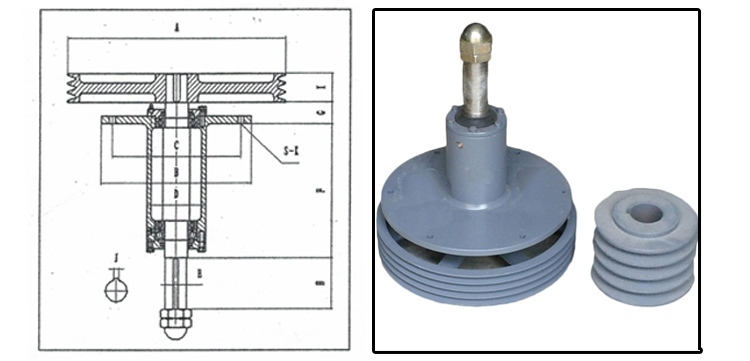
Technical Specifications
PT manufactures multiple models of cooling tower belt reducers to accommodate different cooling tower capacities and fan configurations.
| Specification(#) | External dimensions | Install dimensions |
| P | L | B | AD | E | C | H | A | D | G | F | S-K | V-B
|
| 5# | φ350 | 450 | 45 | φ305 | 78 | 173 | 55 | φ265 | φ34 | 30 | 8 | 4-φ12.5 | 2-B |
| 6# | φ456 | 490 | 67 | φ352 | 105 | 201 | 60 | φ300 | φ38 | 34 | 8 | 4-φ14 | 3-B |
| 8# | φ458 | 565 | 85 | φ420 | 120 | 213 | 60 | φ390 | φ50 | 45 | 12 | 4-φ16 | 4-B |
| 10# | φ608 | 700 | 91 | φ490 | 135 | 310 | 62 | φ450 | φ50 | 45 | 12 | 4-φ16 | 4-B |
| 12# | φ660 | 730 | 111 | φ490 | 145 | 310 | 62 | φ450 | φ60 | 55 | 12 | 4-φ16 | 5-B |
| 14# | φ660 | 750 | 131 | φ490 | 156 | 313 | 62 | φ450 | φ75 | 67.5 | 20 | 6-φ18 | 6-B |
| 16# | φ660 | 760 | 131 | φ490 | 156 | 313 | 62 | φ450 | φ75 | 67.5 | 20 | 6-φ18 | 6-B |
Additional specifications include:
Standardized flange dimensions
Heavy-duty shaft construction
High-quality precision bearings
Adjustable transmission ratios
Multiple mounting hole configurations
Custom models can also be manufactured to match OEM cooling tower designs.
Product Features
Efficient Power Transmission
The belt reducer transfers motor power to the cooling tower fan with minimal energy loss, ensuring smooth and reliable operation.
Key Benefits
High transmission efficiency
Stable fan speed
Reduced power consumption
Improved cooling performance
Heavy-Duty Construction
Built for continuous operation, each belt reducer is manufactured from durable materials that withstand harsh operating environments.
Material Options
Cast Iron
Ductile Iron
Aluminum Alloy
Carbon Steel
Stainless Steel Hardware
These materials provide excellent resistance to corrosion, wear, and outdoor weather conditions.
Smooth and Quiet Operation
Precision-balanced pulleys and accurately machined components help minimize vibration and noise.
Advantages
Easy Installation
The compact design allows for quick installation and convenient replacement, reducing equipment downtime during maintenance.
Simple Maintenance
Routine maintenance is straightforward and includes:
Regular maintenance helps maximize service life and maintain efficient performance.
Technical Specifications
| Specification | Details |
| Product Name | Cooling Tower Belt Reducer |
| Drive Type | V-Belt Drive |
| Application | Cooling Tower Fan Drive |
| Material | Cast Iron, Aluminum Alloy, Carbon Steel |
| Belt Type | Classical V-Belt / Narrow V-Belt |
| Pulley Type | Single Groove / Multiple Groove |
| Motor Power | 1.5–55 kW (Custom Sizes Available) |
| Speed Ratio | Customized |
| Installation | Horizontal or Vertical |
| Surface Treatment | Anti-Corrosion Coating |
| Operating Environment | Indoor & Outdoor |
Main Components
Each cooling tower belt reducer assembly may include:
Drive Pulley
Driven Pulley
High-Strength V-Belts
Bearing Assembly
Shaft
Adjustable Motor Base
Belt Guard
Mounting Brackets
Fasteners
All components are manufactured for reliable performance and long service life.
Product Advantages
Improve Cooling Efficiency
By maintaining the correct fan speed, the belt reducer ensures effective airflow through the cooling tower, improving heat rejection efficiency.
Reduce Maintenance Costs
The simple mechanical structure allows for faster inspections, easier replacement of wear parts, and lower maintenance expenses compared to more complex drive systems.
Long Service Life
High-quality materials and precision manufacturing help reduce wear, ensuring dependable operation over extended periods.
Flexible Speed Adjustment
Changing pulley sizes allows fan speed to be adjusted to match different operating conditions without replacing the motor.
Reliable Performance
Designed for continuous-duty operation, the belt reducer delivers stable performance even in demanding industrial environments.
Applications
Cooling tower belt reducers are widely used in:
Commercial HVAC Systems
Office buildings, hotels, hospitals, shopping malls, airports, and educational facilities.
Industrial Cooling Towers
Manufacturing plants, steel mills, textile factories, paper mills, and machinery production.
Power Generation
Thermal power plants and combined-cycle power stations requiring continuous cooling.
Chemical and Petrochemical Plants
Cooling systems operating in corrosive or high-temperature environments.
Food and Beverage Industry
Breweries, dairy plants, beverage factories, and food processing facilities.
Data Centers
Reliable cooling solutions for mission-critical server and equipment rooms.
Quality Control
Every cooling tower belt reducer undergoes strict quality inspections throughout the manufacturing process.
Inspection procedures include:
Raw material inspection
Precision machining verification
Dimensional measurement
Dynamic balancing
Surface coating inspection
Assembly testing
Final performance inspection
These quality checks ensure consistent performance and product reliability.
Why Choose CoolingTowerPart.com?
Professional Manufacturing Experience
Specializing in cooling tower components with extensive industry expertise.
High-Quality Materials
Only premium materials are selected to ensure durability and long operating life.
Competitive Pricing
Factory-direct supply provides excellent value without compromising quality.
Fast Delivery
Efficient production and inventory management support timely shipment worldwide.
Technical Support
Professional engineers are available to assist with product selection, installation guidance, and maintenance recommendations.
Maintenance Tips
To achieve maximum performance and service life, we recommend:
Inspect belt tension regularly.
Replace belts showing signs of wear or cracking.
Keep pulleys properly aligned.
Lubricate bearings according to maintenance schedules.
Remove dirt and debris from the drive assembly.
Check fasteners periodically for secure installation.
Monitor operating noise and vibration for early detection of potential issues.
Frequently Asked Questions
What is the function of a cooling tower belt reducer?
A cooling tower belt reducer transfers power from the motor to the fan while reducing speed and increasing torque, allowing the fan to operate efficiently.
How often should V-belts be inspected?
V-belts should be inspected regularly as part of routine maintenance. Worn, cracked, or stretched belts should be replaced promptly to maintain efficient operation.
What are the advantages of a belt reducer?
A belt reducer offers smooth power transmission, adjustable fan speed, simple maintenance, lower operating noise, and cost-effective operation.
Can the pulley ratio be customized?
Yes. Different pulley diameters and speed ratios are available to meet various cooling tower performance requirements.
What industries use cooling tower belt reducers?
They are commonly used in HVAC systems, power plants, manufacturing facilities, chemical processing, food production, mining, and commercial buildings.
Why Choose PT for Cooling Tower Belt Reducers?
Premium Quality: Made with imported raw materials for durability.
Competitive Pricing: Flexible pricing tailored to market demands.
Expertise: Over 20 years of experience in cooling tower solutions.
Superior Service: Comprehensive support with a 12-month warranty.


