Replacement Cooling Tower Fan Blade for Industrial Cooling Systems
Meta Description: High-performance replacement
cooling tower fan blades in FRP and aluminum alloy. Low noise, corrosion-resistant, dynamically balanced blades compatible with open, closed, crossflow and counterflow industrial cooling towers for HVAC, power, chemical and manufacturing cooling.
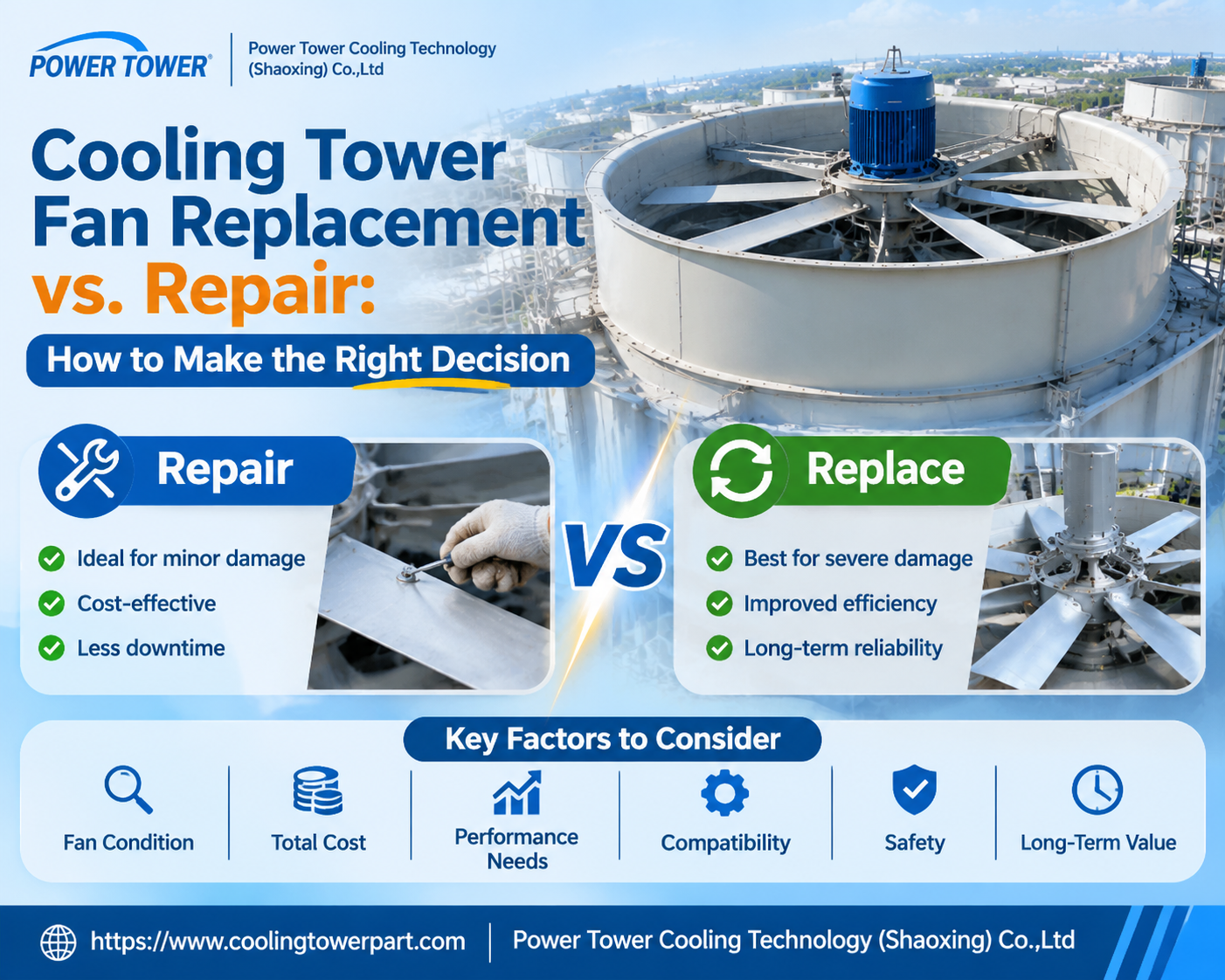
Introduction
Industrial cooling towers are the backbone of process cooling across countless heavy industries. From power generation plants, chemical processing factories and oil refineries to food & beverage facilities, data center cooling systems, steel mills and commercial HVAC installations, cooling towers continuously reject excess process heat into the ambient air. At the heart of every forced-draft and induced-draft cooling tower sits the axial fan assembly, and the fan blade is the critical component that moves massive volumes of air through the fill media to enable efficient evaporative cooling.
After years of continuous operation in harsh environments, original cooling tower fan blades gradually degrade. Exposure to high humidity, circulating water chemicals, chlorine, salt spray, dust, temperature cycling and occasional mechanical impact will wear down blade surfaces, delaminate composite materials or induce metal fatigue. Once fan blades lose their original aerodynamic shape, structural integrity or rotational balance, the whole cooling tower’s performance deteriorates rapidly. Outlet water temperatures climb, energy consumption spikes, vibration transfers to the hub, gear reducer and motor, and unplanned downtime becomes a serious risk for your production line.
This detailed guide focuses entirely on replacement
cooling tower fan blades built for industrial cooling systems. We break down failure causes, material comparisons, core selection criteria, OEM compatibility, aerodynamic design principles, installation standards, ongoing maintenance, common pitfalls and purchasing advice for plant engineers, maintenance supervisors, cooling tower contractors, EPC project managers and spare parts procurement buyers. Whether you are looking for a direct drop-in replacement for an existing tower or planning an efficiency upgrade for an aging cooling system, this article will help you make an informed, cost-effective decision.
The Core Role of Fan Blades Within an Industrial Cooling Tower
Many buyers underestimate how much the fan blade design dictates overall cooling tower performance. Cooling tower heat transfer depends heavily on consistent, uniform airflow passing across the wet fill pack. The axial fan pulls or pushes air through the tower, and each blade’s airfoil shape, pitch angle, surface finish and weight distribution directly control airflow rate, static pressure, noise output and power draw.
Induced Draft vs Forced Draft Fan Blade Applications
Cooling towers are grouped into induced draft and forced draft configurations, and each setup places different stress loads on fan blades.
Induced Draft Cooling Tower Fan Blades
Induced draft fans are mounted at the top exhaust of the tower. Blades work in warm, moisture-saturated exhaust air, where chemical vapors and condensate accelerate corrosion. This is the most common design for counterflow cooling towers and the largest demand segment for replacement fan blades.
Forced Draft Cooling Tower Fan Blades
Forced draft fans sit at the air inlet side. Blades ingest cooler ambient air, but they face higher levels of incoming dust, sand and airborne debris that abrade blade surfaces over time. Crossflow cooling towers frequently use forced draft fan arrangements.
How Blade Condition Impacts Other Fan Train Components
The fan blade set does not operate in isolation. It connects to a central hub, which links to the gearbox, drive shaft and electric motor. An out-of-balance blade creates cyclic vibration that travels through the entire drive train. Small vibration issues can destroy expensive components far faster than most operators expect. Damaged blades are often the root cause of premature gearbox bearing failure, motor winding overheating, cracked hub flanges and loose fastener failures.
Common Root Causes of Cooling Tower Fan Blade Failure
Cooling tower fan blades are engineered for long service life, but the operating environment is extremely aggressive. Understanding failure modes helps you schedule proactive replacement instead of reacting to sudden breakdowns.
Environmental Degradation
Continuous high humidity is the biggest long-term threat. For coastal sites, salt-laden air creates electrochemical corrosion. Chemical plants and wastewater facilities expose blades to chlorine, sulfur compounds and acidic vapors. Even standard circulating water treatment chemicals slowly erode unprotected surfaces. UV radiation from sunlight also breaks down resin binders on FRP blades, leading to surface chalking and gradual fiber exposure.
Mechanical Damage and Impact
Debris pulled into the air stream, falling ice in cold seasons, improper access platform handling, or accidental contact during maintenance can nick, gouge or crack blade edges. Even a small chip on the leading edge disrupts airflow, creates turbulence and raises noise levels. If the damage creates uneven weight distribution, imbalance develops immediately.
Aerodynamic Overload and Improper Pitch Setting
Blade pitch angle is carefully calibrated at the factory. If previous maintenance workers adjust pitch too high to chase more airflow, the fan draws excess power, overloading the motor and creating excessive bending stress on each blade root. Over-pitched blades often develop root cracks, which are hard to spot until catastrophic failure occurs.
Aging, Fatigue and Delamination
Composite FRP blades suffer delamination when water penetrates between fiber layers. Aluminum blades develop fatigue cracks at the root and bolt holes after millions of rotation cycles. These defects often start internally and remain invisible until a visual inspection catches them.
Clear Warning Signs That You Need Replacement Cooling Tower Fan Blades
Plant maintenance teams should include fan blade inspection in their regular cooling tower checklists. Watch for these clear indicators that replacement should be scheduled as soon as possible.
Visual Defects on Blade Surfaces
Visible cracks, splits, bubbling resin, exposed glass fibers, chipped leading/trailing edges, deep gouges, permanent bending or twisted blade profiles all signal structural weakness. Chalking and widespread surface erosion mean the protective outer layer has failed, and degradation will accelerate quickly.
Abnormal Vibration and Noise
Rattling, low-frequency thumping, howling or uneven fan noise are classic imbalance symptoms. Vibration sensors will show elevated readings at the fan bearing, gearbox or motor base. Do not simply tighten bolts to mask vibration; the underlying blade issue will return.
Falling Cooling Efficiency
If your cooling tower can no longer reach the design cold water temperature even when fill media, spray nozzles and water distribution are in good condition, reduced airflow from worn fan blades is very likely the cause. This leads to downstream process overheating and limits production throughput.
Repeated Drive-Train Failures
Frequent bearing replacement, recurring motor overload trips or repeated gearbox seal leaks often trace back to unbalanced fan blades. Replacing only the gearbox or motor without fixing the blade issue leads to repeated repair costs.
Main Material Options for Replacement Cooling Tower Fan Blades
When sourcing replacement blades, material selection is one of your most important decisions. FRP fiberglass blades and aluminum alloy blades dominate the industrial market, and each has distinct strengths, weaknesses and ideal application scenarios.
FRP Fiberglass Reinforced Plastic Cooling Tower Fan Blades
FRP has become the preferred choice for most new cooling towers and retrofits in recent decades.
Key Advantages of FRP Fan Blades
FRP delivers outstanding corrosion resistance against salt spray, chlorine, moisture and mild chemical fumes. It is lighter than aluminum, which reduces static load and rotational inertia on the gearbox and motor. Composite manufacturing allows moldable, highly optimized airfoil shapes that improve aerodynamic efficiency and cut noise. FRP blades can be formulated with UV inhibitors and flame-retardant resin grades for special sites. When properly balanced, they run smoothly for many years with minimal maintenance.
Limitations of FRP Blades
Severe mechanical impact can crack or chip FRP more easily than metal. High-temperature exhaust above the resin rating will accelerate degradation. Repairing deep delamination is difficult and rarely cost-effective; full replacement is usually recommended.
Best Applications for FRP Blades
Coastal facilities, chemical plants, closed circuit cooling towers, wastewater treatment cooling, HVAC towers and sites with treated circulating water chemistry.
Aluminum Alloy Cooling Tower Fan Blades
Aluminum blades were widely used on older generations of cooling towers and remain available as replacement parts.
Key Advantages of Aluminum Fan Blades
Aluminum offers high rigidity and excellent impact resistance. It performs reliably in dry, low-corrosion inland industrial environments. Minor scratches and bends can sometimes be straightened or repaired, and aluminum blades maintain dimensional stability at moderate temperatures.
Limitations of Aluminum Fan Blades
Aluminum corrodes rapidly in salt or chlorine-rich air. After thousands of operating hours, fatigue cracks initiate at bolt holes and blade roots. Aluminum is heavier, creating higher load on the fan drive system, and aerodynamic profiles are harder to refine compared to molded FRP.
Best Applications for Aluminum Blades
Older legacy cooling tower models, inland dry manufacturing sites, temporary cooling skids and installations with low chemical exposure.
Specialized Custom Material Blades
For extremely aggressive environments, suppliers can provide custom options such as coated metal blades or modified vinyl ester resin FRP for stronger chemical resistance. These are specialty, higher-cost selections reserved for refineries and harsh chemical processes.
Critical Technical Specifications You Must Confirm Before Ordering
Poor compatibility is the most common mistake when buying replacement cooling tower fan blades. A blade that visually resembles your original set may not match mounting dimensions, rotation direction or aerodynamic requirements. Collect this full set of data before sending an inquiry to your supplier.
Dimensional and Mounting Data
Record the overall fan sweep diameter, total number of blades in the set (3, 4, 5, 6, 8 blade assemblies are all common), hub bolt circle diameter, bolt quantity and hole spacing, blade root connection style, and blade root thickness. Photos of the hub and original blade root are extremely helpful for the technical team to verify fitment.
Operating Performance Parameters
Note the design RPM, target airflow, maximum allowable noise decibel level, motor power rating and tower design water flow. The blade pitch angle is non-negotiable; matching the original pitch ensures the fan will not overload the motor or under-deliver airflow. Changing pitch arbitrarily creates dangerous operating conditions.
Rotation Direction and Tower Type
Confirm clockwise or counter-clockwise rotation when viewed from the fan outlet side. Also specify whether your tower is counterflow or crossflow, open circuit or closed circuit. Many original OEM brands including BAC, Evapco, Marley and other regional tower makers use proprietary hub interfaces that require careful cross-checking.
Site Environmental Conditions
Share whether the site is coastal, inland, chemical exposure area, high dust, or subject to freezing winter conditions. This information helps the supplier recommend the correct resin system, surface coating and material grade.
The Benefits of Our Direct Replacement Cooling Tower Fan Blades
Our replacement cooling tower fan blades are engineered as drop-in spare parts compatible with a wide range of mainstream cooling tower brands and custom-built industrial cooling systems. We focus on aerodynamic accuracy, structural quality and strict balance control for industrial end users and cooling service contractors.
OEM-Compatible Drop-In Fit
We replicate the original airfoil contour and root mounting geometry for most standard tower models. In most retrofit projects, no cutting, drilling or modification to the existing hub, gearbox or support structure is needed. This drastically cuts field installation time and reduces labor costs for maintenance crews.
100% Dynamic Balanced Before Shipment
Every finished blade set undergoes professional dynamic balance testing. Unbalanced blades are the primary cause of vibration damage, so balancing is not an optional extra. Our balanced blade sets minimize cyclic stress, protecting the gear reducer, bearings and motor and extending the whole fan assembly service life.
Energy-Efficient Optimized Airfoil Profile
Many legacy original blades use outdated flat or simple curved profiles. Our upgraded aerodynamic shapes move more air with lower power consumption. Many customers report measurable energy savings between 15% and 30% after replacing old blade sets with our high-efficiency FRP versions, delivering long-term electricity cost reduction.
Flexible Custom Manufacturing Service
We support custom fan diameters, custom pitch angles, special resin formulations, custom surface colors and special hub connection patterns for non-standard cooling tower skids and bespoke industrial projects. Alongside fan blades, we can supply matching fan hubs, gearboxes, drive shafts and cooling tower spray nozzle spare parts in one consolidated shipment to simplify your procurement.
Strict Quality Inspection
Each blade batch is visually inspected for resin coverage, fiber uniformity and surface defects before balance testing. We provide inspection records upon request for EPC and large industrial project documentation requirements.
Professional Installation, Commissioning and Safety Best Practices
Even premium fan blades will fail prematurely if installed incorrectly. Cooling tower fan replacement is high-risk overhead work and must follow industrial safety protocols.
Pre-Installation Inspection Checklist
Before mounting new blades, fully inspect the hub for corrosion, deformation, cracked flanges or damaged threaded holes. Check all fasteners, lock washers and locking hardware; replace rusted or stretched bolts rather than reusing old hardware. Confirm that every blade in one complete set is set to the identical pitch angle. Keep factory pitch marking references consistent.
Installation and Commissioning Steps
Mount blades evenly around the hub following torque specifications provided by the supplier. After all blades are secured, perform a full visual sweep to confirm no blade touches guard rails, fill media or structural components. After assembly, run a short startup test under locked-out, supervised conditions. Record vibration and noise readings at operating speed. If vibration remains high after installation, recheck pitch uniformity and perform an on-site trim balance if required.
Lockout-Tagout (LOTO) Safety Rules
This rule cannot be skipped. Before entering the fan section or touching any fan component, isolate electrical power to the fan motor, apply lockout-tagout, and confirm zero-energy status. Accidental startup during blade replacement causes severe, fatal workplace accidents. Only trained, certified technicians should perform fan blade replacement work.
Regular Routine Maintenance Schedule
Monthly: Visual inspection for cracks, erosion, loose bolts and surface damage
Quarterly: Vibration and noise measurement logging
Semi-Annual: Torque check of hub fasteners
Annual shutdown: Full fan train inspection, blade detailed examination, cleaning of blade surfaces from dust and biological buildup
FAQ About Replacement Cooling Tower Fan Blades
Can I replace just one damaged blade instead of the full set?
We strongly advise against single-blade replacement in nearly all cases. Old blades have different weight, surface roughness and aerodynamic performance from a brand-new single replacement blade. The mismatch creates persistent imbalance and vibration that will damage your drive train. For safe, stable long-term operation, always replace the entire blade set at once.
Are FRP cooling tower fan blades fire retardant?
Standard FRP blades use general-purpose resin. If your facility operates under strict fire codes or handles flammable materials, notify our engineering team, and we can manufacture blades with flame-retardant vinyl ester or modified resin systems that meet required fire test standards.
What is the typical service life of a new replacement fan blade set?
Under normal inland industrial conditions with clean circulating water, well-maintained FRP blades often last 15–20 years. Coastal or high-chemical exposure environments reduce service life to roughly 8–12 years. Aluminum blade lifespan is generally shorter, often 6–10 years depending on corrosion conditions. Regular inspection will help you plan replacement before failure.
What is the lead time for custom-size cooling tower fan blades?
Standard common diameters and standard pitch blade sets are stocked and available for quick shipment. Non-standard custom diameters, special pitch angles, special resin formulations or unusual hub connection designs require production scheduling, normally 15–25 working days after drawing confirmation and technical approval.
Can you supply blades compatible with BAC, Evapco and other well-known cooling tower brands?
Yes. Our engineering team can cross-reference tower model numbers, original fan drawings or photos of the existing fan assembly to match the required blade geometry for most mainstream OEM cooling tower equipment.
Get Your Quotation for Cooling Tower Fan Blade Replacement
If you are sourcing replacement cooling tower fan blades for your industrial cooling systems, please send us key details including your cooling tower brand and model, fan sweep diameter, blade quantity, preferred material (FRP or aluminum), operating RPM, hub photos and any special site requirements such as coastal anti-salt treatment or flame retardant requirements.
Our technical team will review your information, verify compatibility, and prepare a detailed formal quotation with specifications, packing details and delivery timeline. We support bulk spare part orders for cooling tower maintenance contractors, EPC companies, tower manufacturers and large industrial plant asset management programs. Multiple spare parts can be consolidated into one shipment to reduce ocean freight costs for overseas projects.
Whether you need to replace a failed fan blade set urgently or are planning a scheduled efficiency upgrade for your cooling infrastructure, we can provide durable, balanced, high-performance replacement cooling tower fan blades tailored to your industrial cooling system.


