The Core Aerodynamic Role of FRP Fan Stacks in Induced-Draft Cooling Towers
Many buyers treat the FRP fan stack as a simple protective shroud or safety guard around the cooling tower fan. In reality, this fiberglass assembly is a purpose-built aerodynamic component that shapes how air enters the fan, passes across the blade plane, and discharges to the atmosphere. Unlike steel fan stacks, FRP can be moulded into smooth, continuous curved profiles that minimize flow separation and friction loss — the primary reasons it improves overall airflow performance in industrial, data center and process cooling towers.
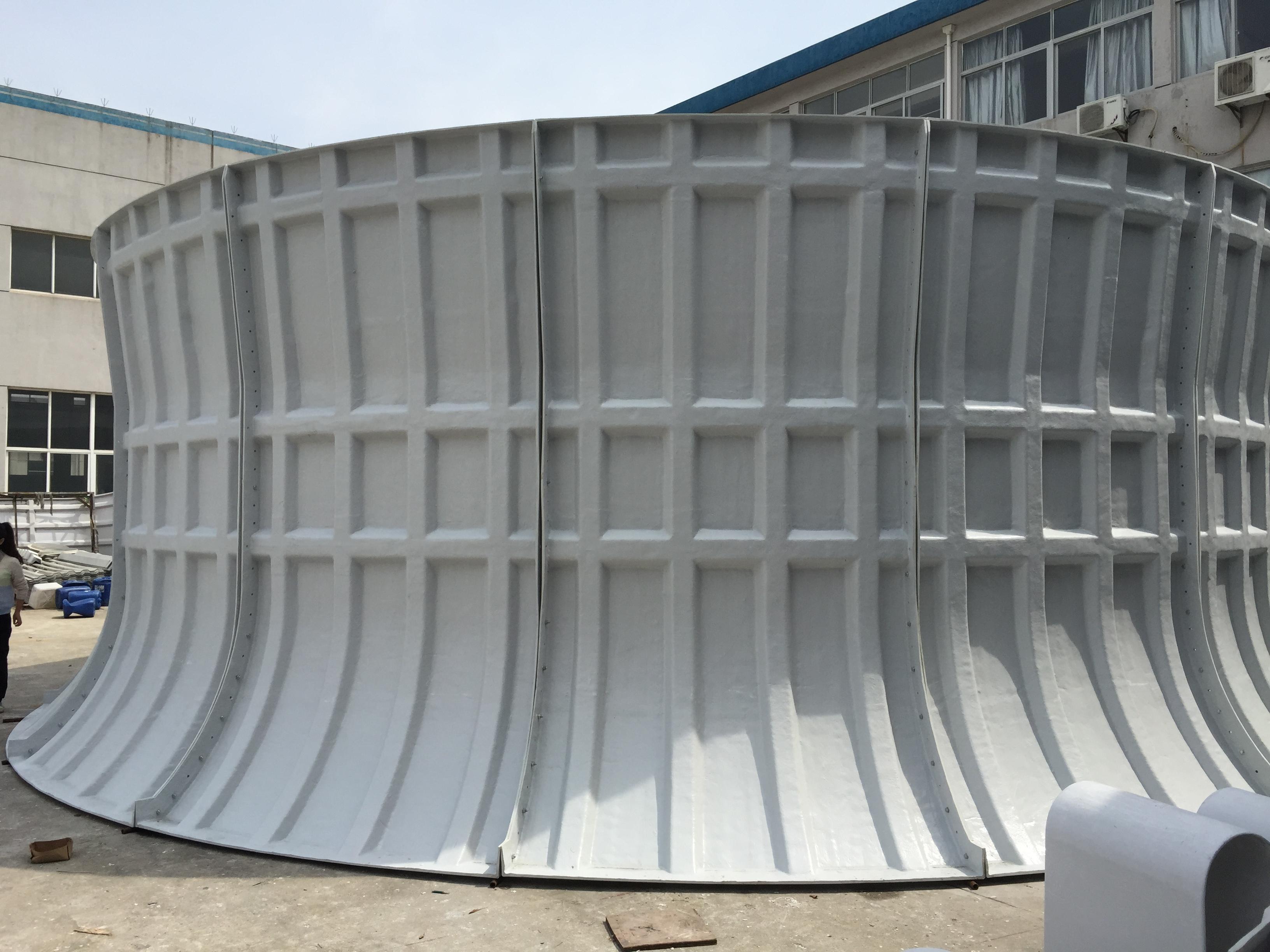
The Difference Between Fan Stack, Fan Ring and Fan Cylinder
Fan stack (discharge side)
Mounted above the fan rotor, this section guides exhaust air upward and outward. Its diverging flare recovers velocity pressure and prevents hot plume recirculation back into tower air intakes.
Fan ring / inlet bell (suction side)
The rounded, bell-shaped inlet sits just upstream of the fan blades. It eliminates sharp edges that would create vena contracta, where airflow narrows and generates turbulence before reaching the fan.
Fan cylinder
A straight or slightly tapered barrel that surrounds the fan blades, maintaining consistent tip clearance between blade edges and the inner wall. When paired with a well-designed stack, it preserves the fan’s rated airflow capacity across variable speed operation.
Why FRP Is Preferred for Aerodynamic Airflow Control
Metal fan stacks are often limited by fabrication constraints; rolled steel creates welded seams and rough transitions that disrupt boundary-layer airflow. FRP laminating allows one-piece, smooth internal contours, matched exactly to CFD-optimized aerodynamic profiles. The gel-coat surface reduces drag and resists fouling, moisture, and chemical drift, so the airflow geometry stays consistent for years rather than degrading quickly under wet cooling conditions.
How FRP Fan Stack Geometry Reduces Turbulence and Pressure Loss
Air turbulence and uneven flow distribution are silent performance killers for cooling tower fans. Even if the fan blade aerofoil is perfectly engineered, distorted inlet airflow can drop airflow volume, raise motor power draw, and create hot zones across the fill media. A properly designed FRP fan stack corrects these flow issues through three key geometric features.
Belled Inlet Profile: Smoother Air Entry to the Fan Plane
Eliminating vena contracta and inlet flow separation
Without a rounded bell inlet, incoming air squeezes inward as it hits the fan opening. This contraction creates low-pressure eddies at the perimeter, meaning only the central portion of the fan blade moves air effectively. The curved FRP bell gradually guides air into the fan sweep, filling the full blade circle with uniform flow. This directly unlocks the fan’s designed airflow capacity without increasing brake horsepower.
Matching inlet flare to fan diameter and operating static pressure
The radius of the FRP inlet flare is not universal. Towers running at higher static pressure from fouled fill require a gentler, wider bell curve. FRP’s custom moulding capability means manufacturers tune this flare to your tower’s specific airflow requirements, rather than relying on off-the-shelf steel parts with fixed geometry.
Diverging Exit Cone for Velocity Pressure Recovery
Converting kinetic energy into static pressure regain
As air exits the fan, it carries high velocity energy. A straight cut-off stack wastes this energy; fast-moving air dissipates into turbulence immediately. The slowly expanding diverging cone on an FRP fan stack slows discharge air in a controlled way, converting velocity pressure into static pressure. This pressure regain reduces the total workload the fan must produce, so the same fan moves more air for the same power input.
Plume lift and dispersion control
The flared FRP exit pushes warm, moist exhaust air upward with consistent momentum. The elevated plume mixes faster with surrounding ambient air, which is critical for towers installed in dense industrial yards or data center campuses where recirculation would otherwise pull hot exhaust back into the tower intakes.
Tight, Consistent Blade Tip Clearance
Tip vortex suppression
Large cooling tower axial fans lose significant airflow efficiency through tip vortices — swirling air that leaks across the gap between blade tip and stack wall. FRP fan stacks are moulded to maintain precise, uniform clearance all around the rotor. Reduced tip leakage means more of the fan’s rotational energy transfers into forward airflow through the tower instead of wasted recirculating eddies at the blade tipsH2O Coolin....
Resistance to deformation under heat and vibration
Steel shrouds can warp over time, opening uneven tip gaps. FRP composite retains its circular shape under thermal cycling and continuous vibration, preserving the optimized clearance and stable airflow performance year after year.
Stopping Hot Air Recirculation: One of the Biggest Airflow Benefits
Recirculation happens when hot, humid discharge air loops back and enters the cooling tower’s air inlets. Even a small amount of recirculation raises the wet-bulb temperature of incoming air, lowering the tower’s heat rejection capacity and forcing fans to run faster to maintain setpoint. FRP fan stacks improve airflow by breaking this harmful cycle.
Stack Height and Exit Velocity Work Together
Adequate stack height for plume separation
A short stack cannot lift the exhaust plume high enough to escape the tower’s surrounding low-pressure zone. Engineered FRP stacks use calculated height paired with a diverging flare to carry the warm air stream well above the air intake level. Many retrofit projects see immediate cooling gains simply by replacing a low, straight steel shroud with a taller, aerodynamic FRP fan stack.
Wind deflection for crosswind conditions
Side winds push exhaust plumes sideways. The streamlined outer profile of an FRP fan stack resists wind shear better than angular metal designs, helping hold the discharge plume on its upward trajectory and preventing wind from folding hot air back onto the tower.
Drift Reduction as a Secondary Airflow Advantage
While drift control is not the primary airflow function, a well-shaped FRP fan stack supports drift eliminator performance. Smooth, organized airflow through the fan plane reduces droplet entrainment in the exhaust stream. When air moves chaotically, fine water droplets get picked up and carried out of the tower; stabilized airflow lets drift eliminators capture those droplets before discharge.
FRP Fan Stack Performance Under Variable-Speed VFD Operation
Modern cooling towers use VFD drives to adjust fan speed to match fluctuating process or data center heat loads. This changing operating range adds complexity to airflow behaviour, and generic fan shrouds often lose efficiency at partial speeds. FRP aerodynamic stacks maintain airflow stability across the fan’s operating window.
How Aerodynamic Profiles Perform at Low and High Fan RPM
High-speed full-load operation
At maximum fan speed, the diverging FRP cone handles high-volume airflow without sudden flow separation. The smooth transition prevents flow stall around the blade tips.
Partial-speed, low-load operation
At reduced RPM, the fan generates lower discharge velocity. A properly designed FRP stack still guides air cleanly, avoiding the inward eddies that form inside poorly shaped shrouds at low flow. This means the tower retains balanced airflow distribution even during light cooling demand.
Reduced Aerodynamic Noise as a Byproduct of Better Airflow
Turbulent airflow is the main source of broadband fan noise. When FRP stack geometry eliminates chaotic eddies and tip vortices, the airflow becomes quieter. This is a major bonus for data center cooling towers and process plants near residential boundaries: the same aerodynamic design that improves airflow also cuts sound levels without sacrificing thermal performance.
FRP Fan Stack Retrofit: Boost Airflow Without Replacing the Fan
Many industrial cooling tower upgrade projects overlook the fan stack. Plant managers replace fan blades or motors expecting airflow gains, while keeping an old steel fan shroud that creates flow restrictions. FRP fan stack retrofits are a cost-effective path to improved airflow and cooling capacity.
Matching FRP Stack Dimensions to Existing Fan and Tower Structure
Diameter and flange compatibility
Quality FRP fan stack manufacturers design custom flanges to bolt onto existing tower fan decks, eliminating structural modification. The internal aerodynamic profile is sized precisely to the fan blade diameter, hub size, and original fan curve.
CFD validation for retrofit airflow gains
Advanced suppliers run CFD simulations of the existing airflow pattern first, then design the FRP stack’s inlet bell and diverging exit to resolve identified flow bottlenecks. Measured results often show improved airflow and lower amp draw on the fan motor.
Comparing FRP Fan Stacks to Galvanized Steel Alternatives
Steel stacks are cheap upfront but difficult to form into optimal aerodynamic shapes. Weld seams, flex under wind load, and corrosion quickly distort the airflow path. FRP fan stacks maintain their engineered aerodynamic shape through decades of service, so the airflow improvement is permanent rather than temporary.
Common Fan Stack Design Mistakes That Limit Airflow Improvement
Even with FRP material, a poorly engineered stack will fail to deliver airflow benefits. These frequent design errors negate the advantages of FRP’s mouldable smooth profile.
Straight-sided barrels with no inlet bell
A simple straight FRP cylinder lacks the rounded suction flare. Airflow contracts as it hits the fan plane, creating the same vena contracta losses seen with metal shrouds.
Over-sized or under-sized exit flare
An overly aggressive wide flare can cause flow separation at the discharge. A flare that is too narrow wastes velocity pressure and fails to lift the exhaust plume away from air intakes.
Ignoring blade tip clearance tolerance
If the FRP stack’s circularity is inconsistent or mounting alignment is poor, some sections of the blade gap become too large. Tip vortex leakage increases, and airflow efficiency drops.
How to Select an FRP Fan Stack for Maximum Airflow Gain
When sourcing, look beyond basic dimensions and ask vendors about aerodynamic testing. Request performance data showing airflow curves, pressure recovery values, and recirculation modelling for your tower configuration. Confirm that the stack’s inlet bell, barrel, and diverging exit are engineered as one integrated aerodynamic system, not separate generic parts assembled together. For critical process cooling and data center towers, ask for CFD reports or field case studies showing airflow improvements after FRP stack installation.
Conclusion
FRP fan stacks improve cooling tower airflow by addressing multiple aerodynamic bottlenecks at once. The moulded belled inlet fills the fan plane with uniform air, the precision barrel maintains optimal blade tip clearance to suppress tip vortices, and the diverging exit cone recovers velocity pressure while lifting hot exhaust air away from tower intakes to stop recirculation. Unlike steel alternatives, FRP can form continuous, seamless curved profiles that resist deformation, fouling and corrosion, keeping airflow optimized year-round across variable fan speeds. Whether for new cooling tower builds or retrofits, a properly engineered FRP fan stack unlocks the full airflow potential of your cooling tower fan system, supporting stable process temperatures, lower energy consumption and reliable heat rejection.


