Beyond a Simple Shroud: The Multi-Faceted Purpose of a Cooling Tower Fan Stack
Many plant operators, procurement engineers and MEP contractors mistakenly view the cooling tower fan stack as nothing more than a protective cover for the rotating fan blades. While safety protection is one of its roles, a properly engineered fan stack is a high-value aerodynamic component that shapes the entire ventilation performance of induced-draft cooling towers. It bridges the gap between the fan assembly and the surrounding atmosphere, governing airflow patterns, thermal output, energy consumption, site safety and long-term mechanical reliability. Its purpose varies slightly based on whether the tower serves process manufacturing, data center cooling, power generation, chemical processing or general HVAC loads, but the core design objectives follow the same aerodynamic principles.
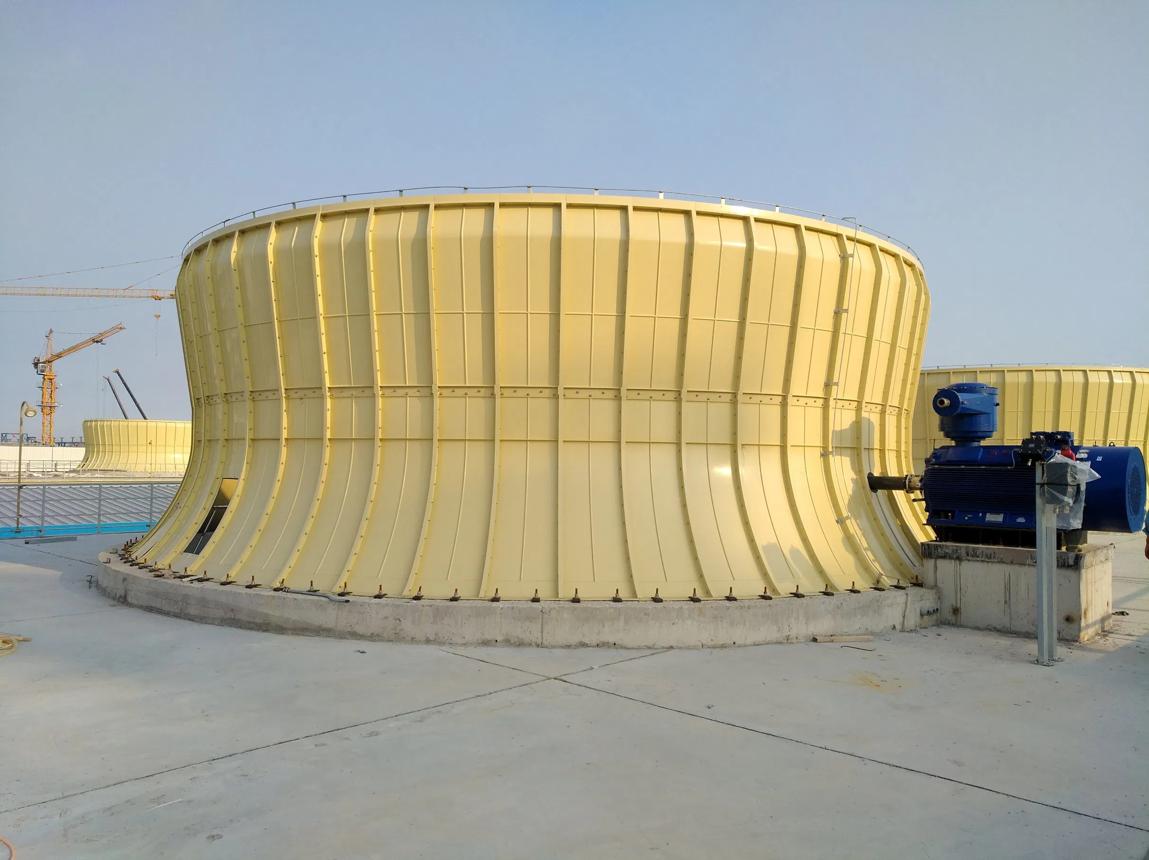
Clarifying Fan Stack, Fan Cylinder and Fan Ring Terminology
Before diving into core purposes, it helps to separate these commonly confused components, because each carries a distinct function within the fan stack assembly.
Fan stack (discharge flare section)
This is the upper, diverging flared section above the fan rotor. It controls how moist, hot exhaust air is released away from the cooling tower envelope, recovers velocity pressure and prevents plume recirculation back into air intakes.
Fan cylinder
The straight barrel section that encircles the fan blade tips. It maintains consistent tip clearance between blade edges and the inner wall, suppressing tip vortex leakage that wastes fan power and creates uneven airflow distribution.
Inlet bell / fan ring
The rounded, bell-shaped transition below the fan plane. Its purpose is to eliminate vena contracta, a flow bottleneck where incoming air narrows and creates low-pressure turbulence before reaching the fan blades. Without this curved inlet, even premium fan blades cannot deliver their rated airflow capacity.
Why induced-draft cooling towers depend more heavily on fan stacks
Induced-draft towers pull air upward through fill media with fans mounted on the fan deck. Unlike forced-draft towers, where fans sit at ground level and push air into the tower, induced-draft systems rely on the stack to manage the low-pressure zone created above the fill. Any disturbance to the exit airflow will directly reduce the pressure differential driving evaporation and heat transfer. This is why fan stack upgrades frequently deliver measurable cooling gains on induced-draft units, while forced-draft tower improvements focus more on inlet ducting.
Primary Purpose 1: Aerodynamic Guidance and Velocity Pressure Recovery
The most technical and commercially valuable purpose of a cooling tower fan stack is recovering velocity pressure from the high-speed air leaving the fan blades. As air exits the rotating fan, it carries a large amount of kinetic energy. A basic straight cut-off shroud allows this energy to dissipate instantly into uncontrolled turbulence. A purpose-built diverging stack slows the exhaust air gradually, converting kinetic velocity energy back into static pressure. This pressure regain reduces the total work the fan must perform, so the same fan can move a larger volume of air while drawing less motor power.
How pressure recovery translates to operational savings
When pressure recovery is optimized, motor amperage drops, and airflow across the fill media becomes more uniform. Hot spots on the fill disappear, and the tower can hold its designed cold water setpoint without forcing the fan to run at maximum speed. For 24/7 assets such as data center cooling towers or continuous chemical process lines, this energy saving accumulates dramatically over seasons of operation.
Matching stack flare geometry to fan diameter and speed
Not all diverging stacks perform equally. The flare angle, overall height and exit opening diameter must be tuned to the fan’s operating RPM and airflow rate. Too sharp an expansion causes flow separation along the stack inner walls; too shallow a flare fails to capture and recover the available velocity pressure. FRP fan stacks excel here because they can be moulded into smooth, continuous curves that steel fabrication cannot easily replicate.
Primary Purpose 2: Prevent Hot Air Recirculation
Recirculation is one of the most persistent performance issues for cooling towers clustered together, towers near building walls, and compact data center cooling yards. It occurs when warm, moisture-laden exhaust air does not disperse and instead loops back into the tower’s air intake grilles. Raised wet-bulb intake air temperature reduces the tower’s theoretical cooling capability, forcing fans and chillers to consume extra power just to maintain baseline cooling.
How fan stack height and exit momentum stop recirculation
Vertical plume lift
A properly sized fan stack adds vertical momentum to the exhaust plume. The flared exit releases the air stream high above the intake plane, giving it time to disperse into the ambient atmosphere before it can sink back toward the tower’s air inlets. This is especially critical for multi-cell cooling tower arrays, where one cell’s exhaust can easily flood the intake of adjacent cells.
Crosswind deflection
Side winds frequently push exhaust sideways toward tower intakes. The streamlined outer contour of a well-designed FRP fan stack resists wind shear, keeping the exhaust plume moving upward rather than folding back onto the tower structure. Many retrofit projects confirm that replacing a short, straight steel shroud with a taller aerodynamic FRP fan stack eliminates chronic recirculation without requiring expensive relocation of cooling tower cells.
Recirculation control for high-humidity tropical and coastal sites
In humid environments, moist exhaust is denser and slower to disperse. The fan stack’s ability to lift the plume becomes even more important here. Process cooling towers for food, beverage and pharmaceutical plants operating in humid climates consistently list anti-recirculation performance as one of their top priorities when sourcing replacement fan stacks.
Primary Purpose 3: Stabilize Airflow and Suppress Turbulence
Turbulent airflow inside a cooling tower ruins heat exchange efficiency. Chaotic, swirling air fails to make consistent contact with the wetted fill surface, leaving large sections of packing underutilized. The fan stack assembly corrects this by organizing airflow before and after the fan blade plane.
Inlet bell function: eliminate vena contracta
As air is pulled toward the fan opening, it naturally tries to squeeze inward into a narrower jet. This vena contracta creates dead zones around the perimeter of the fan sweep. The rounded inlet bell gradually guides air to fill the full circular area of the fan, so every section of the fan blade actively moves air. This unlocks the full rated airflow potential of the fan and reduces uneven loading on individual blades.
Blade tip clearance control
Reducing tip vortex leakage
The gap between fan blade tip and stack inner wall creates tip vortices — tiny rotating eddies where high-pressure air under the blade leaks over the tip to the low-pressure suction side. These vortices waste fan power, generate noise and create uneven airflow through the fill. The fan stack maintains tight, uniform clearance around the full rotor circumference, minimizing this leakage.
Resistance to thermal deformation
Steel fan cylinders can warp under years of thermal cycling and vibration, opening up uneven tip gaps that amplify vortex losses. FRP composite retains its circular geometry far better, so the carefully tuned tip clearance remains stable for decades, preserving consistent airflow quality.
Primary Purpose 4: Reduce Drift and Preserve Water Treatment Balance
Drift refers to fine water droplets picked up by moving air and carried out of the cooling tower. Excessive drift increases water consumption, wastes expensive water treatment chemicals, and can create mineral staining, corrosion and safety hazards on surrounding structures. While drift eliminators capture most droplets, the fan stack supports their performance by stabilizing airflow.
Organized airflow improves drift eliminator capture efficiency
When airflow is turbulent, fine droplets are stripped from the wetted fill and carried at high speed through the drift eliminator bank. High-velocity droplets bounce through the eliminator baffles instead of being captured. The fan stack’s smooth inlet and discharge profile slows chaotic air movement through the tower core, allowing drift eliminators to trap droplets reliably before exhaust leaves the stack.
Containing chemical drift for regulated industrial sites
For chemical plants, refineries and galvanizing facilities, drift control is not just an operational concern — it can trigger environmental compliance reviews. A fan stack that delivers controlled airflow reduces the spread of chemically treated cooling water mist across plant grounds and neighbouring property lines.
Primary Purpose 5: Noise Reduction and Acoustic Control
Noise from cooling tower fans has two major sources: tonal blade-pass noise from rotating blades, and broadband turbulence noise from chaotic airflow. The fan stack targets the turbulence component.
How aerodynamic shaping cuts noise
Sharp transitions, uneven tip gaps and uncontrolled plume turbulence all amplify noise levels. A well-engineered FRP fan stack removes abrupt airflow transitions. Serrated trailing edges on the stack flare and smooth inner contours break large turbulent eddies into smaller, quieter flow structures. This benefit is highly sought after for cooling towers near residential zones, schools, hospitals and urban data center campuses with strict local sound ordinances.
Noise as a secondary but critical design goal
Many industrial buyers select FRP fan stacks specifically because steel alternatives struggle to match low-noise performance. Even when the fan blade aerofoil is optimized, a poorly matched stack can push overall sound levels high enough to require costly acoustic barriers.
Primary Purpose 6: Mechanical Protection for Fan, Hub and Drive Components
Beyond aerodynamics, the fan stack serves practical mechanical and safety roles that should not be overlooked.
Personnel safety guarding
The open fan rotor presents a severe entanglement hazard for maintenance crews working on the fan deck. The stack forms a robust physical barrier around the rotating assembly, preventing accidental contact with spinning fan blades. FRP fan stacks are designed to meet industrial guarding standards while maintaining full airflow performance.
Environmental protection of fan assembly
The stack shields fan blades, hubs, bearings and gearboxes from direct rain, UV radiation, dust and airborne process contaminants. Continuous exposure to sunlight accelerates resin degradation on FRP blades, while dust and chemical vapours speed up bearing and seal wear. The stack’s protective enclosure extends the service life of the entire rotating assembly.
Prevention of reverse fan rotation
Sudden gusts of wind can spin unpowered fan blades backward, causing damage to gearboxes, couplings and motor windings when power is restored. The fan stack’s controlled airflow geometry limits wind-induced reverse rotation by reducing cross-flow forces acting on stationary fan blades. This is a well-documented benefit for towers located in open, exposed industrial sites.
Primary Purpose 7: Support VFD Variable-Speed Operation
Modern cooling towers almost always use VFD drives to adjust fan speed according to fluctuating thermal loads. A fan stack’s purpose extends to maintaining stable performance across a wide operating speed window.
Performance at partial fan speeds
At reduced RPM, fan discharge velocity drops. A stack designed only for full-speed operation can develop internal recirculation and turbulence at low flow rates. Premium FRP fan stacks feature aerodynamic profiles calibrated to remain effective both at high-speed full load and low-speed part-load operation. This stability helps data centers and process plants maintain consistent cooling efficiency even as heat loads shift hour by hour.
Avoiding aerodynamic stall at reduced speed
A stall condition creates sudden airflow breakdown and vibration. The carefully shaped inlet bell and diverging flare inside a quality fan stack reduce stall risk across the VFD operating curve, protecting bearings and gearboxes from damaging aerodynamic shock loads.
Material Choices and How They Align With Fan Stack Purpose
The material selected for the fan stack directly determines how well it can fulfil all these purposes over its design lifespan.
FRP (Fiberglass Reinforced Plastic)
FRP is the dominant choice for new and retrofit cooling tower fan stacks. Its key advantage is mouldability: manufacturers can form the complex continuous curves required for pressure recovery and turbulence control in one seamless piece. FRP resists corrosion from water treatment chemicals, mineral drift and humid tower air, so its aerodynamic shape remains unchanged for many years. Steel stacks, by contrast, rely on welded fabrication; seams and corrosion eventually distort the carefully designed airflow profile, undermining the stack’s core purposes.
FRP surface finish impact
A smooth gel-coat surface reduces boundary-layer turbulence and fouling adhesion. Rough, porous surfaces collect scale and biological slime, which changes the stack’s internal geometry and degrades aerodynamic performance over time.
Galvanized steel and stainless steel
Steel stacks are lower-cost upfront, but they struggle to replicate optimized diverging flare shapes. Weld lines create turbulence, and corrosion gradually alters the internal airflow path. Steel is still used for small cooling towers and temporary installations where long-term aerodynamic stability is not a priority.
Concrete fan stacks
Concrete stacks are found on large utility power plant cooling towers. They provide durability and plume lift but lack the fine aerodynamic tuning available with moulded FRP. Concrete stacks are heavy, difficult to modify and rarely used for industrial process cooling or data center projects.
Matching Fan Stack Purpose to Your Cooling Tower Application
Different facility types prioritize different fan stack functions.
Data center cooling towers
For data centers, the primary fan stack purposes are low noise, anti-recirculation, stable VFD performance and reliability. Hot air recirculation can trigger server overheating and downtime, so plume separation is non-negotiable. Low acoustic output is essential for sites close to residential districts.
Chemical, pharmaceutical and process manufacturing towers
Process cooling towers value drift control, chemical resistance and continuous airflow stability. Many process lines run 24/7, so the fan stack must preserve aerodynamic performance year-round despite exposure to aggressive water chemistry and airborne process fumes.
HVAC and commercial cooling towers
For comfort cooling systems, energy savings and noise reduction are usually the top priorities. Fan stack retrofits can reduce utility bills and bring cooling towers into compliance with local noise limits without replacing the fan assembly.
Common Misconceptions About Fan Stack Purpose
Misconception 1: Any cylindrical cover will work
Many buyers assume a simple straight barrel can replace a purpose-built aerodynamic fan stack. A straight shroud provides safety guarding but delivers minimal pressure recovery, poor plume lift and higher turbulence. It fails to unlock the efficiency gains the fan stack is designed to provide.
Misconception 2: The fan stack only matters for large-diameter fans
Even medium-size cooling tower fans benefit from properly engineered fan stacks. Vena contracta, tip vortex leakage and recirculation affect fans of all sizes, though the geometric proportions change according to fan sweep diameter.
Misconception 3: Fan stack design can be an afterthought
A fan blade upgrade will not deliver the promised airflow gains if the existing stack creates aerodynamic restrictions. The fan stack and fan blade system must work together. Many retrofit projects underperform because engineers upgrade blades while leaving a poorly shaped steel stack in place.
How to Evaluate a Fan Stack Based on Its Core Purposes
When requesting quotations for a new or replacement fan stack, ask questions tied directly to these functional goals. Request performance data showing pressure recovery estimates, recirculation modelling, noise test results and material specifications. For critical cooling assets, ask for CFD airflow reports and field references from similar installations. Confirm whether the inlet bell, barrel and discharge flare are engineered as a single integrated aerodynamic system, rather than generic parts bolted together. The most effective fan stacks are not just structural enclosures; they are tuned aerodynamic tools that support every stage of the cooling tower’s heat rejection cycle.
Conclusion
The purpose of a cooling tower fan stack extends far beyond basic safety guarding. As an integrated aerodynamic component within induced-draft cooling towers, it recovers velocity pressure to cut energy consumption, lifts moist exhaust air to stop hot air recirculation, stabilizes airflow to improve fill heat transfer, suppresses tip vortices and turbulence, limits water and chemical drift, reduces acoustic noise, protects fan hardware from environmental damage, and maintains reliable performance as fan speed shifts under VFD control. FRP fan stacks are preferred in modern industrial, data center and process cooling applications because they can reproduce the smooth, continuous curved profiles required to fulfil all these objectives over a long service life. Whether for new tower construction, fan blade retrofits, noise abatement or recirculation correction, selecting a fan stack based on its aerodynamic performance — rather than only its dimensions or price — delivers the most durable, measurable improvements to cooling tower operation.


