Cooling Tower Fan Blade Angle Adjustment Guide For Cooling Performance
Meta Description: Learn cooling tower fan blade angle adjustment, pitch measurement, common limits, motor load control and troubleshooting for better cooling tower efficiency.
What Is Cooling Tower Fan Blade Pitch Angle
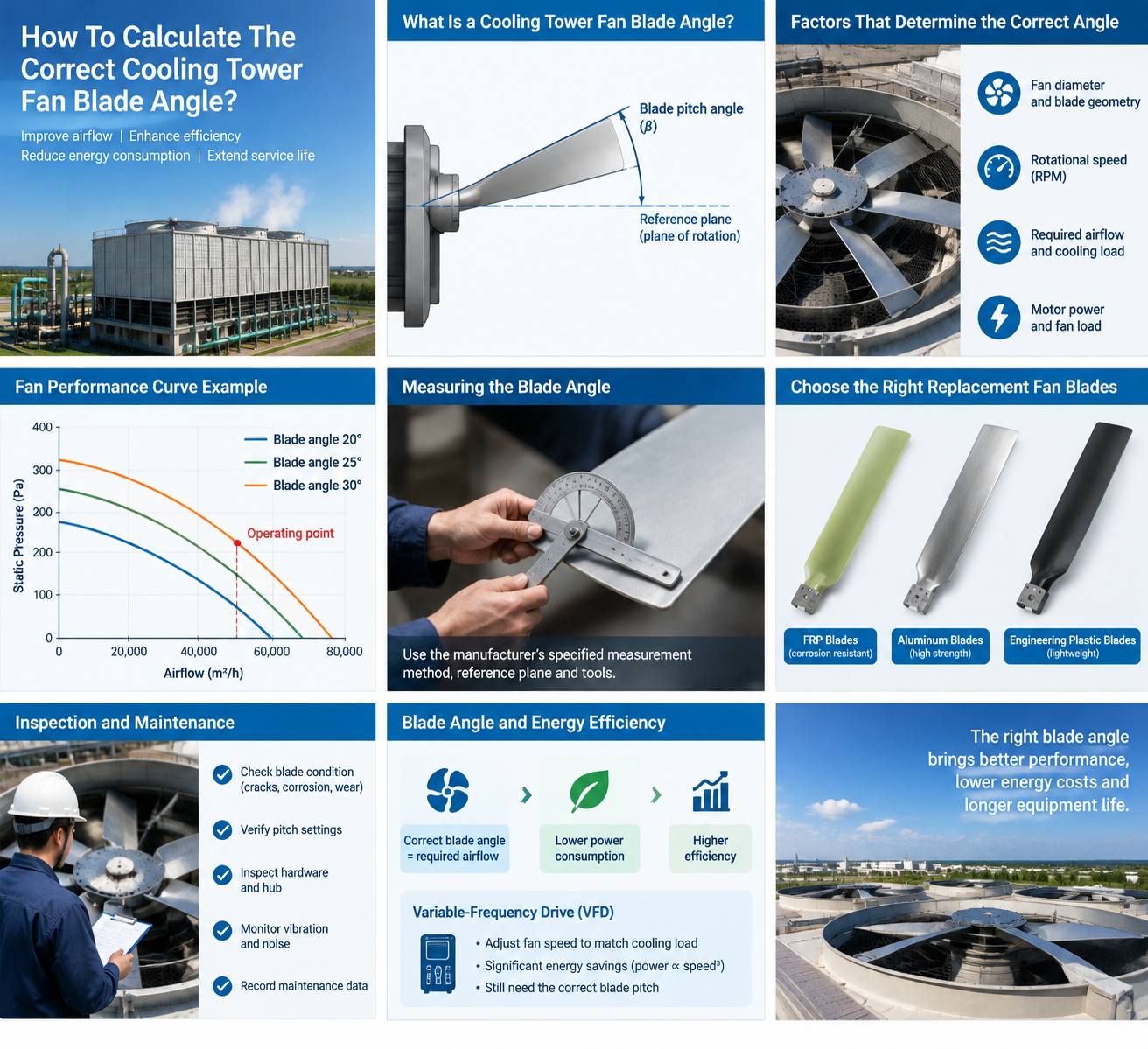
Cooling tower fan blade angle, also called blade pitch angle, refers to the inclined angle between the fan blade chord line and the fan’s rotational plane. It is the core parameter controlling airflow volume, aerodynamic load, noise level and cooling tower heat rejection capacity.
Many industrial operators mistakenly treat blade angle as a simple setting. In fact, a small angle change directly alters how much air the axial fan pulls or pushes through cooling tower fill media. For induced draft and forced draft cooling towers, uniform blade pitch across all blades is the basic requirement for stable fan operation.
Fixed Pitch vs Adjustable Pitch Fan Blades
Fixed Pitch FRP Fan Blades
Most standard aftermarket FRP cooling tower fan blades are preset at a factory fixed angle. This angle is matched to original tower design, motor horsepower, gearbox ratio and fan diameter. Fixed blades are low cost, widely used for cross flow and counter flow cooling towers. The angle cannot be modified after production.
Field Adjustable Pitch Fan Blades
Adjustable pitch blades have a clamping hub structure. Technicians can loosen hub bolts and rotate each blade to tune the pitch on site. This design is popular for retrofit projects, seasonal performance tuning and custom cooling load changes. It is widely used on large diameter fans for power plants, refineries and chemical factories.
Where To Measure The Blade Pitch Angle
Pitch reading is not taken at the blade tip or blade root. Standard industry practice is to measure at a fixed position around 50mm inward from the blade tip. The tolerance for all blades on one fan is usually ±0.5°. Uneven pitch will create unequal aerodynamic thrust and trigger vibration, bearing wear and gearbox damageFanTR.
How Blade Angle Changes Cooling Tower Performance
The relationship between pitch angle, airflow and motor load is non-linear. Raising the pitch increases airflow, but motor current and power consumption rise sharply. Reducing pitch cuts power draw while lowering air delivery and cooling capacity.
Risks Of Setting Blade Angle Too High
Motor Overload and Overheating
Over-pitched blades demand much higher torque. Motor current can exceed the nameplate rating, causing thermal tripping, winding insulation damage and permanent motor failure. This is the most frequent failure after improper angle adjustment.
Aerodynamic Stall and High Noise
When pitch exceeds the aerodynamic stall limit, airflow separates on the blade surface. The fan generates loud turbulence noise, airflow drops and vibration surges.
Extra Stress On Gearbox and Bearings
Higher aerodynamic load transfers continuous extra stress to the reducer gear set, output shaft and bearings, shortening service life dramatically.
Drawbacks Of Setting Blade Angle Too Low
Insufficient Airflow and Poor Cooling
Under-pitched blades cannot pull enough air through the fill. The cooling tower cannot reach the target water temperature, affecting downstream production equipment like compressors, injection molding machines and HVAC systems.
Wasted Fan Investment
A fan assembly with low pitch runs safely but fails to deliver the designed cooling capacity. Operators may wrongly assume they need a larger fan, instead of correcting the blade angle.
Typical Optimal Angle Ranges For Reference
Note: These are general reference values. Manufacturer drawing and motor nameplate data always take priority.
Commercial HVAC cooling tower: 8° – 12°
General industrial counter flow cooling tower: 10° – 16°
Large heavy-duty process cooling tower: 12° – 18°
Step-by-Step Cooling Tower Fan Blade Angle Adjustment Procedure
Safety is the first priority. All adjustment work must be completed with power locked out and tagged out. Never adjust blades while the fan can rotate.
Tools You Need Before Starting
Digital inclinometer / pitch gauge
Torque wrench
Socket set for hub clamp bolts
Vibration meter and clamp ammeter (for post-adjustment test)
Lockout tagout kit, safety harness and PPE
Adjustment Workflow
Step 1 Lock Out Power and Inspect The Fan
Cut power to motor and gearbox. Confirm the fan is fully stationary. Inspect FRP blades for cracks, delamination, hub corrosion and bolt damage. Replace damaged blades before angle tuning.
Step 2 Loosen Hub Clamp Bolts Evenly
Loosen each blade clamping bolt gradually. Do not fully remove bolts. The blade must remain seated inside the hub to avoid dropping.
Step 3 Set Target Pitch Angle With Inclinometer
Rotate the blade slowly until the inclinometer reads the target angle. Set all blades to exactly the same angle. Adjust one by one at the same measuring position.
Step 4 Torque Bolts To Manufacturer Specification
Tighten bolts in a cross pattern to avoid hub distortion. Record torque value for maintenance files. After tightening, recheck each blade angle again because clamping force can shift the blade slightly.
Step 5 Visual Check Blade Tip Clearance
Check the gap between blade tip and fan stack inner wall. Uneven clearance may indicate misaligned pitch or bent blade.
Step 6 Power On, Test Current and Vibration
Remove lockout tag, start the fan. Read running current with clamp meter. Current must stay under motor full load amps. Measure vibration level on gearbox and motor base. Shut down immediately if abnormal noise or vibration appears.
Pro Tip: Adjust pitch in small increments of 1 degree at a time. Do not jump to a large angle change in one step.
Common Mistakes During Blade Angle Calibration
Mistake 1 Adjusting Only One Blade
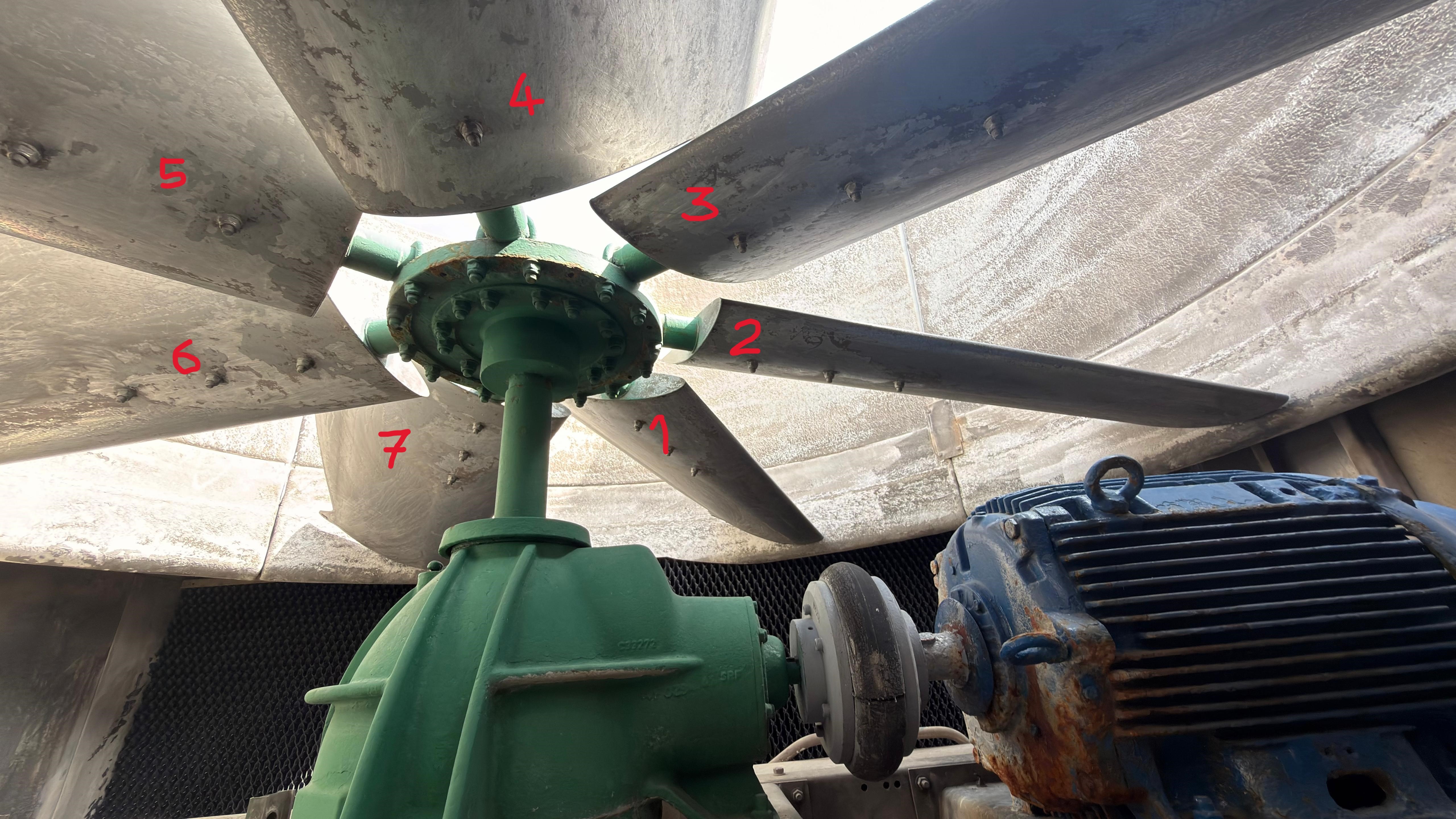
Some technicians re-angle a single blade to fix vibration. This creates inconsistent pitch, worse aerodynamic imbalance and recurring vibration problems. All blades must match the same angle.
Mistake 2 Ignore Motor Amp Limit And Only Chase Cold Water
The target cooling water temperature cannot override motor rated current. If the desired cooling effect needs a pitch that overloads the motor, you need a larger motor or VFD instead of forcing higher blade angle.
Mistake 3 Mix New Replacement Blades With Old Blades Without Matching Pitch
When you replace FRP fan blades, the new blade factory preset angle must match the existing set. Mismatched angle is a common root cause after blade replacement.
Mistake 4 No Dynamic Balance After Large Angle Change
Pitch adjustment changes aerodynamic loading distribution. For large fans over 5 meters diameter, a full dynamic balance test is recommended after pitch modification.
Mistake 5 Confuse Rotation Direction And Leading Edge
Leading edge orientation together with pitch angle decides airflow direction. Even with correct angle, reversed blade installation will push air the wrong way.
Seasonal Angle Tuning Strategy
Air density changes with ambient temperature. Cold winter air is denser, which increases fan load at the same blade angle. Many industrial plants maintain two pitch settings: summer pitch and winter pitch.
Summer Operation Tuning
Higher wet bulb temperature requires stronger heat rejection. Set pitch at the upper safe limit while keeping motor current under FLA.
Winter Operation Tuning
Reduce blade pitch slightly in cold seasons to prevent motor overload and excessive cooling. Combined with VFD speed control, seasonal pitch tuning saves substantial electricity cost.
Blade Angle Troubleshooting Checklist
Fan vibration rises after blade replacement or adjustment
Verify all blade pitch angles are equal within ±0.5°
Check blade weight matching
Check hub bolt torque and clamping condition
Run dynamic balancing test
Motor trips on overload after adjustment
Blade pitch is set too high
Fan diameter and pitch exceed motor power limit
Gearbox bearing friction has increased
Blade tip rubs fan stack
Cooling tower water temperature still high after raising pitch
Fill media fouling or scaling limits heat transfer
Water distribution nozzles blocked
Fan rotation direction reversed
Aerodynamic stall at current pitch angle
Best Practices For Long-Term Fan Blade Management
Keep Pitch Records For Every Fan
Document original design angle, adjusted angle, running current and vibration reading in your cooling tower maintenance log. When ordering replacement FRP fan blades, provide the recorded pitch angle to your supplier.
Choose Compatible Replacement Blades With Matching Aerodynamic Profile
Two blades with identical diameter and angle can behave differently if the airfoil profile is not the same. CFD optimized FRP blades maintain stable airflow at the designed pitch angle. Generic copied blades often stall or draw excess current at the same pitch setting.
Pair Adjustable Pitch Blades With VFD For Maximum Energy Saving
Variable frequency drive controls fan speed, while blade pitch sets the aerodynamic working point. Combined tuning gives operators flexible control for variable process heat loads.
Conclusion
Cooling tower fan blade angle adjustment is a precision tuning task, not a simple twist of the blade. The optimal angle balances airflow demand, cooling target, motor load, noise and mechanical lifespan. Before any adjustment, confirm manufacturer specifications, measure evenly across all blades, and verify ampere and vibration data after commissioning. Proper pitch management reduces energy consumption, extends gearbox and motor service life, and keeps your industrial cooling tower running reliably year-round.


