Professional Cooling Tower Fan Blade Design & Production
Meta Description: Discover professional
cooling tower fan blade design and production process. Learn about CFD aerodynamic optimization, FRP material selection, precision molding, dynamic balancing and quality testing for cross flow and counter flow cooling tower fan blades.
Professional cooling tower fan blade design and production directly define the overall performance of mechanical draft cooling towers. Many operators underestimate how much blade geometry, composite lamination quality and factory testing influence airflow output, energy consumption, noise and service life. A poorly engineered or roughly manufactured blade will trigger vibration, overload the motor and gear reducer, and raise long-term maintenance cost. As a specialized manufacturer of cooling tower spare parts, we integrate aerodynamic simulation, structural calculation, composite molding and full performance testing into every fan blade project. Our standardized design and production workflow supports OEM manufacturing, on-site replacement upgrade and reverse engineering for industrial, HVAC, power and chemical cooling towers worldwide.
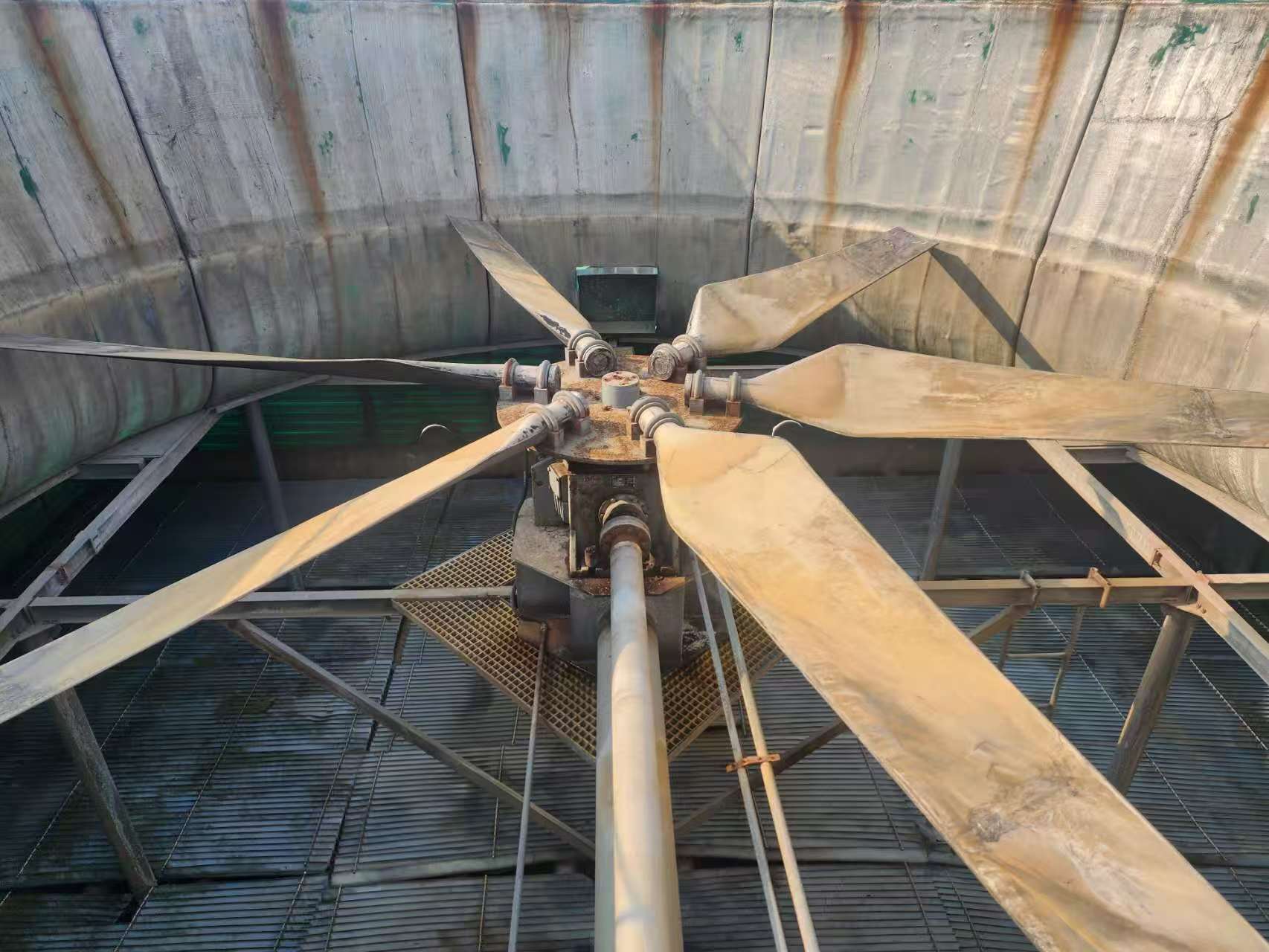
The Core Objectives of Professional Cooling Tower Fan Blade Design
Aerodynamic Performance Targets
High Lift, Low Drag for Low-Speed Axial Fans
Cooling tower axial fans run at relatively low rotational speed with large diameters, which sets them apart from high-speed industrial fans. Professional design selects thick, high-lift airfoil profiles developed specifically for large cooling tower fan operating conditions. The airfoil shape creates stable pressure difference between the suction side and pressure side, pushing sufficient air through fill media while cutting aerodynamic drag. This design reduces flow separation on the blade surface and helps achieve target airflow without excessive power draw from the driving motor.
Noise Suppression and Vibration Control
Aerodynamic noise mainly comes from blade passing frequency and concentrated tip vortex. Professional design adopts backward sweep, tapered chord and optimized tip geometry to break strong tip vortices. Evenly distributed aerodynamic load along the blade span avoids periodic force spikes that excite vibration. For projects near residential zones, data centers and urban facilities, noise control becomes a non-negotiable design index alongside airflow and power efficiency.
Structural Safety and Durability Requirements
Resistance to Centrifugal Load and Fatigue
When rotating continuously, each blade bears persistent centrifugal tension and cyclic aerodynamic bending force. Professional design calculates stress distribution across the whole blade and arranges fiber orientation in FRP laminate to match load direction. Unidirectional glass fibers follow the span direction to resist tensile stress, while woven roving layers improve torsional stiffness. The design keeps a sufficient safety margin under maximum pitch angle and rated rotating speed, preventing cracking and delamination after years of nonstop operation.
Adaptation to Harsh Cooling Tower Environment
The fan deck environment features high humidity, water drift, salt mist and occasional chemical vapor. Professional design includes material matching and surface protection planning from the early stage. Standard isophthalic polyester resin works for general HVAC towers, while vinyl ester resin is reserved for coastal desalination and chemical plant sites. UV-stabilized gel coat blocks moisture penetration and slows resin aging under outdoor sunlight exposure.
Compatibility With The Whole Fan Assembly
Matching Fan Stack, Hub, Gearbox and Motor
A standalone blade with perfect aerodynamic shape may still perform poorly if mismatched with the fan stack. Professional designers take fan stack inner diameter, tip clearance, hub structure, gear ratio and motor power curve into one system. Tip clearance is carefully controlled to limit backflow loss without risking blade rubbing. Blade pitch range and absorption curve are tuned so the working point always stays within the motor safe power envelope.
Interchangeable Interface for Replacement Blades
For retrofit orders, professional design preserves the original mounting hole pattern, root flange size and pitch adjustment mechanism. Even when aerodynamic geometry is upgraded for higher efficiency, the mechanical connection stays compatible with the existing hub. This eliminates extra machining work and downtime during field replacement.
Key Aerodynamic Design Parameters of Cooling Tower Fan Blades
Airfoil Profile and Camber Tuning
Airfoil camber decides lift generation capacity. Larger camber delivers higher airflow at the same rotating speed, yet it increases drag and the risk of flow separation at off-design working conditions. Our design team adjusts camber distribution from blade root to tip according to local relative flow angle. The root section carries heavy structural load with moderate camber, while the outer section adopts refined camber to maximize aerodynamic efficiency.
Blade Twist, Taper and Sweep Layout
Spanwise Twist Design
The linear speed increases gradually from blade root to blade tip. If the angle of attack remains identical across the whole span, some sections will stall while others operate under low efficiency. Twist design changes the geometric pitch angle along the radius, making every blade segment work near its optimal attack angle. This is one of the most critical features separating professional twisted blades from simple flat molded blades.
Backward Swept Blade Configuration
Backward sweep means the blade leans opposite to rotation direction. It delays airflow separation when heat load rises and pitch angle increases. Backward swept blades have wider stable operating ranges and quieter performance than radial straight blades, which is why most large-diameter cooling tower fan blades adopt this layout.
Chord Taper Distribution
Chord width tapers smoothly from root to tip. Taper matches aerodynamic load distribution and prevents the outer blade portion from being overloaded. Uniform wide chord from root to tip creates excessive load near the tip, accelerating vortex generation and power waste.
Blade Count, Diameter and Pitch Adjustment Scheme
Common blade counts include 3, 4, 5 and 6 blades. More blades raise airflow capacity but also increase blade passing noise. Fewer blades reduce noise while each single blade takes heavier aerodynamic load. Adjustable pitch blades remain the mainstream professional solution. Factory calibrated pitch scales allow operators to adjust airflow seasonally for energy saving. Fixed pitch blades are offered for small HVAC towers running under stable constant load.
CFD Simulation and Structural Calculation in The Design Workflow
Pre-Production CFD Simulation Setup
Before mold manufacturing, engineers build 3D fan models and run CFD simulation under multiple working conditions. The simulation outputs airflow volume, static pressure rise, shaft power, flow separation region, vortex distribution and noise source. We also simulate airflow interaction between blades and fan stack to predict actual field performance instead of relying only on theoretical airfoil data.
Iterative Optimization Based on Simulation Feedback
If simulation shows obvious separation near the trailing edge, the camber or tip profile will be revised. If power consumption exceeds motor rating at target airflow, the team reduces pitch range or modifies chord distribution. Multiple rounds of iteration lock the final geometry before prototype production.
Finite Element Structural Analysis
FEA structural analysis calculates tensile stress, bending stress, torsional deformation and natural frequency of the blade. The natural frequency must maintain enough separation from rotating frequency and blade passing frequency to avoid destructive resonance. If resonance risk is identified, laminate thickness, fiber layup scheme or internal reinforcing ribs will be adjusted to retune dynamic characteristics.
Material Selection for Professional FRP Fan Blade Production
FRP as The Preferred Blade Material
Fiberglass reinforced plastic, or FRP, dominates modern cooling tower fan blade production. It is lighter than aluminum alloy and steel, with excellent damping property to cut vibration transmission. Proper resin formulation delivers strong resistance against humid air, salt and weak chemical vapor. Unlike metal blades, FRP will not rust or suffer rapid corrosion on coastal and wastewater sites.
Resin System Selection Guide
Isophthalic polyester resin is the standard choice for general cooling towers. It balances mechanical strength, UV resistance and production cost. Vinyl ester resin provides superior chemical and salt spray resistance for desalination, refinery and coastal projects. Flame retardant resin is available for power plant and hazardous area cooling systems.
Reinforcement Fiber and Laminate Schedule
Chopped strand mat provides good surface covering and resin absorption, while woven roving offers high tensile and torsional strength. Unidirectional fiber is laid along the blade span to bear centrifugal tension. The laminate sequence is documented for each blade model to guarantee consistent strength batch after batch. Gel coat forms the outermost protective layer, improving surface smoothness and blocking water intrusion.
Comparison With Aluminum and Steel Blades
Aluminum alloy blades feature high rigidity, but salt mist will trigger pitting corrosion over time. Steel blades are heavy and require continuous anti-rust coating maintenance. Metal blades also transfer vibration more efficiently, adding stress to the gearbox and tower frame. Metal blades are still selected for some special high-temperature applications, yet FRP becomes the first choice for most new cooling tower builds and replacements.
Step-by-Step Professional Cooling Tower Fan Blade Production Process
Precision Mold Fabrication
Mold quality determines dimensional consistency and surface finish. We machine master patterns according to finalized 3D drawings and then produce FRP female molds. The mold surface is polished and sealed carefully. Any surface defect on the mold will replicate onto the finished blade and disturb local airflow. Large diameter blade molds are reinforced internally to avoid deformation during lamination and curing.
Gel Coat Application and Fiber Lamination
The first production step is uniform gel coat spraying onto the mold cavity. After gel coat reaches proper tackiness, workers lay fiber materials following the approved laminate schedule. Resin is rolled thoroughly to wet out fibers and squeeze trapped air bubbles. Air voids inside the laminate become hidden failure points, which will absorb moisture and expand under cyclic load, leading to delamination. For high-specification blades, vacuum assisted infusion process is adopted to lower void ratio and improve fiber-resin ratio consistency.
Curing, Demolding and Post-Curing
Laminated blades stay inside the mold for primary curing. Controlled temperature curing stabilizes resin crosslinking and reduces internal residual stress. After demolding, blades go through post-curing treatment to further improve mechanical strength, heat resistance and fatigue performance. Improper curing leads to soft resin, low rigidity and permanent deformation under operating load.
CNC Trimming, Drilling and Root Machining
After curing, each blade is positioned on a CNC fixture for trimming trailing edge, shaping root flange and drilling mounting holes. CNC machining guarantees hole position accuracy and consistent root geometry across the whole blade set. Manual grinding alone cannot maintain the uniform tolerance required for adjustable pitch hub installation.
Surface Finishing and Inspection
Sharp edges are rounded smoothly to prevent stress concentration. The surface is sanded and inspected for pinholes, blisters, fiber exposure and resin shortage. Minor surface defects are repaired with matching gel coat before final finishing. The finished surface must be continuous and smooth to preserve aerodynamic performance. Dust buildup is much faster on rough, porous blade surfaces.
Factory Testing and Quality Control Before Shipment
Dimensional and Visual Inspection
Every finished blade is checked against drawing dimensions, including chord width, twist angle, flange size and hole spacing. The whole blade set is grouped and matched to ensure consistent geometry. Blades with obvious deviation are rejected directly, because uneven pitch or shape among a set is the top cause of field vibration.
Static and Dynamic Balance Test
Dynamic balance is the most critical test procedure. The complete blade set mounted on a test hub runs on a balancing machine to ISO 1940 standard. Unbalance mass is corrected by grinding at designated balance area. Even blades with perfect aerodynamic shape will generate strong vibration if mass distribution is inconsistent. After dynamic balance, vibration level is recorded and marked on the test report.
Set Matching for Replacement Orders
For spare blade replacement, we match the new blade mass and balance characteristic to the existing running set wherever possible. If only one single blade is replaced instead of the full set, on-site trim balance is recommended after installation.
Mechanical and Environmental Sample Testing
For new model release or large batch export projects, sample blades undergo destructive tensile test, fatigue cycle test and salt spray aging test. These long-term validation data support material upgrade and provide technical evidence for customers operating in aggressive environments.
Customization and Reverse Engineering Service
Custom Blade Development for New Cooling Tower Projects
We accept custom design based on customer’s cooling load, fan stack diameter, rotating speed, motor power, noise limit and site environment. The output includes 3D model, 2D manufacturing drawing, performance curve and balance report. Custom blades can be tuned for special voltage, VFD variable frequency operation and strict noise regulation.
Reverse Engineering for Obsolete Blade Replacement
Many old cooling towers have original blade models discontinued by the OEM. Our technical team scans or measures old blade samples, photos and nameplate data. We replicate the mounting interface while upgrading aerodynamic profile and resin system. The upgraded reverse-engineered blades fit the existing hub directly and often deliver higher efficiency and corrosion resistance than the original outdated design.
Installation Guidance and Maintenance Tips for Professionally Produced Blades
Synchronized Pitch Adjustment
When installing adjustable pitch blades, all blades must be set to the identical pitch angle with a pitch gauge. Even a small angle difference creates aerodynamic unbalance and vibration. Record the angle value for future seasonal adjustment reference.
Routine On-Site Inspection
Regularly check gel coat condition for cracking, blistering and fiber exposure. Inspect root fastening bolts for looseness. Clean blade surface periodically in dusty environments. Thick dust changes airfoil geometry and ruins the optimized aerodynamic shape. If delamination or structural cracking is found, stop operation immediately and arrange assessment.
Storage and Transport Protection
FRP blades are packed with foam padding and fumigated wooden crates for export shipment. Sharp impact during transport may create invisible internal delamination. Unpacking inspection and rechecking dynamic balance is recommended before installation after long sea transport.
Matching Components Supplied With Cooling Tower Fan Blades
Professional fan blade performance can only be fully realized with a coordinated fan assembly. We supply compatible FRP fan stack, adjustable pitch fan hub, helical and bevel gear reducer, vertical cooling tower motor, vibration switch and safety fan guard. Sourcing the whole fan package from one manufacturer removes aerodynamic and mechanical mismatch risk and simplifies technical communication.
FAQ About Professional Cooling Tower Fan Blade Design & Production
Why is twisted FRP blade better than flat blade
Twisted design adjusts angle of attack along the blade span, letting each section work at optimal aerodynamic condition. Flat blades suffer serious flow separation and low efficiency at most operating points.
What is the typical service life of FRP cooling tower fan blades
With intact gel coat and correct resin selection, FRP blades can operate for 15 to 20 years. Service life shortens rapidly in strong chemical or high salt environments without vinyl ester resin protection.
Can you produce large diameter blades over 8 meters
Yes, our design and production system supports large diameter FRP fan blades for heavy-duty power and industrial cooling towers. Special reinforced mold and segmented transport scheme are applied for ultra-large blades.
What test documents can you provide
We supply dimension inspection record, dynamic balance test report, material certificate and gel coat specification. Third-party witness inspection such as SGS can be arranged for key export orders.
Is dynamic balance required for every fan blade set
Yes, dynamic balance is mandatory for all finished blade sets to reduce vibration and protect bearings, gearbox and tower deck structure.
Why Our Professional Design and Production Workflow Adds Value
Many suppliers only copy existing blade shapes without independent aerodynamic simulation and structural calculation. Our engineering team treats each blade as a system component rather than a simple molded part. We connect design data, molding process and test records together, so every batch maintains consistent performance. Our blades are widely exported and used in cross flow, counter flow, open circuit and closed circuit cooling towers across multiple industrial sectors.
Contact Us For Cooling Tower Fan Blade Design and Production
If you need professional cooling tower fan blades for new tower manufacturing, efficiency upgrade or replacement, share your fan diameter, rotating speed, motor power, hub mounting dimension, noise requirement and site environment. Our engineers will evaluate your demand and provide aerodynamic proposal, drawing confirmation and formal quotation.


