Introduction: Why the Fan Stack Decides How Well Your Cooling Tower Performs
Every industrial cooling tower depends on one thing above all else: a steady, unobstructed flow of air. The fan moves that air, but the fan stack — the fiberglass cylinder that sits above the fan — decides whether it leaves the tower cleanly or curls back into the inlet and destroys the cooling effect you paid for.
Many buyers treat the stack as a cosmetic cover. In practice it is an aerodynamic component. Its profile recovers velocity pressure, reduces discharge turbulence, limits recirculation of hot exhaust air, shields the fan from wind and rain, and directly affects approach temperature, fan power consumption and noise level. A stack that is cracked, out of round, undersized, or fitted with the wrong flare angle costs you capacity and energy every day.
As a dedicated fiberglass cooling tower fan stack manufacturer, we build FRP stacks for cross flow and counter flow towers, in standard sizes and in fully custom configurations matched to your fan diameter, blade profile, tower structure and site conditions. This guide covers the product, the material, the manufacturing routes, the specification points that matter, and our OEM custom process.
What Is a Fiberglass Cooling Tower Fan Stack?
Definition and Position Inside the Tower
A fan stack is the cylindrical or slightly conical structure mounted on top of the cooling tower, surrounding the axial fan and its hub. It starts just above the blade plane and extends upward to roughly half to one full fan diameter. The lower section carries a flange or bell mouth that mates with the tower deck; the upper edge is fitted with a stiffening ring or a slight outward flare.
In a fiberglass version, the whole structure is molded or laminated from glass fiber reinforcement and thermosetting resin — commonly isophthalic polyester, vinyl ester, or fire-retardant polyester — with a gel coat on the weather-facing surface.
How Air Moves Through the Stack
Air enters the inlet, passes across the fill where it absorbs heat and evaporates a fraction of the water, then accelerates through the fan. At discharge, the air has high velocity but uneven pressure. The stack converts that disorganized jet into a smoother column, allowing velocity pressure to be partly recovered as static pressure. Without a stack, discharge air spills sideways and, under cross wind, re-enters the inlet — raising entering wet-bulb temperature and cutting capacity immediately.
Alternative Names Buyers Use When Searching
Regions and OEMs name the same part differently. Useful sourcing keywords: FRP fan stack, fiberglass fan cylinder, cooling tower fan shroud, fan stack cone, fan diffuser, fan barrel, fan cowl and fan housing. When requesting a quotation, give the tower type, fan diameter and model number, since naming varies by manufacturer.
Fan Stack vs Fan Blade vs Fan Cylinder — Avoiding Confusion
Quotation errors often come from mixing up three separate parts:
Fan blade — the rotating aerofoil that moves air. Usually FRP, aluminum or steel.
Fan hub — the central casting that clamps the blades to the shaft.
Fan stack (cylinder) — the stationary FRP housing around the blade.
They are matched but not interchangeable. A stack must always be sized to blade sweep plus a defined tip clearance. Fitting a larger blade without changing the stack causes rubbing, vibration and, eventually, structural cracking.
Why Fiberglass Is the Preferred Material for Fan Stacks
Corrosion Resistance in Wet, Saline and Chemical Environments
A cooling tower is permanently wet, warm and aerated — the worst possible place for mild steel. Galvanized stacks show rust bloom within a few years and then need repainting, which is difficult once the tower is in service. FRP is inert to water, salt and the dilute chemical vapors found in most industrial circuits.
Seawater and Coastal Installations
In coastal plants, seawater towers and desalination facilities, salt-laden air attacks everything. FRP holds up where coated steel fails, and it does not shed rust particles into the basin — important where water chemistry is monitored.
Chemical Plants, Wastewater and Desalination
Where chlorine, acid mist, ammonia or sulfides appear in the air stream, vinyl ester grades add resistance. We select resin from the actual environment rather than offering one universal product.
Strength-to-Weight Ratio and Structural Behavior
With a properly designed laminate, FRP delivers high stiffness at low weight. A stack that would weigh hundreds of kilograms in steel can be handled by two or three workers and lifted with light equipment — decisive in retrofits where a crane cannot reach the tower top.
Wind Load and Vibration Resistance
The stack is a cantilever shell, and its weak point is the joint with the deck. We design a reinforced flange with adequate laminate build-up and extra ribs where needed; for high-wind sites we thicken the lower third and stiffen the upper ring to prevent ovalization. Lightweight sections also cut installation risk, with no welding, hot work or rustproofing — which means no fire permit in hazardous plants.
UV Stability and Long-Term Weathering
The upper surface sees direct sun for decades, so we apply a UV-stabilized gel coat, optionally with a surface veil, to prevent chalking, fiber print-through and micro-cracking. With adequate gel coat thickness, an outdoor FRP stack commonly reaches 15 to 25 years of service.
Fire-Retardant and High-Temperature Grades
For power plants, refineries and enclosed installations, fire-retardant resin with antimony or halogen-free additives is available. For high-temperature process water we use resin rated for continuous service at elevated temperature, with higher glass content to limit thermal distortion.
Life-Cycle Cost Compared with Steel and Aluminum
| Item | Galvanized Steel | Aluminum | FRP (Fiberglass) |
| Initial cost | Low | Medium | Medium |
| Corrosion resistance | Poor in wet air | Moderate | Excellent |
| Weight | Heavy | Light | Light |
| Maintenance (repaint) | Every 3–5 years | Occasional | Almost none |
| UV performance | Needs coating | Good | Good with gel coat |
| Repair method | Weld / patch | Weld | Resin patch |
| Typical life in tower service | 8–12 years | 12–18 years | 15–25 years |
The lowest purchase price is rarely the lowest cost of ownership. On a 20-year basis, an FRP stack that needs no repainting and no rust repair usually wins.
Our Manufacturing Processes for Fiberglass Fan Stacks
SMC Compression Molding
Sheet Molding Compound is a pre-impregnated glass fiber mat thickened with resin, molded in matched metal dies under heat and pressure.
Process Sequence
Charge the weighed SMC blank into the heated lower die.
Close the press; material flows and cures under controlled temperature and pressure.
Demold, trim flash, drill flange holes.
Apply gel coat or paint, then cure.
Quality Advantages of SMC Stacks
Wall thickness is uniform, both surfaces are smooth, glass content is consistent and the cycle is repeatable. That gives stable dimensions order after order — the property that matters most to OEM customers building towers in series. SMC is our default route for standard diameters and repeat production.
Hand Lay-Up Lamination
For very large diameters, non-standard shapes or one-off replacements, hand lay-up is the most economical method.
When Hand Lay-Up Is the Right Choice
Diameter beyond the available mold size
Custom height or non-circular section
Urgent replacement where no mold exists
Low volume with a tight budget
Laminate Schedule and Resin Selection
We specify chopped strand mat in a defined sequence — surface veil, then alternating mat and woven roving to the required thickness, with extra build-up at flanges and penetrations. Resin is chosen from isophthalic polyester, vinyl ester or fire-retardant systems according to the environment.
Vacuum Infusion, RTM and Tooling Control
Where very high fiber content or Class A surface on both faces is required, we produce by vacuum infusion or resin transfer molding — better mechanical properties and lower styrene emission at higher tooling cost, normally reserved for higher-volume programs. Molds are machined and finished to the profile in the approved drawing, and because the stack must be round at the blade plane and concentric with the shaft, mold roundness is verified and recorded before release.
In-House Inspection Before Shipment
Wall thickness is measured on a grid of points, Barcol hardness confirms full cure, and resin-to-glass ratio is verified from coupons on hand lay-up parts. Inner diameter at the blade plane, height, flange flatness, bolt pitch and hole size are measured against the drawing; where a customer supplies a template or matching flange, we trial-fit before packing. We also check for dry spots, voids, delamination, resin-rich areas, flange cracks and gel coat defects — any repair is documented and completed before the final gel coat.
OEM Custom Capabilities
Diameter Range and Height
We produce fan stacks from small HVAC sizes, typically around 1 meter, up to large industrial diameters of 8 meters and above. Height is usually set between 0.5 and 1.0 times the fan diameter, adjustable to suit the tower layout, fan curve and required discharge velocity.
Aerodynamic Profile Design
Flare Angle and Diffuser Effect
A modest outward flare acts as a diffuser: flow area increases, velocity drops, and part of the dynamic pressure is recovered as static pressure — cutting fan power for the same airflow. Too aggressive a flare separates flow on the inner wall, which is worse than no flare at all. We keep the angle within a practical range and tune it to the fan's discharge pattern.
Blade Matching and CFD Support
The right stack is matched to a specific blade: diameter, chord, pitch angle, tip speed and the swirl it imparts. For critical projects we review the fan curve and share geometry for CFD confirmation. In most cases the practical inputs are simply blade diameter, clearance, tower type and airflow.
Flange, Bolt Pattern and Connection Details
Custom is mostly about interfaces. We replicate the existing bolt circle, hole count, hole diameter and flange width, add embedded metal inserts where fastening loads are high, and provide a sealing face suitable for gasket or mastic. Anchor details, lifting lugs and access hatches are optional.
Color, Gel Coat and Surface Finish
Standard color is light grey, which minimizes solar gain and hides dust. Custom colors suit brand matching, in matte or gloss. Where appearance matters we apply a higher-grade isophthalic gel coat with better color retention.
Drawing, Sample and Approval Flow
Customer sends tower model, fan diameter, existing drawing, or measured dimensions.
We return a 2D drawing with all critical dimensions and the proposed laminate or SMC spec.
Customer confirms or marks up; we revise.
On approval we release for production and send photos at molding or lay-up stage.
Final inspection report and packing list accompany the shipment.
Reverse Engineering for Replacement Stacks
Many towers in service are 15 to 30 years old and the original maker no longer supplies spares. Send photographs with a tape measure in frame, or a sketch giving the bolt circle and inner diameter, and we rebuild the geometry to produce an interchangeable part. This is one of our most frequent requests from plants facing obsolescence.
How to Specify the Right Fan Stack
Inner Diameter and Blade Tip Clearance
The inner diameter at the blade plane must equal blade sweep diameter plus clearance. Typical practice is a tip clearance of roughly 1 percent of fan diameter, subject to the fan maker's recommendation. Tight clearance improves efficiency but raises the risk of rubbing if the shaft is misaligned; excessive clearance loses airflow.
Cross Flow vs Counter Flow Configuration
Cross flow towers generally use a rectangular plan and may need a shroud with a shaped inlet rather than a plain circular cylinder. Counter flow towers use a circular fan deck and a straightforward cylindrical stack. Confirm which type you have before ordering, since discharge conditions differ.
Site Conditions and Resin Selection
Coastal or seawater: vinyl ester, heavier gel coat.
Chemical or wastewater: vinyl ester with surface veil.
Power plant, refinery, enclosed area: fire-retardant resin.
High-temperature process: heat-resistant resin, higher glass content.
Cold climate: standard isophthalic resin, with attention to impact resistance.
Wind Load and Seismic Requirements
Provide the design wind speed and any seismic category required by local code. For cyclone-prone regions we add laminate thickness and stiffening rings rather than relying on one thicker shell.
Specification Checklist
Tower type and model
Fan diameter, blade count, blade material
Inner diameter required and tip clearance
Stack height and any flare requirement
Flange bolt circle, hole count and hole size
Number of sections, if transport length is limited
Resin grade and color
Accessories: lifting lugs, access door, bird screen, stiffening rings
Destination port and required delivery date
Installation and Maintenance Best Practices
Lifting, Alignment and Bolting
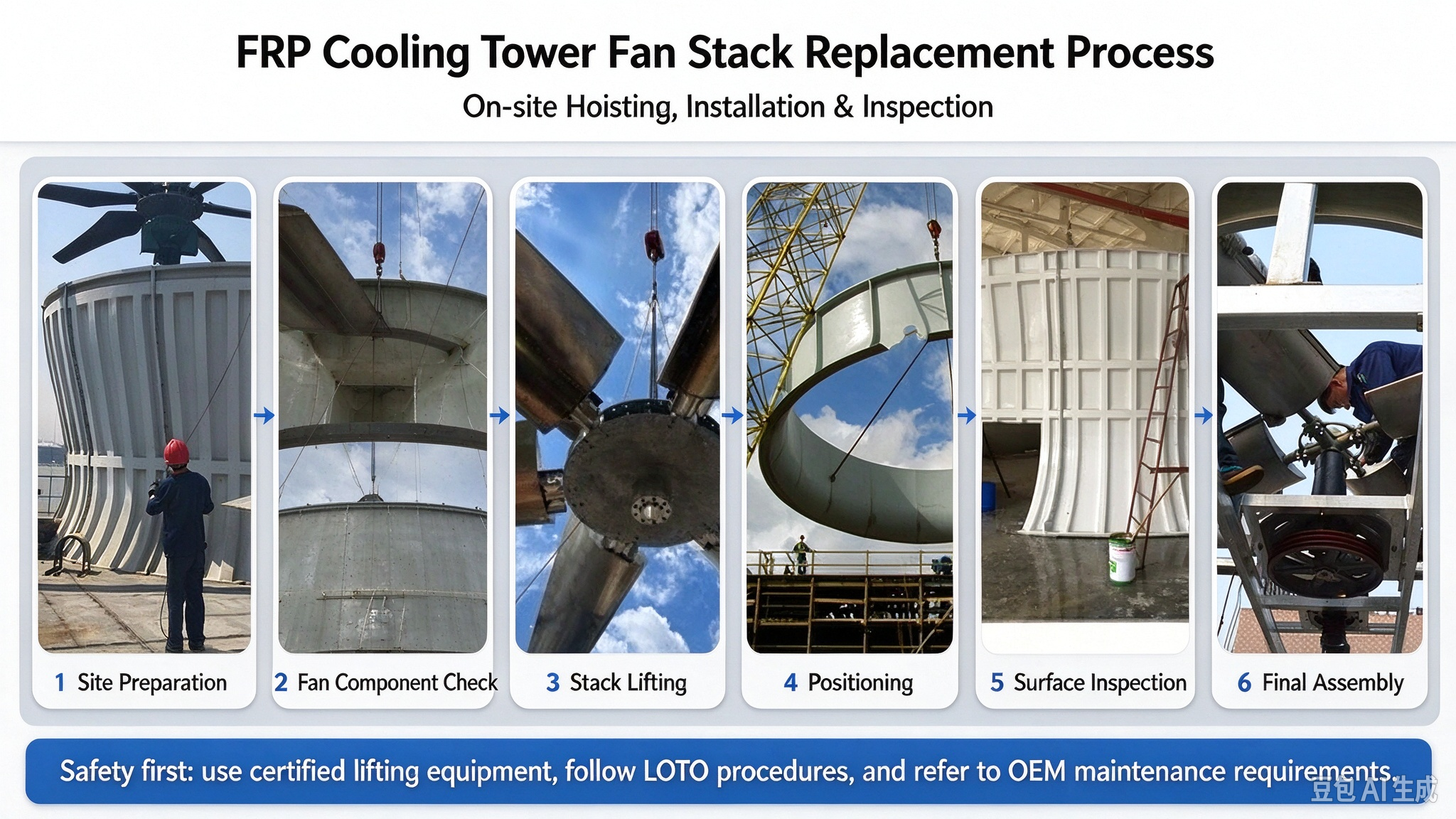
Use a spreader bar with slings at the designated lift points. Lower slowly and align the flange holes before setting down; never drag the part across the deck. Confirm concentricity with the fan shaft after bolting — an eccentric stack reduces tip clearance on one side. Use stainless fasteners with flat washers to avoid stress concentration in the FRP flange, torque in a cross pattern, and seal the joint with compatible mastic or an EPDM gasket.
Routine Inspection and Repair
Monthly: visual check for cracks, chalked gel coat and loose bolts.
Annually: check roundness, flange condition and blade tip clearance.
After unusual vibration or a storm: full structural inspection.
Small cracks and impact damage can be repaired in place: grind back to sound laminate, dry thoroughly, apply resin with glass mat, then gel coat. Large delamination or a cracked flange should be assessed by the manufacturer, because a badly executed structural repair creates a fatigue crack that propagates.
Problems a Correctly Built Stack Prevents
Air Recirculation and Lost Capacity
A short, damaged or oversized-clearance stack lets hot discharge air spill sideways and return to the inlet. The symptom is a tower that cannot reach design cold water temperature, especially in cross wind. Restoring stack geometry often recovers capacity without adding fill or changing the fan.
Vibration, Noise and UV Failure
An out-of-round stack, distorted flange or wrong diameter produces uneven tip clearance, leading to fluctuating blade loading, vibration and eventually blade or bearing failure — so roundness tolerance is a specification item, not a manufacturing detail. On the acoustic side, a smooth inner surface, correct flare and stiff upper edge cut turbulence noise, often making the stack the cheapest abatement measure available. Cheap gel coats chalk within a few years, expose fiber and admit water, after which freeze-thaw and osmotic blistering follow; a proper gel coat and surface veil prevent that failure entirely.
Applications Across Industries
Power generation: large mechanical draft towers where discharge efficiency affects auxiliary power.
Petrochemical and chemical: corrosion-resistant and fire-retardant grades, often in classified areas.
Steel and metallurgy: high dust and heat loads; robust flanges, thicker lower sections.
HVAC and district cooling: small diameters, noise-sensitive sites, color-matched units.
Data centers: high reliability and fast replacement of damaged stacks.
Desalination and seawater cooling: vinyl ester resin, salt-tolerant gel coat.
Closed circuit towers and evaporative condensers: compact stacks, tight tolerances.
Food and pharmaceutical: cleanable surfaces, no rust particle shedding.
Matching Components We Can Supply Together
Blades are matched to the stack diameter and gearbox duty, and supplying both from one source removes the risk of mismatched geometry between two vendors. We also supply cast or fabricated fan hubs with clamp-type blade retention, right-angle spiral bevel or helical gear reducers sized to fan speed and power, TEFC or explosion-proof motors, fan guards, coupling guards, vibration switches and flexible couplings.
Packaging, Logistics and Export
Packing, Loading and Documents
Large stacks are nested where possible, wrapped in protective film and braced with timber to prevent ovalization in transit; small units ship in crates with edge protection. Each package is marked with part number, dimensions and lifting points. A single large stack may occupy most of a 40HQ, while smaller stacks can be nested to use volume efficiently — we calculate the loading plan before booking so you are not paying for air. For very large diameters, break bulk or flat rack may beat a container on cost.
Standard documents: commercial invoice, packing list, certificate of origin, inspection report and material certificate. Lead time for standard molds is typically 15 to 25 days; new molds or reverse-engineered replacements need drawing approval first, then 25 to 40 days depending on size.
Quality Assurance and Warranty
Each order keeps a job file — approved drawing, resin batch, glass content, laminate schedule or SMC lot, cure records and inspection results — so traceability is possible years later. That matters for plants with maintenance audits.
We support SGS, BV, TUV or customer-appointed inspectors at our works, with dimensional reports and material certificates available in advance. Standard warranty covers defects in material and workmanship under normal service conditions; claims are settled by replacement of the affected part or a documented repair procedure.
FAQ
What is the typical service life of a fiberglass fan stack?
Under normal outdoor conditions with an intact gel coat, 15 to 25 years. Coastal installations with vinyl ester resin and a heavier gel coat reach the upper end; poorly specified gel coats may chalk within 5 years.
Can you make a stack for a cross flow tower?
Yes. Cross flow towers often need a shroud with a shaped inlet and a rectangular interface — send the tower model and deck dimensions.
Do you produce replacement stacks for obsolete towers?
Yes, this is a core service. We reverse-engineer from drawings, measured dimensions or photographs with a scale reference and produce an interchangeable part.
What is the minimum order quantity for a custom stack?
One piece is acceptable for replacement demand. Tooling cost may apply for a new mold and is amortized over repeat orders.
Can the stack be supplied in sections?
Yes. Where diameter or height exceeds transport limits, we split it into two or more sections with a splicing flange and site assembly instructions.
How do I confirm the correct inner diameter?
Measure the existing stack at the blade plane, or use blade sweep diameter plus clearance. If in doubt, send the fan model and blade diameter and we will calculate it.
Do you provide drawings before production?
Yes. A 2D drawing with all critical dimensions and the material specification is issued for approval before molding or lay-up begins.
What color options are available?
Light grey as standard, plus custom colors on request. Fire-retardant grades are available in a limited color range because of additive effects on pigmentation.
Why Buy From Us as Your Fiberglass Cooling Tower Fan Stack Manufacturer
Factory Direct Pricing and Engineering Support
We quote from the works with no trading margin layered on, itemizing laminate, gel coat, flange details and packing so you can compare offers fairly. And most sourcing failures come from a wrong dimension, not a wrong price — so we check blade diameter, tower type, flange pattern and site conditions before quoting, and flag inconsistencies instead of simply confirming whatever the inquiry says.
Fast Turnaround and Export Experience
For urgent shutdowns, standard sizes can often be pulled forward in the schedule, and where a mold exists we commit to a firm dispatch date at order. We ship regularly to Africa, Southeast Asia, the Middle East, Latin America and Europe, and know the documentation, packing and inspection expectations of each market.
Contact Us for a Custom Quotation
Send us the following and we will return a drawing and a quotation, usually within one working day:
Cooling tower type and model
Fan diameter and blade count
Existing stack drawing, or measured inner diameter and height
Flange bolt circle, hole count and hole size
Site environment (fresh water, seawater, chemical, high temperature)
Quantity and required delivery date
Fiberglass cooling tower fan stack manufacturer, OEM custom FRP fan stack, SMC and hand lay-up, corrosion resistant, multiple diameters — Mach Industry supplies the part that makes the fan's work count.


