How Does Cooling Tower Fan Blade Angle Affect Airflow?
Meta Description: Learn how
cooling tower fan blade angle (pitch angle) changes airflow volume, static pressure, motor load and stall risk. Practical adjustment guidance for FRP fan blades on crossflow and counterflow towers.
Airflow drives everything in a cooling tower. Heat rejection happens when air moves across wetted fill media, picks up water vapor and carries latent heat out of the stack. If airflow falls short, the evaporative process slows, circulating water returns warmer than setpoint, and the upstream process — a chiller condenser, an injection molding machine, a compressor skid — starts running hotter than designed. Among all the variables that shape airflow, few are as simple to change and as easy to get wrong as the cooling tower fan blade angle, usually called pitch angle. A single degree of adjustment can shift airflow and motor current far more than most operators expect, and an incorrect setting quietly costs energy for years. This article explains the aerodynamic mechanism behind the pitch–airflow relationship, what happens at low and high settings, how the change interacts with static pressure and system resistance, and how engineers should set and verify the angle when commissioning a tower or replacing fan blades.
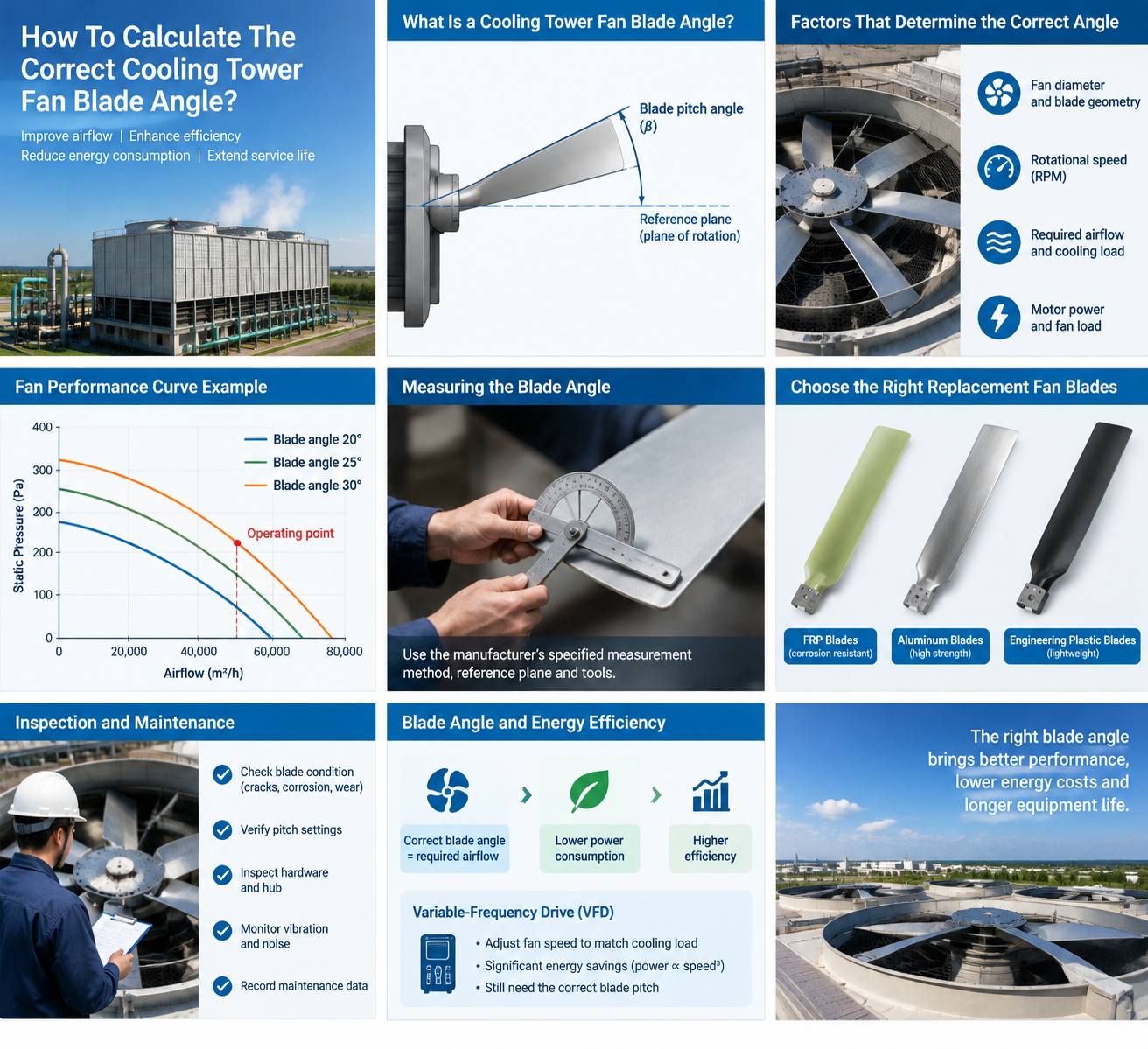
What Exactly Is Cooling Tower Fan Blade Angle (Pitch Angle)?
Pitch angle is the mechanical angle between the blade chord line and the plane of rotation, expressed in degrees. For the twisted airfoil blades used on induced-draft cooling towers, the number is normally read at 70% to 75% of the blade radius measured from the hub, because that band represents the average aerodynamic behavior of the whole blade span. Readings taken at the tip or the root describe local conditions only and do not represent fan performance.
Pitch Angle Versus Angle of Attack
These two values are often used interchangeably in maintenance conversations, which leads to real commissioning mistakes.
Pitch Angle Is a Mechanical Setting
Pitch is what a technician actually changes. Blade root clamps are loosened, the blade is rotated on its mounting axis, and the hardware is retorqued. The value is fixed until someone physically alters it again. Pitch appears on the fan data sheet, in the commissioning record and in the replacement blade specification.
Angle of Attack Is a Dynamic Condition
Angle of attack is the instantaneous angle between the airfoil and the incoming relative airflow while the fan is spinning. It depends on rotational speed, axial air velocity through the tower and system backpressure. Raise the pitch and the angle of attack rises with it. Push it far enough and the boundary layer separates from the blade surface — that is stall, and it is an aerodynamic event, not a mechanical fault.
Fixed, Manually Adjustable and Variable Pitch Configurations
Fixed Pitch Blades
Most low-cost OEM blades arrive set to one angle and stay there. Airflow is then managed only through fan speed, using a two-speed motor or a variable frequency drive. This is the simplest arrangement and works well when the cooling load is fairly constant.
Manually Adjustable Blades
Adjustable blades carry graduated or scribed root hardware so each blade can be repositioned and locked. This is the dominant type in aftermarket replacement and retrofit work, because it lets an engineer tune the fan performance curve to an existing motor and an existing tower before the blades are installed.
Motorized or Hydraulic Variable Pitch
Large utility and heavy-process towers sometimes use hub mechanisms that change pitch while the fan runs, matching airflow to load without a shutdown. Historically this technology was developed for power station draft fans and later adopted for very large cooling tower units, where modulating pitch is more efficient than throttling a huge motor across a wide range.
The Aerodynamic Mechanism: How Blade Angle Produces Airflow
A
cooling tower fan is an axial machine. It adds momentum to air in the direction of the shaft, and the reaction to that momentum appears as static pressure that pushes air through the fill, drift eliminators, inlet louvers and the discharge stack.
Lift, Drag and the Pressure Difference Across the Airfoil
Each blade works like a rotating wing. Air passing over the curved upper surface travels faster than air along the lower surface, so pressure drops on one side and rises on the other. The resulting lift force, resolved into the axial direction, becomes the thrust that moves air upward. Drag acts against rotation and is paid for in motor torque.
From Rotational Speed to Axial Airflow
Air leaving the blade has both a tangential component from rotation and an axial component that actually cools the tower. A shallow pitch produces a velocity vector dominated by rotation — the fan stirs air more than it lifts it, and useful airflow stays low. A steeper pitch redirects more of that velocity into the axial direction, so flow rises. This is why pitch changes move airflow without changing motor speed at all.
Solidity Ratio and Tip Speed Also Set the Ceiling
Pitch alone does not determine pressure capability. Two other parameters matter: tip speed and solidity ratio, which is the total blade chord width divided by the fan circumference. Low solidity with high tip speed can move large volumes at low pressure; high solidity builds more pressure at the same diameter. Field experience with underperforming air-cooled units shows that fan selections which look adequate on paper sometimes stall in service because pressure capability was overestimated for the installed system resistance. When replacing blades, matching blade count and chord width — not only diameter and bolt pattern — keeps pressure capability intact.
Blade Angle and the Fan Performance Curve
Every fan has a performance curve relating airflow to static pressure at a given speed. Every tower has a system resistance curve that rises as airflow increases, because more air through the same fill and eliminators means more friction. The tower runs where the two curves cross.
What a Pitch Change Does to the Curve
Changing pitch reshapes the fan curve itself. It does not slide the operating point along the same curve the way a speed change does.
Lower Pitch Shifts the Curve Down
The fan delivers less airflow at every pressure. The intersection with the system curve moves left and down: lower airflow, lower head, lower amperage.
Higher Pitch Shifts the Curve Up, Until Stall
Airflow and pressure rise together, and the operating point moves right along the system curve. Beyond the peak of the curve the relationship inverts — airflow drops while power and vibration climb.
Pitch Versus Speed: Two Different Levers
Fan laws govern speed changes in a fixed system: airflow varies with speed, static pressure with the square of speed, and power with the cube. Halving speed cuts power to roughly one eighth. Pitch adjustment does not follow those exponents, because it changes blade geometry rather than kinematic similarity. That is exactly why pitch is useful for setting a fan's baseline, while a VFD is better for continuous modulation.

What Happens to Airflow at Different Pitch Settings
Under-Pitched Blades: Insufficient Airflow and Hidden Penalties
A blade set too flat looks harmless. Amperage is comfortably low, vibration is light, noise is modest. The problem is that it is not doing the job.
Airflow volume falls short of the design value, so the approach to wet-bulb widens and cold water temperature rises.
Static pressure capability drops, which matters most when fill is fouled or eliminators are partly blocked. A fan that was adequate when new may stall or under-deliver once resistance creeps up.
The tower compensates by running longer, or the plant compensates by lowering chilled water setpoint and burning more compressor energy upstream.
In multi-cell towers, cells with flatter blades take a disproportionate share of the load, and the operator blames the tower design rather than the pitch setting.
Under-pitching is sometimes deliberate. In cold weather, with low wet-bulb temperature and reduced process load, a flatter setting prevents overcooling and saves power. The mistake is treating a winter setting as a permanent one.
Correctly Pitched Blades: The Efficiency Sweet Spot
At the design pitch, the airfoil operates inside its efficient band. Flow stays attached across most of the chord, the pressure rise is enough to overcome tower resistance, and motor current sits below the nameplate limit with margin to spare. Vibration stays inside ISO limits and aerodynamic noise remains acceptable.
There is no universal correct number. The right angle depends on fan diameter, airfoil family, blade count, rotational speed, fill type and depth, eliminator design, inlet configuration and altitude. Published field ranges for induced-draft towers commonly run roughly 8° to 12° for HVAC duty, 10° to 16° for industrial and process towers and 12° to 18° for large high-efficiency units, but these are orientation values only. The fan manufacturer's data sheet, corrected for the actual installation, always governs.
Over-Pitched Blades: Airflow Gain, Then Stall
Raising pitch does increase airflow — within limits. A five-degree increase on a mid-size industrial fan can add on the order of 15% to 20% airflow, provided the motor and gearbox can absorb the extra torque. Many retrofits chase that number and stop measuring afterward.
Recognizing Aerodynamic Stall on Site
Stall announces itself. Expect a low-frequency roaring or drumming that was not there before, airflow that will not increase no matter how much more pitch is added, motor current that swings rather than holds steady, and vibration that rises sharply at a particular speed band. Because the symptom appears as vibration, mechanics often rebalance the fan when the real cause is blade angle.
Why Power Rises Faster Than Airflow
Fan power scales roughly with the cube of airflow across a system, so a modest flow gain costs a disproportionate amount of electricity. In field terms, one to two degrees of extra pitch can lift motor current by roughly 10% to 25% depending on system resistance. That margin is often the difference between a motor running at 85% of full load amps and one tripping on overload at the first hot afternoon.
Secondary Effects Through Which Pitch Changes Effective Airflow
Blade angle affects airflow directly, and it also changes the tower in ways that feed back into airflow.
Uneven Blade Angles and Airflow Distribution Across the Fill
If one blade sits a degree or two off from the others, that blade produces different lift, and the fan develops an unbalanced aerodynamic load. Air distribution across the fill deck becomes uneven, so some fill areas dry out while others are flooded, and the water leaving the tower is warmer than the average would suggest. Uneven pitch is also a common hidden source of once-per-revolution vibration that balancing alone cannot fix. All blades on a set must match, which is why commissioning practice calls for a uniformity scribe or a fixed reference mark and a tolerance of about a tenth of a degree.
Tip Clearance, Shrouding and Recirculation
Pitch interacts with the fan stack geometry. Excess tip clearance lets high-pressure air curl around the blade tip, reducing effective flow and creating turbulence. A damaged or oversized fan shroud, a missing seal disc or a misaligned velocity recovery stack wastes the pressure the blades just generated. Operators sometimes increase pitch to compensate for a poor stack and end up overloading the drive without recovering the lost flow.
Drift Loss and Water Carryover
A steep pitch raises exit velocity, and higher exit velocity increases drift — fine droplets escaping past the eliminators. That means makeup water demand rises, treatment chemicals are lost, and salt deposits appear on nearby structures and equipment. Coastal installations running FRP blades notice this quickly. When pitch is increased for capacity, drift and water consumption should be rechecked, not assumed.
Air Density, Altitude and Season
Fans move a volume of air, not a mass. Hot, humid, low-pressure air is less dense, so the same volumetric flow carries less cooling capacity. High-altitude sites and summer afternoon conditions therefore need more airflow or more pitch, while the motor sees lower mass-flow loading. A pitch setting validated in cool dry weather may be inadequate in August — the classic reason seasonal pitch review exists.
Mechanical and Electrical Consequences of a Wrong Angle
Airflow is the visible effect; the expensive effects are mechanical.
Motor Amperage and Service Factor
Blade pitch sets aerodynamic torque demand. Increase it without checking nameplate current and the motor runs into its service factor and beyond, with insulation aging accelerated by heat. A sound commissioning rule is to leave the fan running at no more than roughly 90% to 95% of full load amps at design conditions, so there is room for a hot day, a fouled fill or a voltage dip.
Gearbox, Bearings and Shaft Load
Higher pitch raises thrust and torque transmitted through the hub and output shaft. Gear tooth loading, bearing life and seal condition all degrade faster. In cooling tower drivetrain failures, an over-pitched fan is frequently present in the history even when the immediate failure is labeled a bearing or seal problem.
Vibration, Resonance and Blade Pass Frequency
Every fan has structural and acoustic frequencies: rotational frequency, blade pass frequency — blade count times speed — and the natural frequencies of the blade and the supporting beam. Operating near a resonant band amplifies response. Because pitch changes aerodynamic loading without changing speed, it can shift the amplitude of excitation at those frequencies. Composite FRP blades damp vibration better than metal, but damping reduces response, it does not eliminate the excitation.
FRP-Specific Considerations
Fiberglass reinforced plastic blades are light, corrosion proof and moldable into efficient twisted profiles, which is why they dominate modern tower retrofits. Their limits are different from aluminum: the root transition and the laminate schedule govern how much bending load the blade tolerates, and excessive pitch raises that load continuously. FRP blades also tolerate gradual delamination far better than metal tolerates fatigue cracking, but surface damage from impact or abrasion should be inspected before pitch is increased, because a compromised blade should never be pushed harder.
How to Set and Verify Blade Angle for a Target Airflow
Step 1 — Collect Baseline Data
Record fan diameter, blade count and airfoil type, rated speed, motor nameplate current and service factor, gearbox ratio, tower type, fill condition and the current outlet water temperature at a known wet-bulb. Without a baseline, no adjustment can be evaluated.
Step 2 — Fix the Air Path Before Touching the Blades
Clean fouled fill, remove debris from inlet screens, repair damaged eliminators and confirm the fan rotates in the correct direction. Adjusting pitch on a tower with a blocked air path produces misleading results and needless motor load.
Step 3 — Isolate, Lock Out and Measure
De-energize and lock out the fan motor. Use a digital inclinometer or a purpose-made blade pitch gauge, and read every blade at the same radius — the 70% to 75% station. Change in small increments, typically half a degree to one degree at a time, and bring every blade to the identical reading. After torquing the root hardware to specification, re-measure, because tightening can shift a blade slightly.
Step 4 — Re-verify Under Load
Restart and record motor current against nameplate, inlet and outlet water temperature, ambient wet-bulb, visible drift at the stack and vibration at the hub, gearbox and motor. If current exceeds the safe margin or stall noise appears, reduce pitch immediately rather than waiting for a trip.
Step 5 — Document the Setting
Write the final angle, the date, the ambient conditions and the measured current into the tower log. The next technician inherits a known-good reference instead of guessing from a faded scribe mark.
Pitch Adjustment Versus Variable Frequency Drive
A VFD modulates airflow continuously and follows the cube law, so it is the better tool for daily and seasonal load swings. Pitch adjustment sets the platform the VFD modulates from. A tower with a poorly pitched fan and a VFD is still a poorly performing tower — just a more controllable one.
The Seasonal Reset
Where wet-bulb temperature swings widely, many plants re-pitch twice a year: a higher angle for summer peak, a flatter angle for winter, paired with reduced speed. A reduction of one to two degrees can lower fan power by roughly 5% to 15% depending on tower type, which is meaningful for a fan running continuously.
When Only a VFD Will Do
If load changes daily rather than seasonally, if the tower is part of an automated plant loop, or if the fan is large enough that manual re-pitching is impractical, variable speed is the correct answer and pitch should be fixed at the design value.
Choosing the Right Angle When Replacing FRP Cooling Tower Fan Blades
Replacement is where pitch errors are most common. Buyers match diameter and bolt pattern, install the blades, and discover either that the tower no longer reaches setpoint or that the motor trips. New blades with a higher pitch than the originals raise airflow and torque together; new blades with a lower pitch quietly under-cool.
A proper replacement specification includes fan diameter, blade count, chord width, hub bolt circle and keyway, original pitch if known, target airflow, rated speed, motor full load amps and tower type. Suppliers who can tune pitch and airfoil to the existing drive, and who balance every set dynamically before shipping, remove most of the commissioning risk. Interchangeable sets for BAC, Evapco, Marley and Liangchi towers are routinely built this way, but the pitch value has to be part of the conversation, not an afterthought.
FAQ
Can I keep increasing pitch to get unlimited airflow?
No. Airflow rises with pitch only until the airfoil stalls. Past that point flow stops improving and may fall, while current, noise and vibration climb. Every airfoil has a defined safe window.
Should I adjust pitch or install a VFD?
Set pitch to define the fan's baseline performance, then use a VFD for modulation. Pitch is a commissioning decision; speed is an operating decision.
What angle do most industrial cooling tower fans run?
Common field values sit between roughly 8° and 18°, with HVAC towers at the low end and large, slow, high-efficiency fans toward the upper end. Diameter, speed, blade count and airfoil determine the actual figure.
My airflow is low. Is more pitch the answer?
Not always. Low airflow can come from fouled fill, blocked inlets, reversed rotation, a slipping drive, damaged eliminators or a degraded blade surface. Diagnose the air path before changing geometry.
How much does a one-degree change matter?
More than most people expect. One to two degrees can shift motor current by roughly 10% to 25%, depending on system resistance, and a five-degree change can add close to 20% airflow if the drivetrain can absorb it.
Can blades be re-pitched on site after years of service?
Adjustable sets can, provided the root hardware is undamaged and the blades show no delamination or impact damage. Fixed-pitch sets cannot, which is one reason adjustable blades are preferred for retrofits.
Setting Pitch Correctly Is the Cheapest Efficiency Upgrade Available
Blade angle is the single most accessible performance lever on a cooling tower. Correctly set, it delivers rated airflow at the lowest achievable amperage, keeps vibration and drift inside limits, and protects the gearbox that costs more than the blades. Incorrectly set, it produces a tower that never quite reaches setpoint, a motor that trips in hot weather and a maintenance history full of unexplained bearing failures. Industry assessments repeatedly attribute a significant share of avoidable cooling system energy waste — commonly cited at 10% to 30% — to improperly set fan pitch and related air-path problems.
The practical conclusion is simple: measure every blade at the same radius, keep all blades identical, change pitch in small increments, verify against motor current and water temperatures under load, and record what you did. Whether the tower is new, retrofitted or simply overdue for a seasonal reset, that discipline pays back every hour the fan runs.
We manufacture fixed and adjustable pitch custom FRP cooling tower fan blades for crossflow and counterflow towers, and we can calculate a recommended blade angle against your target airflow, existing motor rating and drivetrain. Send your fan diameter, blade count, hub drawing, rated speed and design airflow, and our engineering team will return a pitch recommendation together with a quotation for dynamically balanced blade sets.


