How To Select The Right Cooling Tower Motor Manufacturer for Your Tower
Meta Description: Learn how to select a reliable
cooling tower motor manufacturer. Check IP protection, enclosure, efficiency rating, vertical mounting, OEM replacement service and compatibility with fan blades, gearboxes and cooling tower structures.
A cooling tower motor is the driving heart of every mechanical draft cooling tower. It runs continuously day and night to turn fan blades, pull air through fill media and maintain the designed heat rejection capacity. Many facility managers only compare price when sourcing replacement or new motors, ignoring that the manufacturer’s engineering capability directly impacts uptime, energy cost, noise level and service life. A poorly matched or low-quality motor can lead to winding burnout, bearing seizure, excessive vibration, frequent shutdowns and secondary damage to gear reducers, fan hubs and FRP fan stacks. This guide walks you through every critical factor to evaluate when selecting the right cooling tower motor manufacturer for your cross flow, counter flow, open circuit or closed circuit cooling tower.
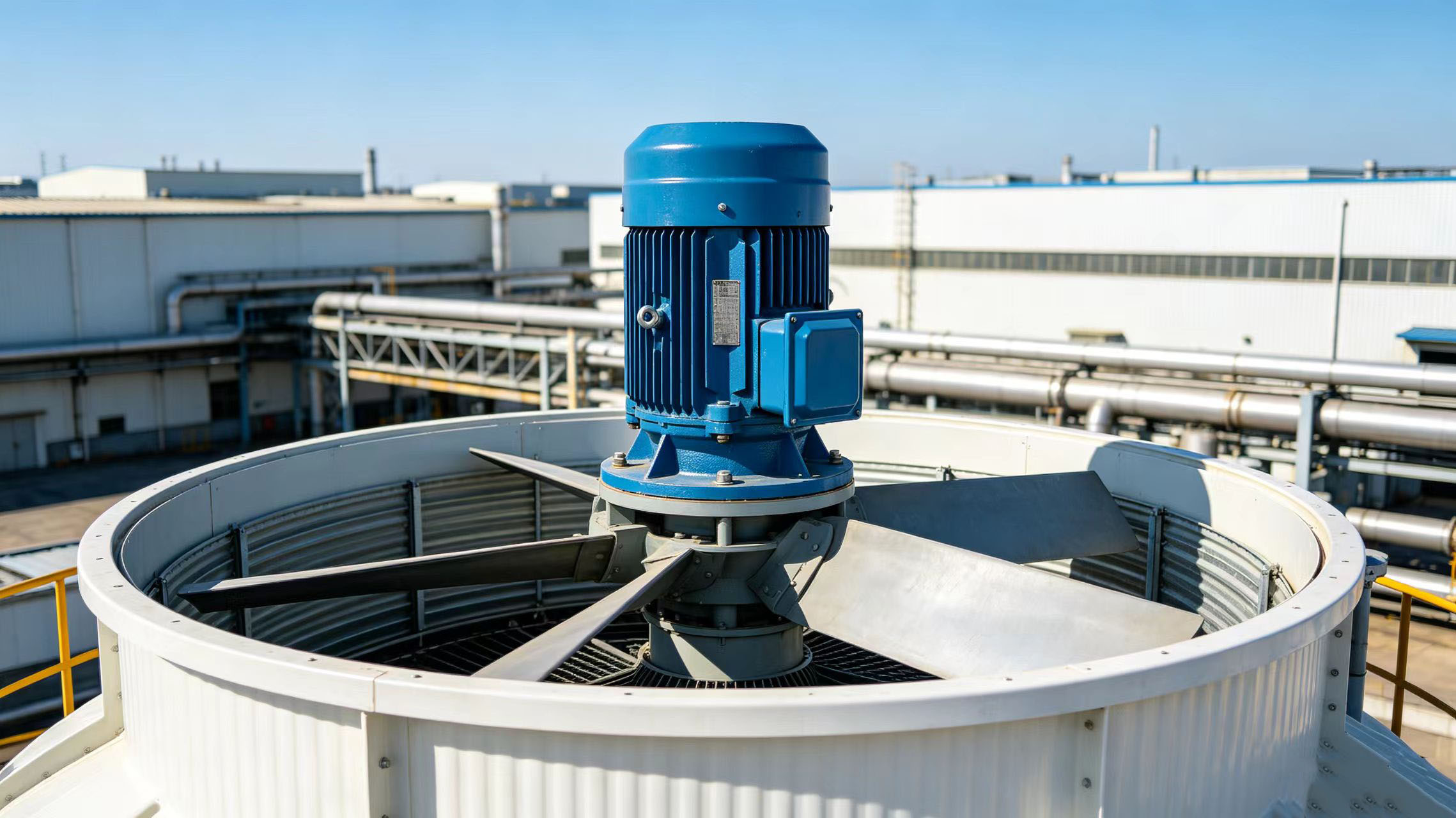
Understand The Unique Operating Environment of Cooling Tower Motors
High Humidity and Water Spray Exposure
Moisture Is The Biggest Cause of Motor Failure
Unlike standard industrial motors placed inside dry workshops, cooling tower motors sit directly on the tower fan deck, exposed to warm humid air, drift water spray, rain and condensation. Moisture can penetrate the motor housing, degrade winding insulation and trigger short circuits or earth faults. A qualified cooling tower motor manufacturer designs products specifically for this wet environment, rather than modifying general-purpose motors. Standard open drip proof motors are never suitable for this duty, as even fine water mist will quickly damage internal windings.
Coastal and Chemical Site Extra Risk
Sites near the sea carry salt-laden moisture, while chemical and wastewater plants have acidic or alkaline vapors. The manufacturer must offer special surface coating options, tropicalized insulation and upgraded sealing solutions for these aggressive environments. Ordinary cast iron housings will rust rapidly and lose structural integrity within a short operating period.
Continuous 24-Hour Duty and Heat Build-Up
Cooling towers for power plants, data centers and chemical facilities operate nonstop all year. The motor cannot rely on intermittent rest to release accumulated heat. Good manufacturers select higher insulation classes and optimize internal heat dissipation to prevent thermal aging of magnet wire. Overheating is one of the most common hidden failure modes that shorten motor lifespan.
Vibration and Mechanical Shock From Fan Assembly
Axial fan rotation creates continuous aerodynamic vibration that transfers directly to the motor shaft and bearings. If the manufacturer uses cheap bearing assemblies or weak mounting flanges, long-term vibration will loosen fasteners, wear bearings and crack the motor housing. The best cooling tower motor designs include reinforced bearing housings, heavy-duty bearing sets and precision dynamic balancing to cope with cyclic excitation force.
Core Technical Specifications You Must Verify With The Manufacturer
Enclosure Type and IP Protection Rating
TEFC Totally Enclosed Fan Cooled Motors
TEFC is the mainstream enclosure type for
cooling tower fan motors. It fully seals internal components and uses an external small cooling fan to dissipate heat. Reputable manufacturers use robust shaft seals and O-rings to block water ingress at the shaft outlet. Some suppliers also provide TENV totally enclosed non-vented models for very high dust or spray conditions.
How To Pick The Right IP Grade
IP rating defines resistance to dust and liquid intrusion. IP55 is the minimum acceptable standard for general cooling tower applications. For positions close to water drift or heavy rainfall, IP56 is strongly recommended. Manufacturers that only supply IP54 motors should be avoided for outdoor tower top installation. In washdown-heavy environments, IP66 options can be requested for extra protection. Always confirm that the stated IP rating is tested under cooling tower operating conditions, not just static lab testing.
Insulation Class and Thermal Capacity
Class F insulation is widely used as the baseline, allowing continuous winding temperature up to 155°C. Class H insulation is preferred for high ambient temperature sites, VFD variable frequency drive operation and heavy-duty industrial towers. A professional manufacturer will impregnate windings with moisture-resistant varnish rather than standard dipping treatment. This extra process raises insulation resistance and slows degradation under humid conditions.
Mounting Form, Shaft Type and Frame Standard
Vertical Top Mount Design
Most cooling tower fan motors adopt vertical mounting. The shaft points downward to connect with the gear reducer or fan hub. Vertical motors have different internal bearing loading designs compared with horizontal motors. General horizontal motors cannot be converted for vertical use, as the bearing will fail quickly under axial thrust. Ask your manufacturer to confirm the motor is purpose-built for vertical mounting.
Hollow Shaft vs Solid Shaft
Hollow shaft motors are common for close-coupled gearbox setups, while solid shaft versions connect via flexible couplings. The manufacturer must match shaft diameter, keyway size and flange bolt pattern to your existing drive assembly. For replacement projects, interchangeable frame size is critical. Most export-oriented manufacturers support both IEC and NEMA frame standards for global retrofits.
Efficiency Class and Energy Performance
IE3 premium efficiency is now the baseline for new cooling tower installations, and many industrial projects specify IE4 super premium efficiency to cut long-term electricity bills. Low efficiency motors may have a cheaper purchase price, but they consume extra power every hour during continuous operation. A responsible manufacturer can supply efficiency test reports and curve data so you calculate total lifecycle cost instead of only unit price. For variable speed control, inverter-duty windings and reinforced insulation are required to withstand harmonic stress from VFD drives.
Special Optional Motor Versions
Explosion proof cooling tower motors are mandatory for petrochemical, refinery and hazardous classified areas. The manufacturer must hold valid explosion-proof certificates matching local safety standards. Brake motors, dual-speed motors and permanent magnet high-efficiency models are available for special control requirements. Confirm whether the factory has production and testing capacity for these special variants before placing orders.
Evaluate The Manufacturer’s Engineering Matching Ability
Compatibility With The Whole Fan System
A cooling tower motor never works alone. It must coordinate perfectly with fan blades, fan hub, gear reducer and FRP fiberglass fan stack. Some motor manufacturers only produce standalone electric motors without cooling tower aerodynamic knowledge. They cannot judge whether the motor power, speed and torque curve match your fan assembly.
Matching Torque and Power Curve
If the motor power is undersized, it will overload and trip under high pitch angle or hot weather. Oversized motors waste capital and run with low load factor, reducing overall efficiency. The ideal supplier can review your fan blade diameter, blade quantity, pitch range and gearbox ratio to recommend the correct motor rating. This system-level check separates specialized cooling tower spare part manufacturers from generic motor factories.
Dynamic Balance and Vibration Matching
After the motor is combined with fan blades, the whole rotating set must maintain low vibration. Good manufacturers provide single-unit dynamic balance testing and can coordinate balance tolerances with your fan blade supplier. Poorly balanced assemblies damage both motor bearings and gearbox bearings rapidly.
OEM Custom and Reverse Engineering Capacity
Customization For New Cooling Tower Projects
Custom requirements include special voltage, frequency, mounting flange, coating color, tropical treatment and non-standard power ratings. Ask whether the manufacturer can modify drawings, adjust machining and arrange custom batch production. Flexible OEM support is essential for tower brand builders launching new models.
Reverse Engineering For Obsolete Replacement Motors
Many cooling towers in service are 15 to 30 years old, and the original OEM has discontinued the motor model. The best cooling tower motor manufacturers accept reverse engineering based on old nameplate data, dimension sketches or photos. They replicate the mounting interface while upgrading internal materials, sealing and efficiency. This is a key service for plant maintenance teams that struggle to find interchangeable spares.
Technical Documentation and Pre-Production Approval Process
A trustworthy manufacturer supplies nameplate drawings, dimension drawings, performance curves, test certificates and installation manuals before shipment. For custom orders, they will send a formal drawing for your confirmation before starting production. Avoid suppliers who only provide simple quotation sheets with no supporting technical data. This approval workflow reduces costly mismatches after delivery.
Check The Manufacturer’s Production, Testing and Quality Control
In-House Production or Outsourced Assembly
Many trading companies resell motors from third-party factories without quality control authority. Manufacturers with their own winding, machining, painting and testing workshops have full control over raw material quality and process consistency. You can ask for factory audit photos, production video or third-party inspection options such as SGS and BV witness inspection.
Mandatory Test Items For Each Motor Batch
Standard finished tests include winding resistance check, insulation resistance test, no-load running test, vibration test, noise test and sealing check. Critical export orders can also request partial discharge test, thermal rise test and salt spray aging test for coastal or chemical site motors. Ask the supplier what test records they provide with each shipment.
Raw Material Traceability
Key components such as copper wire, silicon steel sheet, bearing brand, seal and varnish directly determine reliability. High-end manufacturers use well-known bearing brands and moisture-resistant magnet wire, and keep batch records for traceability. Low-cost suppliers cut corners by using recycled silicon steel and inferior bearings, leading to short service life.
Review After-Sales, Warranty and Export Support
Warranty Terms and Failure Response
Standard warranty periods range from 12 months to 24 months, depending on model and application. Carefully read the exclusion clauses. Some manufacturers exclude damage caused by humid environment, vibration or improper installation. A reliable partner will provide technical guidance for on-site troubleshooting, not only replacement service.
Global Export Logistics and Document Support
Since you may ship motors to Africa, Southeast Asia, Latin America and the Middle East, confirm the manufacturer is familiar with export documentation, including commercial invoice, packing list, certificate of origin and material test reports. They should use suitable export packing with moisture-proof desiccant and reinforced wooden cases. Large fan assemblies including motors, hubs and blades can be bundled into one shipment with a unified loading plan.
Local Technical Support and Spare Part Supply
For long-term cooperation, check whether the manufacturer can continue to supply spare parts such as bearings, shaft seals and terminal blocks after the motor sale. Remote sites often face long lead times for spare components, so continuous parts support greatly reduces downtime risk.
Compare Total Lifecycle Cost Instead of Unit Price
The cheapest motor offer is rarely the most economical choice over ten or fifteen years of operation. A low-price motor may have low efficiency, short bearing life and weak sealing. It consumes more electricity and requires replacement every few years. Premium motors with IE3 or IE4 efficiency, Class H insulation and upgraded sealing cost more upfront, but they save power and extend service intervals.
When comparing quotations, list out all factors: efficiency grade, IP rating, insulation class, bearing configuration, surface coating, warranty, test report and technical service. A specialized cooling tower motor manufacturer can help you complete a simple lifecycle cost calculation for your site.
Align The Manufacturer With Your Tower Application
Cooling Tower Type Matching
Counter flow cooling towers, cross flow cooling towers, closed circuit cooling towers and evaporative condensers have different fan deck layouts and fan setups. The manufacturer should have experience supplying motors for each tower type. Cross flow towers sometimes use special low-profile mounting, while large counter flow towers need high-torque vertical motors for big diameter fan blades.
Industry Working Conditions
Power generation plants prioritize stable continuous operation and fire safety. Petrochemical sites need explosion-proof and chemical-resistant treatment. Data centers demand ultra-low vibration and low noise. Seawater desalination and coastal facilities require salt spray resistant coating and vinyl ester compatible protection. The right manufacturer selects the correct material package based on your industry, not using one universal motor design for all scenarios.
Common Red Flags When Selecting A Cooling Tower Motor Manufacturer
They only quote general-purpose motors and do not ask about tower type, fan diameter or site environment. They cannot provide vibration, noise or thermal test reports. They refuse drawing confirmation before custom production. They cannot support reverse engineering for replacement projects. They promise extremely low prices but shorten warranty coverage and limit technical support. They are unfamiliar with vertical mounting requirements and confuse horizontal motor specifications. These warning signs usually mean the supplier lacks cooling tower specialized engineering.
Matching Cooling Tower Components We Recommend Sourcing Together
Working with one supplier for the whole fan package eliminates compatibility risk. Alongside the cooling tower motor, you can source optimized FRP fan blades, fan hub, helical or bevel gear reducer, fiberglass cooling tower fan stack, vibration switch, flexible coupling and fan guard. One-source engineering ensures the power, aerodynamics and mechanical interface are fully coordinated. This integrated supply model is widely adopted by cooling tower OEM builders and plant maintenance teams.
FAQ
What is the best IP rating for a cooling tower fan motor
IP55 is the minimum standard for most cooling towers. IP56 is preferred when the motor sits close to water drift and frequent spray. IP66 is suitable for washdown and heavy rain exposure.
Can I use a horizontal motor converted to vertical mounting
No. Vertical cooling tower motors have special thrust bearing design to handle downward axial load. Converted horizontal motors will suffer premature bearing failure.
What efficiency class should I choose for continuous operation
IE3 premium efficiency is the mainstream standard. IE4 super premium efficiency is recommended for data centers, power plants and sites with high electricity cost.
Can they produce replacement motors for old cooling towers
Yes, qualified cooling tower motor manufacturers offer reverse engineering service. You can provide nameplate information, dimension measurements and photos to get an interchangeable design.
Do cooling tower motors need special tropical treatment
For high humidity, high temperature and coastal salt areas, tropicalized winding impregnation and epoxy coating are strongly recommended to slow insulation aging and corrosion.
Why Specialized Cooling Tower Motor Manufacturers Outperform General Motor Factories
General motor factories focus on standard industrial drive demands. Cooling tower specialized manufacturers understand fan aerodynamics, tower deck environment, vibration transfer and matching with fan blades and gearboxes. They do not merely sell motors; they deliver a compatible drive solution for your heat rejection system. This depth of knowledge prevents mismatched selections that cause unexpected shutdowns and extra maintenance expense.
Contact Us For Cooling Tower Motor Selection Support
If you are searching for a reliable cooling tower motor manufacturer for new tower assembly or replacement upgrade, share your cooling tower type, required power, voltage, frequency, mounting dimension, fan diameter, operating environment and noise requirements. Our engineering team will review your fan system parameters, confirm specifications and send drawings and formal quotations for your project.


