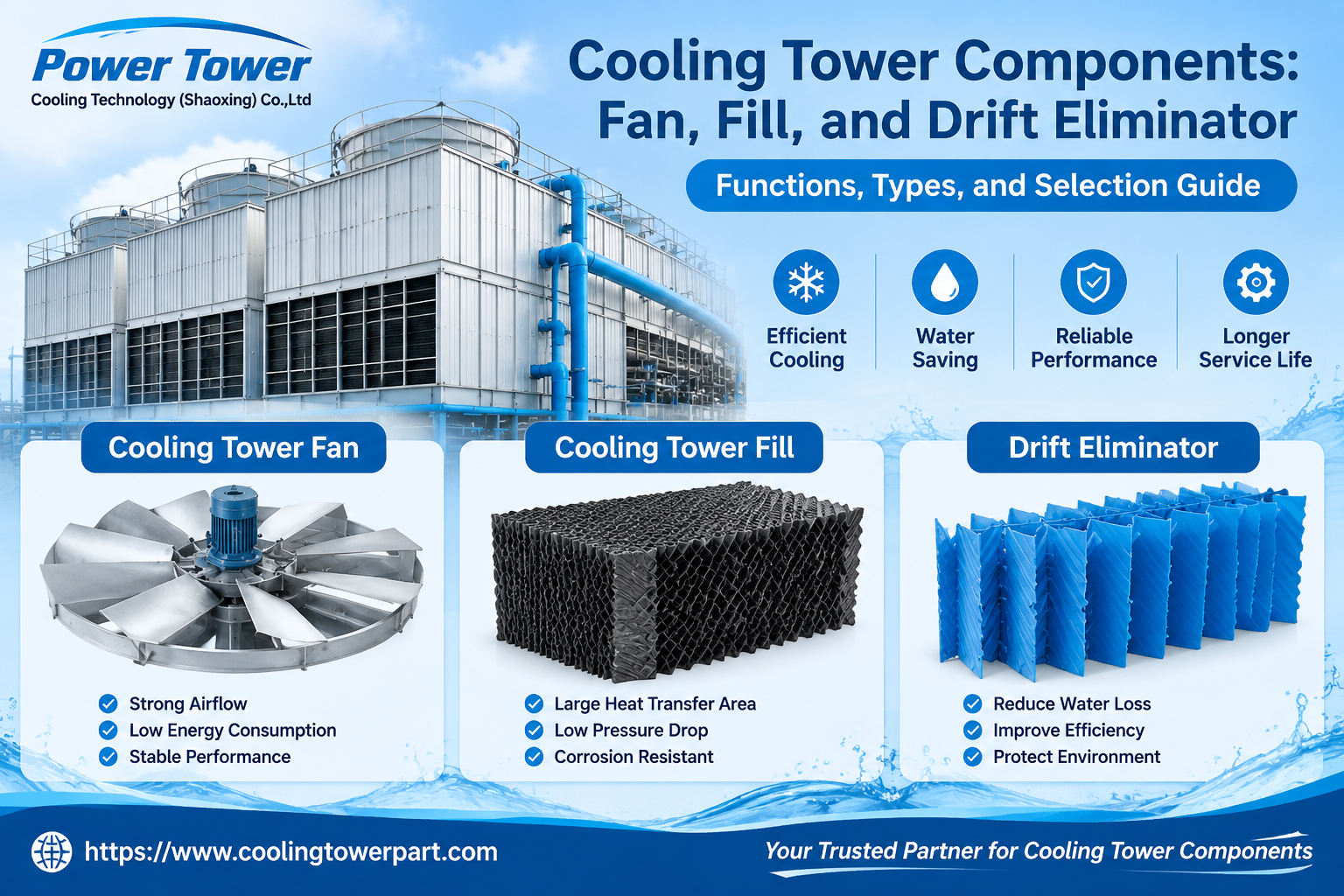
A cooling tower may look like a simple industrial structure from the outside, but its cooling performance depends on several components working together. Among them, three parts play especially important roles: the cooling tower fan, cooling tower fill, and drift eliminator.
Each component has a different responsibility. The fan moves air through the tower, the fill creates a large contact area between water and air, and the drift eliminator captures water droplets before they escape with the exhaust air.
If one of these components performs poorly, the entire cooling system can suffer. You may notice reduced cooling capacity, higher water consumption, increased energy costs, or more frequent maintenance problems.
So, how do these three components work? What types are available? And how can you select the right products for your cooling tower?
In this guide, we'll explain their functions, materials, selection factors, and maintenance requirements. Whether you're responsible for an industrial cooling tower, HVAC system, power plant, or manufacturing facility, understanding these components can help you make better purchasing and maintenance decisions.
1. Understanding the Main Components of a Cooling Tower
An industrial cooling tower removes unwanted heat from circulating water and releases that heat into the atmosphere. This process supports equipment cooling, air conditioning, process temperature control, and many other industrial operations.
A typical cooling tower contains several components, including:
Cooling tower fan and fan drive system
Cooling tower fill
Drift eliminator
Water distribution system
Spray nozzles
Air inlet louvers
Water collection basin
Casing and structural supports
Although every component contributes to system operation, the fan, fill, and drift eliminator have a particularly direct influence on airflow, heat transfer, and water conservation.
Think of them as a team. The fan provides movement, the fill creates the opportunity for heat exchange, and the drift eliminator helps keep valuable water inside the tower.
Understanding how these parts work together is the first step toward choosing suitable replacement components.
2. How Does a Cooling Tower Work?
Before looking at each component individually, let's review the basic cooling process.
Hot water from industrial equipment enters the cooling tower and is distributed over the fill. At the same time, air moves through the tower. As water spreads across the fill and comes into contact with air, a small portion evaporates.
Evaporation removes heat from the remaining water, reducing its temperature. The cooled water collects in the basin and returns to the industrial process.
Meanwhile, warm, moisture-containing air leaves the tower through the air outlet. Before it escapes, the air passes through the drift eliminator, which captures many of the water droplets carried by the airflow.
This process may sound simple, but its efficiency depends on several operating conditions, including:
Entering and leaving water temperatures
Water flow rate
Ambient air temperature and humidity
Wet-bulb temperature
Airflow volume and distribution
Fill design and condition
Drift eliminator performance
A cooling tower is therefore more than a container for hot water. It is a heat and mass transfer system in which every major component has a specific job.
2.1 The Role of Air and Water Contact
The cooling process depends on effective contact between air and water.
If water flows through the tower in large streams, the contact area may be limited. When the water spreads across specially designed fill surfaces, however, the exposed area increases significantly.
This gives air more opportunities to absorb heat and moisture.
The fan supports this process by moving air through the tower, while the fill provides the surface area needed for heat transfer.
2.2 Why Component Coordination Matters
A powerful fan cannot fully compensate for badly clogged fill. Similarly, installing high-efficiency fill will not guarantee good cooling if the airflow is insufficient or uneven.
A damaged drift eliminator can also increase water carryover, even when the fan and fill are operating normally.
That's why cooling tower components should be selected as part of a complete system rather than as unrelated products.
3. Cooling Tower Fan: The Airflow Power Source
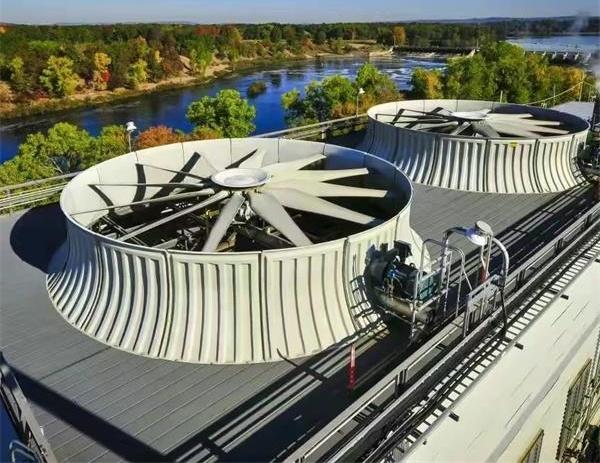
The cooling tower fan is responsible for moving air through a mechanical-draft cooling tower. It creates the airflow required to support evaporation and heat transfer.
Without sufficient airflow, the tower may struggle to achieve its required outlet water temperature, particularly during periods of high ambient temperature or heavy process demand.
Cooling tower fans are commonly used in induced-draft and forced-draft arrangements.
In an induced-draft cooling tower, the fan is usually installed near the top of the tower. It pulls air through the tower and discharges the warm, moisture-laden air upward.
In a forced-draft cooling tower, the fan pushes air into the tower, usually from a lower or side position.
Both arrangements can be effective. The correct configuration depends on the tower design, airflow requirements, installation conditions, and operating environment.
3.1 Main Functions of a Cooling Tower Fan
A cooling tower fan performs several important functions.
First, it provides airflow. The fan moves air through the tower at the required volume and velocity.
Second, it supports heat transfer. Adequate airflow helps maintain effective contact between air and water across the fill.
Third, it helps maintain stable cooling performance. Properly selected fan equipment can support the tower under changing operating conditions.
Fan performance can influence:
An incorrectly selected fan may consume excessive energy or fail to provide enough airflow. In some cases, excessive fan speed can also create unnecessary mechanical stress.
3.2 Common Types of Cooling Tower Fans
Cooling tower fans are generally divided into two main categories: axial fans and centrifugal fans.
The correct choice depends on the cooling tower design, required airflow, static pressure, installation space, and operating conditions.
Axial Cooling Tower Fans
Axial fans move air mainly parallel to the fan shaft. They are widely used in industrial cooling towers because they can handle large air volumes in many relatively low-pressure applications.
Many cooling tower axial fans use multiple blades connected to a central hub. Some designs allow blade pitch adjustment, making it possible to change the fan's aerodynamic characteristics to suit specific operating requirements.
Common materials include:
When selecting an axial fan, buyers should consider the fan diameter, blade number, blade profile, rotational speed, airflow, static pressure, and motor power.
A fan that looks similar to the original may still have different aerodynamic performance. Always check the technical specifications rather than relying on appearance alone.
Centrifugal Cooling Tower Fans
Centrifugal fans draw air into the fan and discharge it in a direction generally perpendicular to the inlet flow.
They are useful in applications requiring higher pressure or specific duct arrangements. However, their installation requirements and energy characteristics can differ from those of axial fans.
Before selecting a centrifugal fan, evaluate the required airflow, static pressure, available installation space, and expected operating conditions.
3.3 Cooling Tower Fan Materials
Fan material affects weight, corrosion resistance, mechanical strength, and service life.
FRP is widely used in cooling tower applications because it offers a useful combination of low weight and corrosion resistance. It can be suitable for humid environments where metal corrosion is a concern.
Aluminum alloy is another common option. It offers useful mechanical properties and relatively low weight, making it suitable for various industrial fan designs.
The best material depends on several factors:
Air temperature and humidity
Chemical exposure
Fan diameter and rotational speed
Mechanical loading
Environmental corrosion conditions
Maintenance requirements
Always confirm material compatibility with the actual operating environment.
3.4 How to Select the Right Cooling Tower Fan
Choosing a cooling tower fan based on diameter alone is a common purchasing mistake.
A suitable fan must match the tower's aerodynamic and mechanical requirements.
Before purchasing, check the following information:
Required airflow volume
Required static pressure
Fan diameter
Rotational speed
Motor power
Blade number and profile
Blade and hub materials
Installation dimensions
Noise and vibration requirements
Operating environment
For a replacement project, provide the existing fan model, technical drawings, operating data, and photographs if available.
This information helps the manufacturer evaluate whether a direct replacement or a redesigned fan is more appropriate.
4. Cooling Tower Fill: The Core Heat Transfer Component
Cooling tower fill is one of the most important components for heat transfer.
It provides a large surface area over which hot water can spread and come into contact with moving air.
Imagine pouring water over a smooth plate compared with spreading it across thousands of thin surfaces. The second arrangement exposes much more water to the air, creating better conditions for evaporation and cooling.
Cooling tower fill works on a similar principle.
It is normally installed inside the tower beneath the water distribution system. Its design aims to increase the contact area and contact time between water and air while maintaining acceptable airflow resistance.
4.1 What Does Cooling Tower Fill Do?
The main purpose of cooling tower fill is to improve heat and mass transfer.
Depending on its design, fill can distribute water into thin films or break it into smaller droplets. Both approaches increase the interaction between water and air.
Good fill design should balance several factors:
If fill becomes blocked by scale, sediment, algae, or biological growth, water and air distribution may become uneven.
This can reduce cooling efficiency and increase operating costs.
4.2 Main Types of Cooling Tower Fill
Cooling tower fill is generally divided into two main categories: film fill and splash fill.
Each has different characteristics, and the right choice depends on water quality, tower design, and operating conditions.
Film Fill
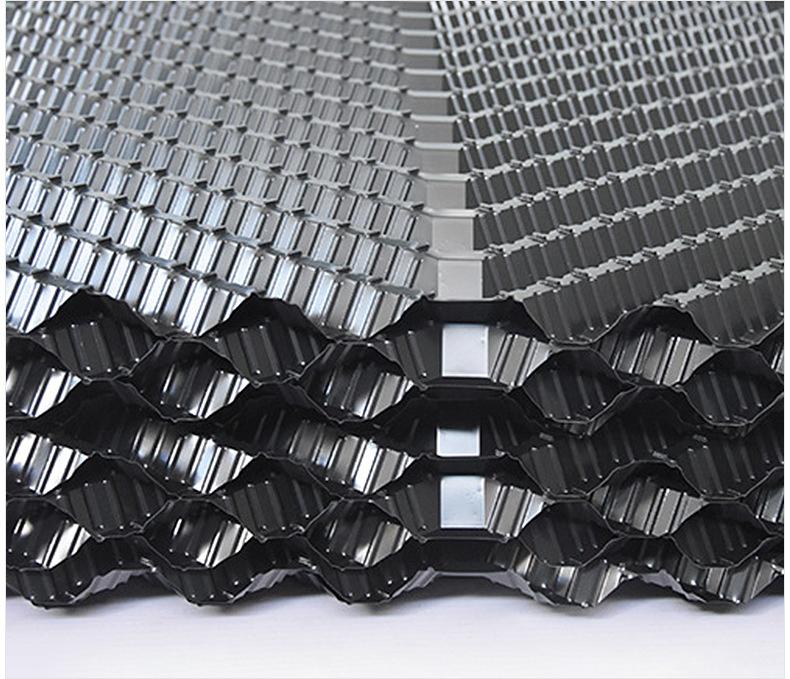
Film fill uses closely spaced sheets with formed surface patterns. Water flows across these sheets as a thin film, creating a large contact area with the air.
Film fill is widely used in applications where water quality can be controlled and high heat-transfer efficiency is required.
Common configurations include:
One advantage of film fill is its ability to provide a large effective surface area in a relatively compact space.
However, narrow passages can be more vulnerable to blockage when circulating water contains high levels of suspended solids, scale-forming minerals, or biological material.
For this reason, water treatment and regular inspection are important.
Splash Fill
Splash fill breaks falling water into smaller droplets as it moves through a series of bars, grids, or other specially designed surfaces.
This increases the exposed water surface and supports heat transfer.
Splash fill is often considered for applications where water quality is more challenging or resistance to fouling is a major concern.
It is available in different configurations and materials, and its suitability depends on the cooling tower structure, water distribution arrangement, and required thermal performance.
4.3 Common Cooling Tower Fill Materials
Material selection affects the fill's temperature resistance, chemical compatibility, durability, and expected service life.
PVC (Polyvinyl Chloride) is widely used in cooling tower fill because it offers good formability, chemical resistance, and cost-effectiveness under suitable operating conditions.
PP (Polypropylene) is another option, particularly where higher temperature resistance or specific chemical properties are required.
Other materials may be considered for specialized operating environments.
When choosing fill material, consider:
Operating water temperature
Water chemistry
Chemical treatment
UV exposure
Fire-performance requirements
Mechanical strength
Expected maintenance conditions
Do not assume that PVC or PP is automatically suitable for every application. Always check the manufacturer's technical data and confirm that the selected material meets the actual operating requirements.
4.4 How to Choose the Right Cooling Tower Fill
Start with water quality.
Is the circulating water relatively clean, or does it contain suspended solids, scale, oil, or biological growth?
This question can help determine whether film fill or splash fill is more appropriate.
Next, check the following factors:
Cooling tower type
Crossflow or counterflow configuration
Fill block dimensions
Sheet spacing and thickness
Flute geometry
Water loading
Airflow direction
Operating temperature
Support structure and installation height
A fill block that looks similar to the original may still have different airflow resistance or thermal performance.
For replacement projects, accurate measurements and operating information are essential.
5. Cooling Tower Drift Eliminator: Reducing Water Loss
A drift eliminator is designed to reduce the amount of liquid water droplets carried out of the cooling tower with the exhaust air.
During normal operation, moving air can carry small water droplets away from the tower. If these droplets escape, they represent water loss and may contribute to wet surfaces or deposits around the facility.
A drift eliminator changes the direction of the airflow so that many droplets collide with its surfaces, collect, and drain back into the tower.
This helps improve water retention and supports more efficient cooling tower operation.
5.1 What Is a Cooling Tower Drift Eliminator?
A cooling tower drift eliminator usually consists of a series of shaped blades, sheets, or passages installed in the air discharge path.
Its geometry is designed to separate liquid droplets from moving air while allowing the air to continue flowing.
It is important not to confuse drift eliminators with air inlet louvers.
Louvers are commonly used to control water splash-out and help manage air entry. Drift eliminators, on the other hand, are installed in the exhaust airflow path to reduce droplet carryover.
They have different functions and should be selected according to their specific installation positions.
5.2 How Does a Drift Eliminator Work?
As moisture-laden air passes through the drift eliminator, it follows a series of turns.
Water droplets have greater inertia than the air itself, so many droplets cannot follow every change in airflow direction. They collide with the eliminator surfaces, combine with other droplets, and drain back into the tower.
The effectiveness of this process depends on:
A well-designed drift eliminator should provide the required droplet separation without creating excessive airflow resistance.
5.3 Common Drift Eliminator Types and Materials
Drift eliminators are available in different configurations, including blade-type and multi-pass designs.
Their internal geometry determines the airflow path, droplet separation characteristics, pressure drop, and installation requirements.
Common materials include PVC and PP.
PVC drift eliminators are widely used in many standard cooling tower applications.
PP drift eliminators may be selected for applications where different temperature or chemical resistance characteristics are required.
The correct material and configuration should always be confirmed against the operating environment and the cooling tower design.
5.4 How to Select the Right Drift Eliminator
Selecting a drift eliminator requires more than checking its external dimensions.
Important factors include:
Cooling tower airflow rate
Air velocity
Required drift performance
Available installation space
Blade spacing and profile
Material and thickness
Support arrangement
Airflow resistance
Installation orientation
You should also check whether the eliminator profile is designed to work in a particular direction.
Incorrect installation can reduce its effectiveness or interfere with airflow.
Before ordering replacement packs, request dimensional drawings and installation guidance from the supplier.
6. How Fan, Fill, and Drift Eliminator Work Together
The cooling tower fan, fill, and drift eliminator have different functions, but their performance is closely connected.
The fan moves air through the tower.
The fill increases contact between water and air so that heat can be transferred.
The drift eliminator reduces the amount of water carried out with the exhaust air.
Consider what happens when one component fails.
If the fan provides insufficient airflow, the fill may not achieve its intended cooling performance.
If the fill is blocked, even a properly operating fan may not deliver the expected cooling result.
If the drift eliminator is damaged or incorrectly installed, water loss may increase.
The relationship between these components can be summarized as follows:
| Component | Primary Function | Main Performance Concern |
| Cooling tower fan | Moves air through the tower | Airflow, power consumption, vibration |
| Cooling tower fill | Improves air-water contact and heat transfer | Thermal performance, fouling, pressure drop |
| Drift eliminator | Captures water droplets from exhaust air | Drift control, pressure drop, water retention |
This is why component selection should consider the entire cooling tower.
A change to one component may affect airflow resistance, water distribution, or operating conditions elsewhere in the system.
7. Signs That Cooling Tower Components Need Replacement
Cooling tower components do not last forever.
Environmental exposure, water chemistry, vibration, mechanical stress, and maintenance quality all influence their service life.
Recognizing early warning signs can help prevent unexpected shutdowns and expensive repairs.
7.1 Cooling Tower Fan Problems
A fan may require inspection or replacement if you notice:
Before replacing the fan, inspect the motor, hub, drive system, mounting structure, and alignment. A vibration problem may not originate from the fan blades alone.
7.2 Cooling Tower Fill Problems
Fill may need replacement when it becomes:
Heavily scaled or blocked
Brittle or deformed
Cracked or physically damaged
Unevenly distributed
Unable to maintain proper water flow
Significantly affected by biological growth
If fill repeatedly becomes blocked, investigate the water-treatment and filtration system as well. Replacing the fill without addressing the underlying water-quality problem may only provide a temporary solution.
7.3 Drift Eliminator Problems
Inspect drift eliminators if you find:
Missing or broken blades
Warped or deformed sections
Loose connections
Damaged support structures
Increased visible water carryover
Incorrect installation orientation
Replacing damaged sections with compatible products can help restore the intended airflow path and droplet separation performance.
8. Maintenance Tips for Longer Component Service Life
Regular inspection can prevent small problems from becoming expensive failures.
A practical maintenance program should cover all three components.
8.1 Fan Inspection and Maintenance
Check the fan for cracks, loose fasteners, corrosion, vibration, and blade damage.
Follow the equipment manufacturer's procedures for balancing, alignment, lubrication, and mechanical inspection.
Do not change blade pitch or fan speed without checking the equipment specifications and operating requirements.
8.2 Fill Cleaning and Inspection
Monitor fill for deposits, blockage, deformation, and uneven water distribution.
Cleaning methods should be compatible with the fill material. Excessive pressure or unsuitable chemicals can damage the sheets.
If deposits return quickly after cleaning, review water treatment, filtration, and operating conditions.
8.3 Drift Eliminator Inspection
Inspect blades, joints, supports, and installation orientation.
Remove accumulated dirt and deposits using an appropriate cleaning method. Replace damaged sections when their structure or droplet separation performance is compromised.
8.4 Keep Maintenance Records
Keep records of:
Inspection dates
Cleaning activities
Water quality
Operating temperatures
Fan vibration observations
Component replacement history
Cooling performance trends
These records make it easier to identify recurring problems and plan maintenance before a component fails.
Always isolate equipment and follow site safety procedures before entering or working inside a cooling tower.
9. Common Mistakes When Buying Cooling Tower Components
Buying cooling tower components may seem straightforward, but several common mistakes can lead to poor performance or unnecessary costs.
Mistake 1: Choosing Only by Price
The cheapest product is not always the most economical choice.
A low-cost fill product may have unsuitable geometry or material properties. A poorly matched fan may consume more power than expected. A drift eliminator with the wrong profile may not provide the required droplet separation.
Compare technical specifications, not just quotations.
Mistake 2: Ignoring Water Quality
Water quality has a major influence on fill selection.
Film fill may provide high thermal performance in suitable water conditions, but narrow passages can be vulnerable to fouling when suspended solids or scale are poorly controlled.
Always consider water quality before choosing fill geometry.
Mistake 3: Assuming Similar Dimensions Mean Compatibility
Two products may have similar external dimensions but different internal structures and performance characteristics.
For example, different fan blade profiles can produce different airflow characteristics. Different fill flute geometries can affect thermal performance and pressure drop.
Confirm the technical specifications before placing an order.
Mistake 4: Ignoring Installation Requirements
Even a suitable product can perform poorly if it is installed incorrectly.
Check support dimensions, installation orientation, connection methods, airflow direction, and access requirements before ordering.
Mistake 5: Replacing Components Without Identifying the Root Cause
If fill becomes blocked repeatedly, investigate water treatment.
If a fan develops abnormal vibration, inspect the drive system and supporting structure.
If drift increases, check the eliminator condition, installation, and airflow conditions.
Replacing a component without addressing the underlying problem can lead to repeated maintenance costs.
10. Why Choose Power Tower Cooling Technology (Shaoxing) Co.,Ltd?
Choosing a reliable cooling tower component manufacturer is about more than finding a product with the right dimensions. You need a supplier that understands how each component works within the complete cooling tower system.
Power Tower Cooling Technology (Shaoxing) Co.,Ltd specializes in cooling tower components and replacement solutions for industrial cooling applications.
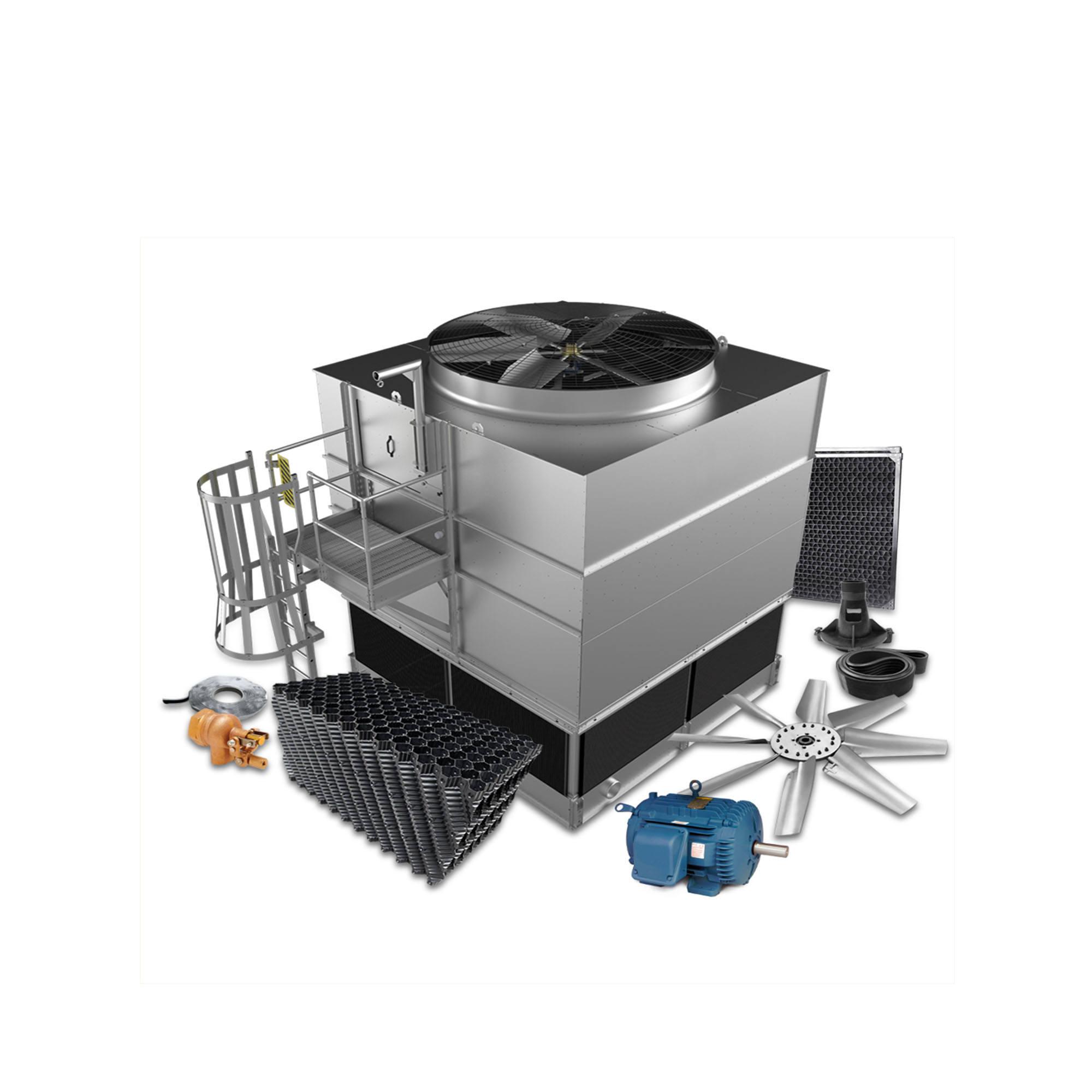
Its product range includes cooling tower fill, cooling tower fans, drift eliminators, motors, speed reducers, spray nozzles, and other related cooling tower parts.
For customers planning maintenance, refurbishment, or replacement projects, sourcing multiple compatible components from a specialized supplier can make purchasing and project coordination easier.
10.1 Cooling Tower Fill Solutions
Power Tower provides cooling tower fill options for different tower configurations and operating requirements.
Typical product categories include:
PVC cooling tower film fill
PP cooling tower fill
Crossflow cooling tower fill
Counterflow cooling tower fill
Splash fill
Replacement fill packs
Customized fill solutions
The correct fill should be selected according to tower design, water quality, operating temperature, and thermal requirements.
10.2 Cooling Tower Fan and Drift Eliminator Products
Power Tower also offers cooling tower fan and fan-drive-related products, together with drift eliminators and other replacement components.
For buyers, this provides an opportunity to discuss several parts of the same cooling tower project with one component supplier.
The important point is to confirm compatibility. Fan performance, fill geometry, and drift eliminator design should all be evaluated against the existing tower and its operating conditions.
10.3 Customized and Replacement Support
Older cooling towers do not always use standard component dimensions. In these cases, customized manufacturing or OEM-compatible replacement solutions may be necessary.
When contacting a supplier, provide as much technical information as possible, including:
Cooling tower brand and model
Existing component dimensions
Product drawings or samples
Material requirements
Operating water temperature
Water flow rate
Water quality information
Photographs of the existing installation
This information helps the manufacturer evaluate the application and recommend a more suitable product.
To explore available products and replacement solutions, visit the official website:
https://www.coolingtowerpart.com
11. Frequently Asked Questions About Cooling Tower Components
11.1 What Are the Three Main Cooling Tower Components?
The three components covered in this guide are the fan, fill, and drift eliminator.
The fan moves air through a mechanical-draft cooling tower. The fill increases contact between water and air to support heat transfer. The drift eliminator captures water droplets carried by exhaust air and helps reduce water loss.
11.2 How Often Should Cooling Tower Fill Be Replaced?
There is no single replacement interval for every cooling tower.
Fill service life depends on material quality, water chemistry, operating temperature, cleaning practices, and exposure to sunlight and chemicals.
Inspect the fill regularly and replace it when damage, severe blockage, deformation, or loss of structural integrity affects performance.
11.3 Can a New Fan Improve Cooling Tower Performance?
Yes, if the existing fan is damaged, incorrectly selected, or unable to provide the required airflow.
However, a new fan should be selected according to the tower's actual airflow and pressure requirements.
Increasing fan size or speed without checking the system can cause excessive power consumption, vibration, or mechanical problems.
11.4 What Happens If a Drift Eliminator Is Damaged?
Damaged or missing drift eliminator sections can allow more water droplets to escape with the exhaust air.
This may increase water consumption and cause unwanted wetting or deposits around the cooling tower.
Inspect the eliminator and replace damaged sections with compatible parts.
11.5 Can Different Cooling Tower Components Be Replaced Separately?
Yes. Fans, fill, and drift eliminators can often be replaced separately, provided the replacement products are compatible with the tower design and operating conditions.
However, a component replacement should include a review of related system requirements.
For example, a fill replacement should consider water distribution, airflow resistance, support dimensions, and operating temperature.
11.6 What Information Should I Provide When Ordering Replacement Parts?
At a minimum, provide the cooling tower brand and model, component dimensions, material, operating temperature, and photographs.
For more complex projects, include technical drawings, water flow rate, water quality information, airflow requirements, and any existing product specifications.
The more accurate the information, the easier it is to evaluate compatibility and reduce ordering errors.
12. Conclusion: Choose the Right Components for Reliable Cooling
The cooling tower fan, fill, and drift eliminator each play a vital role in reliable cooling tower operation.
The fan supplies airflow, the fill supports heat and mass transfer, and the drift eliminator helps reduce water droplet loss.
When these components are correctly selected, installed, and maintained, they can support stable cooling performance, better water conservation, and more predictable operating costs.
When planning a replacement project, don't focus on price or dimensions alone. Consider the complete operating environment, including water quality, airflow, temperature, material compatibility, and installation requirements.
A suitable component is not simply the one that fits inside the tower. It is the one that works reliably with the entire cooling system.
If you need cooling tower fill, fans, drift eliminators, or other replacement components, Power Tower Cooling Technology (Shaoxing) Co.,Ltd can help you explore suitable solutions for your application.
Visit https://www.coolingtowerpart.com to learn more about its cooling tower component products and discuss your replacement requirements.


