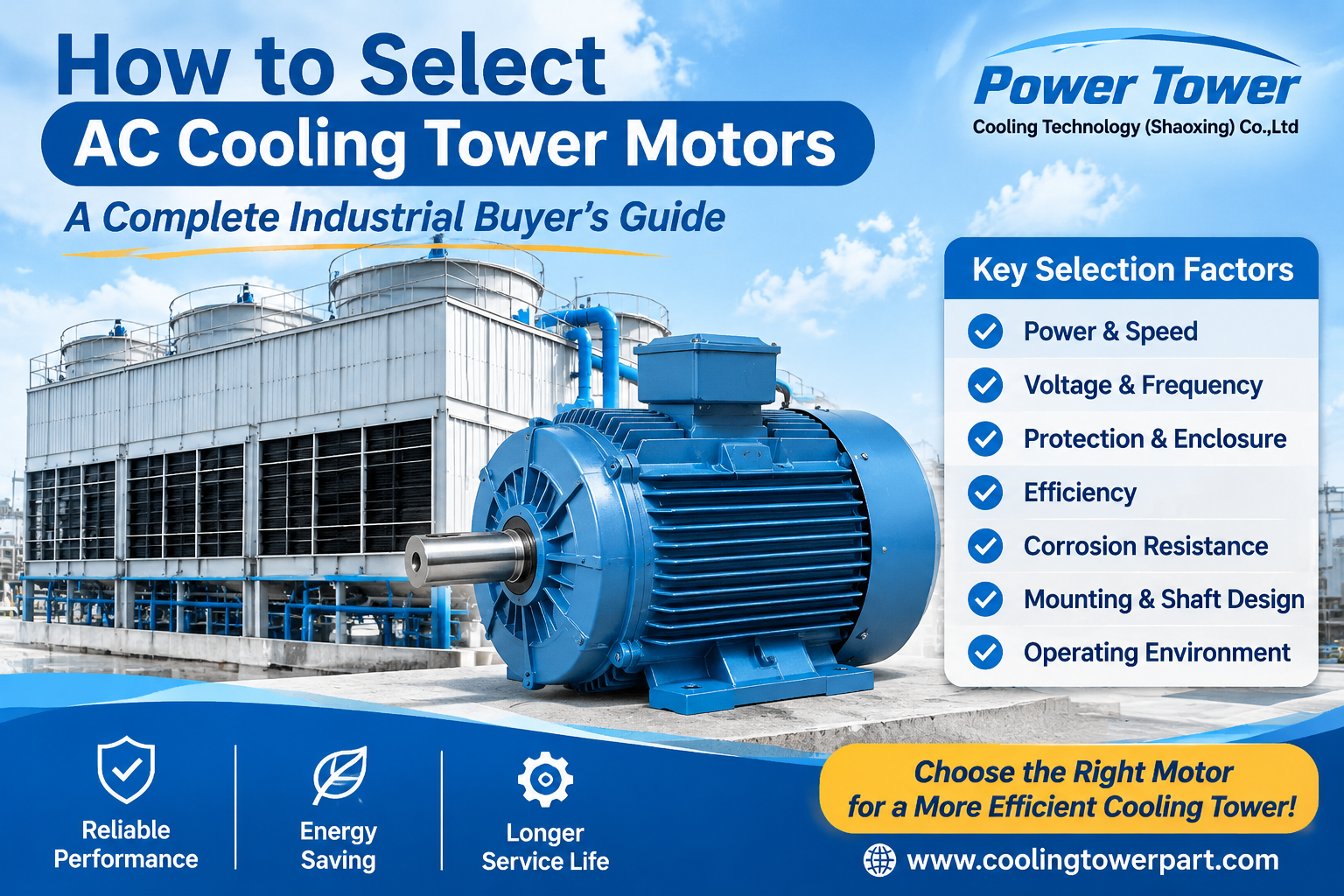
Choosing the right AC cooling tower motor is essential for maintaining stable cooling performance, reducing electricity costs, and avoiding unexpected equipment failures. Although a motor may look like a standard industrial component, cooling tower applications place special demands on its electrical and mechanical design.
Think of the motor as the heart of a cooling tower fan system. It provides the power needed to move air through the tower, helping transfer heat from circulating water into the atmosphere. If the motor is incorrectly selected, the fan may not deliver the required airflow. This can reduce cooling efficiency, increase operating costs, and put unnecessary stress on other equipment.
So, how do you select the right AC cooling tower motor?
You need to look beyond horsepower. Motor speed, voltage, frequency, enclosure protection, insulation class, efficiency, mounting dimensions, and operating conditions all matter. This guide explains the key factors step by step and helps you make a more informed purchasing decision.
1. Understand the Role of an AC Cooling Tower Motor
An AC cooling tower motor converts electrical energy into mechanical power. In a mechanical-draft cooling tower, this power is usually used to drive a fan that moves air through the tower.
As the fan operates, air passes through the cooling tower while hot circulating water is distributed over the fill. Heat transfers from the water to the air, and a portion of the water evaporates. This process lowers the temperature of the remaining water before it returns to the industrial cooling system.
The motor therefore plays an important role in the overall cooling process. If it cannot provide the required power and rotational speed, the fan may not generate sufficient airflow.
Three-phase AC induction motors are widely used in industrial cooling tower applications because of their practical design, availability, and suitability for continuous operation. However, the correct motor depends on the cooling tower's design and operating requirements.
1.1 How the Motor Drives the Cooling Tower Fan
The motor supplies rotational power to the fan. Depending on the cooling tower configuration, power may be transmitted through a direct connection, belts and pulleys, or a gearbox.
Each arrangement has different mechanical requirements. A direct-drive system connects the motor to the fan assembly, while a belt-drive system uses pulleys to transfer power. A gearbox-driven system reduces rotational speed and increases output torque to meet the fan's requirements.
The motor and fan must work together as one system. Selecting a motor without understanding the fan and drive arrangement can lead to incorrect speed, excessive loading, vibration, or installation problems.
1.2 Why Cooling Tower Applications Are Different
Cooling tower motors often operate in demanding environments. Common conditions include:
High humidity and frequent exposure to moisture
Water droplets and spray
Chemical treatment residue
High ambient temperatures
Continuous or extended operating hours
Vibration from rotating equipment
Outdoor exposure to rain, dust, and sunlight
These conditions can affect insulation, bearings, external coatings, terminal boxes, and other motor components.
A standard industrial motor may be suitable for some installations, but you should never select one based on horsepower alone. Its protection level, cooling arrangement, mounting design, and environmental suitability must also be checked.
2. Identify the Cooling Tower Drive Configuration
Before comparing motor specifications, identify how the motor connects to the cooling tower fan. This is one of the most important steps in the selection process.
Check the original equipment documentation, motor nameplate, installation drawings, and existing drive arrangement. If you are replacing an old motor, take clear photographs and record its dimensions before requesting a quotation.
2.1 Direct-Drive Cooling Tower Motors
In a direct-drive system, the motor connects directly to the fan or fan assembly without using belts or a gearbox.
This arrangement has a relatively simple transmission structure and avoids some mechanical transmission losses. However, the motor speed and fan speed are closely related.
When selecting a direct-drive motor, confirm:
Do not assume that a motor with the same horsepower will automatically fit. Its shaft dimensions and physical configuration must also match the equipment.
2.2 Belt-Drive Cooling Tower Motors
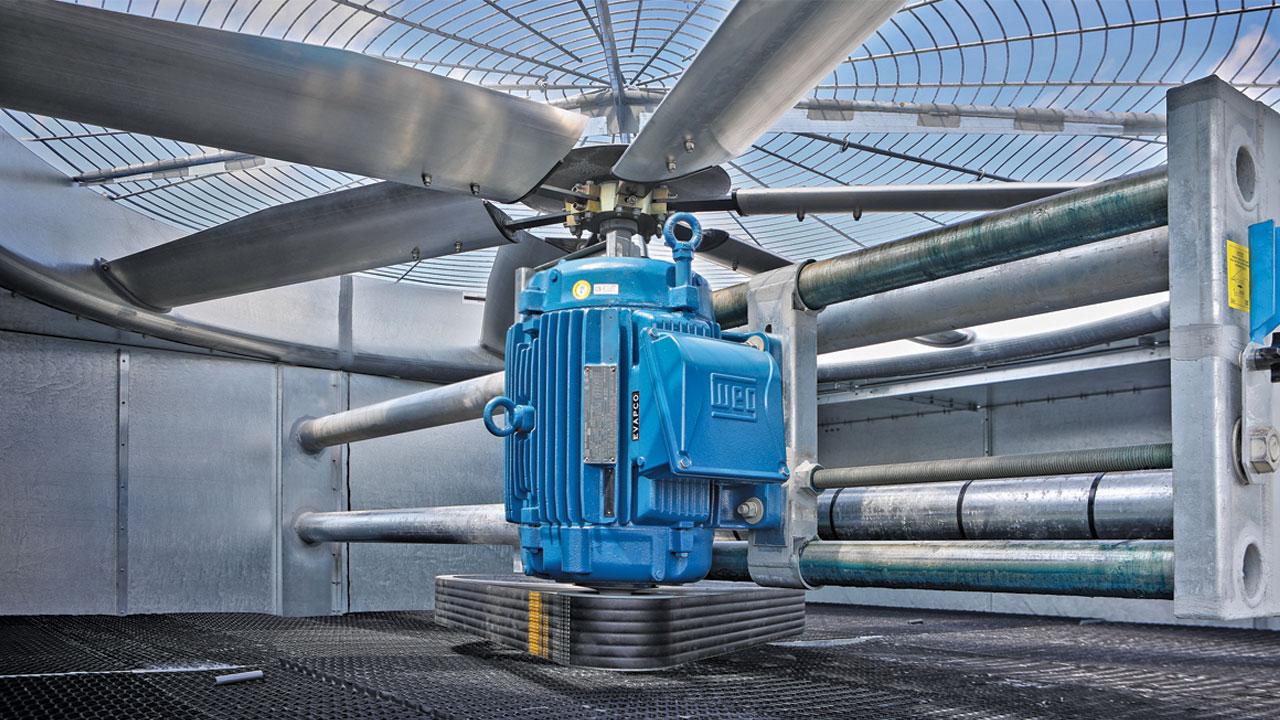
Belt-drive systems use belts and pulleys to transfer power from the motor to the fan shaft.
The pulley ratio determines the relationship between motor speed and fan speed. This arrangement allows designers to adjust fan speed to meet the cooling tower's operating requirements.
When choosing a replacement motor, check the pulley diameter, belt type, shaft diameter, center distance, and available adjustment range.
A change in motor speed or pulley diameter can affect fan speed and power demand. The proposed combination must remain within the fan manufacturer's permitted operating range.
2.3 Gearbox-Driven Cooling Tower Motors
Large industrial cooling towers may use a gearbox between the motor and fan. The gearbox reduces rotational speed and increases output torque to suit the fan.
For these systems, check the gearbox manufacturer's requirements carefully. Important details include:
Some systems use special vertical motor arrangements. A motor designed for standard horizontal mounting may not be suitable.
Before purchasing a replacement, confirm compatibility with both the motor and gearbox manufacturers.
3. Calculate the Required Motor Power
Motor power is commonly expressed in kilowatts (kW) or horsepower (HP). The correct rating depends on the power required to drive the fan under the specified operating conditions.
The best starting point is the original cooling tower documentation. Check the motor nameplate, fan performance data, equipment drawings, and manufacturer's technical specifications.
Do not estimate motor power from cooling tower capacity or physical size alone. Two cooling towers with similar dimensions may use different fan designs, blade angles, rotational speeds, and drive arrangements.
3.1 Check the Cooling Tower Fan Power Requirements
Start by identifying the fan's required shaft power at the intended operating point.
If the system uses a belt drive or gearbox, consider the efficiency of the transmission system when determining the motor input requirement.
The selected motor must be capable of supplying the required load without exceeding its rated operating limits.
If the original motor information is unavailable, ask a qualified engineer or cooling tower equipment supplier to review the fan data and operating conditions.
Choosing a motor based on guesswork can create problems. An undersized motor may overheat or trip during operation, while an unnecessarily oversized motor may increase purchasing and operating costs.
3.2 Consider Operating Conditions and Load
A cooling tower motor's actual load can change depending on several factors:
High ambient temperatures and high installation altitudes may affect the motor's available output. Check whether the manufacturer requires derating for the actual site conditions.
A suitable engineering margin may be necessary, but excessive oversizing should not replace proper calculation.
The objective is to select a motor that can handle the expected load reliably while maintaining efficient operation.
4. Choose the Correct Motor Speed
Motor speed is measured in revolutions per minute (RPM). It is determined mainly by the electrical supply frequency and the number of motor poles.
For example, a four-pole induction motor has a synchronous speed of 1,500 RPM at 50 Hz and 1,800 RPM at 60 Hz. Its actual operating speed is slightly lower because of motor slip.
Two-pole and six-pole motors have different speed characteristics.
But does a higher motor speed always mean better cooling performance? Not necessarily.
The fan must operate within its designed speed range. Excessive fan speed can increase power consumption, noise, vibration, and mechanical stress. It may also exceed the allowable operating limits of the fan blades, hub, or gearbox.
Before selecting a motor, confirm the required fan speed and the relationship between motor speed and fan speed in the drive system.
For belt-driven equipment, check the pulley ratio. For gearbox-driven equipment, confirm the gearbox reduction ratio and input speed requirements.
5. Select the Right Voltage and Frequency
The motor's rated voltage and frequency must match the site's electrical supply and control system.
Industrial facilities use different electrical supply configurations depending on their location and equipment requirements. Common selection details include:
Three-phase motors are common in industrial cooling tower applications, but the correct voltage must be confirmed from the site's electrical drawings and available power supply.
Frequency is equally important. A motor designed for 50 Hz should not automatically be assumed suitable for operation at 60 Hz, or vice versa. Changes in frequency can affect motor speed, torque, and operating characteristics.
If the motor will operate through a variable frequency drive, check the manufacturer's requirements for inverter operation before purchasing.
6. Check Motor Enclosure and Protection
Cooling tower motors often operate in humid environments where water and airborne contaminants may reach external motor surfaces.
The motor enclosure helps protect internal components from dust, water, and other environmental influences.
The required protection depends on the motor's installation position and exposure. A motor installed in a sheltered equipment room may have different requirements from one mounted outdoors near the fan deck.
6.1 TEFC and Other Motor Enclosure Options
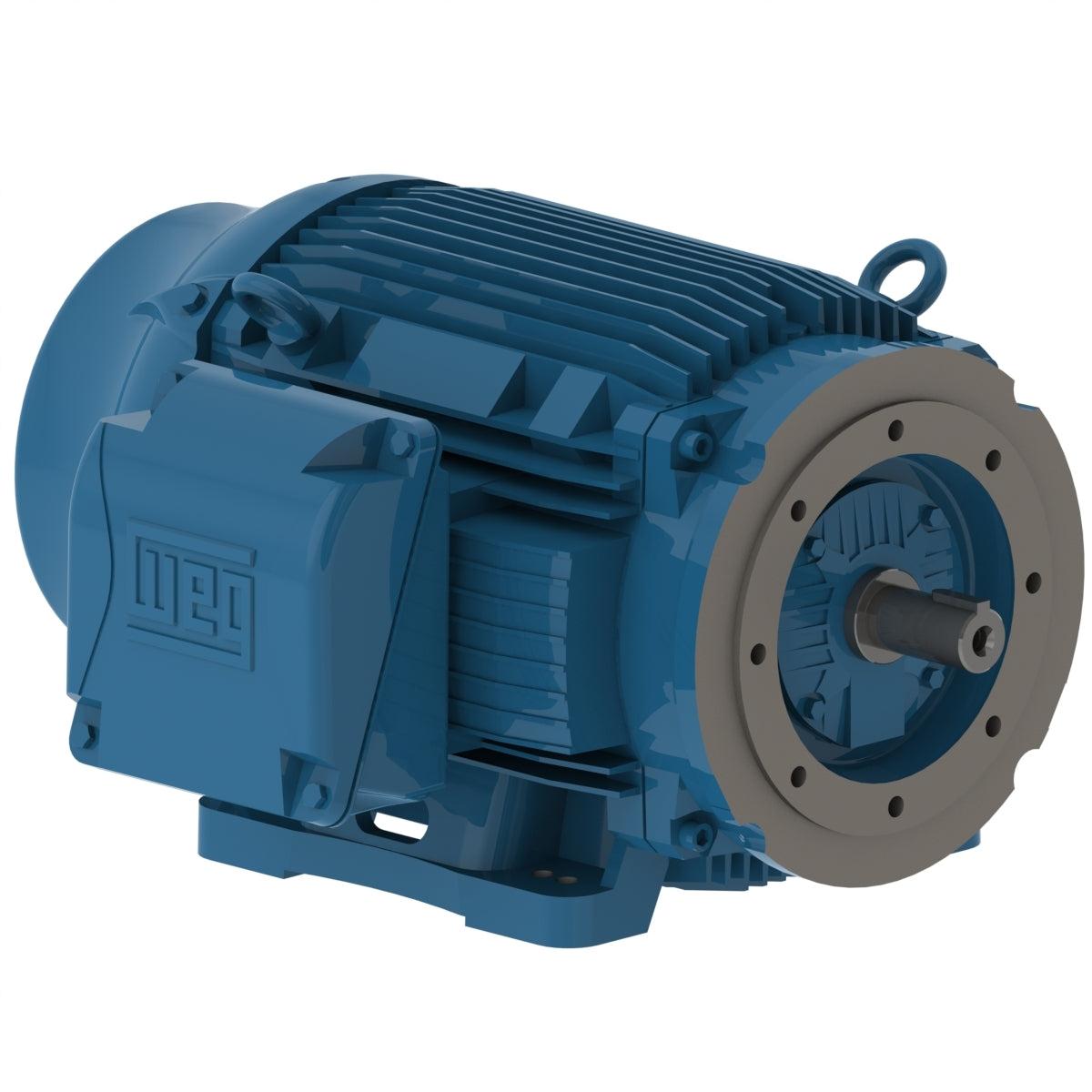
TEFC stands for Totally Enclosed Fan Cooled.
A TEFC motor uses an external fan to move air over the motor housing. Its enclosure limits the exchange of internal and external air while allowing the motor to release heat through its outer surface.
TEFC motors are commonly considered for industrial environments, but the term alone does not guarantee suitability for every cooling tower.
Check the manufacturer's specifications for:
Other enclosure designs may also be suitable for particular applications. The correct option depends on the actual operating environment and the manufacturer's recommendations.
6.2 Understand IP Protection Ratings
An IP rating describes the protection provided by an enclosure against access, solid objects, and water under defined test conditions.
The first digit indicates protection against solid objects, while the second digit relates to water protection.
However, a higher IP rating does not automatically solve every installation problem.
You should also consider water exposure direction, spray pressure, motor orientation, cable entries, terminal box sealing, and maintenance access.
Ask the supplier to confirm that the complete motor configuration meets the required protection level. Do not rely on a rating mentioned for only one component.
7. Consider Insulation Class and Temperature Rise
Motor windings use insulation materials designed to withstand specified thermal conditions.
Common insulation classes include Class F and Class H. These classifications indicate the thermal endurance of the insulation system, but they should not be confused with the motor's actual operating temperature.
Temperature rise, ambient temperature, cooling method, operating load, and duty all influence the motor's thermal condition.
A cooling tower motor running continuously in a hot and humid environment needs suitable thermal design and protection.
When comparing motors, check:
Insulation class
Permitted ambient temperature
Temperature-rise information
Cooling method
Thermal protection options
Rated operating duty
Depending on the application, thermal sensors or other protective devices may be appropriate.
Proper thermal protection helps reduce the risk of winding damage caused by overload, poor ventilation, or abnormal operating conditions.
8. Decide Whether You Need a VFD-Compatible Motor
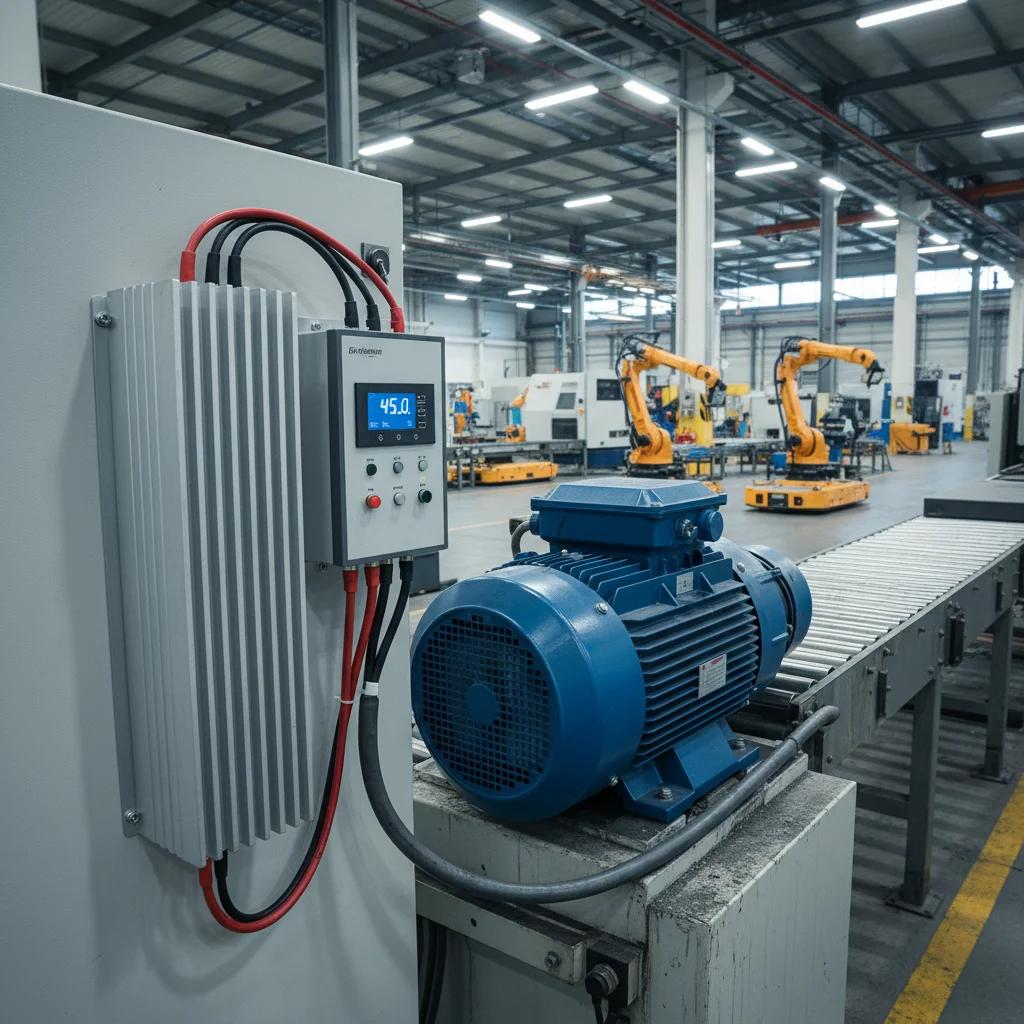
A variable frequency drive (VFD) changes the electrical frequency supplied to an AC motor, allowing its speed to be adjusted.
In cooling tower applications, a VFD can help control fan speed according to changing heat loads and ambient conditions. When full fan speed is unnecessary, reducing speed may help lower energy consumption.
However, not every AC motor is automatically suitable for inverter operation.
VFD operation can introduce additional electrical and thermal stresses. At low speeds, a motor's built-in cooling fan may also move less air, which can affect its ability to release heat.
Before using a VFD, check:
Motor manufacturer's inverter-operation guidance
Permitted operating speed range
Insulation system
Cooling performance at reduced speed
Bearing requirements
Electrical protection
Fan and drive-system speed limits
The motor, VFD, and cooling tower fan should be evaluated as one system.
9. Check Motor Efficiency and Energy Consumption
Cooling tower fans may operate for long periods, so motor efficiency can have a significant effect on electricity costs.
When comparing motors, review their rated efficiency and the applicable efficiency standards. Depending on the motor rating and market, you may encounter classifications such as IE2, IE3, or IE4.
Confirm which standard applies to the motor and compare equivalent ratings under comparable conditions.
A higher-efficiency motor may have a higher initial purchase price, but it can reduce electricity consumption over its service life.
For a practical comparison, consider:
Do not compare efficiency figures from motors with different ratings or test conditions as if they were identical.
A lifecycle cost comparison gives you a better picture of the actual investment.
10. Evaluate Corrosion Resistance and Materials
Moisture and chemical residue can gradually damage exposed motor surfaces and components.
This is particularly important in cooling tower installations where water treatment chemicals, airborne moisture, and outdoor conditions may accelerate corrosion.
When evaluating a motor, pay attention to:
External coating system
Surface preparation
Terminal box materials and sealing
Fastener materials
External cooling fan and cover
Exposed shaft surfaces
Mounting feet and other exposed parts
Coastal environments and industrial sites with aggressive chemical exposure may require additional corrosion protection.
Ask the manufacturer about coating specifications, suitable materials, and recommended inspection intervals.
A durable finish helps protect the motor, but it cannot replace correct installation and routine maintenance.
11. Select the Correct Mounting and Shaft Design
Mechanical compatibility is just as important as electrical compatibility.
Before ordering a motor, confirm whether it is designed for horizontal or vertical mounting. Then check its frame size, shaft dimensions, flange details, and terminal box position.
Important dimensions include:
Motor frame size
Mounting hole positions
Shaft diameter
Shaft length
Keyway dimensions
Flange dimensions
Overall motor dimensions
Terminal box orientation
For replacement projects, compare the existing motor's nameplate and dimensional drawing with the proposed motor.
If the motor drives a gearbox, verify the gearbox input configuration and allowable loads.
A motor may have the correct voltage, power, and speed but still be unsuitable because its mounting dimensions do not match the existing equipment.
Do not rely on visual similarity. Always request a dimensional drawing before confirming an order.
12. Check Bearings, Vibration, and Mechanical Reliability
Bearings support the rotating shaft and help the motor operate smoothly.
In cooling tower applications, bearing life can be affected by moisture, contamination, misalignment, excessive belt tension, and vibration.
When comparing motors, ask about bearing specifications, lubrication methods, relubrication intervals, and maintenance access.
Also consider the expected mechanical loads and operating duty.
If the motor uses a VFD, check whether the manufacturer recommends insulated bearings or shaft-grounding measures for the specific configuration.
Remember that motor quality is only one part of mechanical reliability. Correct alignment, fan balancing, secure foundations, and proper belt tension are equally important.
Even a well-designed motor can fail prematurely if the surrounding drive system is incorrectly installed or poorly maintained.
13. Consider the Cooling Tower Operating Environment
Before finalizing your motor selection, review the complete installation environment.
Ask yourself:
Is the motor installed indoors or outdoors?
Is it exposed to direct rain or cooling tower spray?
Does the site experience high ambient temperatures?
Is there dust, salt air, or chemical vapor?
Will the motor run continuously or start and stop frequently?
Is there enough space for ventilation?
Can maintenance technicians access the motor safely?
These questions help determine the required enclosure, coating, insulation, cooling method, and protection devices.
You should also consider the site's electrical system and applicable local safety requirements.
If the cooling tower is installed in a classified hazardous area, the motor must have the appropriate certified protection for that specific area. A standard industrial motor should not be used in a hazardous location without confirming its suitability and certification.
14. Common Mistakes When Selecting AC Cooling Tower Motors
Even experienced buyers can make mistakes when replacing cooling tower motors. Here are several problems worth avoiding.
14.1 Choosing a Motor by Horsepower Alone
Horsepower is important, but it does not tell you whether the motor has the correct speed, voltage, enclosure, or mounting arrangement.
Always check the complete specification.
14.2 Ignoring the Drive Configuration
A motor intended for direct drive may not be suitable for a belt-driven or gearbox-driven system.
Confirm the drive arrangement before selecting a replacement.
14.3 Overlooking Moisture and Corrosion Protection
A motor with insufficient environmental protection may experience premature deterioration.
Consider the actual exposure to water, humidity, chemicals, and outdoor conditions.
14.4 Ignoring VFD Compatibility
If your cooling tower uses variable-speed control, confirm that the motor is suitable for inverter operation.
Check the manufacturer's speed, insulation, cooling, and bearing recommendations.
14.5 Oversizing the Motor Without Engineering Review
A larger motor is not automatically safer or more efficient.
Excessive oversizing may increase the initial cost and result in inefficient operation under the actual load.
Select the rating based on verified fan requirements and operating conditions.
14.6 Failing to Check Installation Dimensions
Differences in shaft length, frame size, mounting holes, or flange dimensions can make installation difficult.
Request a dimensional drawing and compare it with the existing motor before ordering.
14.7 Purchasing Without Technical Documentation
A motor quotation should be supported by clear technical information.
Request the datasheet, dimensional drawing, nameplate information, and relevant test or compliance documents. This makes it easier to verify that the proposed motor matches your application.
15. A Practical AC Cooling Tower Motor Selection Checklist
Before purchasing a new motor or replacing an existing one, use the following checklist.
Electrical specifications
Rated power in kW or HP
Rated voltage
Supply frequency
Number of phases
Full-load current
Rated speed
Starting method
Motor construction
Mechanical specifications
Operating conditions
Ambient temperature
Humidity
Water exposure
Installation altitude
Operating hours
Expected load
Corrosion exposure
Drive system
Direct drive, belt drive, or gearbox
Required fan speed
Pulley ratio or gearbox ratio
VFD operation
Permitted speed range
Protection and maintenance
Thermal protection
Bearing arrangement
Lubrication requirements
Corrosion protection
Maintenance access
Spare-parts availability
If any important information is missing, ask the cooling tower manufacturer, motor supplier, or a qualified engineer to help verify it before ordering.
16. Why Work with an Experienced Cooling Tower Parts Supplier?
Selecting an AC cooling tower motor is easier when you work with a supplier who understands cooling tower equipment and replacement requirements.
A knowledgeable supplier can help review the existing motor information, drive configuration, fan requirements, and installation dimensions. This reduces the risk of ordering a motor that is electrically suitable but mechanically incompatible.
Power Tower Cooling Technology (Shaoxing) Co.,Ltd specializes in cooling tower components and related replacement needs.
Through its website, www.coolingtowerpart.com, buyers can explore cooling tower parts and seek assistance with component selection.
When contacting Power Tower about a cooling tower motor or related replacement component, prepare the following information:
Cooling tower manufacturer and model
Existing motor nameplate photograph
Motor power, voltage, frequency, and speed
Motor mounting and shaft dimensions
Fan or gearbox information
Installation environment
Quantity required
Drawings or photographs of the existing installation
Providing these details makes technical communication more efficient and helps the supplier understand your actual requirements.
Before confirming an order, request the relevant technical datasheet and dimensional drawing. The final motor specification should always be checked against the equipment manufacturer's requirements.
17. FAQs About AC Cooling Tower Motors
Q1: What type of AC motor is commonly used in cooling towers?
Three-phase AC induction motors are commonly used in industrial cooling tower fan systems. The correct motor design depends on the tower's drive arrangement, power requirement, speed, mounting configuration, and operating environment.
Q2: How do I know what horsepower motor my cooling tower needs?
Start with the original motor nameplate and cooling tower design documentation. Confirm the fan's required shaft power and consider the efficiency of the drive system.
Do not estimate motor horsepower from cooling tower capacity alone. Fan diameter, blade design, speed, and operating conditions also affect the required power.
Q3: Can I use a standard TEFC motor for a cooling tower?
A TEFC motor may be suitable for some cooling tower applications, but TEFC construction alone does not guarantee compatibility.
Check the motor's IP rating, corrosion protection, mounting arrangement, shaft design, ambient-temperature limits, and operating duty.
Q4: Can a cooling tower motor work with a VFD?
Many AC motors can operate with a VFD when correctly specified.
However, you should confirm the manufacturer's permitted speed range, insulation requirements, cooling performance, and bearing recommendations before using variable-speed control.
Q5: Does a higher-efficiency motor always save money?
Not necessarily. The actual savings depend on operating hours, average load, electricity prices, and the efficiency difference between the motors being compared.
A lifecycle cost calculation is a better way to evaluate the investment.
Q6: What information should I provide when ordering a replacement cooling tower motor?
Provide the existing motor nameplate, rated power, voltage, frequency, speed, frame size, mounting details, shaft dimensions, drive type, and installation photographs.
Also explain whether the motor operates continuously, uses a VFD, or works with a gearbox.
Q7: How can I extend the service life of a cooling tower motor?
Follow the motor manufacturer's maintenance instructions. Inspect the motor regularly, keep ventilation paths clear, check for abnormal vibration and noise, maintain correct alignment, and follow the recommended bearing lubrication schedule.
Also inspect electrical connections and protection devices. Correct installation and preventive maintenance can help reduce unexpected failures.
18. Conclusion: Choose the Right Motor for Reliable Cooling Tower Operation
Selecting the right AC cooling tower motor requires more than matching a horsepower number.
You need to understand the fan drive arrangement, calculate the required power, verify speed and electrical supply, and choose suitable protection against moisture, heat, and corrosion. Mounting dimensions, shaft design, bearings, efficiency, and VFD compatibility also deserve careful attention.
A correctly matched motor supports stable airflow, dependable operation, and better control of lifecycle costs. On the other hand, an unsuitable motor can create unnecessary maintenance work, energy waste, and downtime.
Take the time to collect the original equipment information and confirm every important specification before purchasing.
If you need assistance with cooling tower replacement components, contact Power Tower Cooling Technology (Shaoxing) Co.,Ltd through https://www.coolingtowerpart.com. Share your equipment details and technical requirements so the appropriate solution can be reviewed before you make a final selection.
The right motor is not simply the one that fits. It is the one that matches your cooling tower's actual operating requirements.


