Cooling Tower Fan Blade Balancing Service for Industrial Process Cooling Systems
Meta Description: Our cooling tower fan blade balancing service delivers precision on-site dynamic balancing for axial fan rotors. Minimize vibration, cut noise, protect gearboxes and bearings, suitable for FRP and aluminum blades in chemical, power, manufacturing and coastal process cooling towers.
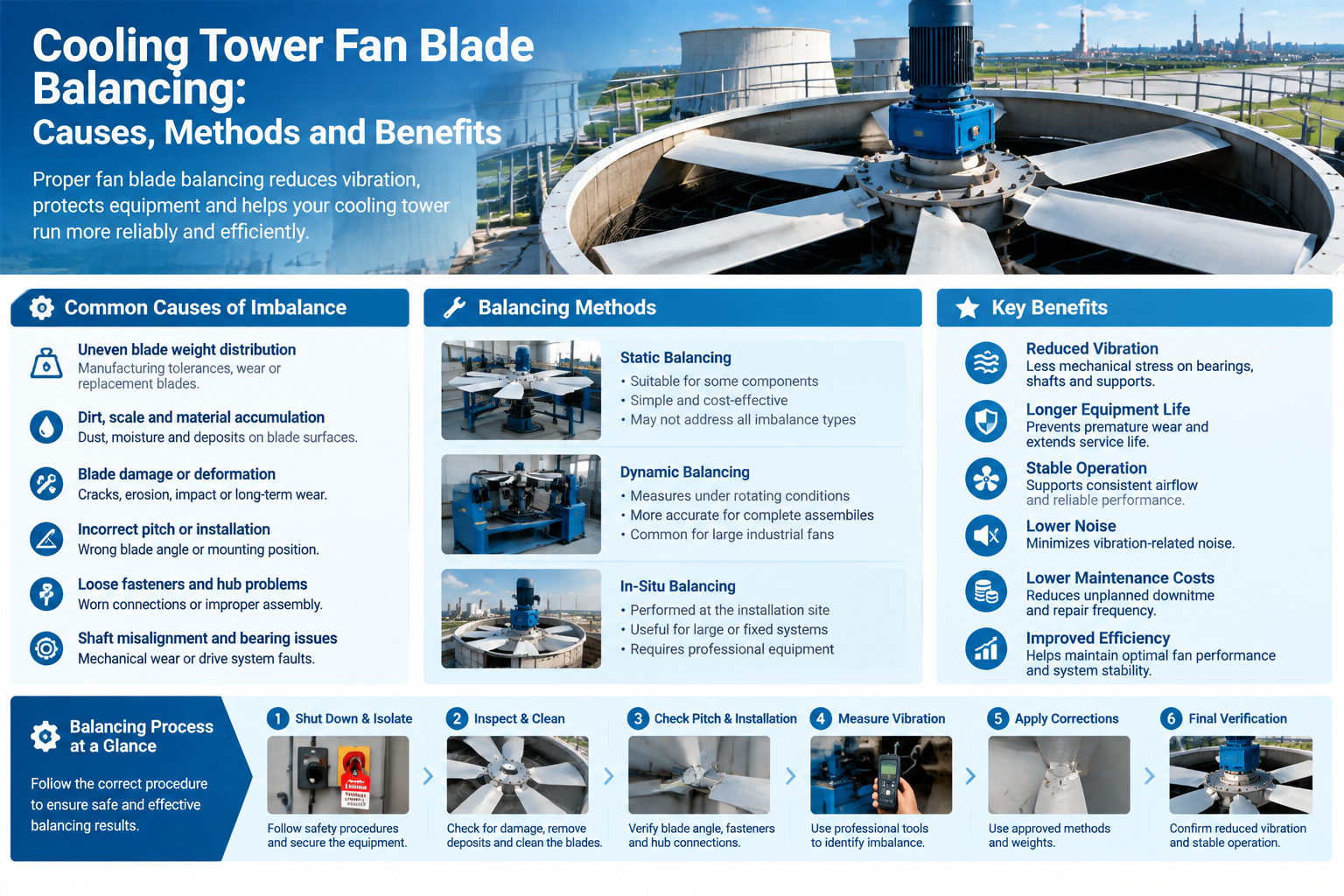
The Hidden Cost of Unbalanced Cooling Tower Fan Rotors in Process Cooling
For industrial process cooling systems, stable cooling performance is not just about water temperature. Many process plants run continuous 24/7 production lines where even minor cooling tower fan vibration can snowball into expensive breakdowns. Operators often focus on blade corrosion, motor amps or water distribution issues while overlooking rotor imbalance, one of the most common root causes of recurring mechanical failures.
Unlike HVAC towers with flexible load cycles, process cooling towers operate under steady, uninterrupted duty. An unbalanced fan assembly creates cyclic force that transfers through the hub, shaft, gear reducer, bearings and tower steel structure. Over weeks and months, this repetitive shaking loosens bolts, wears bearing races, cracks gear teeth and accelerates fatigue on FRP or aluminum fan blades. Even blades that look visually intact can generate destructive vibration when mass distribution across the rotor is uneven.
Why Process Cooling Towers Are More Vulnerable to Imbalance Risks
Process cooling towers handle unique operating conditions that constantly disrupt rotor balance:
Mineral scale, sludge and salt deposits accumulate unevenly on blade surfaces during continuous operation
Blade tip erosion and leading-edge wear happens at different rates across individual blades
Retrofit replacement blades often have slight weight and moment differences from the original OEM set
High humidity and chemical exposure create uneven coating loss and material degradation
Long running hours amplify small balance errors into severe vibration and resonance
The Difference Between Static Balancing and Dynamic Rotor Balancing
A lot of maintenance teams confuse static balance with the dynamic balancing required for cooling tower fan blades.
Static Balancing
Static balancing only checks mass distribution on a single plane. It can identify a heavy spot when the rotor sits stationary, but it cannot detect couple imbalance. Couple imbalance occurs when two opposing heavy points create twisting forces during rotation, which is extremely common for large-diameter cooling tower fans. Static balancing alone is insufficient for axial cooling tower fan assemblies.
Dynamic Balancing
Dynamic balancing measures vibration across at least two planes while the fan rotates at its actual operating RPM. This is the standard our service follows. It corrects both single-plane unbalance and couple unbalance, matching the real working state of your cooling tower fan inside the fan stack.
Our Cooling Tower Fan Blade Balancing Service Workflow
Our balancing service is tailored to the field environment of industrial process cooling towers. We do not rely on generic workshop balancing standards. Our technicians bring portable high-precision analyzers to your site and complete the full procedure without removing the entire fan rotor in most cases.
Pre-Service Assessment & Safety Lockout
Before taking any vibration readings, safety protocols come first. We follow LOTO lockout-tagout procedures to isolate the fan drive system. We inspect the full rotor assembly to rule out underlying mechanical defects that mimic imbalance symptoms. Items we verify in this assessment phase:
Blade condition: cracks, delamination, scale buildup, tip damage
Hub clamping bolts and blade pitch lock security
Shaft runout, keyway damage and bushing slippage
Gearbox bearing noise and shaft deflection
Fan stack internal clearance to rule out blade rubbing
If we discover damaged blades, deformed hubs or loose mechanical components, we will report these issues upfront. Balancing cannot fix structural damage; correcting those defects is a prerequisite for a stable balance result.
Vibration Data Collection & Spectrum Analysis
We mount vibration sensors at designated test points on the bearing housing of the fan drive. The analyzer captures vibration amplitude, phase angle and frequency spectrum at normal operating speed. Spectrum analysis separates imbalance vibration signals from other vibration sources such as gear mesh noise, bearing defects, motor electrical vibration or aerodynamic pulsation. This step prevents us from misdiagnosing resonance, aerodynamic noise or bearing wear as simple fan blade imbalance.
Trial Weight Addition & Correction Calculation
Once imbalance is confirmed, we add calibrated trial weights on the fan blades to record the vibration response. Our balancing software calculates the exact weight value and angular position required to offset the heavy spot on the rotor. For FRP composite blades, we apply corrosion-safe balance weights that will not damage the gel coat or laminate structure. For aluminum blades, we select weights compatible with wet, chemically aggressive cooling tower atmosphere. We avoid drilling or machining blades wherever possible to preserve blade structural integrity.
Final Verification & Vibration Benchmark Report
After applying correction weights, we restart the fan and take a second round of readings. We keep adjusting until vibration levels fall within industry acceptable thresholds for process cooling towers. At project handover, you receive a formal balancing report, including before-and-after vibration data, correction weight records and recommended re-inspection intervals. This document is valuable for plant maintenance logs, audit records and future tower overhaul planning.
When to Schedule Cooling Tower Fan Blade Balancing Service
Balancing is not a one-time project only for new fan installations. Process cooling facilities should schedule this service under these scenarios.
After Fan Blade Replacement or Retrofit
Installing new FRP or aluminum replacement blades is the most frequent trigger for balancing work. Even blades from the same production batch have minor variations in mass and moment. Simply matching blade diameter and pitch angle cannot guarantee a smooth-running rotor.
Retrofit Upgrade Projects
Many process plants upgrade old aluminum blade sets to custom FRP blades for corrosion resistance. This rotor mass change shifts the original balance state. Post-retrofit balancing protects the existing gearbox, shaft assembly and support structure from new vibration loads.
When Vibration Monitoring Alarms Trigger
Modern process cooling systems are equipped with online vibration transmitters. Persistent rising vibration trends or vibration alarm triggers are clear signs to arrange balancing service, before permanent mechanical damage develops.
After Major Cleaning or Scale Removal
High-pressure washing to remove mineral deposits can strip uneven layers of scale from fan blades. This suddenly alters the rotor mass distribution, often introducing imbalance after cleaning work is finished.
Routine Preventative Maintenance Cycles
For continuous-process cooling towers, we recommend fan blade balancing checks during annual shutdown or scheduled turnaround. This proactive service extends the service life of expensive rotating assets and reduces emergency maintenance callouts.
Benefits of Professional Fan Blade Balancing for Process Cooling Towers
The advantages extend far beyond lowering vibration numbers on a report. For industrial process cooling, balanced fan rotors directly protect production stability and operational expenditure.
Extended Lifespan of High-Cost Drive Components
Gear reducers, tapered roller bearings and fan shafts are some of the most costly spare parts on a cooling tower. Chronic imbalance creates repeated impact loads that shorten bearing and gear life dramatically. A properly balanced rotor reduces bearing replacement frequency and avoids costly gearbox overhaul.
Reduced Noise Levels for On-Site Work Zones
Process cooling towers located close to production workshops or plant access roads often face site noise limits. Imbalanced fans generate harsh, pulsating low-frequency noise. Precision balancing smooths rotation and brings fan sound within site noise control requirements.
Stable Airflow & Consistent Heat Rejection
Imbalance causes small, cyclic variations in blade deflection, which disrupts the designed airflow through fill media. Balanced fans maintain steady aerodynamic performance, helping your cooling tower hold stable outlet water temperature for sensitive production processes.
Minimized Risk of Catastrophic Fan Failure
In extreme cases, sustained imbalance can loosen blade clamping or propagate cracks on blade roots. A failed fan blade inside the fan stack leads to forced production shutdown, secondary damage to adjacent components and expensive emergency repairs. Regular balancing is a proven risk-mitigation measure.
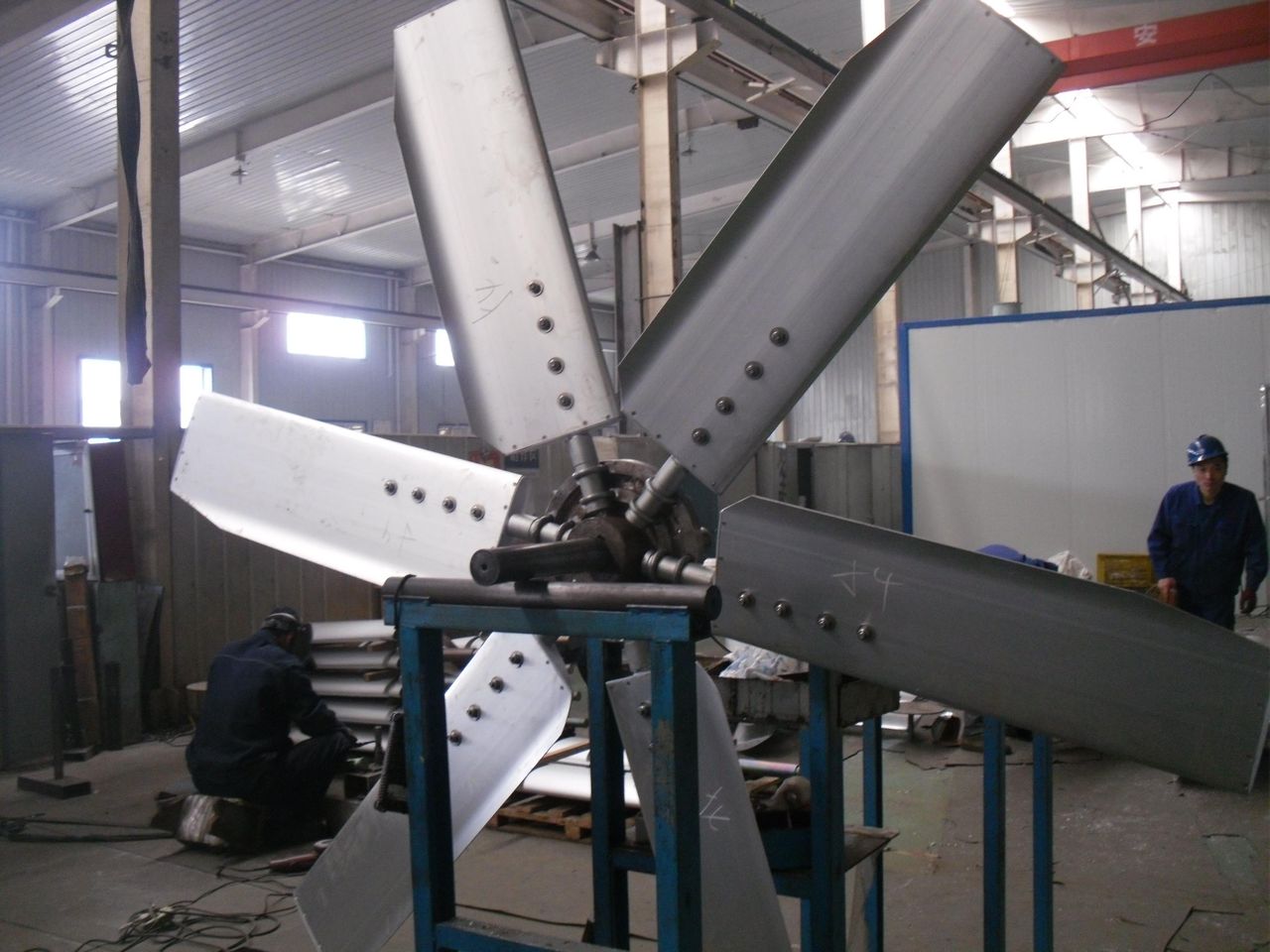
Material-Specific Considerations for FRP and Aluminum Fan Blade Balancing
Our technicians adapt balancing methods according to blade material, as FRP composite blades and metallic aluminum blades behave differently during rotation and weight correction.
FRP Fan Blade Balancing Notes
FRP blades have excellent corrosion resistance and lightweight properties, but their laminate structure is sensitive to improper drilling, clamping and weight attachment.
We use adhesive-mounted balance weights as the preferred correction method
We avoid drilling into the airfoil section, which can create laminate delamination
Balance weights must use compatible coatings to prevent galvanic corrosion when attached to composite-metal root assemblies
FRP blades can develop hidden internal damage from vibration; our visual inspection checks for micro-cracks around bolt holes and root shoulders
Aluminum Fan Blade Balancing Notes
Aluminum blades have high rigidity, but they are prone to pitting corrosion in chemical and coastal cooling circuits.
Welded correction weights are avoided for aluminum to prevent heat distortion and material weakening
Clamp-on balance weights are the standard choice for long-term reliability
We inspect for fatigue cracks originating from balance weight mounting points during every service
Common Myths About Cooling Tower Fan Blade Balancing
Misconceptions often make process cooling teams delay balancing service or attempt unsafe DIY corrections.
Myth 1: Matching blade weight alone creates a balanced rotor
Matching individual blade static weight is helpful, but it cannot eliminate couple imbalance across the rotor plane. Two blades of identical weight can still create twisting dynamic forces when their mass moment distribution differs.
Myth 2: Balancing can fix fan resonance issues
Resonance happens when fan rotating frequency matches the natural frequency of the fan stack or support structure. Balancing reduces excitation force, but it will not fully eliminate structural resonance. We identify resonance separately and provide structural adjustment recommendations alongside balancing work.
Myth 3: If the fan runs quietly, balancing is unnecessary
Some imbalanced rotors do not produce obvious loud noise. Low-amplitude high-frequency vibration can still erode bearings and gears without creating noticeable sound. Only vibration spectrum analysis can confirm balance status accurately.
Myth 4: Once balanced, the fan stays balanced forever
Continuous operation, scale accumulation, erosion and coating wear will gradually shift rotor balance over time. Process cooling fans require periodic rechecks as part of long-term asset management.
Partner With Us for Your Cooling Tower Fan Blade Balancing Requirements
Our balancing service is built specifically for industrial process cooling systems, including counterflow and crossflow cooling towers from mainstream OEM brands. We support FRP and aluminum axial fan rotors, covering new installations, blade retrofits, hub replacements and routine maintenance projects. We combine portable precision testing equipment, experienced field technicians and clear post-service reporting. Whether your plant operates in chemical processing, power generation, food and beverage, or coastal manufacturing environments, our cooling tower fan blade balancing service stabilizes your fan operation, protects your cooling assets and keeps your critical production processes running reliably.


